
Table of Contents
Shape Investment Report
Category: Agentic IDE and visual software-development tools
Company Stage: Pre-seed / product launch
Founder or Founders: Nathan (full legal name and biography not publicly verified)
Headquarters: Not publicly disclosed
Funding: No public financing announcement found
Business Model: Currently free; paid AI-credit or subscription model appears contemplated but public pricing is not sufficiently available
Product Hunt Launch Date: 2026/08/20
Report Date: August 26, 2026
| Investment Metric | Assessment |
|---|---|
| Venture Potential | 54/100 |
| Unicorn Path | Unproven |
| Valuation Attractiveness | Not Assessable |
| Evidence Confidence | 68/100 |
| Final Decision | Pass |
Executive Summary
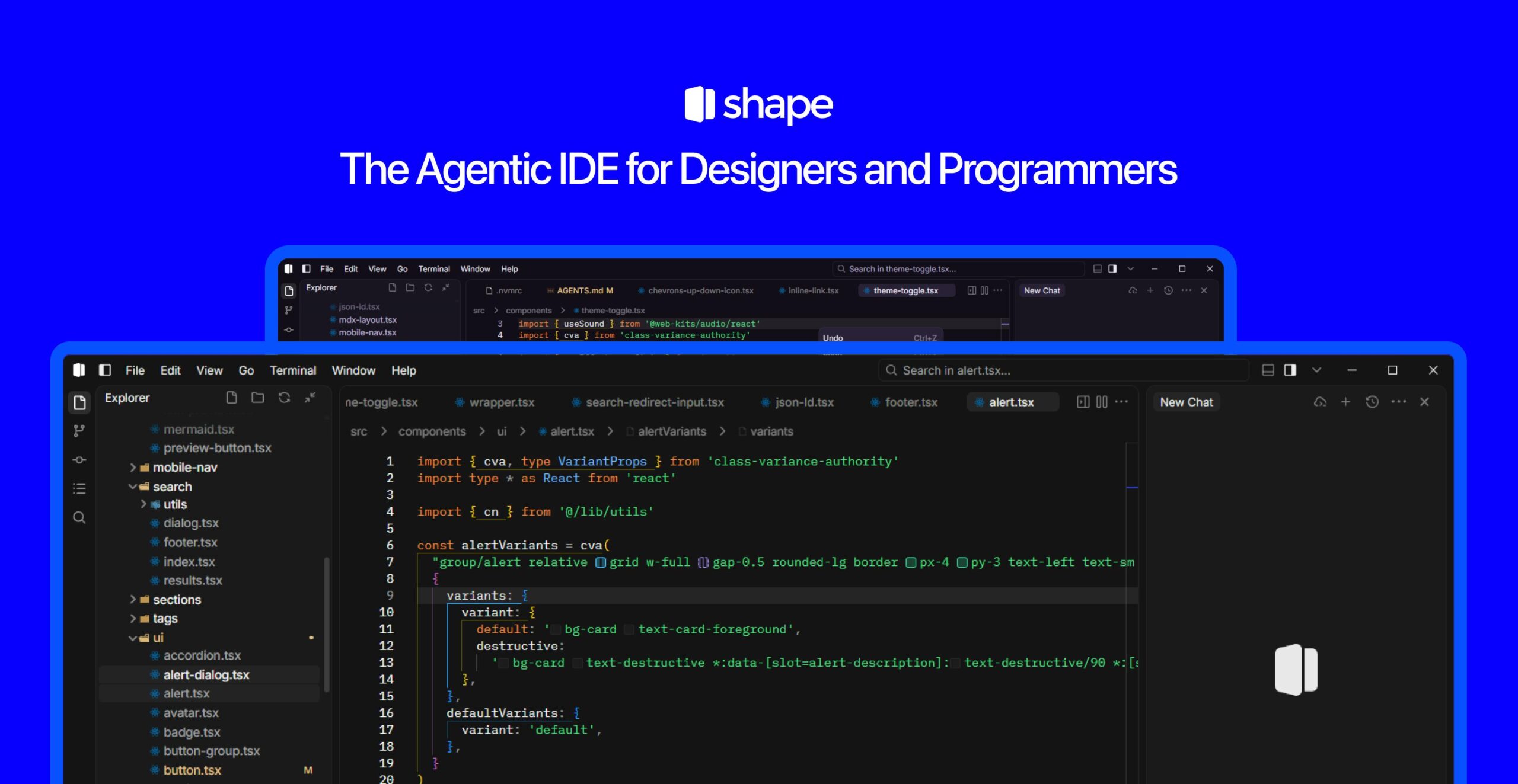
Shape is a Windows-first desktop IDE that combines code editing, live visual design, Git, an integrated terminal, language tooling, and an AI agent. Its central thesis is attractive: designers and programmers lose context while moving among an editor, Figma, a browser preview, GitHub, terminal tools, and AI chat. Shape attempts to put those workflows into one workspace, including visual edits that become ordinary source-code diffs.
The product is unusually complete for a new solo-led launch. Public documentation covers editing, language servers, Git, AI edit review, previews, testing, shortcuts, error handling, and contributor architecture. The source is publicly visible under the Business Source License 1.1, and the Windows app is downloadable. Product Hunt recorded 113 points, a number-twelve daily ranking, and 105 followers. The repository had 12 stars, no forks, and 16 commits when reviewed. These show launch execution, not product-market fit.
The opportunity is meaningful because AI coding tools are changing how software and interfaces are produced. The problem is competition and evidence. Cursor, Windsurf, Zed, VS Code with Copilot, Claude Code, Replit, v0, Lovable, and design-to-code products already command large communities, capital, and distribution. Shape has not disclosed active users, retention, revenue, paid conversion, team depth, funding, or a durable acquisition channel. Windows-first access is differentiated but also limits the initial professional-design audience.
Final decision: Pass for investment today. Shape is worth monitoring as a product, but the current evidence does not justify venture diligence. Reconsider if users repeatedly choose its visual-agent loop, retention is strong, and the company establishes a credible paid model and team.
Product Overview
Shape targets fragmented product building: developers write code, designers manipulate interfaces, agents edit repositories, Git tracks changes, and previews show results. Switching among separate apps creates delay and obscures who changed what.
The Product Hunt page describes one desktop app for design, code, Git, terminal, and AI. Visual changes remain pending until Apply; Shape then writes source and Git sees a normal diff. AI edits remain visible in chat, and approval mode can gate writes. The maker acknowledged that an agent write can replace unsaved edits, with a notification afterward—an important collaboration risk.
The public repository shows a Tauri app with editor, preview, Git, tests, and platform layers. Documentation covers IntelliSense, diff/merge, Git graph, chat modes, edit review, terminal, scripts, and language servers. The official download is Windows-only.
Product Hunt marks Shape free. Documentation references AI credits and payment errors, while disclosures mention Stripe and OpenRouter. Public materials did not establish pricing, included credits, or model-cost policy.
Founder and Team Assessment
The maker identifies as Nathan, handle “natcale,” and says he built Shape to eliminate switching among Figma, GitHub, terminal, AI, and an editor. His launch responses show product fluency, direct edge-case engagement, and openness to feedback.
No reliable source established his full identity, prior work, location, full-time status, or other team members. The repository is young with no community forks. A solo builder can move quickly, but a secure cross-platform IDE spanning language tools, Git, previews, billing, models, and support is unusually broad.
Founder Assessment: Strong ownership and shipping ability are visible; background, commitment, recruiting, and capacity are unverified.
Market Opportunity
The broad developer-tools market is venture-scale, and AI code generation is moving spending from conventional editors toward agentic workflows. Shape’s narrower wedge is developers and designer-developers who need visual UI manipulation and code-level control in the same local environment.
A bottom-up scenario might target 20 million professional developers and technical designers globally. At 1% paid penetration and $240 annual revenue per user, Shape would produce $48 million ARR. Teams and enterprise governance could lift average revenue: 50,000 teams at $2,000 annually would create $100 million ARR. These are scenario assumptions, not management forecasts.
The addressable market is large, but distribution is concentrated. Developers already have deeply embedded editors and extensions; designers often prefer Figma; web-first builders offer immediate deployment. Shape must prove that unifying these tools saves enough time to overcome migration, trust, and ecosystem costs.
Market Assessment: Large theoretical market, but the attainable wedge is uncertain.
Traction and Growth Signals
The launch showed 113 Product Hunt points, number-twelve daily rank, and 105 followers. Comments praised the visual-agent loop and Windows availability, but no established customer reviews were present.
GitHub showed 12 stars, zero forks, and 16 commits. Public source and documentation aid technical inspection, yet community pull is minimal. No evidence was found for downloads, active users, project creation, retention, paid users, revenue, waitlist, or referral growth. Product Hunt interest is not PMF; the critical signal is whether developers entrust real repositories to Shape and remain weekly users.
Traction Assessment: Credible launch, no verified market traction.
Competitive Position
Direct competition includes Cursor, Windsurf, Zed, VS Code/Copilot, JetBrains AI, Replit, and AI-native editors. Adjacent competitors include Claude Code and other terminal agents, v0 and Lovable for generated interfaces, Figma’s developer workflows, Framer, and visual coding layers. These products have stronger brands, ecosystems, capital, integrations, and user bases.
Shape’s differentiation is the tight loop among live visual changes, source code, agent actions, and ordinary Git diffs. Windows-first support serves users often reached later by design-led developer tools. Public source availability and a lightweight Tauri architecture may also build trust.
The moat is currently weak. Features can be copied, the repository has little community adoption, model access comes through third parties, and users can remain in familiar editors using extensions. Durable advantage would require a superior visual-to-code representation, proprietary interaction data, exceptional workflow reliability, or a vibrant extension/community ecosystem.
If an incumbent released comparable visual editing, Shape’s present switching case would be limited. Retention evidence is required before assigning defensibility.
Defensibility Assessment: Low
Business Model and Economics
The product is currently presented as free. Stripe use, AI-credit documentation, and payment error codes indicate possible subscriptions or usage billing, but public pricing and packaging could not be confirmed. A likely model is individual subscriptions with metered AI usage, followed by team plans for centralized billing, policy, and collaboration; this remains an inference.
Major costs include model inference, code indexing, cloud synchronization, support, payment fees, signing and distributing desktop releases, security, and development across operating systems. OpenRouter may simplify model access but adds supplier dependency. Gross margin depends on credit pricing, user model mix, caching, and whether users bring their own keys.
Without revenue, retention, or acquisition data, CAC, payback, lifetime value, and contribution margin cannot be assessed.
Unicorn Path
At an illustrative 10x ARR multiple, a $1 billion valuation requires roughly $100 million ARR. That could mean 417,000 individual subscribers at $240 annually, or 50,000 teams at $2,000, before churn and discounts. Reaching that scale requires multi-platform support, high trust, an ecosystem, differentiated design workflows, and repeatable distribution.
The route is currently speculative because Shape has not shown retained users or a paid product. The crowded market increases the probability that a useful feature becomes an acquisition opportunity or niche business rather than an independent unicorn.
Unicorn Path: Unproven
Valuation Assessment
No verified funding round, valuation, revenue, cap table, or current fundraising terms were found. Product completeness does not establish investment value.
Valuation Attractiveness: Not Assessable
Required inputs include legal entity, founder ownership, any SAFEs, round size, valuation cap, cash, burn, runway, revenue, cohorts, model gross margin, and hiring plan.
Key Risks
- No verified retention, revenue, or customer evidence.
- Extremely strong and well-funded IDE competition.
- A visual-editor feature may be copied by incumbents.
- Windows-only availability narrows initial adoption.
- Solo-team concentration across an unusually broad product.
- Agent writes can conflict with unsaved human work.
- Third-party model and OpenRouter dependency.
- Unclear pricing, credits, and gross margin.
- Repository and plugin ecosystem remain tiny.
- Security risk from local code, credentials, terminals, and model context.
Final Assessment
Venture Potential: 54/100
| Category | Score |
|---|---|
| Market Size and Expansion Potential | 17/20 |
| Traction and Growth Evidence | 5/20 |
| Founder and Team | 7/15 |
| Product Strength | 7/10 |
| Distribution Potential | 6/15 |
| Business Model and Economics | 5/10 |
| Defensibility | 7/10 |
| Total | 54/100 |
Evidence Confidence: 68/100
Product functionality, Windows availability, repository activity, license, launch response, and Product Hunt metrics are public. Founder identity, user cohorts, revenue, pricing, funding, and economics are not.
Final Decision: Pass
Shape has a coherent product insight and respectable execution, but there is insufficient traction, team, monetization, and defensibility evidence for investment. Monitoring is appropriate only if the visual-agent workflow proves habitual.
Upgrade Conditions
- More than 10,000 weekly active developers with strong 12-week retention.
- Clear evidence that visual editing drives materially higher retention.
- Paid conversion above 5% with sustainable model gross margin.
- Mac and Linux delivery without compromising reliability.
- Meaningful GitHub, extension, or template ecosystem growth.
- A credible full-time team and financing plan.
Downgrade Conditions
- Usage is limited to launch experimentation.
- Incumbents ship equivalent visual-to-code workflows.
- Agent conflicts cause code loss or trust failures.
- Model costs prevent attractive margins.
- Cross-platform development stalls.
Questions for Further Diligence
- What is Nathan’s full background, ownership, and full-time commitment?
- How many downloads, activated users, weekly users, and retained users exist?
- What percentage of sessions use visual editing, AI, Git, and terminal features?
- How often do agent and human edits conflict or cause lost work?
- What are planned prices, included credits, and gross margins by model?
- Why do retained users choose Shape over Cursor or VS Code extensions?
- What is the Mac and Linux roadmap?
- Which languages and frameworks produce reliable visual-to-source changes?
- What security boundaries protect repository code, secrets, and terminal access?
- What are funding history, burn, runway, and current round terms?
- What proprietary technology or data compounds with use?
- What acquisition channel can scale beyond Product Hunt?