
Table of Contents
bitdrift.ai Investment Report
Category: Agentic mobile observability and developer infrastructure
Company Stage: Series A / commercial expansion
Founder or Founders: Peter Morelli and Matt Klein
Headquarters: San Francisco, California, United States
Funding: $15 million Series A announced in December 2023, led by Amplify Partners; complete current capitalization is not public
Business Model: Enterprise SaaS priced by monthly active applications, with a free developer tier
Product Hunt Launch Date: 2026/08/20
Report Date: August 26, 2026
| Investment Metric | Assessment |
|---|---|
| Venture Potential | 82/100 |
| Unicorn Path | Plausible but execution-dependent |
| Valuation Attractiveness | Not Assessable |
| Evidence Confidence | 82/100 |
| Final Decision | DD |
Executive Summary
bitdrift.ai adds agentic investigation to bitdrift’s mobile-first observability platform. Coding and operations agents can query user journeys, crashes, performance, logs, and behavior collected on devices. Its differentiated architecture keeps high-volume telemetry in a local ring buffer and remotely uploads only evidence needed for an investigation, reducing sampling, ingestion cost, and mobile release delays.
The underlying system was developed from work at Lyft, backed by a $15 million Series A led by Amplify Partners, exposed through public SDKs, and referenced by users including Lyft, Reddit, Favor, MileIQ, and iCabbi. The maker reports more than one billion installs and one trillion edge logs daily; those are unverified infrastructure figures, not revenue or PMF.
The market is large and budgeted, and AI can increase value by shortening mean time to resolution. Risks include SDK migration, security and privacy, customer concentration, aggressive incumbents, and unknown financial performance.
Final decision: DD, conditional on ARR growth, retention, margins, sales efficiency, production AI usage, security, and financing terms.
Product Overview
Mobile incidents are difficult because application releases move through app stores slowly, connectivity is intermittent, device states vary, and traditional telemetry is sampled or uploaded before engineers know what will matter. bitdrift installs a lightweight SDK for Android, iOS, React Native, and Electron. Its control plane can deploy collection workflows without a new app release, select affected devices, and retrieve relevant timelines, crashes, network events, resource usage, and replay context.
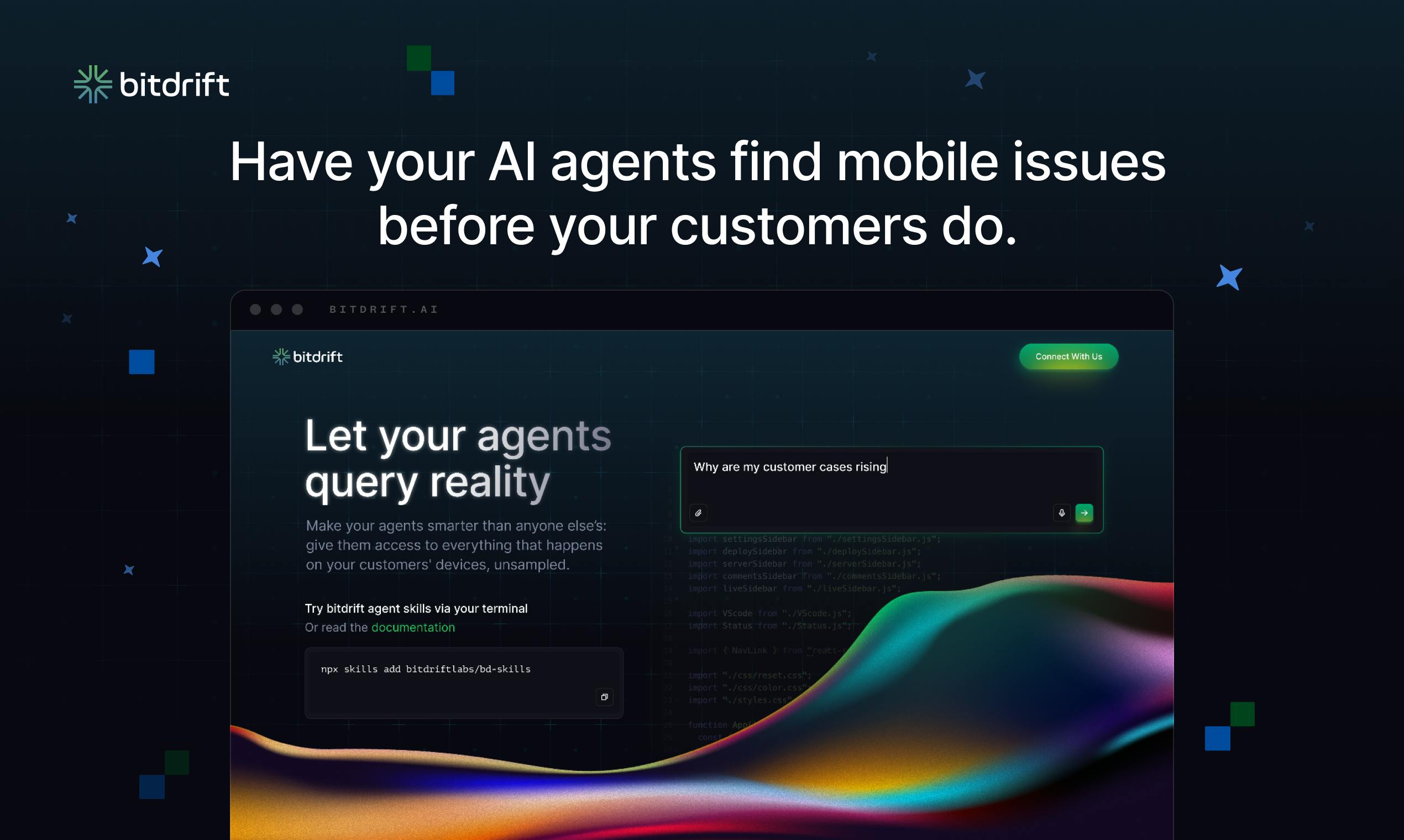
bitdrift.ai exposes this system through a public API, command-line tools, and agent skills for environments such as Claude Code, Cursor, Codex, and Copilot. Agents can investigate live customer behavior and iterate against new evidence instead of reasoning from stale crash reports. The Product Hunt launch reports early users improving investigation and defect-fix speed by roughly 10x; this is vendor-supplied evidence and needs customer-level validation.
The official pricing page offers a free tier with five users, 50,000 monthly active applications for basic performance monitoring, 100,000 crash reports monthly, 14-day retention, and three workflows. Enterprise pricing is custom and adds unlimited users and applications, configurable retention, unlimited workflows, session replay, spans, SLOs, RBAC, SSO, integrations, and support. No overages are advertised. Pricing by active application rather than log volume aligns spend with customer reach but may create infrastructure-cost risk if usage is intense.
Founder and Team Assessment
Peter Morelli is co-founder and CEO and previously served as a Lyft engineering vice president. Matt Klein is co-founder and a prominent infrastructure engineer who created Envoy, the open-source proxy originally developed at Lyft and now widely used in cloud-native systems. Amplify’s investment announcement also credits Martin Conte Mac Donell and former colleagues with developing the underlying observability approach at Lyft.
The founders experienced the problem at scale, battle-tested a solution, spun it out, and retained Lyft as a reference. Klein’s open-source credibility aids recruiting and trust; Morelli brings operating experience. Public profiles suggest 11–50 employees, but organization, attrition, and equity are undisclosed.
Founder Assessment: Strong technical credibility and direct problem experience; go-to-market repeatability and organizational scaling require diligence.
Market Opportunity
The beachhead is mobile observability for consumer apps with large device fleets. An illustrative 20,000 global mobile organizations at $50,000 average annual contract value produces a $1 billion revenue market. Client-side observability, desktop, connected devices, and AI-agent debugging expand the ceiling. These are analytical inputs, not guidance.
Failures drive lost ratings, support burden, and engineering cost. Mobile remains harder than server observability, and AI agents need reliable production evidence. However, many buyers prefer one vendor across backend, web, and mobile.
Market Assessment: Large and budgeted, with serious incumbent bundling power.
Traction and Growth Signals
The official site names practitioners from Lyft, Reddit, Favor, MileIQ, and iCabbi describing device-level diagnosis. A Product Hunt customer describes migration from Firebase and lower cost. The maker reports one billion-plus installs, one trillion edge logs daily, and a beta customer improving defect-fix speed 10x. These claims suggest technical scale but omit paying logos and contracts.
Product Hunt attention is not PMF. Public GitHub work was active in August 2026; Capture SDK had 38 stars and 13 forks. A company retrospective says bitdrift added complete crash and issue reporting after buyers resisted an additional standalone tool—useful learning, but evidence of displacement difficulty.
Missing metrics are ARR, growth, logo count, concentration, retention, trial conversion, sales cycle, implementation time, SDK overhead, and AI adoption.
Traction Assessment: Credible production references; commercial scale unverified.
Competitive Position
Competitors include Firebase Crashlytics, Sentry, Embrace, Datadog Mobile RUM, New Relic, Dynatrace, Instabug, Bugsnag, Grafana ecosystems, and internal telemetry systems. Incumbents offer broader integrations, mature security, existing procurement relationships, and large developer communities. Free Crashlytics and Sentry create price pressure for smaller teams.
bitdrift differentiates through on-device storage, remote workflow control, selective upload, predictable non-log-volume pricing, mobile specialization, and an API designed for iterative agent investigations. The architecture may collect far richer context without proportional cloud ingestion cost. Switching costs arise from embedded SDKs, workflows, dashboards, integrations, historical data, and operational habits.
Defensibility depends on whether patents and hard engineering protect the ring-buffer/control-plane design, whether performance remains superior at scale, and whether proprietary workflow data improves the AI experience. Models themselves are not a moat. If Datadog or Sentry reproduced the feature, customers could favor their existing stack unless bitdrift demonstrates materially better completeness, cost, speed, and mobile expertise.
Defensibility Assessment: Medium-High
Business Model and Economics
Enterprise contracts are the revenue engine; the free tier supports adoption. Pricing by monthly active applications is predictable and can expand with customers. Session replay, SLOs, performance, integrations, SSO, RBAC, and support provide an enterprise fence.
Costs include telemetry, storage, egress, replay, control-plane infrastructure, AI, support, compliance, and sales. Selective upload should help margins, but unlimited usage and agent queries require disciplined contracts. Diligence must establish ACV, gross margin by fleet, expansion, implementation burden, discounting, sales payback, and whether AI is separately monetized.
Unicorn Path
At an illustrative 10x ARR multiple for a fast-growing infrastructure company, a $1 billion valuation requires about $100 million ARR. One plausible route is 2,000 enterprise customers at $50,000 ACV, or 500 larger customers at $200,000 ACV. A blended portfolio could combine major consumer platforms with mid-market mobile teams.
To reach that level, bitdrift must prove repeatable displacement of crash-reporting incumbents, land-and-expand behavior, strong gross retention, security readiness, and agentic workflows that raise ACV rather than merely improve demos. International data requirements and mobile privacy regulations add execution cost.
Unicorn Path: Plausible but execution-dependent
Valuation Assessment
The company and lead investor confirm a $15 million Series A in December 2023. Secondary databases list additional investors, but the current valuation, later financing, ownership, revenue, burn, and liquidation terms are not reliably public. A secondary estimate of valuation should not be treated as fact.
Valuation Attractiveness: Not Assessable
Required inputs include current ARR and growth, gross margin, net retention, cash, burn, runway, cap table, option pool, SAFEs, proposed round size and price, liquidation preferences, and pro-rata rights.
Key Risks
- Commercial traction may lag impressive technical-scale claims.
- Incumbents can bundle mobile observability into broader contracts.
- SDK integration and migration create adoption friction.
- Large customers may dominate revenue and bargaining power.
- Device telemetry and session replay create privacy, security, and compliance exposure.
- Unlimited usage may pressure infrastructure margins.
- Agentic functionality may be copied or remain lightly used.
- App-store, OS, and device changes can disrupt collection.
- Enterprise sales cycles may be long and support-heavy.
- Current financing terms and dilution are unknown.
Final Assessment
Venture Potential: 82/100
| Category | Score |
|---|---|
| Market Size and Expansion Potential | 18/20 |
| Traction and Growth Evidence | 16/20 |
| Founder and Team | 14/15 |
| Product Strength | 9/10 |
| Distribution Potential | 11/15 |
| Business Model and Economics | 7/10 |
| Defensibility | 7/10 |
| Total | 82/100 |
Evidence Confidence: 82/100
Product architecture, pricing, SDK activity, founders, funding, and named references are well supported. Usage-scale and performance claims come mainly from the company. Financial and cohort data are absent.
Final Decision: DD
bitdrift has venture-grade technical foundations, strong founder-market fit, and credible enterprise references. Proceed to diligence, not investment, until commercial scale, retention, margins, AI adoption, security, and price are verified.
Upgrade Conditions
- Verified ARR above $5 million with more than 100% net revenue retention.
- Multiple referenceable customers expanding from crash reporting into advanced workflows.
- Gross margin above 75% at large fleet sizes.
- Measurable AI-driven reductions in investigation time and higher contract value.
- Efficient enterprise sales with acceptable concentration.
- Financing price consistent with verified revenue quality.
Downgrade Conditions
- Infrastructure-scale claims do not translate into paying revenue.
- Churn rises after pilots or migrations remain difficult.
- Incumbents close the capability gap through bundling.
- Security or privacy controls fail enterprise review.
- Unlimited usage creates structurally weak margins.
Questions for Further Diligence
- What are current ARR, growth rate, customer count, and average contract value?
- What are gross retention, net revenue retention, churn, and expansion by cohort?
- How concentrated is revenue among Lyft and the five largest customers?
- How are one billion installs and one trillion daily edge logs measured?
- What production share uses bitdrift.ai, and how does it change MTTR?
- What are gross margins by customer size after storage, egress, replay, and AI costs?
- How long do SDK implementation, security review, and migration take?
- Which competitors are most often displaced, and why are deals lost?
- What patents, performance advantages, or datasets protect the architecture?
- What privacy controls govern session replay and agent access to device data?
- What are burn, runway, headcount plan, and go-to-market productivity?
- What are the current cap table, proposed financing terms, and investor rights?
Sources
- Product Hunt: bitdrift and bitdrift.ai
- bitdrift official product site
- bitdrift pricing
- Capture product documentation
- bitdrift: $15 million Series A announcement
- Amplify Partners investment announcement
- bitdrift two-year retrospective
- bitdrift GitHub organization
- Capture SDK repository
- CB Insights funding summary, secondary source