
Table of Contents
- Jotform AI Data Assistant Investment Report
Jotform AI Data Assistant Investment Report
Category: AI-powered data analysis, no-code workflow automation, and online forms
Company Stage: Established, growth-stage private software company; founded in 2006
Founder or Founders: Aytekin Tank
Headquarters: San Francisco, California, with additional global offices
Funding: Bootstrapped; no outside funding publicly reported
Business Model: Freemium SaaS, paid individual subscriptions, and custom-priced enterprise contracts
Product Hunt Launch Date: August 25, 2026
Report Date: August 28, 2026
| Investment Metric | Assessment |
|---|---|
| Venture Potential | 84/100 |
| Unicorn Path | Plausible |
| Valuation Attractiveness | Not Assessable |
| Evidence Confidence | 72/100 |
| Final Decision | DD |
Executive Summary
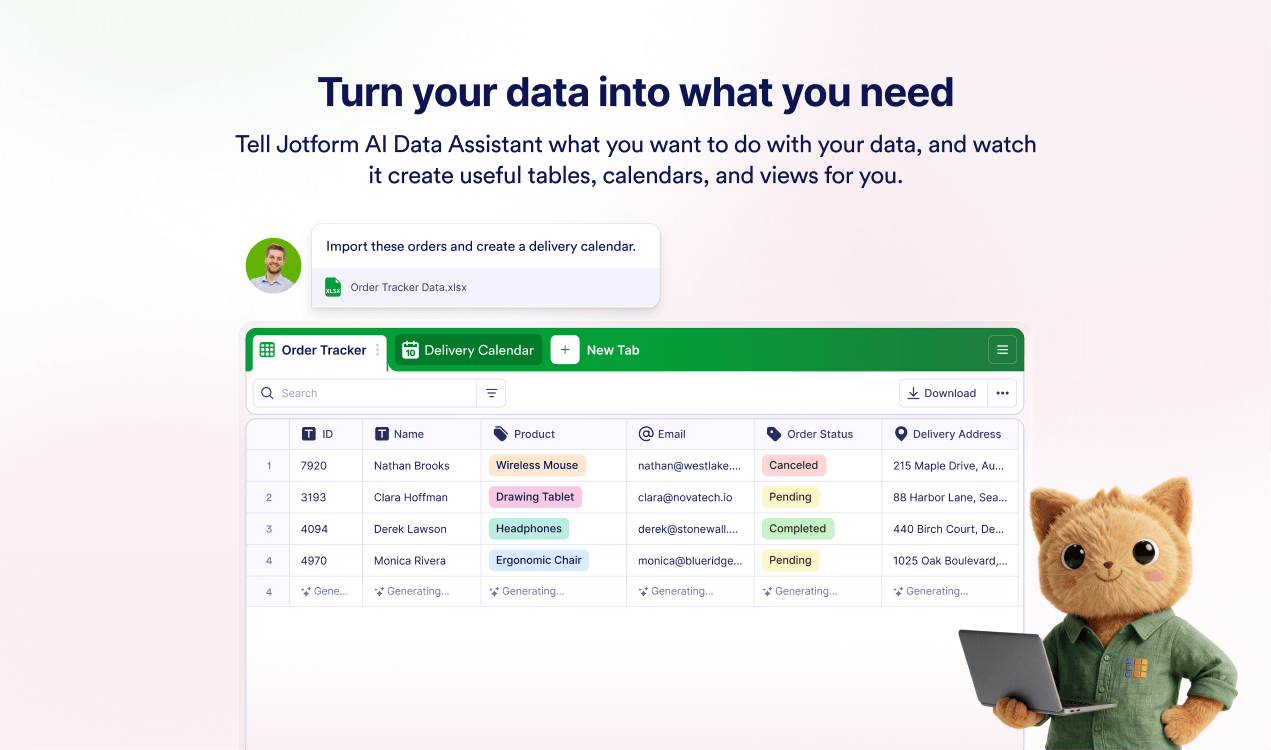
Jotform AI Data Assistant is an AI interface for creating tables, analyzing form submissions, producing summaries and visualizations, editing records, and initiating follow-up actions through natural-language instructions. It operates inside Jotform Tables and Inbox rather than as an independent analytics product (official announcement).
The product’s principal advantage is not a uniquely defensible AI model. It is its location inside an established data-collection platform. Jotform says it has more than 40 million users, two billion-plus historical submissions, over 20,000 templates, and operations across more than 190 countries (company overview). The assistant can analyze data where it is collected and then act on the results without requiring a separate export, business-intelligence tool, or automation platform.
The strongest investment signal is therefore company quality and distribution, not Product Hunt attention. Jotform was founded in 2006, remains founder-led and bootstrapped, employs more than 600 people according to the company, and has demonstrated sustained product expansion beyond forms into tables, e-signatures, applications, workflows, payments, and AI agents (20-year company history). Its mobile product also has substantial external validation: the U.S. App Store listing shows a 4.9 rating from approximately 44,000 ratings, while Google Play reports more than one million downloads and approximately 29,000 reviews (Apple App Store, Google Play).
The principal investment concern is information asymmetry. Jotform does not disclose verified revenue, paid-customer count, retention, margins, cash flow, or valuation. More specifically, there are no public usage, conversion, retention, or incremental-revenue metrics for AI Data Assistant. The feature may be a valuable retention and upsell mechanism without becoming a material standalone business.
The final decision is DD. Jotform clearly qualifies as a venture-scale software company, and a credible path to a billion-dollar valuation exists. However, the company’s bootstrapped status may mean no investable round is available, while valuation attractiveness cannot be determined without financial statements and transaction terms.
Product Overview
Jotform AI Data Assistant addresses the work that follows data collection. Form users typically export submissions into spreadsheets or analytics tools, manually create filters and formulas, review free-text responses, build reports, and send follow-up messages. The assistant replaces part of that workflow with a conversational interface.
Users can create structured tables from prompts or files; summarize, translate, categorize, and calculate data; identify trends and outliers; generate charts; change table views; update or archive records in bulk; and draft replies or reminders. “AI Columns” applies repeatable analysis to existing and future records, while integration with Jotform Inbox turns findings into follow-up actions (product page, official announcement).
The initial target user is an existing Jotform customer in operations, education, healthcare, events, human resources, marketing, or customer support who collects enough submissions to make manual analysis inefficient. The product competes with spreadsheets, manual review, exports to business-intelligence platforms, and custom automation.
AI Data Assistant is available without a separate product fee, but the quantity of data users can analyze depends on their underlying Jotform plan. Published annual-billing prices are Starter at no charge, Bronze at $34 per month, Silver at $39, Gold at $99, and custom Enterprise pricing. The free plan is limited to 100 monthly submissions, while Gold supports up to 5,000 (pricing, Data Assistant FAQ).
The broader Jotform platform is available on the web and through iOS and Android applications. AI Data Assistant itself appears primarily integrated into the web-based Workspace, Tables, and Inbox experience; separate mobile availability was not clearly documented.
Product Quality Assessment: High potential customer utility and strong workflow integration, but no independent evidence yet establishes analytical accuracy, sustained usage, or willingness to pay specifically for the assistant.
Founder and Team Assessment
Aytekin Tank founded Jotform in 2006 after working as a web developer at Internet.com. He remains CEO and has operated the company without outside financing, according to both Jotform and his account published by Fortune (Jotform about page, Fortune, LinkedIn).
Twenty years of continuous operation, international expansion, and product development provide stronger evidence of execution than a typical early-stage founder résumé. The company reports more than 600 employees and seven global offices. LinkedIn categorizes Jotform as a 501–1,000-person private software company and shows approximately 900 associated profiles, although LinkedIn counts can include contractors and former employees (Jotform milestones, LinkedIn).
Jotform has established product, enterprise-sales, growth, security, and international operating capabilities. Key-person risk remains because Tank is the controlling founder, and no succession or governance structure is publicly disclosed. Founder commitment is nevertheless well established.
Founder Assessment: Exceptional evidence of long-term product and operational execution; governance, succession planning, and leadership depth require diligence.
Market Opportunity
The initial market is organizations already collecting operational, survey, application, intake, payment, or customer-feedback data through online forms. Their problem is converting high-volume submissions into decisions and follow-up actions without analysts, spreadsheet expertise, or separate workflow software.
Jotform’s reported 40 million registered users provide a large embedded distribution base, although registered users should not be confused with active or paying customers. An illustrative expansion scenario is:
- 40 million registered users;
- 0.5%–2% adopting a paid plan partly because of AI analysis;
- $400–$1,200 annual subscription revenue per paid account.
That produces a theoretical range of approximately $80 million–$960 million in annual subscription revenue. This is an analyst scenario, not a forecast: current active-user rates, paid conversion, overlap with existing subscribers, and incremental AI-driven revenue are unknown.
Adjacent opportunities include enterprise data governance, automated workflows, AI agents, e-signatures, payments, application building, customer communication, and industry-specific deployments. Geographic reach is already broad: Jotform reports operations in more than 190 countries and 16 languages.
Market timing is favorable because generative AI lowers the skill required to analyze data. However, the same technology also enables Microsoft, Google, Airtable, Salesforce, and other platforms to embed conversational analysis into existing products.
Traction and Growth Signals
The AI Data Assistant ranked fourth on Product Hunt for August 25, 2026. This demonstrates launch visibility but does not establish product-market fit (Product Hunt).
Company-level traction is substantially stronger. Jotform reports:
- More than 35 million users in 2025 and more than 40 million currently;
- More than 70 million forms created and 2.3 billion submissions by the end of 2025;
- More than 600 employees and seven offices;
- Revenue growth exceeding 248% since 2021, without disclosing the revenue base;
- More than 700,000 AI agents created during 2025 (2025 review, 20-year metrics).
These are company-reported figures, not audited disclosures. They nevertheless show long-term platform usage, international distribution, and active product development. App-store ratings provide independent evidence that the broader product has significant mobile adoption and generally positive customer sentiment.
No reliable public information was found for AI Data Assistant active users, prompt volume, repeat usage, error rate, paid-plan conversion, incremental revenue, or retention.
Traction Assessment: The parent platform has substantial and durable traction; the new AI feature’s commercial contribution remains unverified.
Competitive Position
Direct competitors include Typeform, SurveyMonkey, Airtable, Google Forms, Microsoft Forms, Fillout, Zoho Forms, Formstack, and Cognito Forms. At the analysis layer, Jotform also competes with Microsoft Excel Copilot, Google Sheets’ AI capabilities, Airtable AI, Power BI, Tableau, and general-purpose assistants connected to spreadsheets.
Free alternatives include Google Forms combined with Google Sheets, Microsoft Forms, and manual spreadsheet analysis. Larger platforms can bundle similar natural-language querying, classification, charting, and automated follow-up.
Jotform’s advantage is its end-to-end workflow: it collects the original data, stores it in Tables, analyzes it, and can act through Inbox, workflows, integrations, and AI agents. Existing forms, templates, submission histories, integrations, permissions, and compliance settings produce meaningful switching friction.
If Google, Microsoft, or Airtable launched an equivalent feature within six months, customers could still remain with Jotform because their forms, historical submissions, payment flows, approvals, templates, and automations are already embedded there. However, the AI capability itself is readily replicable and is unlikely to provide model-level defensibility.
Defensibility Assessment: Medium
Business Model and Economics
Jotform follows a freemium SaaS model. Individual plans generate approximately $408–$1,188 in annualized revenue at published annual-billing prices, while Enterprise pricing is negotiated. AI Data Assistant currently appears to support conversion, retention, and expansion of the overall platform rather than generating a separate subscription.
The business should have attractive SaaS gross-margin potential, but AI introduces incremental inference costs. Since the assistant analyzes user-provided records and may perform bulk classification or generation, cost rises with both prompt activity and submission volume. Jotform has not disclosed model providers for this specific product, cost per analysis, usage limits, or AI gross margin.
The existing installed base, template-driven acquisition, product-led onboarding, integrations, and free plan should reduce reliance on paid customer acquisition. Enterprise deployments introduce sales and customer-success costs but increase ACV and retention potential.
The central economic question is whether AI usage increases paid conversion and enterprise ACV faster than inference, support, security, and compliance costs. No public evidence currently answers that question.
Unicorn Path
For an established private SaaS platform with meaningful but undisclosed growth and margins, an 8× ARR multiple is a reasonable analytical midpoint. Actual multiples could be materially lower or higher depending on growth, profitability, and retention.
Required ARR for a $1 billion valuation:
$1 billion ÷ 8 = $125 million ARR
At a hypothetical blended annual revenue of $500 per paid account, Jotform would need approximately 250,000 paying accounts. At $1,200 per account, it would require approximately 104,000. A mix of individual plans and higher-value enterprise contracts would reduce the required account count.
Jotform’s 40-million-user base makes these customer counts numerically achievable, but its actual paying-customer count is undisclosed. Unverified third-party sources estimate revenue near or above the required level, but those estimates are insufficient to conclude that Jotform has already earned a unicorn valuation.
Reaching or sustaining this threshold requires paid conversion, enterprise expansion, retention, continued international growth, and differentiation from bundled Google and Microsoft products. AI Data Assistant can contribute by increasing the value of every collected submission, but it is unlikely to create a unicorn independently from the broader Jotform platform.
Unicorn Path: Plausible
Valuation Assessment
Jotform states that it is bootstrapped, and no institutional financing round or external investors were identified. No verified valuation, secondary transaction, current fundraising process, or acquisition offer is public.
Relevant category outcomes include Symphony Technology Group’s $1.5 billion acquisition of SurveyMonkey parent Momentive and Silver Lake’s $12.5 billion acquisition of Qualtrics, but these companies had disclosed financial data and materially different enterprise-market positions (Momentive transaction, Qualtrics transaction). They demonstrate strategic value in forms, surveys, and experience management but do not establish Jotform’s current value.
Valuation Attractiveness: Not Assessable
Assessment requires verified ARR, revenue growth, gross margin, EBITDA or free cash flow, net retention, paid-customer count, customer concentration, ownership structure, proposed transaction size, and investor liquidity rights.
Key Risks
- Feature-level monetization is unproven: AI Data Assistant is free and may not materially improve conversion or retention.
- Competitive bundling: Google, Microsoft, Airtable, Salesforce, and established survey platforms can replicate conversational data analysis.
- Financial opacity: Revenue, margins, paid customers, cash flow, and valuation are undisclosed.
- AI accuracy: Incorrect summaries, classifications, record modifications, or follow-up messages could cause operational harm.
- Privacy and compliance: Submission data can include healthcare, education, payment, and personal information, increasing AI-processing risk.
- Product sprawl: Forms, tables, e-signatures, workflows, apps, agents, and analytics may increase complexity and dilute focus.
- Low incremental willingness to pay: Users may consider AI analysis a standard bundled feature rather than a premium product.
- Founder and governance concentration: Ownership, board structure, succession planning, and minority-investor protections are unknown.
- Investment availability: A profitable or well-capitalized bootstrapper may have little reason to issue venture equity.
Final Assessment
Venture Potential: 84/100
| Category | Score |
|---|---|
| Market Size and Expansion Potential | 18/20 |
| Traction and Growth Evidence | 17/20 |
| Founder and Team | 14/15 |
| Product Strength | 8/10 |
| Distribution Potential | 14/15 |
| Business Model and Economics | 7/10 |
| Defensibility | 6/10 |
| Total | 84/100 |
Jotform’s installed base, long operating history, international distribution, founder execution, and broad platform are the strongest elements. Feature-level monetization, financial opacity, and the replicability of generative-AI analysis are the weakest.
Evidence Confidence: 72/100
Founder identity, company history, headquarters, pricing, product functionality, mobile usage, bootstrapped status, and approximate organization size are well supported. User, submission, employee, AI-agent, and revenue-growth figures are company-reported. Revenue, retention, profitability, ownership, valuation, and AI Data Assistant adoption remain unavailable.
Final Decision: DD
Jotform merits formal diligence as an established venture-scale software company, not because of its Product Hunt launch. Investment depends on whether equity is available, whether financial performance supports the requested valuation, and whether AI features are measurably accelerating paid conversion, enterprise expansion, or retention.
Upgrade Conditions
- Audited or verified ARR above the level needed to support the proposed valuation.
- Strong net revenue retention and sustainable free cash flow.
- Evidence that AI Data Assistant increases conversion, retention, or enterprise ACV.
- High repeat usage with documented analytical accuracy.
- Attractive secondary or primary transaction terms with adequate investor protections.
- Clear AI security, data-governance, and model-provider controls.
Downgrade Conditions
- AI Data Assistant usage falls sharply after launch.
- No measurable impact on paid conversion or retention.
- Major platform competitors achieve feature parity and pressure pricing.
- AI inference and compliance costs materially reduce margins.
- Evidence of slowing company growth or weak enterprise retention.
- Unfavorable governance, liquidity, or transaction terms.
Questions for Further Diligence
- What are current ARR, annual growth, gross margin, EBITDA, and free cash flow?
- How many active and paying customers does Jotform have?
- What are gross and net revenue retention by individual and enterprise segment?
- How many customers use AI Data Assistant weekly, and what is 30- and 90-day retention?
- Has the assistant increased free-to-paid conversion, expansion revenue, or customer retention?
- What is the inference and infrastructure cost per active AI user or analyzed submission?
- Which model providers process customer data, and what retention and training restrictions apply?
- How are inaccurate analyses and unauthorized bulk actions prevented or reversed?
- What percentage of revenue comes from Enterprise, individual subscriptions, and ancillary products?
- What are customer acquisition costs and payback periods by channel?
- What is the company’s ownership and governance structure, and is a primary or secondary transaction contemplated?
- What valuation, transaction size, investor rights, and liquidity terms are being offered?