
Table of Contents
Omi Investment Report
Category: AI memory assistant, meeting intelligence, and wearable hardware
Company Stage: Seed-stage; early commercial scale
Founder or Founders: Nik Shevchenko; Aarav Garg identifies himself as co-founder and COO. Public databases also name Joan Cabezas, but his current role is unclear.
Headquarters: Public company materials list San Francisco; the founder recently stated that the operating team moved to New York, creating a location discrepancy (LinkedIn company page; founder profile)
Funding: At least $2 million publicly announced; later secondary reporting says approximately $3 million, but the incremental amount and round structure are not independently verified (founder announcement; Dealroom)
Business Model: $179 wearable hardware, freemium consumer subscriptions, developer platform, and enterprise sales (hardware store; subscription guide)
Product Hunt Launch Date: September 3, 2026, for the current desktop-centered release (Product Hunt leaderboard)
Report Date: September 6, 2026
| Investment Metric | Assessment |
|---|---|
| Venture Potential | 74/100 |
| Unicorn Path | Conditional |
| Valuation Attractiveness | Not Assessable |
| Evidence Confidence | 67/100 |
| Final Decision | DD |
Executive Summary
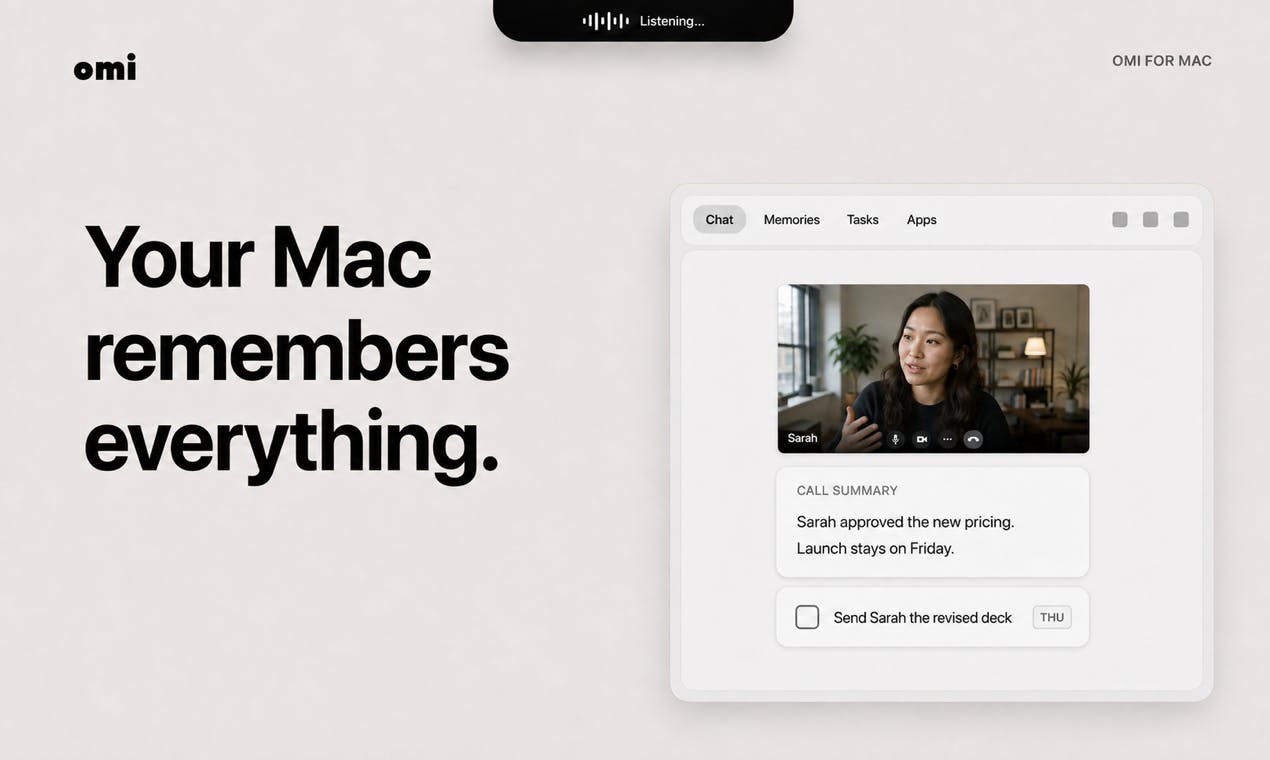
Omi is building a persistent personal-memory system that captures conversations and computer activity, transcribes and summarizes the information, and lets users retrieve it through natural-language questions. It spans a $179 pendant, mobile applications, a web interface, and a new desktop application that captures screen and meeting context (official site; Product Hunt).
The product’s strongest qualities are its cross-device scope and unusually substantial open-source footprint. Omi publishes its mobile, desktop, backend, firmware, hardware, SDK, and MCP components under an MIT license. The repository had approximately 13,400 stars, 2,241 forks and a same-day code push as of the report date, indicating meaningful developer attention and continuing engineering activity (GitHub repository; GitHub API).
The strongest commercial signal is a founder-reported claim that Omi exceeded $1.5 million ARR and reached profitability. Additional company or management claims include more than 300,000 users or professionals and more than 25,000 devices sold. These figures are encouraging but have not been verified through financial statements, payment records or cohort data (founder ARR statement; official repository; Dealroom).
The principal concern is product reliability and retention. Omi’s U.S. iOS application has a 3.9/5 rating from 172 ratings, while Google Play shows approximately 4.0/5, 421 reviews and 10,000-plus downloads. Reviews and Omi’s own changelog identify synchronization, battery-use, Bluetooth and transcription issues. The founder has also publicly acknowledged that an earlier version attracted substantial attention while the product itself did not work well enough and was too slow (Apple App Store; Google Play; changelog; founder profile/activity).
The investment decision is DD. Omi has enough reported revenue, product activity, distribution, developer adoption and strategic optionality to justify formal diligence. It does not merit an “Invest” decision without verification of ARR quality, subscription retention, hardware margins, privacy controls, current valuation and financing terms.
Product Overview
Omi addresses fragmented personal and professional context. Meetings, informal conversations, tasks and on-screen work are normally spread across note-taking applications, calendars, messaging systems and human memory. Omi records audio or screen activity, produces transcripts and summaries, extracts tasks and memories, and allows users to search or question that history with citations to the underlying source (Product Hunt; official product page).
The service is available on iOS, Android, macOS, the web and Omi’s wearable. Its public repository also contains an early Windows implementation and Omi Glass components. The architecture uses mobile and desktop clients, Bluetooth hardware, a Python backend, speech-to-text providers, Firebase, Redis and LLM services (GitHub).
Current subscription pricing is:
- Basic: Free, 300 processed minutes per month
- Plus: $19 monthly or $161.91 annually, 1,500 minutes per month
- Unlimited: $29 monthly or $269.91 annually
- Wearable: $179 one-time purchase
These prices are verified on Omi’s current help and commerce pages (subscription guide; store).
The primary benefit is continuous, searchable context without requiring users to take notes manually. Existing alternatives include handwritten notes, phone recorders, calendar-connected meeting bots and stand-alone transcription applications. Product quality is promising but not yet consistently strong: app-store ratings are moderate, and Omi continues to issue fixes for battery consumption, device reconnection, audio synchronization and transcription regressions (Apple App Store; changelog).
Founder and Team Assessment
Nik Shevchenko founded Omi in 2024 and is a Thiel Fellow. His profile identifies two earlier companies—WLNC and Fund Platform—as acquired, although transaction terms and personal proceeds are not publicly verified (LinkedIn). His strengths appear to be product velocity, consumer marketing, fundraising and community formation.
Aarav Garg’s profile identifies him as co-founder and COO from May 2025. Purdue previously described him as a founding-team member rather than an original founder, suggesting his title evolved after joining (LinkedIn; Purdue). Secondary sources also identify Joan Cabezas as a co-founder, but Omi’s present leadership materials do not clearly establish his current operating role (Pulse 2.0).
LinkedIn lists 28 associated employees while displaying a nominal company-size band of 2–10, so current full-time headcount is not verified. Omi is recruiting founding engineering and other leadership roles, indicating active team expansion (LinkedIn company page; Omi jobs).
Founder Assessment: Strong product, fundraising and distribution initiative, but leadership history, team composition and institutional operating capability require verification.
Market Opportunity
The initial segment should be defined as professionals with frequent in-person or virtual conversations whose value depends on accurate follow-up: founders, salespeople, consultants, clinicians, recruiters and field-service personnel.
An illustrative bottom-up scenario—not a verified market forecast—is:
- 20 million English-speaking professionals with sufficiently high meeting or conversation volume;
- 3%–5% eventual willingness to pay;
- 600,000–1 million paying users;
- $162–$270 annual subscription revenue per user.
That produces approximately $97 million–$270 million in potential annual subscription revenue, before hardware or enterprise sales. The range is highly sensitive to retention, privacy acceptance and willingness to wear or continuously run a recording product.
Expansion opportunities include team knowledge bases, enterprise compliance, healthcare documentation, field-service workflows, APIs and third-party hardware. The category also has strategic significance: Amazon acquired voice-wearable company Bee, while Meta acquired Limitless and stopped new Pendant sales (TechCrunch on Bee; Limitless announcement). These transactions validate platform interest, but Limitless’s hardware discontinuation also highlights category risk.
Traction and Growth Signals
Omi’s September 3 desktop launch ranked fourth on Product Hunt with approximately 274 votes. This demonstrates launch attention, not sustained demand (Product Hunt leaderboard).
More meaningful signals include:
- Founder-reported $1.5 million ARR and profitability, not independently verified.
- Company-reported 300,000-plus professionals/users.
- Secondary reporting of more than 25,000 devices sold.
- Approximately 13,400 GitHub stars and 2,241 forks.
- More than 1,600 pull requests merged during the year, according to the Product Hunt launch statement.
- Frequent product releases through 2025–2026, including offline recording, local transcription, desktop actions, web access and three-day battery firmware (changelog).
The “300,000 professionals” claim is difficult to reconcile directly with Google Play’s 10,000-plus download band and the relatively small U.S. App Store review count. It could include desktop, web, iOS and registrations rather than active users, but Omi does not publicly provide that definition.
Traction Assessment: Material early commercial and developer signals, but revenue quality, active usage and retention remain unverified.
Competitive Position
Direct competitors include Plaud’s NotePin and related recorders, which combine hardware with subscriptions. Plaud lists a free tier, an $8.33 monthly-equivalent Pro plan, $19.99 Unlimited and $20-per-user Team pricing—generally below Omi’s recurring prices (Plaud pricing). Software competitors include Granola and Otter, while phones, laptops, Apple Watch recording and open-source transcription tools are substitutes.
Omi’s differentiation is its combination of open hardware, MIT-licensed software, wearable capture, desktop screen context, local operation, APIs and an application marketplace. Its accumulating personal-memory corpus can create switching costs because historical context improves retrieval value. However, export and open-source functionality intentionally reduce lock-in.
If a major platform reproduced the feature within six months, customers might remain for Omi’s cross-platform history, open architecture, hardware interoperability and developer ecosystem. That answer is credible but not decisive. Meta and Amazon possess stronger hardware distribution, consumer identity, capital and AI infrastructure.
Defensibility Assessment: Medium-Low.
Business Model and Economics
Omi combines hardware revenue with recurring subscriptions. At list prices, annual subscription revenue is approximately $162 for Plus and $270 for Unlimited. Enterprise pricing is not publicly disclosed.
Hardware creates cash-conversion, inventory, warranty, shipping and return risk; Omi offers a one-year limited warranty and generally only a five-day discretionary return-request window (terms). Subscription margins depend on transcription minutes, LLM usage, cloud storage and support. Local transcription and bring-your-own-key options can lower Omi’s variable cost, but segment gross margins are undisclosed.
The founder-reported profitability claim is positive but insufficient to establish normalized gross margin or cash flow. Required diligence includes hardware landed cost, replacement rate, subscription attachment, renewal, app-store fee exposure and cloud cost per recorded hour.
Unicorn Path
A 6× forward-revenue multiple is assumed for a blended hardware and recurring-software company. This is below a premium pure-SaaS multiple because Omi has inventory and hardware-margin exposure, but above a hardware-only multiple if subscriptions become the majority of gross profit.
\[
\$1\,\text{billion} \div 6 = \$167\,\text{million annual revenue}
\]
If the target were entirely subscription ARR:
- At $161.91 annually: approximately 1.03 million Plus subscribers
- At $269.91 annually: approximately 619,000 Unlimited subscribers
- At an illustrative $10,000 enterprise ACV: approximately 16,700 enterprise accounts
Relative to the founder-reported $1.5 million ARR, Omi would need roughly 110-fold recurring-revenue expansion. Achieving this requires verified consumer retention, materially stronger mobile reliability, enterprise administration and compliance, international distribution, and a subscription attach rate sufficient to avoid dependence on low-multiple hardware sales.
Unicorn Path: Conditional
Valuation Assessment
Omi announced $2 million in funding from investors including Tim Draper and Dropbox co-founder Arash Ferdowsi. Later secondary reporting refers to approximately $3 million total funding, while PitchBook and Tracxn still report $2 million; the discrepancy is unresolved (founder announcement; PitchBook; Tracxn).
No reliable current valuation, SAFE cap, ownership structure or round terms were found.
Valuation Attractiveness: Not Assessable
Assessment requires verified ARR, growth, gross margin, subscription retention, hardware contribution margin, burn, cash balance, cap table and current financing terms.
Key Risks
- Retention risk: Continuous recording may be initially compelling but not habitual enough to sustain subscriptions.
- Reliability: App reviews and changelogs document synchronization, Bluetooth, battery and transcription problems.
- Privacy and consent: Users are responsible for recording-law compliance; always-on audio and screen capture create material legal and adoption friction (terms).
- Traction verification: ARR, profitability, users and device-sales figures are management or secondary-source claims.
- Platform competition: Meta, Amazon and major operating-system vendors can bundle similar functions.
- Hardware economics: Manufacturing, inventory, warranty and global fulfillment may constrain gross margin.
- Weak lock-in: Open-source code and export controls benefit users but lower technical switching barriers.
- Founder/key-person concentration: Product narrative and distribution remain closely associated with Shevchenko.
- Security exposure: Omi stores highly sensitive conversational and screen data. Omi reports SOC 2 and HIPAA compliance, but independent audit scope should be reviewed (compliance announcement).
Final Assessment
Venture Potential: 74/100
| Category | Score |
|---|---|
| Market Size and Expansion Potential | 17/20 |
| Traction and Growth Evidence | 14/20 |
| Founder and Team | 12/15 |
| Product Strength | 8/10 |
| Distribution Potential | 11/15 |
| Business Model and Economics | 6/10 |
| Defensibility | 6/10 |
| Total | 74/100 |
The strongest elements are multi-platform product scope, open-source adoption, rapid development and reported recurring revenue. The weakest are unverified commercial metrics, mixed reliability evidence, hardware economics and limited structural defensibility.
Evidence Confidence: 67/100
Product functionality, prices, legal entity, app ratings, repository activity and release history are well supported. Funding and leadership are partially supported but contain discrepancies. ARR, profitability, users, device sales, retention, margins, burn, runway and valuation are company-reported or unavailable.
Final Decision: DD
Omi merits formal diligence because it has stronger signals than a typical Product Hunt launch: reported seven-figure ARR, hardware sales, active applications and a large open-source community. The decision cannot advance to Invest until commercial claims, cohort retention, economics, compliance scope and financing terms are verified.
Upgrade Conditions
- Verify at least $1.5 million ARR through financial records.
- Demonstrate greater than 70% six-month paid-subscriber retention.
- Show subscription revenue growing faster than hardware revenue.
- Establish blended gross margin above 60%, with software gross margin above 75%.
- Verify 25,000-plus fulfilled devices and acceptable return/warranty rates.
- Produce enterprise references and repeatable non-founder-led sales.
- Document audit scope, data flows and recording-consent controls.
Downgrade Conditions
- Material gap between reported and verified ARR or active users.
- High subscription churn or low hardware-to-subscription conversion.
- Persistent synchronization or transcription failures.
- Hardware gross margin below sustainable consumer-electronics levels.
- Major privacy, security or recording-consent incident.
- Loss of founder commitment or declining repository activity.
- Bundled platform competition materially reducing paid conversion.
Questions for Further Diligence
- What are current recognized ARR, MRR and monthly growth, excluding hardware?
- How many monthly active, weekly active and paying users exist across each platform?
- What are 30-, 90- and 180-day paid retention by acquisition cohort?
- What percentage of device purchasers attach and renew a subscription?
- What are device landed cost, gross margin, return rate and warranty-replacement rate?
- What are transcription, LLM, storage and support costs per active paid user?
- How are the 300,000 users and 25,000 devices measured and reconciled?
- What percentage of acquisition is organic, paid, affiliate or reseller driven?
- What enterprise contracts are active, and what are ACV and renewal terms?
- What are current burn, cash balance and runway?
- Who are the current founders and executives, and what is the fully diluted cap table?
- What valuation, round size, liquidation preference and SAFE terms are currently proposed?