
Table of Contents
- Compliance by TwelveLabs Investment Report
Compliance by TwelveLabs Investment Report
Category: Enterprise video intelligence, media compliance, and AI infrastructure
Company Stage: Series B
Founder or Founders: Jae Lee, Aiden Lee, Soyoung Lee, Dave Chung, and SJ Kim
Headquarters: San Francisco, California, with offices in Seoul, New York, London, and Pangyo
Funding: Latest round: $100 million Series B; valuation not publicly disclosed
Business Model: Enterprise SaaS, usage-based video-intelligence APIs, cloud marketplace distribution, and private-cloud deployment
Product Hunt Launch Date: September 4, 2026
Report Date: September 7, 2026
| Investment Metric | Assessment |
|---|---|
| Venture Potential | 83/100 |
| Unicorn Path | Plausible |
| Valuation Attractiveness | Not Assessable |
| Evidence Confidence | 69/100 |
| Final Decision | DD |
Executive Summary
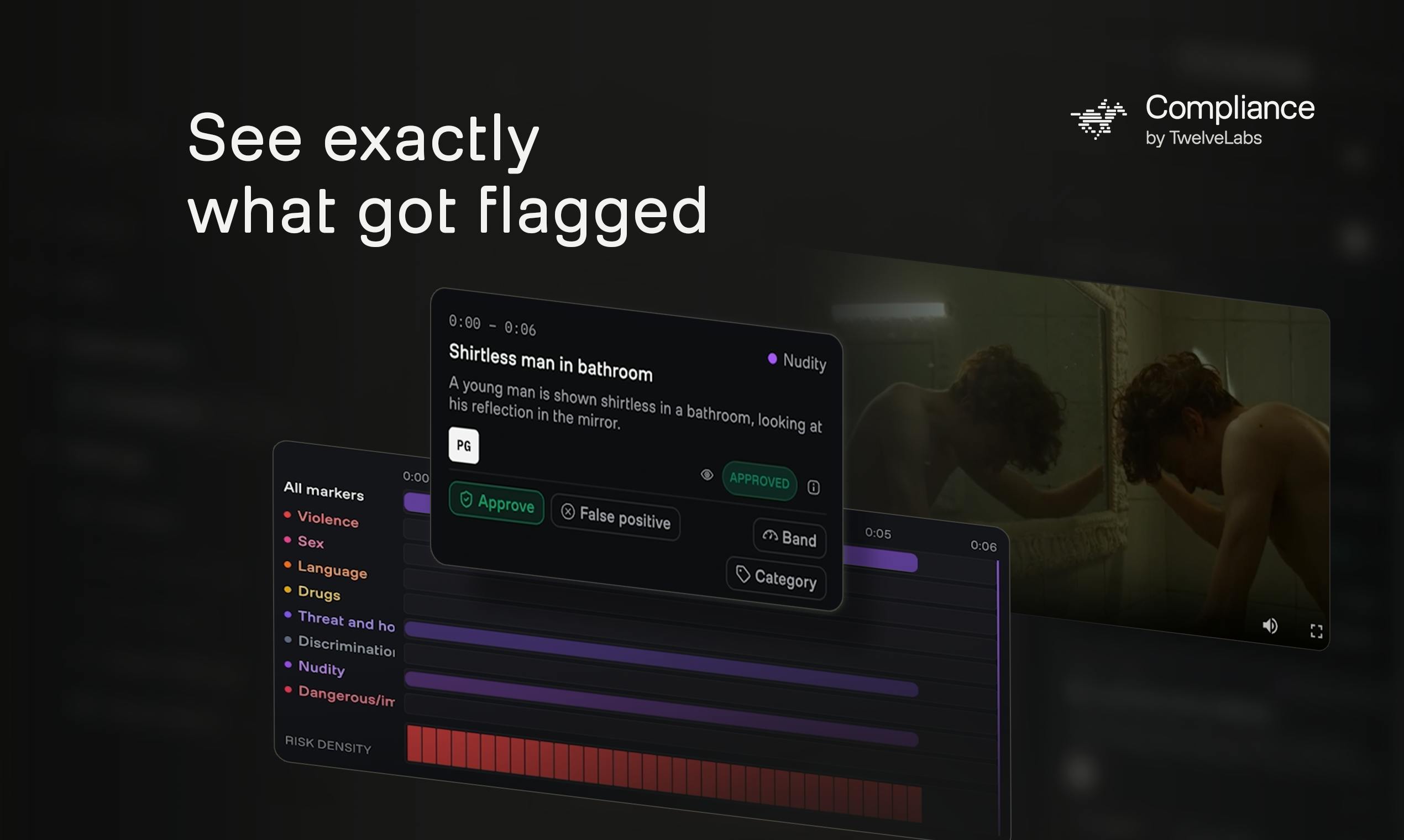
Compliance by TwelveLabs automates the first-pass review of film, television, broadcast, and other video against regulatory and internal content rules. It analyzes visuals, dialogue, audio, text, and narrative context, then gives human reviewers timecoded findings, supporting evidence, severity grades, and proposed remediation actions (official product page).
The product addresses a costly and defensible workflow. Long-form video is commonly reviewed manually, repeatedly, and separately for different territories, broadcasters, age classifications, and brand-safety policies. TwelveLabs allows customers to create, edit, version, and test their own rules rather than accepting a vendor-controlled compliance taxonomy (product announcement).
The strongest investment signal is company quality rather than the three-day-old product launch. TwelveLabs has developed proprietary video-native models, raised a $100 million Series B from institutional and strategic investors, secured distribution through Amazon Bedrock and AWS Marketplace, and moved at least one brand-safety workflow into production with Mantis Solutions, Reach PLC’s technology division (Series B announcement, Mantis case study).
The principal concern is commercial transparency. Revenue, growth, retention, gross margin, compliance-product customers, contract values, and the latest financing valuation are not publicly disclosed. Product-performance claims—92.5% agreement with a manual baseline and an 80% reduction in reviewer time—come from an internal 53-asset evaluation rather than independent production studies.
The decision is DD. TwelveLabs has credible technical differentiation, strong investors, enterprise distribution, and a plausible route to venture-scale revenue. Formal diligence is required to determine whether the new application has repeatable demand and whether the latest financing valuation leaves sufficient upside.
Product Overview
The initial customer is a broadcaster, studio, streaming service, publisher, distributor, or advertising platform that reviews substantial volumes of video across multiple jurisdictions or internal policies.
Compliance by TwelveLabs ingests footage and runs it against one or more customer-controlled rule packs. Forty-five rule sets ship with the product, covering classification boards, broadcast regulators, and scheduling regimes. Customers can clone or edit them, or import their own policies and generate draft rules (official announcement).
Findings include timestamps, observed visual and audio evidence, relevant dialogue, rationale, and severity. Remediation instructions can specify actions such as cutting, blurring, bleeping, adding warnings, or redacting subtitles. Rules are versioned and tested against prior human reviews, producing a comparison before a revised rule set goes into production.
The product deliberately does not issue autonomous legal clearance. Human reviewers accept, reject, or override findings, and both model and reviewer decisions remain in the audit record. It focuses on editorial compliance rather than technical video quality such as file conformance or audio distortion.
Deployment is available as managed, multi-tenant SaaS or inside a customer’s AWS account. Compliance-specific pricing is custom and not publicly disclosed. TwelveLabs’ underlying API has a free tier and usage pricing that includes $2.50 per indexed video hour, $1.75 per analyzed video hour, and $4 per 1,000 searches, although those API prices should not be assumed to represent Compliance pricing (API pricing).
Product Quality: Strong workflow design and thoughtful human oversight, but performance evidence is primarily internal.
Founder and Team Assessment
TwelveLabs was founded in 2021 by a team that included Jae Lee, Aiden Lee, Soyoung Lee, Dave Chung, and SJ Kim. Investor profiles differ slightly on which original members they label as founders; Index Ventures lists the first four, while Radical Ventures also lists SJ Kim (Index Ventures, Radical Ventures).
CEO Jae Lee is a data scientist by training and previously served as a lead data scientist at South Korea’s Ministry of National Defense. That background is directly relevant to large-scale video analysis and security-sensitive deployments (TechCrunch). Soyoung Lee leads go-to-market and has discussed deployments across media, sports, advertising, and government (Observer).
The company added Yoon Kim as president and chief strategy officer. TwelveLabs reports that he was previously SK Telecom’s CTO and led speech-recognition work for Siri after Apple acquired Novauris, where he had been CEO (company announcement).
Exact headcount is not disclosed. LinkedIn classifies TwelveLabs as having 51–200 employees, which is directional rather than verified. The company is hiring across research, engineering, product, and commercial functions and has opened offices beyond San Francisco and Seoul (careers page).
Founder Assessment: Strong technical founder-market fit and increasingly credible enterprise leadership, with execution risk from an ambitious multi-product strategy.
Market Opportunity
The narrow initial market consists of organizations that distribute or monetize enough video to justify dedicated compliance operations. This includes large broadcasters, streaming platforms, studios, news publishers, sports media owners, advertising platforms, and international distributors.
Pricing is private, so a bottom-up market scenario requires assumptions. If 500–1,500 global organizations could support annual contracts of $100,000–$500,000, the initial compliance opportunity would be approximately $50 million–$750 million in annual recurring revenue. This is an analyst scenario, not a reported market size.
Willingness to pay depends on avoided reviewer hours, faster release schedules, fewer regulatory failures, and the ability to distribute one title across more territories. TwelveLabs internally reports that the product reduced reviewer time by 80% and processed a two-hour master against 12 rules in 12 minutes, but those results vary by content and have not been independently validated (product page).
Expansion opportunities are substantial: advertising suitability, copyright review, synthetic-media detection, workplace safety, public-sector video retrieval, sports archives, automotive data, and security footage. TwelveLabs can also sell the underlying model and API rather than relying exclusively on one compliance application.
The standalone compliance market may be insufficient for a very large outcome at conservative contract values. The wider video-intelligence platform is large enough to support venture-scale revenue if TwelveLabs becomes an infrastructure layer across several industries.
Traction and Growth Signals
Compliance received 253 Product Hunt points, 18 comments, the #3 daily rank, and the #23 weekly rank after its September 4 launch (Product Hunt). This demonstrates launch visibility but has minimal bearing on enterprise product-market fit.
Company-level evidence is materially stronger:
- TwelveLabs raised a $100 million Series B in July 2026, co-led by NEA and NAVER Ventures, with participation from Amazon, Radical Ventures, Korea Investment Partners, Index Ventures, Quadrille Capital, and Red Bull Ventures (Series B announcement).
- Earlier publicly announced rounds include a $50 million Series A and a subsequent $30 million strategic financing involving Databricks, Snowflake, SK Telecom, HubSpot Ventures, and In-Q-Tel (Series A, strategic financing).
- Marengo and Pegasus are distributed through Amazon Bedrock, while AWS is the company’s preferred cloud provider under a multiyear infrastructure relationship.
- Mantis Solutions moved a Pegasus-powered brand-safety workflow into production in March 2026 after testing it on more than 70 videos. The case study says Mantis is expanding usage and contributing labeled production data (Mantis case study).
- The company reported tens of thousands of users at the time of its Series A. A later Observer profile reported thousands of developers and hundreds of enterprise customers, but did not disclose the underlying methodology or commercial status of those accounts (Series A announcement, Observer).
The most important missing metrics are ARR, revenue growth, net revenue retention, production video hours, paying customer count, contract size, customer concentration, and Compliance-specific pipeline conversion.
Traction Assessment: Strong company-level enterprise validation; new-product traction remains commercially unverified.
Competitive Position
Direct competitors include Spherex, which offers AI-driven global video compliance and age-rating services, and Hive, which provides video, image, text, and audio moderation APIs (Spherex, Hive).
Large-platform alternatives include Amazon Rekognition, Google Cloud Video Intelligence, and Microsoft Azure AI Video Indexer. These products detect explicit or unsafe content and return labels or timestamps, but their public materials emphasize standardized moderation categories rather than customer-authored, version-controlled regulatory reasoning (AWS Rekognition, Google Cloud, Microsoft).
TwelveLabs differentiates through video-native foundation models, contextual reasoning across time, editable rule packs, human-review workflows, AWS deployment, auditability, and the ability to learn from reviewer overrides. Customer-specific benchmark libraries and rule histories could create switching costs and a proprietary improvement loop.
If a major cloud provider launched an equivalent product, customers might remain because TwelveLabs owns the specialized review workflow, customer-calibrated rules, historical evaluations, and multimodal video models. However, that defense depends on maintaining a measurable accuracy and workflow advantage.
Defensibility Assessment: High
Business Model and Economics
Compliance appears to be an enterprise subscription with usage components, professional implementation, and optional private AWS deployment. Contract pricing and expected ACV are not disclosed.
Potential expansion revenue includes additional territories, rule packs, video volume, departments, archives, and adjacent applications. AWS Marketplace can simplify enterprise procurement but may introduce marketplace and infrastructure costs.
Video inference is compute-intensive. TwelveLabs uses AWS infrastructure, including GPU instances, SageMaker HyperPod, S3, and Bedrock. AWS states that the architecture has improved scalability and unit economics, but neither party discloses actual gross margin (AWS case study).
Economics will depend on whether per-hour revenue exceeds video ingestion, storage, inference, retrieval, customer-specific evaluation, and support costs. Human review remains necessary, but it is performed by the customer; that should be more scalable than TwelveLabs supplying compliance reviewers itself.
Unicorn Path
An 8-times ARR multiple is assumed for a fast-growing enterprise AI platform with proprietary models and recurring revenue. This is above conventional vertical SaaS because of technical differentiation, but it assumes satisfactory retention and gross margin.
Required ARR = $1 billion ÷ 8 = $125 million.
Possible customer scenarios are:
- 1,250 customers at $100,000 ACV;
- 625 customers at $200,000 ACV; or
- 250 large customers at $500,000 ACV.
Compliance alone could theoretically reach this scale, but it would require broad adoption across studios, broadcasters, platforms, publishers, and advertisers. A more credible route combines Compliance with usage-based APIs, search, archive intelligence, creative tools, public-sector deployments, and other vertical applications.
Required strategic achievements include high-confidence production evaluations, repeatable enterprise sales, international regulatory coverage, gross margins appropriate for software, lower inference cost per hour, and proprietary customer-derived evaluation data.
Unicorn Path: Plausible
Valuation Assessment
The latest financing was a $100 million Series B. The post-money valuation, ownership sold, liquidation preferences, and other terms were not publicly disclosed. Public databases provide inconsistent cumulative funding figures, partly because earlier seed and strategic rounds are categorized differently.
Revenue and growth are also unavailable. Therefore, the round price cannot be compared responsibly with ARR or gross profit.
Valuation Attractiveness: Not Assessable
Assessment requires current ARR, growth, gross margin by product, inference commitments, burn, runway, customer concentration, Series B post-money valuation, preferred terms, and current financing status.
Key Risks
- Compliance-specific revenue and customer adoption are unverified.
- False negatives could create regulatory, reputational, or contractual liability.
- Internal performance testing covers only 53 assets and lacks independent replication.
- Video inference may create weaker gross margins than conventional SaaS.
- Large cloud and AI platforms could bundle competing moderation capabilities.
- Customer sales cycles may be long because of legal, security, and workflow integration.
- Regulatory interpretations require continuous maintenance across jurisdictions.
- The business is expanding simultaneously across models, infrastructure, agents, and applications.
- AWS is both a valuable distribution partner and a material platform dependency.
- The undisclosed Series B valuation may already price in substantial future success.
Final Assessment
Venture Potential: 83/100
| Category | Score |
|---|---|
| Market Size and Expansion Potential | 17/20 |
| Traction and Growth Evidence | 14/20 |
| Founder and Team | 14/15 |
| Product Strength | 9/10 |
| Distribution Potential | 13/15 |
| Business Model and Economics | 7/10 |
| Defensibility | 9/10 |
| Total | 83/100 |
The strongest elements are proprietary technology, enterprise distribution, founder quality, and a credible application-layer strategy. The weakest are absent financial data, internal-only product validation, and compute-intensive economics.
Evidence Confidence: 69/100
Funding, investors, product functionality, public API pricing, AWS distribution, founders, offices, and Product Hunt activity are supported by primary or credible third-party sources. Mantis provides meaningful production evidence for the underlying platform.
Compliance-product accuracy is company-reported. Revenue, retention, valuation, gross margin, customer concentration, burn, and detailed round terms remain unavailable.
Final Decision: DD
TwelveLabs is sufficiently differentiated and commercially credible to justify formal diligence. It has a plausible unicorn path, but an investment recommendation cannot be made without confirming revenue quality, unit economics, customer retention, and Series B valuation terms.
Upgrade Conditions
- Verified Compliance contracts with multiple broadcasters, studios, or streaming platforms.
- Independent validation across substantially larger and more diverse video sets.
- ARR and growth consistent with a Series B company.
- Net revenue retention above 120%.
- Gross margin above 65% with a documented path toward 75%.
- Evidence of falling inference cost per reviewed hour.
- Multi-year customer commitments and low concentration.
- Financing terms that offer venture-return potential.
Downgrade Conditions
- Material false-negative incidents in production.
- Compliance pilots fail to convert into recurring contracts.
- Inference costs scale as quickly as revenue.
- AWS or another platform develops and bundles an equivalent workflow.
- Customer-specific implementation becomes services-heavy.
- Revenue growth materially trails the expectations embedded in the Series B.
- Material privacy, copyright, regulatory, or security failures emerge.
Questions for Further Diligence
- What are current ARR, year-over-year growth, and Compliance-specific contracted ARR?
- How many customers are in pilot, production, and paid expansion?
- What are average ACV, sales cycle, and implementation cost?
- What are gross margin and inference cost per processed video hour?
- How does accuracy vary by content category, language, territory, and video length?
- What are false-negative, false-positive, and reviewer-rejection rates in production?
- What are gross retention and net revenue retention?
- How concentrated is revenue among the ten largest customers?
- How much revenue originates through AWS Marketplace, direct sales, and APIs?
- What are current burn, cash balance, and runway after the Series B?
- What were the Series B post-money valuation, ownership sold, and liquidation preferences?
- Who bears legal responsibility when the system misses a compliance violation?