
Table of Contents
ChatCut Desktop Investment Report
Category: AI-native video editing / creator software
Company Stage: Seed-stage
Founder or Founders: Kaiwen Li (CEO), Alima Strickland (COO)
Headquarters: San Francisco according to LinkedIn; ChatCut Inc. is registered at an Austin, Texas address
Funding: $1.35 million seed round reported, led by ZhenFund with Antler participating; valuation not disclosed
Business Model: Freemium, credit-based monthly subscription
Product Hunt Launch Date: August 26, 2026
Report Date: August 29, 2026
| Investment Metric | Assessment |
|---|---|
| Venture Potential | 64/100 |
| Unicorn Path | Conditional |
| Valuation Attractiveness | Not Assessable |
| Evidence Confidence | 52/100 |
| Final Decision | Watch |
Executive Summary
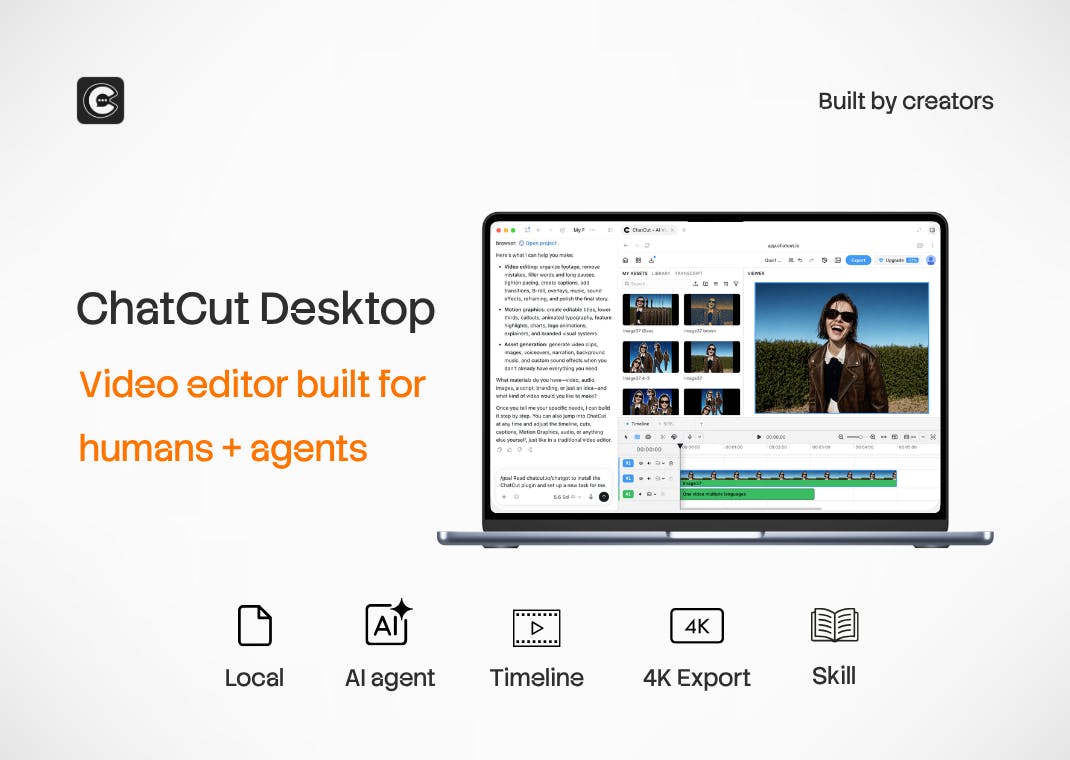
ChatCut Desktop is an AI-assisted video editor that lets users describe edits in natural language while preserving a conventional, editable multitrack timeline. It supports transcript-based editing, captions, motion graphics, generated images and video, music, voice features, and XML export to professional editors. The desktop product is differentiated by local footage handling and the option to use ChatCut’s agent or connect ChatGPT/Codex and Claude Code (Product Hunt launch; official website).
The product addresses a credible problem: editing long-form interviews, talking-head content, advertisements, and social videos is labor-intensive, while fully automated video generators often produce flattened outputs that are difficult to refine. ChatCut’s combination of automation and an editable timeline is a better workflow proposition than “one-click” generation for users who still require creative control.
The strongest company-quality signal is founder-market fit. Kaiwen Li and Alima Strickland have professional production backgrounds, and Antler says they worked on commercials and documentaries before building ChatCut. Li reports experience at VICE Media, Warner Bros. Discovery, and Homework Productions (Antler; Li’s LinkedIn). The founders understand video-production workflows firsthand.
The main investment concern is weak commercial verification. Revenue, paying customers, active usage, retention, conversion, gross margin, CAC, burn, and current valuation are not publicly disclosed. A company LinkedIn post claimed “100K+ creators and businesses” used its motion-graphics functionality, but the definition, period, and activity threshold were not supplied, so this is an unverified company claim rather than proof of product-market fit (ChatCut LinkedIn).
ChatCut could become a meaningful creator-software company, but its present individual subscription model would require several hundred thousand paying subscribers to support a unicorn valuation. It would likely need team collaboration, enterprise controls, reusable organizational workflows, and API/platform revenue. The appropriate decision is Watch, pending evidence of retention, paid conversion, sustainable gross margin, and repeatable acquisition.
Product Overview
ChatCut replaces parts of the manual workflow in Premiere Pro, DaVinci Resolve, Final Cut Pro, CapCut, and After Effects. Users import footage, request edits conversationally, and inspect or modify the resulting timeline. Its principal value is shortening rough-cut preparation without eliminating editorial control.
Core capabilities include transcript-based cutting, removal of filler words, captions in more than 100 languages, prompt-generated motion graphics, AI-generated images and video, music generation, and agent-driven editing. XML export allows users to continue in Premiere Pro, DaVinci Resolve, or CapCut (Product Hunt). The public agent-plugin repository documents a hosted MCP endpoint connecting ChatCut projects to Codex and Claude Code.
The product is available through the browser, desktop, and agent integrations. Product Hunt states that Desktop keeps original footage and editing/export operations local. However, authentication and AI functions may still communicate with hosted services and third-party models; “local” should therefore not be interpreted as fully offline.
Pricing is credit-based: $25, $45, $88, or $160 per month for 100, 200, 400, or 800 credits. Credits cover generated video, images, motion graphics, and music. Core editing can be free when users connect an existing agent subscription, while advanced generation, XML export, and voice capabilities require paid access (pricing).
Product Quality Assessment: Strong workflow concept and broad functionality, but quality and reliability are insufficiently validated by independent users.
Founder and Team Assessment
Kaiwen Li has approximately a decade of filmmaking and production experience and co-founded Homework Productions before ChatCut. Alima Strickland also co-founded Homework Productions and has been ChatCut’s COO since 2024 (Li; Strickland). Antler independently corroborates their production background and awards, although some detailed project claims originate from founder biographies.
LinkedIn lists ChatCut as having 2–10 employees and eight associated profiles, with locations in San Francisco and Shanghai. This is a platform-reported indicator, not verified payroll data (company LinkedIn). The company’s legal terms identify ChatCut Inc. as Texas-registered at an Austin address, while LinkedIn labels San Francisco as headquarters (terms). This discrepancy is probably operational rather than material but should be clarified.
Founder-market fit is strong, but public evidence regarding the senior engineering team, prior software-company scaling, enterprise sales capability, and hiring pipeline is limited. The small team creates execution and key-person risk.
Founder Assessment: Strong domain expertise and credible commitment, but software scaling and commercial execution remain unproven.
Market Opportunity
The initial customer is a solo creator, freelance editor, agency, or small marketing team producing frequent talking-head, interview, advertising, podcast, or social-video content. The willingness-to-pay signal is credible because these users already buy editing software, AI generation credits, stock media, or freelance editing.
The U.S. Bureau of Labor Statistics counts approximately 39,400 professional film and video editors, excluding many creators and marketers who edit video as part of another job (BLS). At ChatCut’s $300–$1,920 annual pricing, that narrow U.S. professional-editor segment represents only about $12–$76 million of theoretical annual subscription spend if every editor subscribed—an unrealistic ceiling, but useful for demonstrating that professional editors alone are insufficient.
The broader opportunity includes creators, in-house marketing departments, agencies, education, podcasting, and corporate communications. As an analyst scenario—not a verified market count—100,000–500,000 paying individuals or small teams at a blended $540 annually would produce approximately $54–$270 million in revenue. IAB expects U.S. creator advertising expenditure to reach $44 billion in 2026, supporting favorable demand for content-production tools but not directly measuring ChatCut’s addressable software revenue (IAB).
The market can support a venture-scale business, but only if ChatCut expands beyond a narrow professional-editor audience and captures recurring organizational workflows.
Traction and Growth Signals
ChatCut has shipped at least three Product Hunt launches since April 2026. The July launch received 450 points, 107 comments, and ranked first of the day; Desktop received 293 points, 22 comments, ranked fourth of the day and thirteenth of the week (July launch; Desktop launch). This indicates launch execution and early interest, not product-market fit.
Product Hunt shows a 4.5/5 rating from only two reviews. Both reviews contain substantially identical wording, making them weak independent evidence. They praise editable timelines and XML handoff but criticize subjective pacing, repetitive stock assets, and limited motion-graphics precision (reviews).
The reported $1.35 million seed round, led by ZhenFund with Antler participating, supplies external investor validation and development capital (TNGlobal). Product releases and founder activity indicate active development.
Revenue, active users, paying customers, downloads, retention, cohort usage, customer references, and traffic trends remain unavailable.
Traction Assessment: Visible product momentum and funding, but commercially unverified.
Competitive Position
Direct competitors include Descript, CapCut, Adobe Premiere Pro, Runway, VEED, Riverside, OpusClip, and emerging agent-native editors. Indirect alternatives include freelance editors, agencies, traditional NLE workflows, and combinations of ChatGPT with existing editing scripts. OpenChatCut offers an open-source agent-native alternative with local storage and MCP support (GitHub).
ChatCut’s differentiation is the combination of natural-language agency, a real editable timeline, local media handling, model choice, and professional XML handoff. This is useful differentiation, but not yet a durable moat. Descript already offers an AI co-editor, text-based editing, collaboration, enterprise controls, and timeline export (Descript pricing); Runway bundles multiple generation models and enterprise plans (Runway pricing).
If Adobe, CapCut, or Descript launched equivalent agent editing within six months, customers might retain ChatCut for model-agnostic integrations, local-first workflows, and faster product iteration. That answer is plausible but weak: project portability and XML export also reduce switching costs, and there is no demonstrated proprietary dataset or network effect.
Defensibility Assessment: Low to Medium
Business Model and Economics
ChatCut combines subscription and usage economics. Its credit tiers create expansion revenue from heavier generation usage, while local editing may reduce video-storage and rendering costs.
The critical uncertainty is gross margin. Seedance, Kling, image generation, transcription, voice cloning, and music generation incur model-provider or infrastructure costs. Credits appear designed to constrain consumption, but model costs, unused-credit breakage, refunds, and contribution margin are not disclosed. Payment-processing fees also apply, although direct web distribution avoids mandatory mobile-app-store commissions.
A bring-your-own-agent strategy reduces ChatCut’s inference burden and aids adoption, but it may also make free users difficult to monetize. No public enterprise tier, SSO, audit controls, contractual SLA, or dedicated team administration is evident. The legal terms state that user media is not used for model training, but no SOC 2 certification was found (terms).
Unicorn Path
Assume an 8× revenue multiple, appropriate only for a high-growth AI software company with strong retention and healthy gross margins. This is more conservative than premium SaaS valuations because generated-media costs may constrain margins.
Required annual revenue = $1 billion ÷ 8 = approximately $125 million.
At the $25 monthly tier, ChatCut would need roughly 417,000 continuously paying subscribers before discounts. At a blended $45 monthly revenue per subscriber, it would require approximately 231,000 subscribers. Alternatively, at a hypothetical $10,000 enterprise ACV, it would need 12,500 enterprise customers. These calculations ignore churn, discounts, failed payments, and cost of revenue.
Achieving this scale likely requires team workspaces, brand governance, enterprise security, APIs, reusable editing agents or “skills,” international distribution, and substantially higher organizational ACVs. Current evidence does not demonstrate that path, but the underlying market does not rule it out.
Unicorn Path: Conditional
Valuation Assessment
The reported seed financing was $1.35 million, led by ZhenFund with participation from Antler. Company posts also name Old Friendship Capital, BlackBoat, Fruit Lake Capital, and Xiaoxiao Fund (company LinkedIn). The post-money valuation, SAFE cap, dilution, liquidation preferences, and current fundraising terms are not publicly disclosed.
Revenue and growth are also unknown, so comparisons with Descript, Runway, or other creator-software financings would produce false precision.
Valuation Attractiveness: Not Assessable
Assessment requires current ARR, monthly growth, gross margin, retention, burn, runway, cap table, round instrument, valuation cap or post-money valuation, and investor rights.
Key Risks
- Commercial traction is unverified: no reliable revenue, paying-customer, retention, or usage cohorts.
- Feature commoditization: Adobe, CapCut, Descript, and Runway can bundle similar agent capabilities.
- Low switching costs: editable exports help adoption but also facilitate departure.
- AI cost exposure: generated video and voice can carry substantial variable costs.
- Weak enterprise readiness: no verified SOC 2, SSO, audit logging, or enterprise contracting capabilities.
- Free-tier monetization: users connecting their own AI subscriptions may consume product value without paying.
- Small-team execution risk: eight LinkedIn-associated profiles imply limited capacity across engineering, support, and sales.
- Content and IP exposure: voice cloning and generated media introduce consent, copyright, and misuse risks despite the published usage policy.
- Limited review evidence: only two Product Hunt reviews, with duplicated wording, and a very small third-party review base.
- Platform dependency: functionality depends partly on external agent and generation-model providers.
Final Assessment
Venture Potential: 64/100
| Category | Score |
|---|---|
| Market Size and Expansion Potential | 16/20 |
| Traction and Growth Evidence | 8/20 |
| Founder and Team | 12/15 |
| Product Strength | 8/10 |
| Distribution Potential | 10/15 |
| Business Model and Economics | 6/10 |
| Defensibility | 4/10 |
| Total | 64/100 |
The strongest elements are founder-market fit, product design, market timing, and multi-surface distribution. The weakest are commercial validation, defensibility, enterprise maturity, and unknown unit economics.
Evidence Confidence: 52/100
Product functionality, pricing, founders, legal entity, Product Hunt results, and the reported financing are reasonably documented. Team size is LinkedIn-derived, while the 100,000-user statement is company-reported and unverified. Revenue, growth, retention, margins, CAC, burn, runway, and valuation remain unavailable.
Final Decision: Watch
ChatCut merits continued monitoring but not formal investment due diligence yet. The product is differentiated enough to build a meaningful company, and the founders have unusually relevant domain experience. However, the current public record does not establish paid demand, durable retention, favorable unit economics, or defensibility sufficient for a venture-scale underwriting.
Upgrade Conditions
- Verified ARR above $1 million with sustained monthly growth.
- At least 1,000 paying customers or 50 meaningful team accounts.
- Six-month paid-customer retention above 70%.
- Gross margin above 70%, including generation-model costs.
- Evidence that organic, partner, or agent-channel acquisition persists beyond launch campaigns.
- Enterprise security roadmap and multiple referenceable organizational customers.
- Demonstrated repeat usage of agent workflows and reusable editing skills.
Downgrade Conditions
- Weak free-to-paid conversion or rapid subscription churn.
- Generation costs rising faster than revenue.
- Desktop activity declining after launch.
- Adobe, CapCut, or Descript replicating the workflow without meaningful ChatCut differentiation.
- Loss of important ChatGPT, Claude, Seedance, or Kling access.
- Material copyright, voice-consent, privacy, or security incidents.
- Misleading user, revenue, or partnership claims.
Questions for Further Diligence
- What are current MRR, ARR, and month-over-month revenue growth?
- How many monthly active, weekly active, and paying users does ChatCut have?
- What does the “100K+ creators and businesses” claim count?
- What are 30-, 90-, and 180-day retention by acquisition cohort?
- What percentage of Desktop users convert to a paid credit plan?
- What are gross margin and model costs by pricing tier?
- Which acquisition channels produce retained paying users, and at what CAC?
- How many customers use ChatCut through teams rather than individually?
- What are burn, cash balance, runway, and current headcount?
- What are the cap table, seed-round valuation, and current financing terms?
- What proprietary workflow data or technology prevents incumbent replication?
- What security certifications, media-retention controls, and model-provider agreements are planned?