
Table of Contents
PostHog Desktop Investment Report
Category: Developer tools / product analytics / AI coding agents
Company Stage: Series E, growth-stage
Founder or Founders: James Hawkins and Tim Glaser
Headquarters: San Francisco, United States; fully distributed workforce
Funding: Latest round: $75 million Series E at a $1.4 billion valuation
Business Model: Usage-based cloud SaaS with enterprise plans and optional open-source self-hosting
Product Hunt Launch Date: August 26, 2026
Report Date: August 29, 2026
| Investment Metric | Assessment |
|---|---|
| Venture Potential | 90/100 |
| Unicorn Path | Clear |
| Valuation Attractiveness | Not Assessable |
| Evidence Confidence | 76/100 |
| Final Decision | DD |
Executive Summary
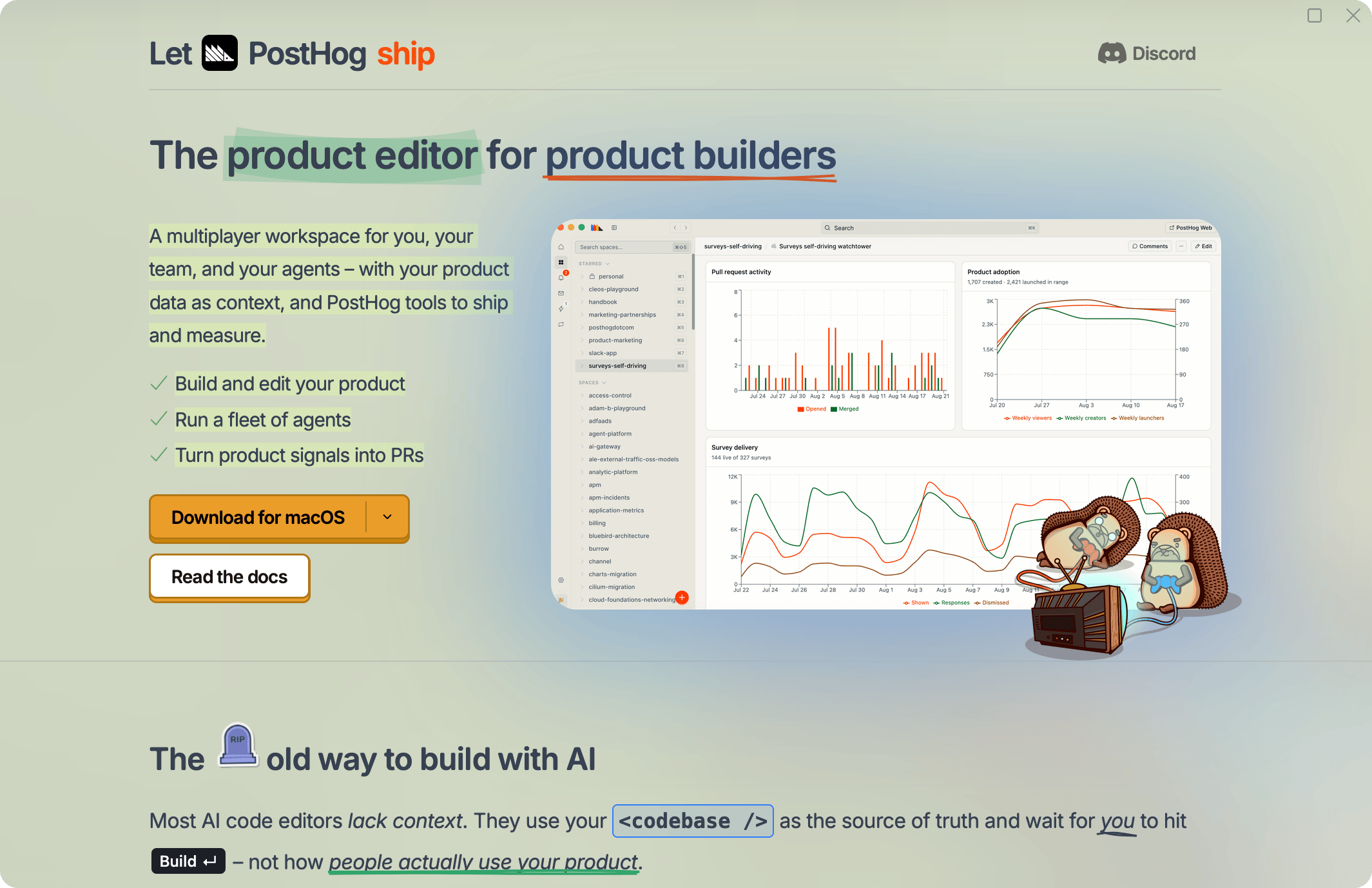
PostHog Desktop is an AI-powered product-development environment that connects coding agents with production context: analytics, errors, session recordings, feature flags, experiments, customer tickets and other product signals. Instead of receiving isolated coding prompts, agents can investigate observed problems, generate plans and produce pull requests inside a shared workspace.
The product serves software engineers and product teams already using AI coding tools but still manually connecting product data, issue trackers and code repositories. PostHog Desktop competes with Cursor, Claude Code, GitHub Copilot, OpenAI Codex, Windsurf and Devin, but differentiates itself through native access to PostHog’s broader customer-data and experimentation infrastructure.
The strongest investment signal is the existing company rather than the Product Hunt launch. PostHog reports adoption by more than 500,000 teams, maintains an active open-source repository, publishes substantial customer evidence and raised a $75 million Series E at a $1.4 billion valuation in September 2025. It is already a unicorn by the conventional private-market definition.
The central concern is valuation relative to verified financial performance. PostHog has not publicly disclosed current audited ARR, retention, gross margin or cash burn. A third-party estimate places ARR at $57.5 million in February 2026, but this is not company-verified. Desktop itself is also new, and it remains unclear whether it will produce substantial incremental revenue or primarily increase retention for PostHog’s existing products.
PostHog is a strong company with credible venture-scale economics and meaningful product differentiation. The decision is DD, not Invest, because current financing terms, verified revenue, cohort retention and unit economics remain unavailable.
Product Overview
PostHog Desktop is a downloadable application for macOS, Windows and Linux. It provides a multiplayer workspace where developers can run multiple coding agents, switch among models, maintain persistent project context and connect services through MCP integrations. The product converts production signals—such as errors, funnel abandonment or user feedback—into investigation reports and pull requests (product page; documentation).
The customer problem is context fragmentation. Generic coding agents understand a repository but do not automatically understand how customers use the application, which releases caused regressions or which product problems are commercially important. Teams currently bridge this gap manually through dashboards, Slack, Linear, GitHub, support tickets and engineering meetings.
Desktop is integrated with PostHog’s product analytics, replay, feature flags, experimentation, error tracking, logs, data warehouse and AI-observability products. This makes it more valuable to existing PostHog customers than to teams without PostHog instrumentation.
Pricing is usage-based. Each organization receives $20 of monthly Desktop AI usage, after which charges depend on the selected model and consumption (Desktop pricing documentation). PostHog’s broader pricing page provides large free allowances across its product suite; the company says 97% of companies use PostHog without paying.
Product-quality assessment: Strong product concept and integration architecture, but Desktop’s reliability, agent success rate and sustained usage are too new to assess independently.
Founder and Team Assessment
PostHog was founded in 2020 by James Hawkins and Tim Glaser as part of Y Combinator’s Winter 2020 batch. The company launched an MVP on Hacker News approximately four weeks after beginning development (PostHog history).
The founders offer complementary capabilities. Hawkins previously held a sales and channels leadership role at risk-intelligence company Arachnys, while Glaser worked in engineering there. PostHog’s subsequent growth demonstrates both technical execution and commercial competence. The company now describes both founders as co-CEOs.
PostHog reports approximately 200 employees in its public company history and operates as a remote organization. Its careers page listed 13 open positions at the time of research, including infrastructure and AI roles, supporting continued investment in product development.
Key-person risk is lower than at a seed-stage startup because PostHog has autonomous product teams and established operational infrastructure. However, the unconventional co-CEO structure and rapid expansion across many products warrant diligence around decision rights and organizational focus.
Founder Assessment: Strong technical-commercial pairing with demonstrated ability to build, distribute and finance a large developer-tools company.
Market Opportunity
The initial Desktop customer is a software-product team already using AI coding agents and collecting meaningful production telemetry. These teams want to reduce the manual work between identifying a product problem and safely deploying a fix.
A bottom-up scenario can be constructed from PostHog’s company-reported 500,000-team installed base:
- 500,000 registered teams
- 3% becoming meaningful paying organizations
- 15,000 paying organizations
- $10,000 average annual spend across analytics, infrastructure and AI execution
- Implied ARR: approximately $150 million
This is an analyst scenario, not reported revenue. The assumed conversion is directionally consistent with PostHog’s claim that 97% of companies use the platform for free, but “using for free” does not establish that all remaining organizations pay or have a $10,000 ACV.
Expansion opportunities include observability, data infrastructure, customer messaging, autonomous issue remediation and enterprise AI governance. The geographic market is global because the product is self-serve, developer-oriented and available on major desktop platforms.
The market can support a multibillion-dollar company. The constraint is execution across a broad suite, not aggregate demand.
Traction and Growth Signals
PostHog Desktop ranked #3 of the day on Product Hunt on August 26, 2026 and #7 for that week (daily leaderboard; weekly leaderboard). This is launch attention, not evidence of Desktop retention or revenue.
More material traction signals include:
- More than 500,000 teams using PostHog, according to the company.
- Named customer stories involving Y Combinator, Supabase and other technology businesses (customers).
- An active, publicly accessible GitHub repository with ongoing development.
- Multiple products with usage-based monetization and established production deployment.
- A current corporate objective of reaching $100 million ARR by the end of 2026, explicitly described as a target rather than achieved revenue (finance handbook).
- Approximately 1,000 G2 reviews with a roughly 4.5/5 rating, according to G2.
Sacra estimates $57.5 million ARR in February 2026, up approximately 99% year over year, but the number is a third-party estimate and should not be treated as verified.
Missing metrics include Desktop downloads, weekly active users, paid AI consumption, agent-task completion, pull-request acceptance, company-wide net revenue retention and current gross margin.
Traction Assessment: Strong company-level traction; Desktop-specific commercial adoption remains unproven.
Competitive Position
Direct Desktop competitors include Cursor, Windsurf, Claude Code, GitHub Copilot, Codex and Devin. Indirect competitors include Sentry, Datadog, Amplitude, Mixpanel, LaunchDarkly and manually assembled stacks involving analytics, observability and issue trackers.
PostHog’s central differentiation is integrated context. It owns or processes analytics events, replays, errors, flags, experiments, surveys and warehouse data. This allows agents to prioritize issues based on customer impact and evaluate results after deployment.
Distribution is also advantageous: PostHog can expose Desktop to its existing developer user base without paying to acquire every user independently. Open source, technical content, generous free tiers and transparent pricing reinforce its developer brand.
Switching costs increase as customers deploy SDKs, event taxonomies, experiments, pipelines and warehouse integrations. The moat is weaker for Desktop alone because foundational coding models are supplied by third parties and agent interfaces can be replicated.
If Microsoft/GitHub launched the same feature within six months, customers would continue using PostHog where its cross-platform telemetry, experimentation history and existing instrumentation provide better product context. Customers using only basic analytics would have less reason to stay.
Defensibility Assessment: Medium to High
Business Model and Economics
PostHog uses product-led, usage-based pricing. Free allowances attract startups and individual developers; revenue expands as event volume, session recordings, feature-flag requests, warehouse rows, logs and AI credits increase. Enterprise revenue can include annual commitments, volume discounts, support and advanced controls.
This model supports low-friction acquisition and natural account expansion. However, the claim that 97% of companies use the product for free indicates a deliberately broad top of funnel and potential infrastructure subsidy.
Variable costs include ClickHouse and cloud infrastructure, data storage, bandwidth, replay processing, support engineering and third-party AI inference. Desktop’s credit-based pricing should allow PostHog to pass through model costs, but margin by model and agent workload is not publicly disclosed.
Desktop has no App Store dependency because it is distributed directly. Payment-processing costs should be modest relative to infrastructure costs. Current CAC, payback, gross margin and net revenue retention are not publicly verified, although the company previously reported sub-two-month CAC payback during an earlier stage (company history).
Unicorn Path
PostHog already reached a company-reported $1.4 billion valuation in its Series E. Therefore, the path is established rather than hypothetical.
Using a 10× ARR multiple for a fast-growing, category-leading developer-infrastructure company:
Required ARR for a $1 billion valuation = $1 billion ÷ 10 = $100 million.
At an 8× multiple, required ARR would be $125 million. PostHog’s stated goal is $100 million ARR by the end of 2026, but achievement has not been verified.
If average annual revenue is:
- $10,000 per paying organization: 10,000 customers for $100 million ARR
- $25,000 per organization: 4,000 customers
- $100,000 enterprise ACV: 1,000 enterprise customers
Sustaining the valuation requires approximately 70% or better gross margin, durable retention and successful cross-selling across the product suite. Desktop strengthens the case if agent usage creates incremental high-margin revenue rather than merely increasing third-party inference costs.
Unicorn Path: Clear
Valuation Assessment
The latest verified financing was a $75 million Series E at a $1.4 billion valuation, led by Peak XV Partners with participation from existing investors. The preceding announced financing was $70 million at a $920 million valuation, led by Stripe with Y Combinator, GV and Formus Capital participating.
The September 2025 valuation is known, but its attractiveness cannot be responsibly determined without verified current ARR, growth, gross margin and retention. Using Sacra’s unverified $57.5 million ARR estimate would imply a roughly 24× valuation-to-ARR multiple, which is demanding but potentially defensible for near-100% growth. Because the denominator is not verified, this is not a reliable valuation conclusion.
Comparable businesses include Amplitude, Datadog, GitLab, Confluent and private AI developer-tool companies. Their multiples vary materially based on growth, margins and market conditions.
Valuation Attractiveness: Not Assessable
Required diligence includes current ARR, organic growth, NRR, gross margin by product, burn, runway, secondary pricing, current round terms, cap table and liquidation preferences.
Key Risks
- Valuation risk: The $1.4 billion price may already discount successful execution toward $100 million ARR.
- Product sprawl: Analytics, infrastructure, messaging, observability and coding agents could dilute focus.
- Desktop adoption: Existing PostHog usage does not guarantee developers will switch coding environments.
- AI commoditization: GitHub, Anthropic, OpenAI or Cursor could add similar production-context integrations.
- Inference economics: Heavy agent workloads may produce lower margins than core analytics.
- Infrastructure costs: High event, replay and log volumes require significant storage and compute.
- Free-to-paid conversion: A very generous free tier may support adoption without proportional monetization.
- Security exposure: Autonomous agents with repository and production-data access create material permission and supply-chain risks.
- Suite complexity: Bundling many products can increase onboarding friction and operational burden.
Final Assessment
Venture Potential: 90/100
| Category | Score |
|---|---|
| Market Size and Expansion Potential | 20/20 |
| Traction and Growth Evidence | 18/20 |
| Founder and Team | 15/15 |
| Product Strength | 9/10 |
| Distribution Potential | 14/15 |
| Business Model and Economics | 7/10 |
| Defensibility | 7/10 |
| Total | 90/100 |
The strongest elements are the installed base, founder execution, product-led distribution and expanding infrastructure platform. The weakest are valuation uncertainty, unverified current economics and Desktop’s early maturity.
Evidence Confidence: 76/100
Funding, valuation, founders, pricing, platforms, product activity and customer references are well documented through primary sources. Adoption and financial targets are company-reported. Current ARR is only available through third-party estimation. Retention, margins, burn, runway and Desktop-specific usage remain unavailable.
Final Decision: DD
PostHog is already an exceptional venture-scale company, and Desktop presents a logical expansion from measuring products to autonomously improving them. Formal diligence is justified. An investment recommendation is inappropriate until current financial performance and transaction terms are verified.
Upgrade Conditions
- Verified ARR and growth consistent with the $1.4 billion valuation.
- Company-level NRR above 120% and gross margin above 70%.
- Strong Desktop weekly retention and repeat agent usage.
- Evidence that generated pull requests are reviewed, merged and produce measurable improvements.
- Positive incremental margin after AI inference costs.
- Acceptable current financing or secondary terms.
Downgrade Conditions
- Material slowdown relative to the $100 million ARR objective.
- Desktop serving primarily as an expensive retention feature rather than a revenue product.
- Significant security incident involving repositories or customer data.
- Declining gross margin from AI and infrastructure costs.
- Incumbents neutralizing PostHog’s production-context advantage.
- Organizational complexity materially slowing core-product execution.
Questions for Further Diligence
- What are current ARR, monthly growth and organic growth excluding acquired or migrated revenue?
- How many organizations pay, and what are median and average ACV?
- What are gross revenue retention and NRR by customer segment?
- How many teams use Desktop weekly, and what are 30-, 90- and 180-day retention?
- What percentage of Desktop-generated pull requests are opened, reviewed and merged?
- What is Desktop revenue per active organization versus model and sandbox cost?
- What are company and product-level gross margins?
- Which acquisition channels produce paying customers, and what are CAC and payback?
- What are current burn, cash balance and runway after the Series E?
- How are autonomous-agent permissions, data isolation and repository security controlled?
- What are the current cap table, liquidation preferences and available financing or secondary terms?
- How will PostHog prevent product sprawl while competing across analytics, observability and coding agents?
Sources
- Product Hunt – PostHog
- Product Hunt daily leaderboard
- PostHog Desktop
- Desktop documentation
- Desktop pricing
- PostHog pricing
- Series E announcement
- Series D announcement
- Company and founder information
- PostHog customers
- PostHog GitHub repository
- Financial strategy and ARR target
- Sacra ARR estimate—secondary, unverified