
Table of Contents
Keiki Investment Report
Category: Customer-facing AI agents, conversational commerce, messaging infrastructure
Company Stage: Seed
Founder or Founders: Nizar “Nizzy” Abi Zaher and Adam Wazzan
Headquarters: San Francisco, California, United States
Funding: $2 million seed round announced in 2025; led by 1984 Ventures, with participation from Pioneer Fund, Y Combinator, and angel investors
Business Model: Subscription and usage-based B2B SaaS; public pricing not disclosed
Product Hunt Launch Date: September 1, 2026
Report Date: September 4, 2026
| Investment Metric | Assessment |
|---|---|
| Venture Potential | 64/100 |
| Unicorn Path | Conditional |
| Valuation Attractiveness | Not Assessable |
| Evidence Confidence | 55/100 |
| Final Decision | Watch |
Executive Summary
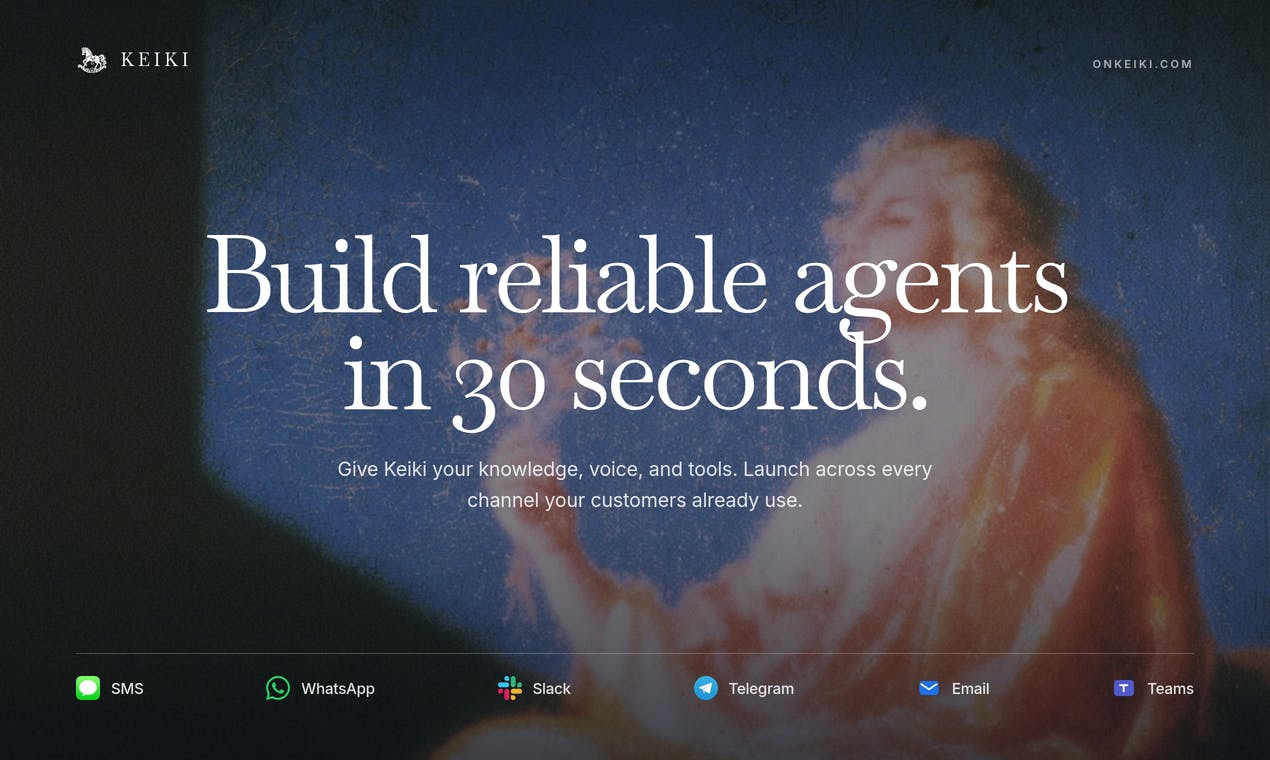
Keiki is a platform for building one customer-facing AI agent and deploying it across SMS, iMessage/RCS, WhatsApp, Slack, Telegram, email, and API endpoints. It provides the surrounding infrastructure—memory, messaging, tool execution, background jobs, observability, approvals, billing, and human escalation—rather than only a chatbot interface (Keiki launch article, Product Hunt).
The product is operated by Zero Email, Inc., now branded around Orchid, an AI personal assistant delivered through messaging. Founders Nizar Abi Zaher and Adam Wazzan initially built an open-source AI email client, pivoted it into the Orchid assistant, and then commercialized the underlying agent infrastructure as Keiki. The company is a Y Combinator-backed seed startup with a small San Francisco team (Y Combinator, Orchid privacy policy).
Keiki’s strongest signal is that the infrastructure was developed for an operating consumer product rather than solely as a platform demonstration. Orchid reports hundreds of thousands of processed emails and actions, while the founders state that Keiki is already managing more than one million messages monthly. However, these are company-reported operational metrics; it is unclear how much usage comes from Orchid itself rather than third-party Keiki customers (Orchid, founder launch post).
The most important concern is insufficient commercial validation. Public pricing is unavailable, no independent customer references were found, and the company has not disclosed revenue, paying-customer count, retention, gross margin, or customer acquisition economics. Keiki also enters a heavily financed category containing Sierra, Decagon, Intercom, Voiceflow, Botpress, and major cloud and CRM platforms.
The final decision is Watch. The market and product architecture are potentially venture-scale, but Keiki is too early and commercially opaque for formal diligence today. Evidence of third-party customer adoption, retention, safe autonomous execution, and attractive unit economics would upgrade the decision to DD.
Product Overview
Businesses increasingly want AI to answer customer questions and complete tasks, but deploying an agent across messaging channels requires more than connecting an LLM. Teams must handle channel APIs, identity, persistent memory, background work, tool permissions, failure recovery, approvals, escalation, analytics, and billing.
Keiki lets a team define an agent’s purpose, knowledge, behavior, memory, tools, and safety boundaries once. The same agent can then operate across multiple messaging channels. Its reported capabilities include:
- SMS, iMessage/RCS, WhatsApp, Slack, Telegram, and email deployment.
- OpenAI- and Anthropic-compatible API endpoints.
- Knowledge retrieval and persistent customer memory.
- Browser automation, MCP servers, HTTP integrations, and custom tools.
- Background and recurring workflows.
- Human approval before sensitive actions.
- Human handoff when judgment is required.
- A unified inbox, contact history, usage metrics, error monitoring, and step-level execution traces.
- Visual configuration or code-based agent definition.
- Hosted deployment or self-hosting for customers needing greater control.
Keiki is aimed at founders, product teams, customer-experience teams, and developers building agents that do more than answer static FAQs. Potential workflows include order lookup, appointment scheduling, lead qualification, travel booking, claims intake, and customer support (official launch article).
Public pricing is not disclosed. Keiki’s terms state that paid plans and usage charges appear at checkout or inside the account, preventing independent assessment of annual contract value or price competitiveness (Keiki terms).
Product Quality: Broad and thoughtfully designed for operating agents across channels, but reliability and safe action execution have not been independently validated.
Founder and Team Assessment
Y Combinator identifies Orchid’s founders as Nizar Abi Zaher and Adam Wazzan and reports a three-person team in San Francisco (Y Combinator). LinkedIn displays approximately five associated company profiles, creating a modest headcount discrepancy. The YC figure is used because it identifies a specific operating team, although current headcount should be confirmed.
Abi Zaher’s profile reports prior engineering work at Cal.com and experience managing a restaurant operation. This combination provides relevant exposure to scheduling infrastructure and operational customer workflows, although the claims are largely founder-reported through LinkedIn (Abi Zaher profile). Public information about Wazzan’s detailed professional history is more limited.
The company has demonstrated technical breadth through the previous open-source Zero email product, Orchid’s connected-tool assistant, and Keiki’s multi-channel runtime. The original Zero repository provides tangible evidence of shipping capability, though Keiki’s core platform code is not publicly available (Zero GitHub).
The company’s rapid evolution—from AI email client to personal assistant to B2B agent infrastructure—shows adaptability but also creates focus risk. Investors should determine whether Keiki is a decisive platform strategy or another experiment alongside Orchid.
Founder Assessment: Strong early product velocity and relevant technical capability, but limited scaling history and repeated positioning changes increase execution risk.
Market Opportunity
Keiki’s narrow initial market is technology-enabled SMBs and mid-market service businesses that receive substantial customer communication through messaging and need agents capable of completing transactions.
A reasonable bottom-up scenario—not a verified company forecast—is:
- 100,000–250,000 potential businesses globally with sufficient message volume and integration complexity;
- $3,000–$12,000 annual Keiki revenue per business, depending on seats, channels, messages, and model use;
- Implied addressable annual revenue of approximately $300 million–$3 billion.
The lower end assumes small-team pricing comparable to agent-building platforms such as Botpress, whose paid plan starts at $150 monthly, while higher contract values require enterprise-grade workflow execution, governance, and support (Botpress pricing). Intercom’s Fin charges $0.99 per successful outcome, illustrating willingness to pay for measurable support automation rather than raw message volume (Intercom pricing).
Adjacent opportunities include vertical agents for healthcare, travel, real estate, financial services, restaurants, and e-commerce; transaction fees; developer infrastructure; and reusable agent templates. International expansion is technically plausible because WhatsApp and Telegram are already supported, but language quality, channel regulation, and local data requirements create additional complexity.
The market can support venture-scale businesses, as demonstrated by Decagon’s January 2026 $250 million financing at a $4.5 billion valuation. That validates investor demand for AI customer-service agents but also highlights the intensity and capitalization of the competitive field (Decagon announcement).
Traction and Growth Signals
Keiki ranked fifteenth on Product Hunt on September 1, 2026 (daily leaderboard). This is modest launch attention and should not be interpreted as product-market fit.
More substantive but still company-reported signals include:
- More than one million messages reportedly managed each month by the Keiki infrastructure.
- Orchid’s website displaying over 232,000 processed emails and approximately 798,000 logged actions at the time reviewed.
- Almost one year spent developing the runtime through Orchid before Keiki’s external launch.
- A $2 million seed round announced by the company, led by 1984 Ventures with participation from Pioneer Fund, Y Combinator, and angels (Orchid LinkedIn).
- Continued product releases covering integrations, recurring workflows, carousels, browser access, and messaging-based experiences (Orchid blog).
The one-million-message figure does not identify unique users, paying customers, third-party businesses, or revenue. It may substantially reflect Orchid’s own consumer assistant. No independent Keiki case study, marketplace review base, or named enterprise customer was found.
The most important missing metrics are paying businesses, external versus internal message volume, monthly recurring revenue, customer cohorts, gross retention, agent-resolution rate, human-escalation rate, and cost per successful action.
Traction Assessment: Meaningful infrastructure usage is claimed, but independent commercial traction is not yet demonstrated.
Competitive Position
Direct competitors include:
- Voiceflow, which provides visual development and deployment for customer-experience agents.
- Botpress, which offers an agent-building platform with free and paid plans.
- Sierra, which prices enterprise customer-service agents around successful outcomes.
- Decagon, an enterprise AI customer-experience platform.
- Intercom Fin, which combines AI support with an established help-desk distribution channel.
- Microsoft Copilot Studio, Salesforce Agentforce, and other existing enterprise platforms capable of bundling agent functionality.
Indirect and free alternatives include direct LLM APIs, open-source agent frameworks, workflow tools, channel-specific bots, and manually staffed customer-support inboxes.
Keiki’s differentiation is its “one agent, many channels” architecture, particularly inclusion of iMessage alongside conventional business channels. Its combination of durable memory, background work, tool execution, human approvals, and inspectable traces also goes beyond simple chatbot builders.
However, switching costs are initially limited. Customers may retain their knowledge and tools outside Keiki, and the product supports standard APIs intended to make integration easy. There is no verified network effect, proprietary model, or unique dataset.
If the largest customer-service platform launched equivalent multichannel agents within six months, customers would continue using Keiki only if it offered faster deployment, better action completion, superior cross-channel memory, lower total cost, or access to channels competitors could not reliably support. Public evidence does not yet establish those advantages.
Defensibility Assessment: Low-Medium
Business Model and Economics
Keiki appears to use paid plans plus usage-based charges, but pricing, included message volume, and model-cost treatment are not public. Plausible revenue components include:
- Platform subscriptions.
- Usage charges per message, agent run, or task.
- Model-inference pass-through and markup.
- Channel charges for SMS and WhatsApp.
- Premium integrations and governance.
- Enterprise support or private deployment.
Variable costs are potentially significant. Keiki uses external providers including OpenAI, Anthropic, Google Vertex AI, OpenRouter, Composio, Convex, Cloudflare, and Linq (privacy policy). It must cover model inference, browser execution, memory storage, messaging transport, integration fees, and support.
For context, Twilio charges from $0.0083 to send or receive an SMS and $0.005 per WhatsApp message before applicable Meta charges (Twilio pricing, WhatsApp pricing). Long agent conversations can therefore accumulate both channel and model costs.
The relevant economic metric is contribution margin per resolved workflow, not gross message volume. Enterprise customers may produce attractive expansion revenue as they add channels and use cases, but only if Keiki controls inference and support costs.
Unicorn Path
An 8× ARR multiple is assumed for a high-growth agent-platform company with strong retention, improving margins, and material recurring software revenue.
Required ARR = $1 billion ÷ 8 = approximately $125 million.
Illustrative paths include:
- 41,700 small businesses at $3,000 ARR.
- 10,400 mid-market customers at $12,000 ARR.
- 2,500 enterprise customers at $50,000 ARR.
- A blended model combining subscriptions, usage, and successful-transaction fees.
The first route requires extremely efficient self-service distribution. The enterprise route requires security certifications, reliability commitments, extensive integrations, and a larger sales and customer-success organization.
Keiki would also need to develop durable vertical expertise or proprietary cross-channel operating data. Remaining a general-purpose agent builder would expose it to feature commoditization and well-capitalized competitors.
Unicorn Path: Conditional
Valuation Assessment
The company announced a $2 million seed round led by 1984 Ventures with participation from Pioneer Fund, Y Combinator, and angel investors. The exact close date is reported inconsistently across company posts and secondary databases, but sources generally place the financing in 2025.
No reliable public information was found regarding the post-money valuation, SAFE cap, investor ownership, current fundraising status, or later financing. Revenue is also undisclosed.
Valuation Attractiveness: Not Assessable
Assessment requires current ARR, growth, gross and net retention, gross margin, customer concentration, burn, runway, cap table, round size, valuation, option pool, and liquidation preferences.
Key Risks
- No verified external customer traction: Message volume may largely originate from Orchid.
- Intense competition: Well-funded agent platforms and incumbent help desks have stronger enterprise distribution.
- Strategic focus: The company has moved from Zero to Orchid to Keiki in a short period.
- Low switching costs: Standard APIs and common integrations make migration relatively easy.
- Safety and liability: Agents can send messages, make bookings, access business tools, and potentially initiate transactions.
- Gross-margin pressure: Inference, browser execution, channel charges, and support costs increase with usage.
- Platform dependency: iMessage, WhatsApp, Google, Slack, and other platforms can change access or compliance rules.
- Sensitive-data exposure: Agents may handle email, calendars, billing, healthcare, and customer records.
- Small-team execution risk: Supporting multiple channels and enterprise reliability is operationally demanding.
- Unclear willingness to pay: Public pricing and conversion data are unavailable.
Final Assessment
Venture Potential: 64/100
| Category | Score |
|---|---|
| Market Size and Expansion Potential | 18/20 |
| Traction and Growth Evidence | 8/20 |
| Founder and Team | 11/15 |
| Product Strength | 8/10 |
| Distribution Potential | 8/15 |
| Business Model and Economics | 6/10 |
| Defensibility | 5/10 |
| Total | 64/100 |
The market, product architecture, and founder velocity are the strongest elements. Commercial validation, distribution, defensibility, and unit economics are the weakest.
Evidence Confidence: 55/100
The founders, legal entity, YC participation, seed financing announcement, product functionality, privacy policy, and underlying Zero repository are publicly documented. Message and activity volumes are company-reported. Pricing, revenue, customers, retention, margins, headcount, burn, and valuation remain unavailable.
Final Decision: Watch
Keiki is promising but insufficiently validated for formal diligence. The product solves a real infrastructure problem, but the public record does not yet prove that unrelated businesses will adopt and retain it at commercially attractive prices.
Upgrade Conditions
- At least $1 million ARR from external Keiki customers.
- Ten or more referenceable businesses using Keiki in production.
- More than 70% six-month logo retention.
- Gross margin above 65% after model, browser, and channel costs.
- Evidence that Keiki resolves or completes more than 50% of targeted workflows without human intervention.
- A repeatable self-service or partner-led acquisition channel.
- Enterprise security documentation and an independent penetration test.
- Clear commitment to Keiki as the company’s primary strategy.
Downgrade Conditions
- External customers represent only a small share of message volume.
- High failure or human-escalation rates.
- Gross margins deteriorate as agents use more tools and longer contexts.
- Another major strategic pivot before Keiki establishes retention.
- Loss of iMessage, WhatsApp, or other critical channel access.
- Material privacy, security, unauthorized-action, or data-isolation incident.
- Major customer platforms bundle equivalent functionality at lower cost.
Questions for Further Diligence
- How many businesses pay for Keiki, and how many are unrelated to the founders or investors?
- What percentage of the reported one million monthly messages comes from Orchid versus third-party agents?
- What are Keiki’s current MRR, monthly growth, and average revenue per customer?
- What are 30-, 90-, and 180-day customer retention rates?
- What percentage of agent conversations results in successful resolution, human escalation, or failure?
- What is gross margin after model, browser, messaging, storage, and integration expenses?
- How are subscriptions and usage priced, and what is the expected annual contract value by segment?
- Which acquisition channels have generated paying customers, and what are CAC and payback?
- How are unauthorized actions, prompt injection, account compromise, and cross-customer data leakage prevented?
- What drove the transitions from Zero to Orchid and from Orchid to Keiki, and which product is now the primary focus?
- What are current headcount, monthly burn, cash balance, and runway?
- What are the fully diluted cap table, latest valuation, and proposed financing terms?
Sources
- Keiki on Product Hunt
- Product Hunt leaderboard—September 1, 2026
- Official Keiki launch article
- Keiki website
- Orchid website
- Orchid on Y Combinator
- Orchid privacy policy
- Zero open-source repository
- Nizar Abi Zaher’s LinkedIn profile
- Orchid LinkedIn company page
- Botpress pricing
- Intercom pricing
- Decagon financing announcement