
Table of Contents
Monid Investment Report
Category: AI-agent infrastructure / API and tool marketplace
Company Stage: Pre-seed
Founder or Founders: Feiyou Guo; Shengkun Ye
Headquarters: San Francisco, California
Funding: $2.1 million pre-seed, company-reported and corroborated by secondary coverage
Business Model: Usage-based marketplace; per-call or per-result tool charges
Product Hunt Launch Date: September 2, 2026
Report Date: September 5, 2026
| Investment Metric | Assessment |
|---|---|
| Venture Potential | 63/100 |
| Unicorn Path | Conditional |
| Valuation Attractiveness | Not Assessable |
| Evidence Confidence | 48/100 |
| Final Decision | Watch |
Executive Summary
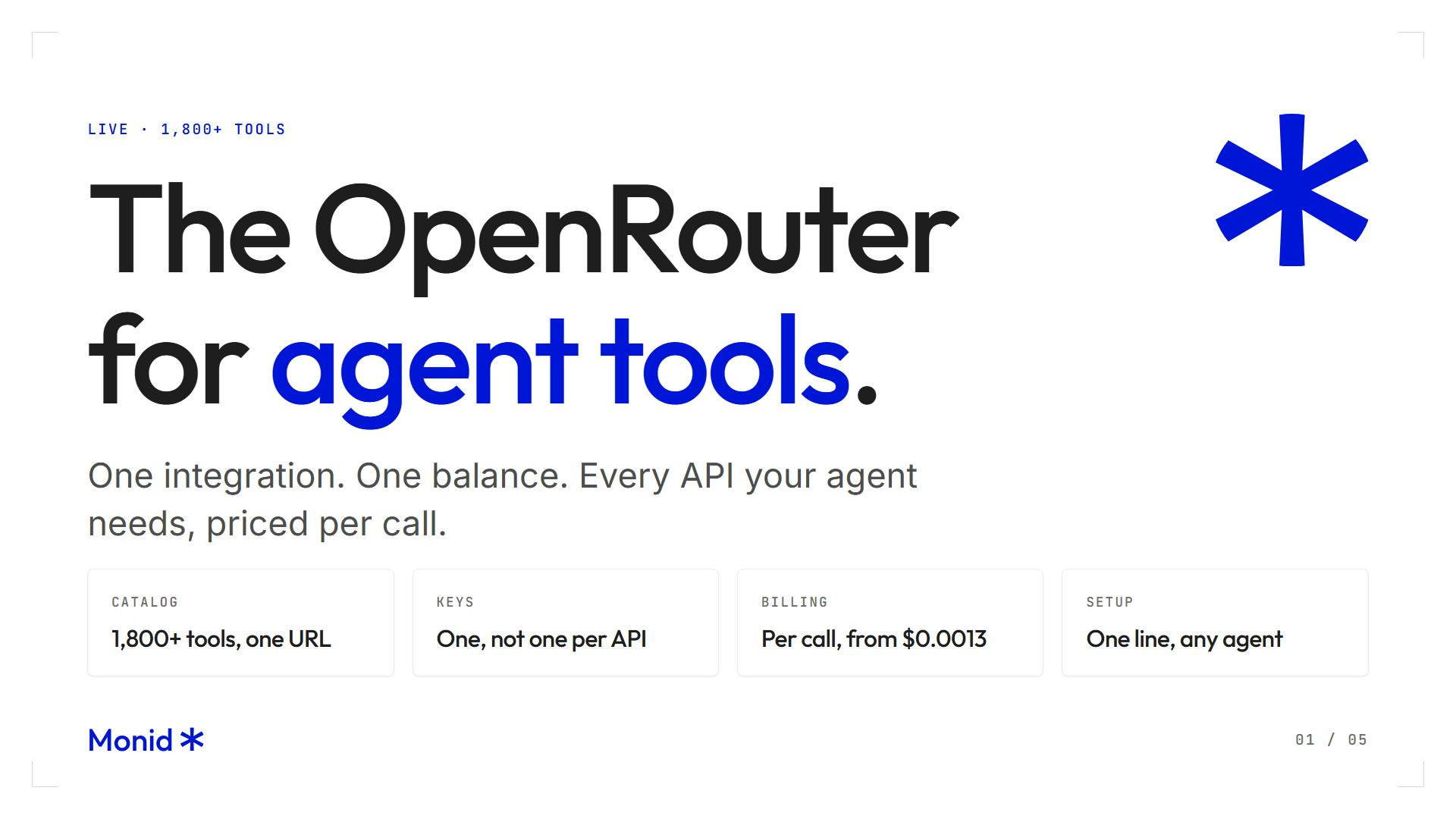
Monid provides a unified discovery, execution, and payment layer through which AI agents can access external APIs and tools. Instead of developers maintaining separate accounts, subscriptions, credentials, and billing relationships, an agent can search Monid’s catalog, inspect pricing and schemas, execute a tool, and pay from one balance. The product supports MCP, agent skills, a CLI, an HTTP API, and OAuth integrations (documentation).
The product addresses a credible developer pain point: agents increasingly need search, data, scraping, media-generation, communications, and workflow tools, but connecting and paying for each provider individually creates integration overhead. Monid’s pay-per-use model is particularly relevant for low-frequency tools whose direct subscriptions are uneconomic. Official materials claim access to 1,700-plus tools, while the Product Hunt and funding materials use 1,800-plus; the discrepancy is minor but indicates that catalog statistics are changing rapidly and are not independently audited (website, Product Hunt, funding coverage).
The strongest investment signal is the combination of rapid product development, technically relevant founders, and early usage claims. Co-founder Shengkun Ye reported that Monid crossed four million agent transactions, while earlier posts described approximately 400,000 transactions and a growing user base. These are founder-reported operational figures—not independently verified revenue, customers, or paid transaction volume—and may include free or very inexpensive calls (founder profile and activity).
The central concern is monetization quality. Monid has not publicly disclosed revenue, take rate, gross margin, paying customers, retention, transaction value, supplier economics, or customer concentration. Millions of calls priced at fractions of a cent can still produce little net revenue. The model could also face margin pressure from API suppliers, payment costs, fraud, support, and competing integration platforms.
Product quality appears promising; company quality is encouraging but young; the venture case remains commercially unverified. A unicorn outcome is possible only if Monid becomes a high-volume infrastructure and commerce layer rather than a convenient API reseller. The appropriate decision is Watch, with an upgrade to DD after verified monetization, retention, and gross-margin evidence.
Product Overview
Monid targets developers and teams building agents that need capabilities not contained in the underlying language model. Its workflow has three steps: discover tools relevant to a task, inspect schemas and prices, and execute the selected endpoint. Monid handles payment and fulfillment between the agent and provider (official documentation).
Core access methods include:
- A hosted MCP endpoint for compatible clients.
- An installable agent skill.
- A TypeScript CLI.
- A direct HTTP API.
- OAuth for platforms acting on behalf of users.
Pricing is usage-based. Endpoints charge either a flat amount per call or a base fee plus a price per returned result. The website offers $1 of initial credit, but Monid does not publish a platform-wide markup, provider revenue share, minimum spend, or enterprise plan (pricing documentation).
The primary benefit is reduced integration and procurement friction. Monid replaces separate API registrations, keys, subscriptions, and billing accounts with one catalog and balance. It is currently a developer infrastructure product rather than an app-store product; no relevant mobile listing was identified.
The product is documented and has public CLI and example-skill repositories, although this research did not independently execute paid endpoints. The open-source example-skills repository currently highlights investor-sourcing and job-finding workflows and uses the MIT license (GitHub skills repository, CLI repository).
Founder and Team Assessment
Feiyou Guo is a former Amazon software engineer with a University of Washington background in computer science and biology. His profile shows previous development projects and founder experience, supporting technical founder-market fit.
Shengkun Ye previously worked in product roles at TabaPay, Deserve, WeChat, and DiDi. His stated experience includes API products, payments, risk, user growth, and financial infrastructure—relevant to a metered agent-commerce platform.
Both profiles show Monid commitments beginning in April 2026 and affiliations with Founders, Inc. LinkedIn lists three associated employees and a company-size band of 2–10, but exact full-time headcount is not verified (company profile). Founder posts indicate hiring for a first founding engineer, suggesting a small, founder-dependent team.
No previous exits were found. Technical and product capability appear credible, while enterprise sales, marketplace operations, security leadership, and scaled commercial execution remain unproven.
Founder Assessment: Complementary technical, product, and payments experience, but limited evidence of prior company-building at scale.
Market Opportunity
The initial segment is developers and small AI-agent teams that require multiple external data or generation APIs but lack the usage volume or engineering resources to justify direct integrations.
Public evidence does not support a reliable estimate of this segment’s customer count or average annual spend. A scenario analysis is therefore more responsible than a claimed market size:
- 100,000 active business accounts
- $5,000 average annual tool spend per account
- $500 million annual marketplace volume
- 20% assumed platform take rate
- $100 million net annual revenue
The 20% take rate is an analyst assumption, not Monid’s disclosed economics. As a reference point, RapidAPI states that it charges providers a 25% marketplace fee, demonstrating that substantial marketplace fees can exist but not that Monid can sustain the same rate (RapidAPI provider terms).
Expansion opportunities include enterprise governance, usage controls, routing optimization, consolidated invoicing, provider analytics, API monetization, and international developer adoption. The opportunity can support venture-scale revenue, but only if agent tool consumption becomes recurring and large enough to overcome low per-call prices.
Traction and Growth Signals
The latest Product Hunt launch received approximately 460 points and ranked first for September 2, 2026; it was Monid’s third launch (Product Hunt). One visible testimonial described frequent use and time savings, but this is anecdotal and does not establish retention or broad satisfaction.
Founder-reported milestones include more than four million agent transactions and earlier rapid growth from approximately 400,000 transactions. These figures are directionally encouraging but lack definitions, date-normalized growth data, paid/free segmentation, transaction value, or third-party verification (Shengkun Ye).
Monid announced a $2.1 million pre-seed round involving 1984 Ventures, Llama Ventures, Untapped Capital, and Founders, Inc. Secondary coverage dates the financing to September 1, 2026; founder profiles identify the same investors (funding coverage, 1984 Ventures portfolio).
Revenue, paying customers, active accounts, retention, website traffic, gross merchandise volume, and post-launch cohorts are not publicly disclosed.
Traction Assessment: High early activity by company report, but commercially unverified.
Competitive Position
Direct and adjacent competitors include Composio, Arcade, Pipedream Connect, RapidAPI, and MCP registries. Pipedream advertises 2,700-plus integrations for apps and agents, while Arcade emphasizes authenticated, governed enterprise actions and offers deployment options including private cloud and on-premises environments (Pipedream Connect, Arcade). Composio has announced $29 million in funding, demonstrating substantial investor interest in agent integration infrastructure (Composio announcement).
Indirect alternatives include direct provider APIs, custom integrations, open-source MCP servers, and free API registries. Large agent platforms could bundle discovery, authentication, billing, or preferred-provider routing.
Monid’s current differentiation is dynamic tool discovery plus unified pay-per-call purchasing—not merely preconfigured integrations. Its potential moat would come from provider breadth, routing data, negotiated pricing, transaction history, reliability scoring, and becoming the default agent wallet.
However, switching costs appear low today. Developers can replace Monid with direct APIs or competing runtimes, and the public interfaces reduce migration friction. If a major agent platform launched equivalent discovery and consolidated billing within six months, customers would remain only if Monid offered materially broader supply, lower prices, better routing, or superior reliability. None of these advantages is yet independently established.
Defensibility Assessment: Low to Medium
Business Model and Economics
Monid appears to collect prepaid funds and charge per tool execution or result. Its platform take rate and provider payout structure are not disclosed.
Gross-margin potential depends on whether Monid receives wholesale discounts or adds a markup to provider costs. Material variable costs include supplier fees, cloud infrastructure, payment processing, refunds, fraud, observability, and support. Unlike a pure SaaS model, increasing usage may increase costs almost proportionally unless routing economics or volume discounts improve the spread.
Enterprise controls, budgets, audit logs, service-level guarantees, and consolidated billing could generate higher-margin subscription revenue. No such pricing is currently disclosed.
Critical unknowns are net revenue versus gross billings, gross margin by provider, prepaid-credit breakage, provider concentration, customer acquisition cost, and whether usage persists after promotional credits.
Unicorn Path
A 10× net-revenue multiple is assumed for a high-growth infrastructure marketplace with strong retention and attractive margins. This is an analytical assumption, not a current market valuation.
Required net revenue = $1 billion ÷ 10 = approximately $100 million annually.
Illustrative requirements:
- At a 20% take rate: approximately $500 million annual tool spend.
- At $5,000 annual spend per business account: approximately 100,000 active paying accounts.
- At a 10% take rate: required tool spend doubles to $1 billion.
- At only $500 annual spend per account and a 20% take rate: approximately one million paying accounts would be required.
To reach this scale, Monid would likely need enterprise customers, recurring production workloads, international supply, negotiated provider economics, governance features, and proprietary routing or reliability data. Merely expanding the catalog will not be sufficient.
Unicorn Path: Conditional
Valuation Assessment
The $2.1 million pre-seed amount and participating investors are disclosed, but the SAFE cap, post-money valuation, ownership sold, liquidation terms, and current fundraising status are not public. Revenue and growth are also unknown.
Valuation Attractiveness: Not Assessable
Assessment requires current ARR or net revenue, monthly growth, gross billings, take rate, gross margin, retention, burn, runway, round structure, post-money valuation, investor ownership, and liquidation preferences. Product quality or Product Hunt performance cannot support a responsible valuation range.
Key Risks
- Transaction volume may generate negligible net revenue.
- Retention and paid conversion are undisclosed.
- Tool suppliers or agent platforms may bypass Monid.
- Pipedream, Composio, Arcade, and large platforms can bundle overlapping functionality.
- Low switching costs and limited present defensibility.
- Supplier pricing, outages, or policy changes could compress margins.
- Security, credential handling, data provenance, and unauthorized agent spending create enterprise risks.
- Catalog claims vary between 1,700 and 1,800-plus tools.
- The small team creates execution and key-person risk.
- Product Hunt and social-media attention may not translate into durable distribution.
Final Assessment
Venture Potential: 63/100
| Category | Score |
|---|---|
| Market Size and Expansion Potential | 15/20 |
| Traction and Growth Evidence | 11/20 |
| Founder and Team | 12/15 |
| Product Strength | 8/10 |
| Distribution Potential | 9/15 |
| Business Model and Economics | 5/10 |
| Defensibility | 3/10 |
| Total | 63/100 |
The strongest elements are a timely product, credible founder-market fit, broad integration ambition, and reported transaction activity. The weakest are unverified commercial traction, undisclosed economics, and limited evidence of durable defensibility.
Evidence Confidence: 48/100
Product functionality, founders, headquarters, funding announcement, documentation, pricing mechanism, and public repositories are reasonably verified. Tool count and transaction volume are company-reported. Market sizing and unicorn economics are analyst scenarios. Revenue, retention, margins, customers, cap table, burn, runway, and valuation remain unavailable.
Final Decision: Watch
Monid is potentially venture-backable, but public evidence does not yet justify formal underwriting. The product is promising and the team is relevant; the company must demonstrate that transactions produce recurring, high-margin net revenue and that distribution extends beyond launch-driven attention.
Upgrade Conditions
- Verified net revenue and at least six months of monthly growth.
- Cohort evidence showing strong 90- and 180-day retention.
- Meaningful recurring spend from production agent workloads.
- Gross margin above 60%, with a credible path above 70%.
- Multiple enterprise or platform customers.
- A defensible routing, pricing, data, or supplier advantage.
- Transparent financing terms and sufficient runway.
Downgrade Conditions
- Transaction growth without corresponding net revenue.
- Weak repeat usage after free credits.
- Material supplier concentration or margin compression.
- Major platform replication that removes the need for Monid.
- Security, privacy, billing, or unauthorized-spending incidents.
- Declining product activity or founder disengagement.
- Materially misleading traction or catalog claims.
Questions for Further Diligence
- What are current monthly net revenue, gross billings, and month-over-month growth?
- How many funded, paying, and monthly active accounts exist?
- What proportion of the four million reported transactions were paid, free, test, or internal calls?
- What are 30-, 90-, and 180-day account and spend retention?
- What are the average take rate and gross margin by provider category?
- How concentrated are transactions and gross profit among the top five customers and providers?
- What safeguards prevent prompt injection, data leakage, and unauthorized agent spending?
- Which acquisition channels produce retained paying users, and at what CAC?
- What are monthly burn, cash balance, and runway after the pre-seed round?
- What is the team structure, and are both founders working full-time?
- What were the pre-seed valuation, security type, dilution, and material investor rights?
- What proprietary routing, reliability, pricing, or transaction data can produce a defensible advantage?