
Table of Contents
Dial Investment Report
Category: Communications infrastructure for AI agents
Company Stage: Seed-stage company; recently pivoted product
Founder or Founders: Gal Dayan is publicly identified as Dial’s founder; Dial is built by Genway, originally founded by Gal Dayan, Natan Voitenkov, and Omri Ben-Shoham
Headquarters: San Francisco, California, with operations in Tel Aviv
Funding: Genway raised a $6 million seed round; no Dial-specific round disclosed
Business Model: Usage-based communications API plus committed-volume enterprise agreements
Product Hunt Launch Date: September 2, 2026
Report Date: September 5, 2026
| Investment Metric | Assessment |
|---|---|
| Venture Potential | 64/100 |
| Unicorn Path | Conditional |
| Valuation Attractiveness | Not Assessable |
| Evidence Confidence | 57/100 |
| Final Decision | Watch |
Executive Summary
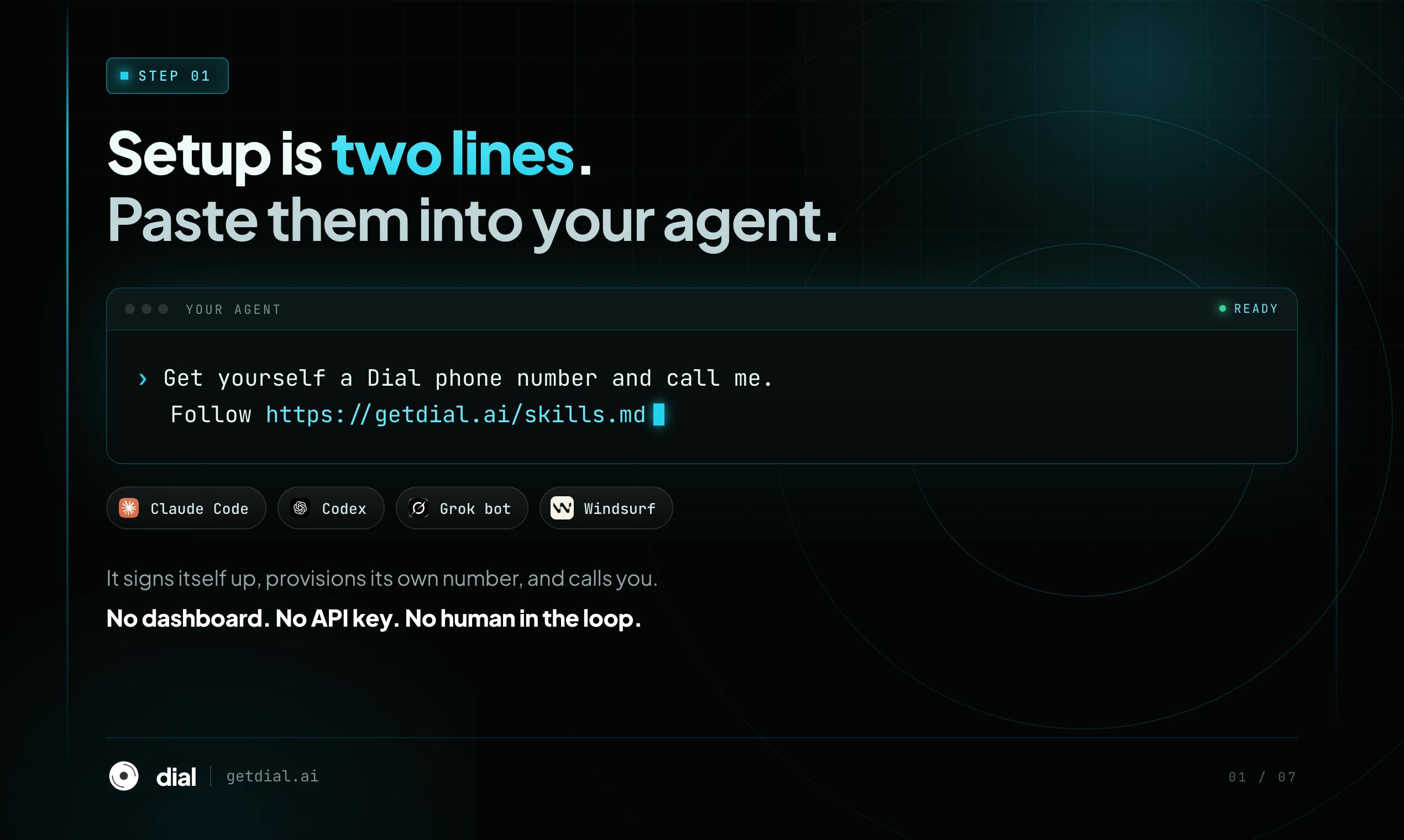
Dial provides programmable phone numbers and communications infrastructure for AI agents. Through a REST API, MCP server, CLI, or SDK, an agent can provision a number and place or receive voice calls, send or receive SMS, and use iMessage. Dial combines these channels in a unified webhook and offers either customer-hosted AI logic or a managed voice-agent service (official website, documentation).
The initial customer is a developer or AI-native company building agents that must interact with people or phone-gated services. Dial attempts to remove telecom complexity—number procurement, channel-specific APIs, transcription, carrier registration, and webhook management—while exposing the resulting infrastructure in formats that coding agents can configure themselves.
The strongest positive investment signal is the underlying team and financing history. Dial is operated by Genway Inc and Genway Israel Ltd. Genway previously raised a $6 million seed round co-led by JBV Capital and Andreessen Horowitz’s Speedrun, with angel participation, and the team has relevant experience in conversational AI, enterprise sales, data infrastructure, and voice products (CS Angel funding announcement, a16z Speedrun profile).
The main concern is that Dial is a recent pivot from Genway’s AI-moderated user-research product. No Dial revenue, usage volume, paying-customer count, retention, gross margin, or enterprise contracts are publicly disclosed. Its product sits between commoditized carrier APIs and well-funded voice-agent platforms, while also carrying significant regulatory, fraud, privacy, and platform-dependency risks.
Product quality appears credible and unusually agent-native; company quality benefits from experienced technical founders and existing capital. However, venture-scale economics and defensibility remain unverified. The appropriate decision is Watch, pending evidence that Dial’s launch activity converts into recurring production traffic and attractive gross profit.
Product Overview
AI agents can operate software through APIs but often cannot independently acquire a phone number, receive a verification code, call a person, or maintain conversations across voice and messaging channels. Developers can assemble these capabilities from communications providers, speech vendors, models, and custom webhooks, but this introduces multiple vendors and compliance requirements.
Dial packages the workflow into one communications layer. Its principal capabilities include:
- API-based provisioning of US, Canadian, and international numbers.
- Inbound and outbound voice calls.
- Real-time transcription and text-to-speech responses.
- Two-way SMS in more than 200 countries.
- iMessage with RCS or SMS fallback.
- Beta WhatsApp support.
- A unified webhook for calls and messages.
- REST, MCP, CLI, Node.js, and Python integration paths.
The current public pricing is usage-based: $3 per number per month, US SMS from $0.02 per message, self-hosted calls from $0.13 per minute, and managed calls from $0.22 per minute. An iMessage-enabled number costs $250 per month. Every account receives $5 of credit, while enterprise pricing is negotiated against committed volume (pricing).
The product is technically documented, and recent release notes show active development, including WhatsApp lines, group conversations, and expanded message-channel controls (September 3 release notes). Public GitHub repositories provide implementation examples and a chat-SDK adapter, though public repository activity is not evidence of commercial adoption (GitHub organization).
There are notable documentation conflicts. The June terms describe a $20 monthly flat-fee option and WhatsApp-oriented service, while the current pricing page uses $3 per number plus usage and the main website emphasizes iMessage. The current pricing page is used for this report, but the legal and commercial documents should be synchronized (terms).
Product Quality Assessment: Strong developer experience and broad channel coverage, with unresolved reliability, compliance, and documentation-consistency questions.
Founder and Team Assessment
Gal Dayan identifies himself as Dial’s founder in the Product Hunt launch. His public background includes serving as Genway’s co-founder and CTO, R&D manager and early engineer at Justt, and software leadership in an Israeli military technology unit. His experience covers scalable infrastructure, security, machine learning systems, DevOps, and enterprise applications (Gal Dayan, Product Hunt).
Genway was originally co-founded by Dayan, Natan Voitenkov, and Omri Ben-Shoham. Voitenkov brought enterprise sales experience from Google and Justt; Ben-Shoham brought conversational-AI and engineering experience from Salesforce and military intelligence. The original team’s combined commercial and technical capabilities are relevant to telecom and voice infrastructure (Genway team, a16z Speedrun).
However, current responsibilities need clarification. Voitenkov’s profile indicates that his Genway CEO role ended in August 2026. Dayan’s profile describes a new stealth company beginning in May 2026 rather than explicitly naming Dial. Dial’s official About page does not list individual team members, although it confirms that the product is built by Genway across San Francisco and Tel Aviv (Dial About, Natan Voitenkov).
LinkedIn lists Dial as a 2–10-person company, but no associated headcount is available. A separate a16z profile previously listed seven Genway employees; this may not represent Dial’s current dedicated team.
Founder Assessment: Strong technical and enterprise experience, but the post-pivot leadership structure and founder commitments require verification.
Market Opportunity
Dial’s narrow initial market consists of developers and AI-native startups operating voice or messaging agents that require dedicated telephone identities. Relevant workloads include customer support, appointment management, vendor communication, workflow verification, lead qualification, operational monitoring, and personal assistants.
Customer willingness to pay is already established at the category level by direct telecom and voice-agent providers. However, Dial has not disclosed its own average customer spend.
An illustrative bottom-up scenario—not a verified market estimate—is:
- 5,000 production customers
- $25,000 average annual communications spend
- Approximately $125 million annual revenue
At the self-service end, the same revenue would require approximately 125,000 customers spending $1,000 annually. At $0.13 per voice minute, $125 million of revenue would represent approximately 962 million billed minutes before discounts and other products. Per-number fees alone are insufficient: $125 million divided by $36 annually would require approximately 3.5 million standard numbers.
The market can support venture-scale revenue only if autonomous agents create substantial recurring communications traffic. Adjacent opportunities include agent identity, consent management, communications governance, fraud prevention, routing, observability, number reputation, enterprise administration, and an agent-to-agent communications protocol.
Traction and Growth Signals
Dial received approximately 221 Product Hunt points and ranked fifth on September 2, 2026 (Product Hunt awards). Product Hunt records one review with a five-star rating, which is too small a sample to assess customer satisfaction (reviews).
The company has disclosed several developer testimonials and implementation examples, including NanoClaw, Satao, and June. These demonstrate real integrations but do not establish paid contracts, scale, or retention (official website).
Dial’s June hackathon reportedly received registrations from more than 200 teams, with 55 builders producing 25 projects. These are company-reported community metrics rather than recurring commercial usage. The event included a Stripe-sponsored track, but sponsorship should not be interpreted as a commercial partnership or endorsement beyond the event (Dial LinkedIn).
Product releases continued before and after launch, including SDKs, MCP integrations, WhatsApp beta support, and group messaging. That supports execution velocity. Conversely, Dial’s LinkedIn profile had approximately 161 followers before the Product Hunt launch, indicating limited established brand distribution.
The most important missing metrics are active phone numbers, monthly call minutes, messages sent, funded accounts, paying customers, net revenue, retained usage, enterprise contracts, and channel-level gross profit.
Traction Assessment: Technically active with encouraging developer engagement, but commercially unverified.
Competitive Position
Direct competitors include AgentPhone, which similarly provisions numbers for AI agents, and voice-agent infrastructure providers such as Vapi, Retell AI, and Bland AI. Infrastructure alternatives include Twilio and Telnyx, which expose underlying communications APIs.
Free or manual alternatives include connecting existing carrier accounts to open-source agent frameworks, using a personal or business number, or combining lower-level telephony, speech, and model APIs.
Dial’s differentiation is not simply AI calling. It is the concept of an agent-controlled number spanning voice, SMS, iMessage, and potentially WhatsApp, with self-provisioning through agent-native interfaces. iMessage support and a unified webhook are meaningful short-term differentiators.
Switching costs are currently modest because phone numbers may not always be portable and applications can be rewritten against another provider. Dial’s terms explicitly state that numbers are licensed, may be reclaimed, and are not guaranteed to be portable, potentially reducing customer confidence in treating a Dial number as a durable identity (terms).
“If the largest platform in this market launched the same feature within six months, why would customers continue using Dial?” A credible answer would require superior multi-channel coverage, reliable number reputation, lower compliance overhead, established agent-framework distribution, or proprietary agent-identity infrastructure. These advantages are not yet proven.
Defensibility Assessment: Low to Medium
Business Model and Economics
Dial earns usage revenue from numbers, messages, and voice minutes, with enterprise agreements adding committed spend and support. Gross margin will depend on the spread between customer prices and underlying carrier, number, transcription, model, and voice-generation costs.
The self-hosted voice option should carry lower AI inference exposure because customers supply their own LLM. The managed $0.22-per-minute option adds model and speech costs, making margin sensitive to conversation length, model selection, latency requirements, and failed calls. iMessage numbers produce higher recurring revenue but may create concentration and platform-policy risk.
Customer acquisition could be product-led through MCP, SDKs, documentation, hackathons, and integrations. Enterprise customers will require sales, compliance assistance, security review, service-level guarantees, fraud management, and carrier registration support.
The website claims SOC 2 certification and HIPAA compliance, but no audit report or public BAA details were located. These should be verified directly rather than treated as independently established (official website). The DPA and privacy policy provide a reasonable legal foundation, but the absence of fixed deletion schedules and the handling of recordings and transcripts may concern regulated customers (privacy policy, DPA).
Unicorn Path
An 8× revenue multiple is assumed for a rapidly growing communications-infrastructure company with recurring usage, strong net retention, and healthy gross profit.
Required annual revenue = $1 billion ÷ 8 = approximately $125 million.
Illustrative routes include:
- 5,000 enterprise customers at $25,000 annual spend.
- 1,250 larger customers at $100,000 annual spend.
- 125,000 self-service customers at $1,000 annual spend.
- Approximately 962 million annual voice minutes at $0.13 per minute, ignoring messaging and number revenue.
A credible unicorn route requires enterprise-grade reliability, substantially more production usage, international carrier coverage, compliance automation, repeatable developer distribution, and a defensible identity or routing layer. Gross margin must remain attractive after telecom and AI costs; revenue alone will not justify a premium software multiple if the economics resemble low-margin resale.
Unicorn Path: Conditional
Valuation Assessment
Genway announced a $6 million seed round co-led by JBV Capital and Andreessen Horowitz’s Speedrun. The announcement did not disclose valuation, dilution, security type, or other financing terms. No separate Dial financing or current fundraising terms were found.
The pivot raises additional capitalization questions: whether the prior seed capital funds Dial, whether the original investors approved the pivot, and whether the discontinued Genway product retains liabilities or contractual obligations.
Valuation Attractiveness: Not Assessable
Required information includes current net revenue, growth, gross margin by channel, remaining cash, burn, runway, cap table, investor ownership, option pool, SAFE or preferred-stock terms, current round size, post-money valuation, and liquidation preferences.
Key Risks
- No verified Dial revenue, retention, or production usage.
- Intense competition from carrier APIs and AI voice platforms.
- Regulatory exposure involving TCPA, consent, call recording, spam, and AI disclosure.
- Fraud, phishing, verification-code abuse, and number-reputation risk.
- Dependence on carriers and messaging platforms, particularly for iMessage and WhatsApp.
- Potentially low gross margin after telecom, speech, and model costs.
- Recent pivot from a materially different market.
- Unclear current founder roles following Voitenkov’s departure from Genway.
- Inconsistent pricing and channel descriptions across legal and marketing pages.
- Low switching costs and uncertain phone-number portability.
Final Assessment
Venture Potential: 64/100
| Category | Score |
|---|---|
| Market Size and Expansion Potential | 16/20 |
| Traction and Growth Evidence | 9/20 |
| Founder and Team | 12/15 |
| Product Strength | 8/10 |
| Distribution Potential | 9/15 |
| Business Model and Economics | 6/10 |
| Defensibility | 4/10 |
| Total | 64/100 |
The strongest elements are the potentially large communications market, credible technical founders, prior funding, agent-native onboarding, and multi-channel product. The weakest are the absence of commercial metrics, recent pivot, regulatory complexity, and limited demonstrated defensibility.
Evidence Confidence: 57/100
Legal entities, pricing, funding history, product functionality, founder backgrounds, documentation, and product activity are reasonably evidenced. Customer testimonials, security certifications, and hackathon engagement are company-reported. Revenue, usage, retention, margins, current headcount, runway, valuation, and post-pivot cap-table details remain unavailable.
Final Decision: Watch
Dial is sufficiently interesting to monitor but not yet sufficiently validated for formal investment diligence. The company must show that developer enthusiasm becomes recurring, compliant production usage with attractive gross profit. The pivot and leadership changes also require clarification before advancing.
Upgrade Conditions
- At least $1 million in annualized Dial revenue.
- More than 70% six-month customer retention.
- Meaningful net revenue retention from expanding call and message volume.
- Gross margin above 60%, with a credible path above 70%.
- Several referenceable enterprise customers running production traffic.
- Verified SOC 2 documentation and mature telecom-compliance controls.
- Clear post-pivot leadership, cap table, burn, and runway.
- Demonstrable advantage in distribution, channel coverage, or number reputation.
Downgrade Conditions
- High fraud or carrier-suspension rates.
- Weak repeat usage after free credits and hackathons.
- Material compression in per-minute or per-message margins.
- Loss of iMessage or another important channel.
- Persistent conflicts between product, pricing, and legal documents.
- Regulatory enforcement or material privacy incidents.
- Further founder departures or failure to establish a stable commercial leader.
Questions for Further Diligence
- What are Dial’s current MRR, monthly growth, and paying-customer count?
- How many active numbers, monthly voice minutes, and monthly messages are processed?
- What are 30-, 90-, and 180-day account and usage retention?
- What are gross margins for numbers, SMS, self-hosted voice, managed voice, and iMessage?
- What percentage of customers move from free credits to funded accounts?
- Which carriers and platforms underlie each channel, and how concentrated is supplier risk?
- What fraud, abuse, consent, and number-reputation controls are automated?
- What are current CAC and the contribution of SDKs, MCP, integrations, hackathons, and outbound sales?
- Which founders remain full-time, and who owns enterprise sales and telecom operations?
- How much of the $6 million seed round remains, and what are current burn and runway?
- What are the current financing valuation, round terms, and post-pivot capitalization?
- What prevents AgentPhone, Twilio, Telnyx, Vapi, or Retell from matching Dial’s agent-native workflow?