
Table of Contents
Type.com Investment Report
Category: Collaborative AI workspace / enterprise agent infrastructure
Company Stage: Pre-seed; recently launched
Founder or Founders: Fletcher Richman, Alex Campbell, and Komran Rashidov
Headquarters: New York, New York
Funding: $4 million pre-seed
Business Model: Per-workspace SaaS subscription with included AI usage, bring-your-own Claude/Codex subscriptions, and custom enterprise contracts
Product Hunt Launch Date: September 12, 2026
Report Date: September 12, 2026
> Entity clarification: This report covers Type.com, operated under terms naming Savvy Learn, Inc. It should not be confused with the separate Type.ai writing product and its 2023 $2.8 million financing. Type.com has different founders, investors, positioning, pricing, and company profiles (Type.com terms; Type.com LinkedIn; Type.ai funding announcement).
| Investment Metric | Assessment |
|---|---|
| Venture Potential | 73/100 |
| Unicorn Path | Plausible |
| Valuation Attractiveness | Not Assessable |
| Evidence Confidence | 61/100 |
| Final Decision | DD |
Executive Summary
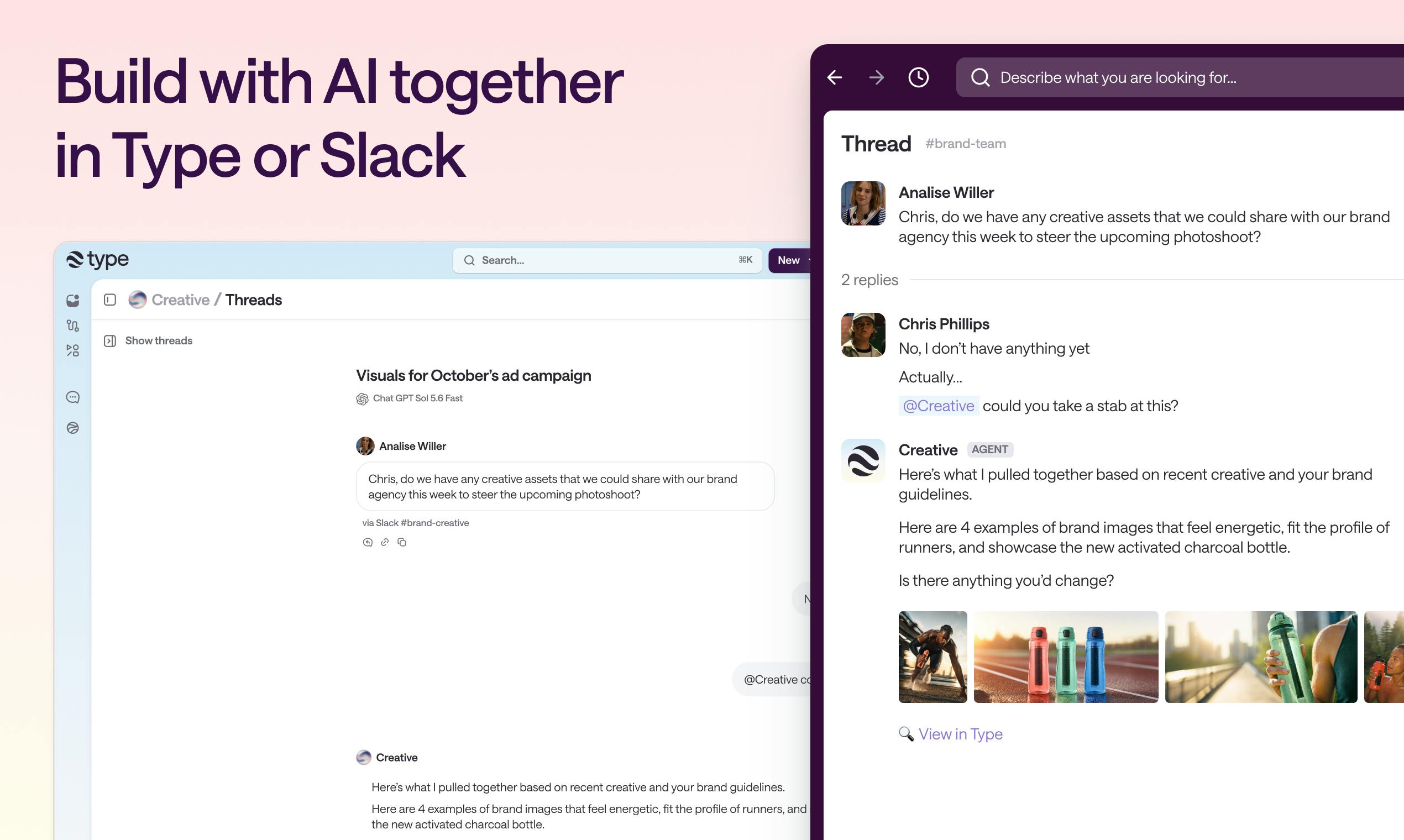
Type.com is a shared AI workspace where teams use Claude, Codex, and other models against common integrations, files, memory, instructions, conversations, and automations. Instead of AI work remaining in individual chat accounts, Type organizes it into departmental “Spaces” that colleagues can jointly inspect, continue, and reuse. It is available through the web, desktop, mobile, CLI, and Slack (Type documentation).
The product addresses an increasingly relevant organizational problem: employees are adopting AI agents individually, but their prompts, context, tool connections, and successful workflows do not automatically become reusable company assets. Type combines collaborative threads, shared memory, reusable skills, automations, connected business systems, and AI-generated documents or apps. Its strongest product attribute is not access to any one model, but the collaboration and governance layer around multiple models and tools.
The strongest investment signal is the founding team. CEO Fletcher Richman previously co-founded Halp, raised institutional funding, sold the company to Atlassian, and subsequently led product for Confluence. Co-founder Komran Rashidov also co-founded Halp and worked at Atlassian, while Alex Campbell has engineering and product experience at Twitter, HackerOne, Waking Up, and Meta (Richman profile; Campbell profile; Atlassian acquisition announcement). This represents unusually strong founder-market fit for an inception-stage collaboration product.
The main concern is commercial validation. Lerer Hippeau reports that customers have run “tens of thousands” of agent jobs, and the CEO identifies 25–200-person companies—particularly direct-to-consumer businesses—as an early target segment. However, revenue, paying-customer count, growth, retention, usage concentration, gross margin, and sales efficiency are not publicly disclosed (Lerer Hippeau; founder interview summary).
Type operates in a large but intensely contested category. Notion, Microsoft, Glean, Dust, Anthropic, OpenAI, Slack, and numerous agent-automation startups can bundle overlapping capabilities. Type’s multi-model, shared-context architecture is credible differentiation today, but it is not yet proven to be durable.
The decision is DD. The team and market justify direct diligence, but investment should depend on verifying retention, paid adoption, AI-cost exposure, security readiness, and financing terms.
Product Overview
Type’s initial customer is a non-technical or mixed-function team that uses multiple AI tools but lacks a shared environment for retaining and operationalizing its work. The existing workflow typically involves personal AI accounts, manually copied prompts, separate automation products, and data spread across Slack, documents, repositories, CRM systems, and warehouses.
Type organizes work into departmental Spaces. Each Space shares integrations, skills, memory, model configuration, channels, threads, documents, dashboards, and applications. Automations can run on schedules or be triggered by Slack messages, email, webhooks, feeds, or application events (product documentation).
Supported connection patterns include OAuth, API keys, service accounts, hosted Model Context Protocol servers, and custom APIs. Documentation names Slack, GitHub, Linear, Notion, Google Drive, Salesforce, HubSpot, PostgreSQL, BigQuery, Databricks, Snowflake, Shopify, and NetSuite among supported systems (connector documentation).
Users can connect their own Claude or ChatGPT subscriptions. Eligible requests then use those subscriptions rather than Type’s AI allowance, reducing duplicated model expenditure. Type also supports provider-billed usage through workspace credits (subscription documentation).
Current self-serve pricing is:
| Plan | Monthly Price | Included Members | Included AI Usage |
|---|---|---|---|
| Basic | $50 | 2 | $100/month |
| Pro | $100 | 4 | $200/month |
| Enterprise | $250 | 20 | $500/month |
| Enterprise | $500 | 40 | $1,000/month |
| Enterprise | $750 | 60 | $1,500/month |
Custom contracts are available above 60 users or for additional security and procurement requirements. A 14-day trial includes $100 of AI usage for work-email registrations and $10 for personal-email registrations (billing documentation).
Product Quality Assessment: Strong early product scope and documentation, with a clear collaboration problem and credible multi-model architecture. Enterprise-grade security, reliability, administrative control, and workflow accuracy require further validation.
Founder and Team Assessment
The founders are Fletcher Richman, Alex Campbell, and Komran Rashidov, according to investor Lerer Hippeau (investor announcement).
Richman previously co-founded and led Halp, a conversational ticketing product acquired by Atlassian in 2020. He later served as Head of Product for Confluence and reports managing more than 40 product managers across over 500 engineers (Richman profile; Atlassian).
Rashidov was also a Halp co-founder and subsequently a senior software engineer at Atlassian, providing technical continuity from the prior company (Rashidov profile). Campbell’s background includes software engineering at Twitter and product roles involving trust, safety, and data products at Twitter, HackerOne, Waking Up, and Meta (Campbell profile).
LinkedIn displays eight associated employees and a company-size range of 2–10; these figures are directional rather than audited. The company has advertised a founding-marketer role, indicating active go-to-market hiring (Type.com LinkedIn; careers).
The prior Halp exit materially strengthens execution credibility. The team has direct experience with workplace collaboration, Slack-native workflows, enterprise product management, integrations, and acquisition. Key-person risk remains meaningful because of the company’s small size.
Founder Assessment: Strong founder-market fit, relevant prior exit, and balanced product and engineering experience; current organizational depth remains limited.
Market Opportunity
The initial target is non-technical operating teams inside companies of approximately 25–200 employees. The founder specifically identifies direct-to-consumer businesses as an early use case because their marketing, inventory, reporting, and customer workflows have structured inputs and repeatable actions (founder interview).
A reasonable bottom-up scenario is:
- Target organizations: 100,000–300,000 digitally mature SMB and mid-market companies globally—analyst assumption.
- Potential annual contract value: $3,000–$15,000, based on current self-serve tiers and potential custom contracts.
- Illustrative addressable revenue: $300 million–$4.5 billion annually.
This is not a forecast. It assumes Type can sell beyond individual enthusiasts into recurring departmental deployments. The current $600–$9,000 annual self-serve pricing supports a meaningful SaaS market, but large outcomes require expansion across multiple departments or larger custom contracts.
Adjacent opportunities include enterprise-wide AI governance, workflow automation, internal application development, searchable institutional memory, analytics, and orchestration across specialized agents. International distribution is feasible because the product is cloud-based, although data residency, security certifications, procurement, and local privacy requirements could slow larger deployments.
Traction and Growth Signals
The strongest publicly available traction claim comes from Lerer Hippeau, which says teams have run “tens of thousands of successful agent jobs” and that the investor uses Type internally. This is investor-reported and does not disclose active customers, timeframe, retention, or paid usage (Lerer Hippeau).
Type has shipped regularly. Its changelog records shared skills, additional integrations, CLI access, collaborative documents and apps, organizational memory, Spaces, and model selection between June and July 2026 (changelog). The company also reports Slack as nearly universal among connected customers and claims access to more than 1,000 tools; these claims have not been independently audited (LinkedIn).
Product Hunt showed approximately 120 points, 95 followers, and three reviews around launch. The review sample is too small—and partly consists of founder reviews—to establish customer satisfaction or product-market fit (Product Hunt; reviews).
Revenue, customer count, ARR growth, retention, active workspaces, automation frequency, expansion revenue, and churn are not publicly disclosed.
Traction Assessment: Credible usage and shipping signals, but commercially unverified.
Competitive Position
Direct competitors include Dust, which offers shared company context, reusable skills, model flexibility, 70-plus connectors, permissions, and audit logs; Glean, whose assistant now supports shared conversations, company context, multi-system actions, and automated workflows; and Notion AI, which combines agents, enterprise search, connected applications, and recurring automations inside an established workspace (Dust; Glean; Notion AI).
Microsoft 365 Copilot is a major bundling threat because it embeds agents and workplace context into software already deployed across enterprises (Microsoft). Claude, ChatGPT, Slack, automation platforms, shared prompt libraries, and manual copying between systems are additional alternatives.
Type’s differentiation is its shared-computer architecture, model independence, bring-your-own subscriptions, unified memory, and collaborative threads. It is not tied to one document suite or model vendor. Reusable shared context may create workflow switching costs as organizations accumulate skills, memories, connections, and automations.
Nevertheless, the moat is immature. The underlying models are third-party, integrations can be replicated, and incumbent workspace providers already possess distribution and enterprise trust.
If the largest platforms released equivalent functionality within six months, customers would remain only if Type provides materially better cross-model orchestration, faster workflow creation, superior interoperability, and portable institutional memory. That advantage has not yet been demonstrated through retention or customer references.
Defensibility Assessment: Medium-Low
Business Model and Economics
Type sells recurring workspace subscriptions rather than charging strictly per seat. Current pricing effectively ranges from approximately $12.50 to $25 per included member per month, before custom enterprise terms.
The bring-your-own-subscription design can improve gross margin because eligible requests use the customer’s Claude or ChatGPT allowance. However, Type’s published plans include AI usage valued at twice the monthly subscription price—for example, $100 of model usage within a $50 plan. If customers consume the full allowance, direct model costs could exceed subscription revenue before cloud infrastructure and support. The company may rely on low utilization, negotiated rates, connected customer subscriptions, or a credit denomination that differs economically from cash expenditure; this requires clarification (billing documentation).
Other variable costs include cloud workspaces, storage, browser automation, database access, connectors, monitoring, support, and security operations. Expansion potential comes from additional members, departments, usage, enterprise controls, and custom contracts.
Unicorn Path
A high-growth collaborative SaaS company could plausibly receive an 8×–10× ARR multiple, provided it demonstrates strong growth, high gross margins, durable retention, and enterprise expansion.
At 10× ARR:
\[
\$1\text{ billion valuation} \div 10 = \$100\text{ million ARR}
\]
Illustrative paths include:
- 33,000 customers at the current $250 monthly tier;
- 11,100 customers at the current $750 monthly tier;
- 10,000 customers at a $10,000 blended annual contract value; or
- 2,000 enterprise customers at $50,000 ACV.
The last two routes are more credible than relying on tens of thousands of low-value subscriptions, but they require enterprise-grade security, auditability, administration, reliability, sales capacity, and multi-department adoption.
The market can support this outcome, and the founders have relevant scaling experience. However, Type must establish repeatable distribution and survive bundling by much larger collaboration platforms.
Unicorn Path: Plausible
Valuation Assessment
Type announced $4 million in pre-seed funding from Lerer Hippeau, Haystack, Matchstick Ventures, and executives associated with Slack, GitHub, and other technology companies (company launch announcement; Lerer Hippeau).
The round’s valuation, ownership sold, security type, liquidation preferences, and current fundraising status are not publicly disclosed. Revenue is also unknown.
Valuation Attractiveness: Not Assessable
Assessment requires current ARR, monthly growth, gross margin, net retention, customer concentration, burn, runway, round size, SAFE or note cap, post-money valuation, and investor rights.
Key Risks
- Commercial traction is undisclosed: Agent jobs do not establish revenue or retention.
- Incumbent bundling: Notion, Microsoft, Glean, Slack, Anthropic, and OpenAI can absorb similar workflows.
- Potentially adverse AI economics: Included AI allowances appear high relative to subscription prices.
- Security and permissioning: Broad write access across CRM, code, data warehouses, and messaging systems creates substantial enterprise risk.
- Unproven differentiation: “Multiplayer AI” may become a standard feature rather than a distinct category.
- Platform dependency: Product functionality depends on model providers, subscription policies, APIs, and third-party connectors.
- Broad positioning: Serving marketing, sales, support, operations, and engineering could dilute the initial use case.
- Early-stage team: A small team must simultaneously build infrastructure, integrations, security, and enterprise sales.
- Pivot history: The legal entity previously presented learning-oriented products under Savvy/Memora, suggesting adaptability but also unresolved positioning risk.
- Low initial contract values: Self-serve pricing may require efficient acquisition and strong expansion to support venture returns.
Final Assessment
Venture Potential: 73/100
| Category | Score |
|---|---|
| Market Size and Expansion Potential | 18/20 |
| Traction and Growth Evidence | 10/20 |
| Founder and Team | 14/15 |
| Product Strength | 8/10 |
| Distribution Potential | 10/15 |
| Business Model and Economics | 7/10 |
| Defensibility | 6/10 |
| Total | 73/100 |
The strongest elements are the experienced founding team, credible enterprise problem, broad expansion surface, and rapid product development. The weakest are absent commercial metrics, potentially unfavorable model-cost exposure, and strong competitive bundling risk.
Evidence Confidence: 61/100
Product functionality, pricing, funding, founders, legal entity, integrations, and release activity are supported by primary documentation or investor announcements. Usage volume is company- or investor-reported. Revenue, customer count, retention, margins, burn, runway, customer acquisition cost, valuation, and financing terms remain unavailable.
Final Decision: DD
Type merits formal diligence because it combines a credible market opportunity with a repeat founder, a prior exit, relevant enterprise-product experience, and an operational product. It does not merit an “Invest” decision from public information because valuation, revenue quality, retention, unit economics, security readiness, and financing terms are unknown.
Upgrade Conditions
- Verified ARR above $1 million with sustained monthly growth.
- Strong 90- and 180-day workspace retention.
- Expansion from one department into multiple departments per customer.
- Gross margin above 70% after model and workspace costs.
- Referenceable customers in the 25–200-employee segment.
- Evidence that shared Spaces materially outperform individual Claude or ChatGPT usage.
- SOC 2 or equivalent enterprise security controls.
- A repeatable acquisition channel beyond founder networks and launch activity.
Downgrade Conditions
- Low paid conversion after the trial.
- High workspace churn or automations becoming inactive after initial setup.
- AI usage costs approaching or exceeding subscription revenue.
- Rapid parity from Notion, Microsoft, Glean, or model providers.
- Security incidents involving connected credentials or agent actions.
- Continued broad positioning without a dominant use case.
- Materially aggressive financing terms unsupported by revenue.
Questions for Further Diligence
- What are current ARR, MRR, monthly growth, and recognized versus contracted revenue?
- How many paying workspaces exist, and how many use Type weekly?
- What are 30-, 90-, and 180-day workspace retention rates?
- What percentage of customers expand seats, Spaces, or usage within six months?
- What is gross margin after model costs, cloud workspaces, browser infrastructure, and support?
- How often do customers consume the full included AI allowance?
- What percentage of requests use customer-connected Claude or ChatGPT subscriptions?
- Which use case has the highest retention: marketing, e-commerce operations, support, sales, or engineering?
- What security certifications, audit logs, data-retention controls, and incident-response procedures exist?
- What are customer acquisition cost, sales cycle, and primary acquisition channels?
- What are current burn, runway, headcount plan, and founder compensation?
- What are the cap table, current valuation, round terms, and liquidation preferences?