
Table of Contents
Noodle Seed Investment Report
Category: AI-agent infrastructure; governed MCP runtime; developer tools
Company Stage: Early stage / public beta
Founder or Founders: Fahd Rafi and Asad Iqbal
Headquarters: Fremont, California / San Francisco Bay Area
Funding: Financing has been company-reported, but amount, investors and terms are not publicly disclosed
Business Model: Open-core, usage-based SaaS, enterprise contracts and implementation services
Product Hunt Launch Date: September 9, 2026
Report Date: September 12, 2026
| Investment Metric | Assessment |
|---|---|
| Venture Potential | 60/100 |
| Unicorn Path | Conditional |
| Valuation Attractiveness | Not Assessable |
| Evidence Confidence | 58/100 |
| Final Decision | Watch |
Executive Summary
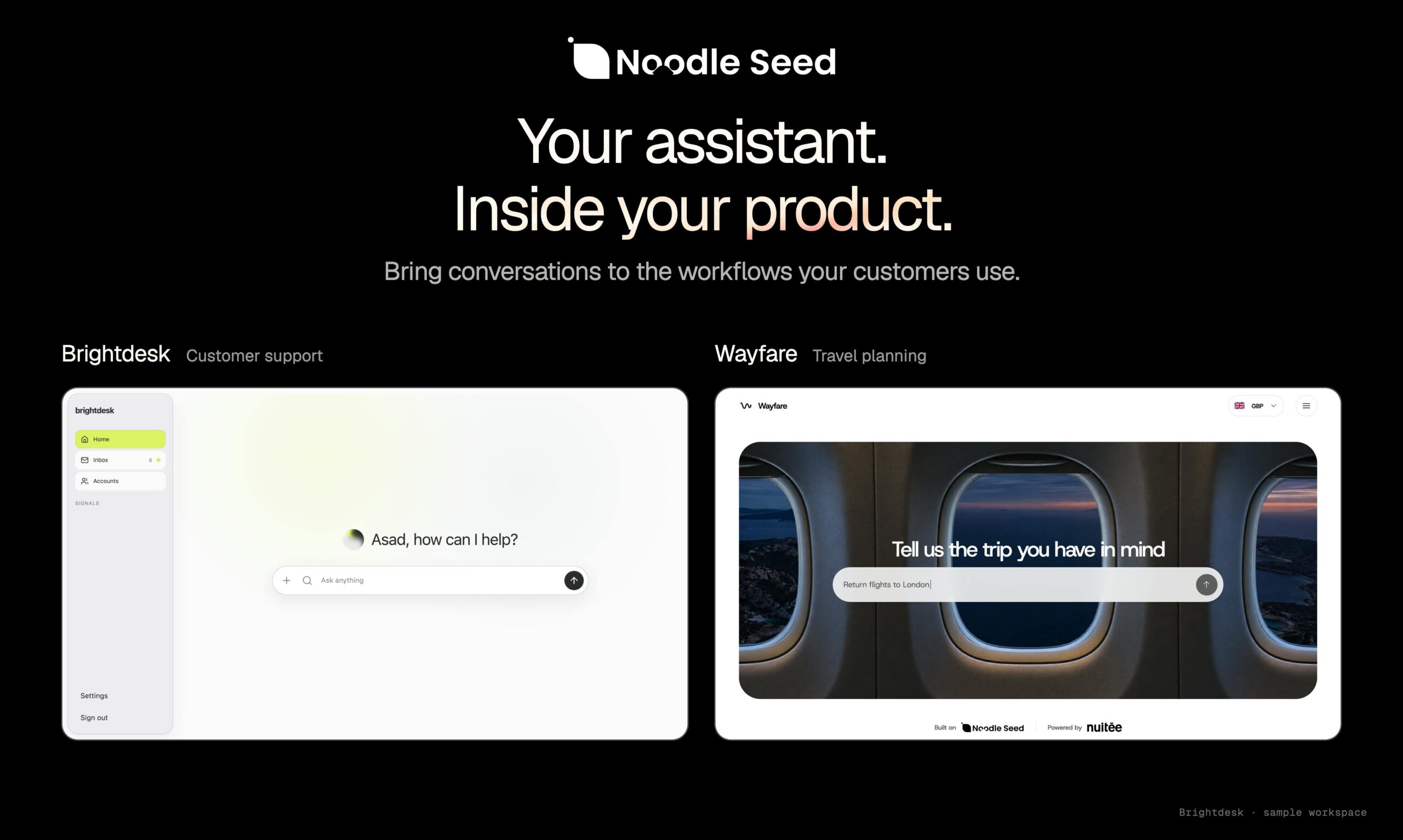
Noodle Seed helps software companies expose existing product workflows to AI agents without rebuilding identity, permissions, credential management, rate limits, audit and hosting for every agent interface. Developers define capabilities in TypeScript, test them locally and deploy them to Noodle Seed’s governed runtime. The same capabilities can power an embedded assistant and external clients such as ChatGPT, Claude, Copilot, Gemini and other Model Context Protocol clients (official website; Product Hunt launch).
The product addresses a credible infrastructure problem. A demonstration MCP server can be built with free SDKs, but operating one securely across customers and agent surfaces requires authentication, tenant isolation, secrets, policy enforcement, deployment controls and observability. Noodle Seed packages these requirements into an open-core platform.
The strongest company signal is the founders’ relevant technical and enterprise experience. CEO Fahd Rafi previously worked in AI, data and cloud roles at Google, Microsoft and Hewlett Packard Enterprise, while CTO Asad Iqbal previously led innovation work at Troon Technologies (Rafi profile; company entity page). The company also publishes unusually candid investor updates acknowledging prior pivots, limited paid conversion and unresolved product-market fit.
The principal concern is commercialization. Noodle Seed’s Q1 2026 update reported more than 1,000 users but only “a handful” of organic upgrades, with no user reaching free-plan limits. The current website claims more than 2,000 teams, but the definition, activity and paid status of those teams are not disclosed (Q1 update; homepage). Revenue, retention and gross margin remain unknown.
Final decision: Watch. Product quality is promising and company quality is credible, but venture-scale potential is not yet validated. The company should be upgraded to DD only after showing paid conversion, active production workloads and repeatable customer acquisition beyond launch activity.
Product Overview
Noodle Seed is designed for software teams that want AI agents to complete real customer workflows—such as investigating an invoice, booking travel or updating an account—while preserving the product’s existing identity, authorization and business rules.
The product includes:
- A TypeScript authoring SDK, compiler, CLI and runtime.
- Embedded, customer-branded assistants.
- MCP endpoints for external agents.
- Customer and tenant context.
- Credential and secret brokering.
- Policies, quotas and rate limits.
- Deployment history and rollback.
- Audit and observability.
- Hosted, dedicated and potential customer-hosted deployment options.
The Apache-2.0-licensed Noodle Core repository provides a single-node, self-hosted beta. It does not include the commercial cloud console, billing, managed identity, key custody, automated deployment, backups, high availability or SLA. The repository was created on September 7, 2026 and had eight stars and no forks as of September 12 (GitHub API).
Current pricing is:
- Free: One production app and one million pooled monthly MCP calls.
- Pro: $30 monthly, or $300 annually, for up to five apps and ten million calls.
- Scale: $300 monthly, or $3,000 annually, for up to 25 apps and 100 million calls.
- Enterprise: Custom pricing.
- Implementation: $1,500–$15,000 standard packages; enterprise enablement from $25,000.
Overages are $5 per started block of one million calls (pricing page).
The public website contains stale positioning and pricing information. Its structured entity page still describes Noodle Seed primarily as a no-code SMB app builder priced at $50 monthly, while the current product and pricing pages position it as developer infrastructure with $30 and $300 plans. The latest product and pricing pages are used in this report.
Product quality: A thoughtful and technically substantive beta, but several enterprise identity, policy, connectivity and audit features remain in private preview or future scope.
Founder and Team Assessment
Fahd Rafi is founder and CEO. His public professional profile lists experience as a Google Cloud customer engineer for data and AI, a Microsoft data and AI technical architect, and an HPE data architect. It also lists earlier engineering and commercial experience, providing relevant founder-market fit for enterprise infrastructure and technical sales (LinkedIn).
Asad Iqbal is co-founder and CTO. Company materials identify him as a former vice president of innovation at Troon Technologies. The December 2025 investor update describes him as central to engineering, operations, prioritization and go-to-market execution (investor update).
That update reported five engineers, one administrator and two working co-founders. LinkedIn currently associates seven profiles with the company, broadly consistent with a small team, but neither source verifies payroll headcount. No current job listings or independently verified hiring plan were found.
Both founders appear full-time. No previous exits were verified. Key-person risk is material because product architecture, sales and operations remain concentrated in the two founders, and the company itself described Iqbal as a key person.
Founder Assessment: Strong enterprise-technology and technical execution backgrounds, but repeatable startup commercialization remains unproven.
Market Opportunity
The narrow initial customer is a SaaS or API company that wants its authenticated workflows available through an embedded assistant and external AI agents. The buyer is likely a CTO, product leader, platform-engineering team or AI-product team.
GitHub reports more than four million organizations, providing a broad proxy for the global population of software-building teams (GitHub). Most are not realistic Noodle Seed buyers.
An illustrative bottom-up scenario is:
- Four million GitHub organizations.
- Assume 1% have customer-facing agent workflows and sufficient operational requirements: 40,000 potential accounts.
- Assume the current Scale annual price of $3,000.
- Addressable base subscription revenue: 40,000 × $3,000 = $120 million annually.
This is an analyst scenario, not a verified market estimate. The customer filter may be substantially below 1%, while enterprise ACVs could be much higher than $3,000.
Expansion opportunities include enterprise identity, private connectivity, dedicated deployment, agent governance, transaction infrastructure, implementation and vertical starter kits. Geographic expansion is natural because the product is API-based, although enterprise compliance and data residency increase operational complexity.
The market can support a meaningful infrastructure company. It supports a unicorn only if Noodle Seed captures higher enterprise ACVs and becomes a durable control plane rather than a low-priced MCP hosting utility.
Traction and Growth Signals
The September Product Hunt launch generated 253 points, 39 comments, a #4 daily rank and a #18 weekly rank as displayed on the launch page (Product Hunt). This indicates interest but not product-market fit.
More substantive, though still company-reported, signals include:
- More than 1,000 platform users in Q1 2026, up from roughly 450 in January.
- Two paid design partnerships as of the Q1 update.
- A current homepage claim of more than 2,000 teams.
- Multiple current customer or demonstration logos.
- Active public code updates around the September launch.
- Published self-service pricing and Stripe-based upgrades.
The negative evidence is equally important. In Q1, only a handful of users had upgraded, none needed to upgrade because they had not reached free-plan limits, and more than 70 submitted customer applications had not yet gone live in the ChatGPT app ecosystem. Noodle Seed’s earlier December update explicitly stated that it had not found product-market fit and had previously pivoted twice.
The current website suggests progress since Q1, but it does not disclose how many of the 2,000 claimed teams are active, in production or paying.
Traction Assessment: User interest and product activity are credible, but commercial adoption remains weakly evidenced.
Competitive Position
Direct competitors include Arcade, which provides an enterprise actions runtime with authorization, policy enforcement and flexible deployment, and Composio, which offers a governed MCP gateway, managed authentication and a large integration catalog. Pipedream Connect also enables developers to embed integrations and hosted MCP capabilities.
Indirect competitors include identity providers such as WorkOS, cloud API gateways, integration platforms and agent-framework vendors. The free alternative is the official MCP TypeScript SDK combined with custom hosting, OAuth, secrets management and logging.
Noodle Seed’s current differentiation is its combination of embedded customer-facing assistants, external agent surfaces, an open-source TypeScript core and inexpensive hosted deployment. Its application-centric pricing is attractive relative to seat-based software.
Defensibility is limited today. MCP is an open standard; the core is Apache-licensed; public GitHub adoption is minimal; and larger competitors already offer identity, tool catalogs and enterprise controls. Proprietary advantages could emerge from cross-platform compatibility, customer workflow data and embedded distribution, but none is yet demonstrated at scale.
If the largest platform launched the same feature within six months, why would customers continue using Noodle Seed? The answer would need to be cross-platform portability and a neutral governance layer spanning competing assistants. That is credible in principle but not yet proven in customer behavior.
Defensibility Assessment: Low
Business Model and Economics
The current model combines free developer adoption, paid platform subscriptions, overages, enterprise contracts and implementation services. The earlier plan to take a percentage of transactions is described in the December investor update, but current public pricing does not show transaction fees; implementation should therefore be treated as the verified ancillary revenue stream.
List-price ACVs are approximately $300 for annual Pro and $3,000 for annual Scale. Enterprise ACV is not disclosed.
Infrastructure costs include runtime compute, database operations, asset delivery, observability, credential storage, support and potentially dedicated deployments. Noodle Seed does not appear to provide the underlying foundation-model inference in every workflow, which could reduce AI-related variable cost. However, one million free calls and very low overage pricing create a unit-economic risk if calls involve meaningful orchestration, logging or support expense.
Implementation revenue can finance early deployments but may reduce gross margin and distract from repeatable platform development. Gross margin, cloud cost per million calls, CAC, sales cycle and expansion revenue are unknown.
Unicorn Path
Assume a 10× ARR multiple, appropriate only for a high-growth infrastructure SaaS company with strong retention and healthy gross margin.
Required ARR = $1 billion ÷ 10 = approximately $100 million.
At current annual pricing:
- Pro at $300 annually: approximately 333,000 paying accounts.
- Scale at $3,000 annually: approximately 33,300 paying accounts.
A more credible route would combine, for example, 10,000 Scale accounts producing $30 million ARR with 1,400 enterprise accounts at an assumed $50,000 ACV producing $70 million. The enterprise ACV is an analyst assumption, not disclosed pricing.
Noodle Seed would need enterprise-grade identity, compliance, reliability and private deployment; a repeatable sales motion; substantially higher paid conversion; and a defensible cross-platform position. Current low-price self-service plans alone are unlikely to support a unicorn outcome.
Unicorn Path: Conditional
Valuation Assessment
Noodle Seed states that it closed sufficient capital for its then-current growth phase and was not actively fundraising in Q1 2026. The amount, investors, security type, valuation and ownership were not disclosed. The December 2025 update had previously described plans for a seed round, but the subsequent update does not identify whether the completed financing constituted that round.
Valuation Attractiveness: Not Assessable
Assessment requires current ARR, growth, paid accounts, gross margin, burn, runway, financing amount, SAFE or equity terms, post-money valuation, investor ownership and liquidation preferences.
Key Risks
- Limited verified paid conversion and no disclosed ARR.
- Dependence on adoption policies of major AI-agent platforms.
- Competition from better-funded agent-runtime and integration vendors.
- Very low pricing relative to the infrastructure and support burden.
- Low switching costs and an open standard.
- Enterprise features and compliance controls remain incomplete.
- Repeated historical pivots and continuing positioning changes.
- Services work could overwhelm a small engineering team.
- Security exposure from handling credentials and authorized agent actions.
- Inconsistent public pricing, positioning and SOC 2 status disclosures.
Final Assessment
Venture Potential: 60/100
| Category | Score |
|---|---|
| Market Size and Expansion Potential | 16/20 |
| Traction and Growth Evidence | 7/20 |
| Founder and Team | 12/15 |
| Product Strength | 7/10 |
| Distribution Potential | 8/15 |
| Business Model and Economics | 6/10 |
| Defensibility | 4/10 |
| Total | 60/100 |
The strongest factors are founder-market fit, market timing and a substantive product. The weakest are paid traction, platform dependence and limited defensibility.
Evidence Confidence: 58/100
Pricing, product availability, founders, legal entity and public code are verifiable. User counts, partnerships and financing are company-reported. Revenue, retention, active usage, gross margin, funding terms and valuation are unavailable. Several older company pages contain stale or conflicting positioning and compliance claims.
Final Decision: Watch
Noodle Seed is promising but insufficiently validated for formal diligence. Product Hunt activity and 2,000 claimed teams do not offset the lack of verified paid conversion, retention and production usage.
Upgrade Conditions
- At least $1 million ARR or equivalent contracted recurring revenue.
- More than 100 paying production customers.
- Six-month customer retention above 80%.
- Gross margin above 70% after infrastructure and support.
- Multiple referenceable customers operating substantial agent-call volume.
- Verified conversion from Free to Pro, Scale or Enterprise.
- SOC 2 completion and production-ready enterprise identity controls.
- Evidence that cross-platform deployment materially reduces churn or CAC.
Downgrade Conditions
- Continued low paid conversion despite growing registrations.
- Major platforms bundling equivalent deployment and governance.
- Persistent custom-services dependence.
- Infrastructure cost exceeding usage revenue.
- Security incidents involving customer credentials or cross-tenant access.
- Further major pivot without evidence from existing customers.
- Misleading user, compliance, funding or partnership claims.
Questions for Further Diligence
- What are current ARR, MRR and monthly revenue growth?
- How many of the claimed 2,000 teams are active, paying and in production?
- What are 30-, 90- and 180-day retention rates?
- What are Free-to-Pro and Free-to-Scale conversion rates?
- How many MCP calls are processed monthly, and what percentage comes from paying customers?
- What are revenue and infrastructure cost per million calls?
- What percentage of revenue comes from implementation services?
- Which customer applications are live and referenceable?
- What are CAC, sales-cycle length and primary acquisition channels?
- What financing was closed, at what valuation and on what terms?
- What are current burn, cash runway and founder compensation?
- Which enterprise security features are generally available versus private preview?