
Table of Contents
ABrush Investment Report
Category: Generative-AI creative software and Photoshop workflow automation
Company Stage: Early commercial / early access
Founder or Founders: Ivanna Pogrebniak; other co-founder(s) not publicly identified
Headquarters: Cyprus; operating roots in Ukraine
Funding: Not publicly disclosed; supported by AB Games and participated in Oxford Venture Builder
Business Model: Usage-based creative software with tokens; intended individual and business subscription plans
Product Hunt Launch Date: September 12, 2026
Report Date: September 15, 2026
| Investment Metric | Assessment |
|---|---|
| Venture Potential | 51/100 |
| Unicorn Path | Conditional |
| Valuation Attractiveness | Not Assessable |
| Evidence Confidence | 46/100 |
| Final Decision | Watch |
Executive Summary
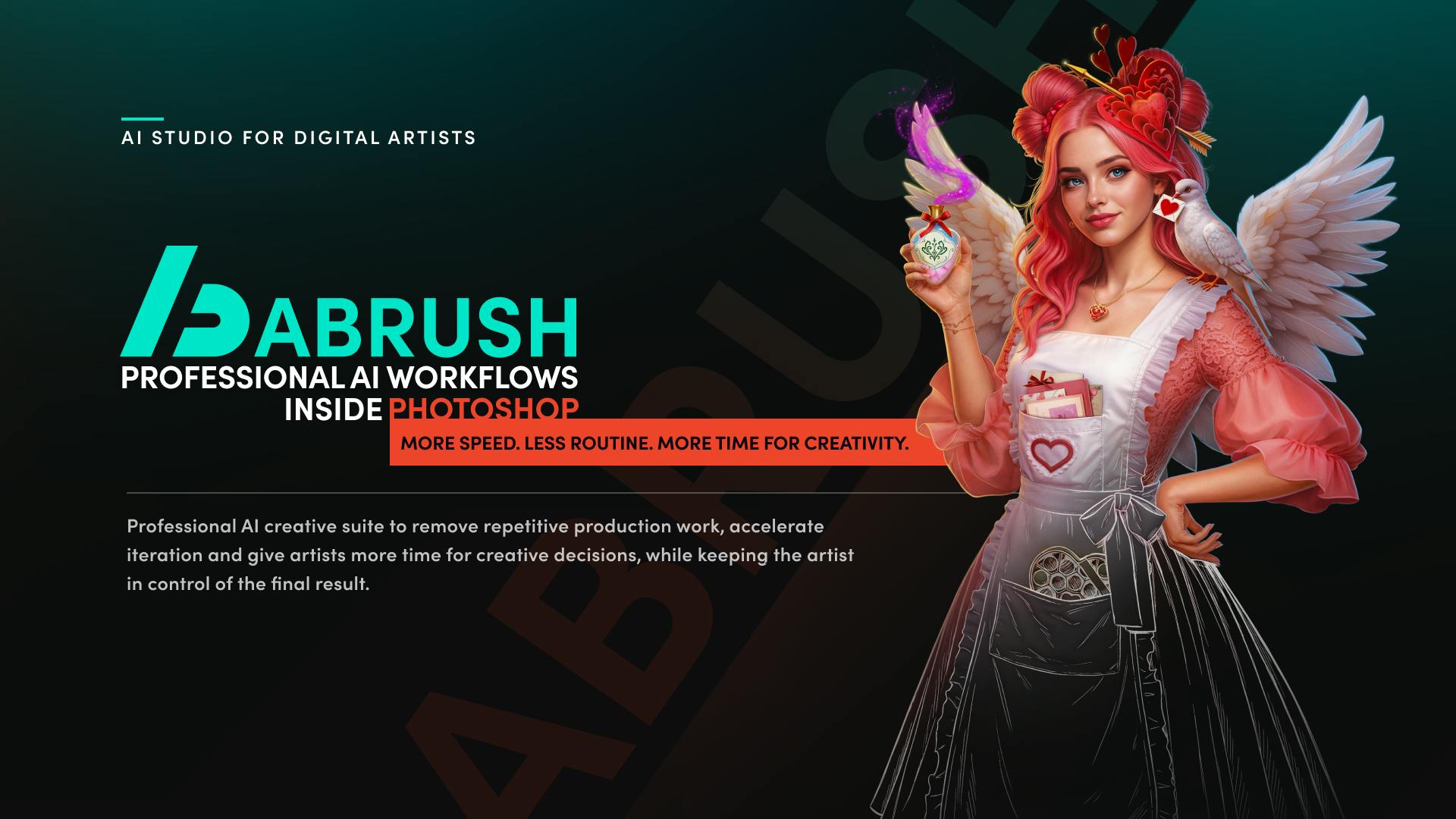
ABrush is a Photoshop-integrated generative-AI workspace for professional digital artists. It provides access to more than 23 image models alongside text-to-image, image editing, upscaling, ControlNet, image references, LoRA styles, reusable presets, generation history, and shared workflows (official website; Product Hunt).
The product originated as an internal tool at game developer AB Games. The company reports that ABrush was used internally for approximately three years and tested with 52 artists generating more than 50,000 images monthly before its external launch (Product Hunt; AB Games LinkedIn post). This internal production history is a stronger product signal than a typical newly launched AI wrapper, although it does not establish external product-market fit.
The primary investment concern is platform competition. Adobe now embeds generative editing and partner models directly into Photoshop and Firefly, including models from Google, OpenAI, and Black Forest Labs. Adobe also provides enterprise administration, contractual protections, and generative credits as part of its broader ecosystem (Adobe partner-model documentation; Adobe Firefly). ABrush is therefore competing against the owner of its principal distribution platform.
ABrush could build a meaningful specialist business by serving game-art teams that require consistent styles, reusable production workflows, and control over model choice. Its current differentiation, however, appears product-level rather than structurally defensible. Revenue, paying customers, retention, gross margin, external financing, and enterprise contracts are not publicly verified.
The final decision is Watch. Product quality is promising and the team has strong domain experience, but the venture case requires proof that independent studios will pay and remain customers despite Adobe’s rapidly expanding native capabilities.
Product Overview
Professional artists increasingly use several generative-image models because different models perform better for different styles and production tasks. The resulting workflow often involves browser applications, separate subscriptions, image exports, reimports, and lost layer context.
ABrush consolidates these models inside Photoshop. Artists can generate variations, selectively alter image regions, use reference images and LoRAs, upscale outputs, preserve work in Photoshop layers, save prompts and settings, and share presets across teams (official website). The primary benefit is reduced workflow switching and greater repeatability, not merely faster image generation.
The initial target users are concept artists, game-art teams, illustrators, photographers, retouchers, and small or midsized studios already using Photoshop. It replaces combinations of Firefly, Midjourney, Stable Diffusion or ComfyUI, standalone upscalers, browser-based editors, and manual Photoshop work.
The product remains in early access. ABrush’s terms describe the software as pre-release alpha or beta code that may be modified or withdrawn and may not operate correctly (terms). Public pricing is incomplete: the website says no subscription plans are available yet, provides 300 introductory tokens, and refers to promotional early-access pricing. Prices and token packages are visible only inside the account dashboard.
ABrush states that users retain ownership of their content and that local or cloud content is not used to train ABrush or third-party generative models. Cloud content is nevertheless processed to provide generation and may be scanned for illegal material (terms).
Product Quality Assessment: Well aligned with professional artist workflows and tested in a real game-production environment, but still pre-release and increasingly overlapped by Photoshop’s native AI functionality.
Founder and Team Assessment
Ivanna Pogrebniak identifies herself as ABrush co-founder and CEO and as CEO of AB Games. Her responsibilities reportedly cover product vision, strategy, fundraising, team development, and go-to-market (LinkedIn). Operating a game studio gives her relevant exposure to art-production costs and customer workflows.
AB Games is an established independent game developer founded by Anton Bolshakov. Its best-known product, Hidden City, is developed by AB Games and distributed by G5 Entertainment (AB Games; Google Play). ABrush describes itself as a spin-out from AB Games, and a company post calls Bolshakov an investor, but the invested amount, ownership structure, and whether this represents cash or contributed resources are not disclosed (ABrush LinkedIn).
The team has credible artist-domain knowledge because it developed and operated the product internally. However, the technical co-founder or CTO is not publicly identified. LinkedIn creates a material ambiguity: the company profile selects the 51–200 employee band but displays only two associated profiles. Dedicated ABrush headcount is therefore not verified.
Pogrebniak remains CEO of AB Games, creating possible divided-attention and related-party risks. Investors must establish which employees, intellectual property, model contracts, and costs belong to ABrush rather than its parent or sponsor.
Founder Assessment: Strong creative-production and operating experience, but technical leadership, full-time allocation, team size, and separation from AB Games remain unclear.
Market Opportunity
The narrow initial segment is professional Photoshop users who create large volumes of commercial 2D artwork and need multiple models, consistent style, and shared workflows. Game studios, advertising production teams, and visual-content agencies are more attractive than occasional individual creators because they have higher generation volumes and clearer labor-cost savings.
A bottom-up scenario—not a verified market estimate—could include:
- 200,000–300,000 professional individual users at $300–$600 annually: $60 million–$180 million;
- 5,000–15,000 studios at $5,000–$20,000 annually: $25 million–$300 million;
- Combined potential serviceable revenue: approximately $85 million–$480 million.
The upper end requires substantial enterprise adoption and team pricing, not only individual token purchases. Category spending is demonstrably large: Adobe ended fiscal 2025 with $19.2 billion in Digital Media ARR (Adobe FY2025 10-K). That does not prove ABrush can capture a meaningful portion.
Adjacent expansion could include integrations with other creative applications, video and 3D generation, asset approval, model governance, studio-specific fine-tuning, API access, and enterprise content provenance.
Traction and Growth Signals
ABrush received approximately 130 Product Hunt points and ranked #4 on September 12, 2026 (Product Hunt; awards). This demonstrates launch interest but provides little evidence of revenue or retention.
The strongest usage evidence is company-reported internal testing by 52 AB Games artists producing more than 50,000 monthly generations. Because these users were affiliated with the source organization, their behavior may not predict external willingness to pay.
In August 2026, ABrush publicly announced a goal—not an achieved milestone—of reaching 100 paying customers by October (LinkedIn). This wording suggests that external commercial adoption was still nascent shortly before launch.
The company exhibited at Gamescom, participated in Oxford Venture Builder, published tutorials, and was hiring for visual-content marketing. Oxford describes Venture Builder as a non-equity educational program where top teams can compete for cash grants; participation is not equivalent to institutional venture backing (Oxford Saïd).
No reliable G2 review base, Adobe Exchange listing, independently verified customer case studies, revenue data, or sustained external usage metrics were found.
Traction Assessment: Meaningful internal usage but externally and commercially unverified.
Competitive Position
Direct competitors include Adobe Firefly and Photoshop Generative Fill, Krea, Leonardo.Ai, Midjourney, Stable Diffusion platforms, and Photoshop plugins such as Alpaca. Free alternatives include ComfyUI Photoshop connectors and Krita AI Diffusion, whose open-source repository has more than 10,000 stars (Krita AI Diffusion; ComfyUI Photoshop).
ABrush’s differentiation is its combination of multiple models, professional Photoshop controls, reusable workflows, style consistency, and team sharing. Three years of use by a game-art team may have produced valuable workflow knowledge.
Nevertheless, switching costs are currently low. Presets, LoRAs, and generation histories create some stickiness, but the underlying models are predominantly supplied by third parties. There is no demonstrated network effect, proprietary foundational model, unique data asset, or exclusive distribution channel.
“If the largest platform in this market launched the same feature within six months, why would customers continue using this product?” That situation has substantially arrived: Adobe provides native generative editing, partner-model choice, privacy commitments, credits, and enterprise controls. Customers would remain only if ABrush delivers materially better production workflows, studio-style consistency, model breadth, or economics. Those advantages have not yet been quantified.
Defensibility Assessment: Low
Business Model and Economics
ABrush uses token-based consumption and intends to offer monthly plans for individuals and businesses. Exact pricing, token consumption per model, discounts, and enterprise minimums are not publicly available.
Variable costs may include model API charges, GPU inference, storage, content moderation, payment processing, and customer support. Offering 23+ models increases customer choice but creates supplier dependency and uneven gross margin: premium models may cost substantially more per generation than open-weight models.
The critical economic question is whether token revenue increases faster than inference cost. Team presets, private styles, approval workflows, and studio governance could support higher-margin subscription revenue, while pure model reselling risks thin margins and price competition.
No App Store fee applies, but dependence on Photoshop creates a separate platform risk. Distribution may require direct downloads because no verified Adobe Exchange listing was found.
Unicorn Path
Assuming an 8× ARR multiple for a scaled, high-growth creative SaaS company:
Required ARR = $1 billion ÷ 8 = approximately $125 million.
Illustrative requirements are:
- About 417,000 individual customers at $300 annually;
- About 125,000 blended customers at $1,000 annually; or
- About 12,500 studio customers at $10,000 ACV.
Krea demonstrates that investors assign substantial value to multi-model creative platforms: it raised $83 million and was reported at a $500 million post-money valuation, with enterprise customers and expansion beyond images (TechCrunch). Canva’s acquisition of Leonardo.Ai also confirms strategic interest in generative creative platforms (Canva).
ABrush would need to become a cross-application operating layer for professional art teams, establish enterprise ACVs, expand beyond Photoshop and still images, and build proprietary workflow or style data. A Photoshop plugin alone is unlikely to support a unicorn outcome.
Unicorn Path: Conditional
Valuation Assessment
No verified external round, round size, valuation, SAFE cap, or current fundraising terms were found. AB Games support and Oxford Venture Builder participation do not provide a valuation benchmark.
Valuation Attractiveness: Not Assessable
Assessment requires current ARR, monthly growth, gross margin by model, retention, paying-customer count, enterprise pipeline, burn, runway, proposed round terms, AB Games ownership, investor rights, and the PERLTEC capitalization table.
Key Risks
- Adobe can bundle overlapping functionality directly into Photoshop.
- External paying-customer traction and retention are unverified.
- Low switching costs and limited proprietary technology.
- Third-party model and inference-cost dependency.
- Photoshop-only distribution restricts the addressable market.
- Product remains legally characterized as pre-release software.
- Founder attention is divided between ABrush and AB Games.
- Dedicated team size and technical leadership are unclear.
- Intellectual-property and related-party boundaries with AB Games require verification.
- Commercial artwork creates copyright, licensing, provenance, and customer-policy risks.
Final Assessment
Venture Potential: 51/100
| Category | Score |
|---|---|
| Market Size and Expansion Potential | 16/20 |
| Traction and Growth Evidence | 6/20 |
| Founder and Team | 11/15 |
| Product Strength | 7/10 |
| Distribution Potential | 5/15 |
| Business Model and Economics | 4/10 |
| Defensibility | 2/10 |
| Total | 51/100 |
The strongest elements are founder-market fit, internal production testing, and a large creative-software category. The weakest are external traction, Adobe platform risk, pricing opacity, and limited defensibility.
Evidence Confidence: 46/100
Verified evidence includes the functioning product site, legal entity, terms, feature set, Product Hunt result, founder identity, Oxford program participation, and Adobe competitive capabilities. Usage figures are company-reported. Market sizing and customer requirements are analyst assumptions. Revenue, retention, funding, team allocation, gross margin, and valuation remain unknown.
Final Decision: Watch
ABrush is an interesting early product but not yet ready for formal investment diligence. It must demonstrate that external creative teams will pay for a separate Photoshop AI layer and that its workflow differentiation survives Adobe’s native multi-model expansion.
Upgrade Conditions
- Reach at least $1 million ARR with independently verified recurring revenue.
- Demonstrate more than 70% six-month customer retention.
- Sign at least ten unaffiliated studios at meaningful multi-seat ACVs.
- Maintain gross margin above 70% after model and GPU costs.
- Quantify time savings and output acceptance versus native Photoshop AI.
- Show repeatable acquisition outside AB Games, events, and Product Hunt.
- Establish cross-application or proprietary workflow defensibility.
Downgrade Conditions
- Failure to convert early-access users into paying subscribers.
- High churn after initial token consumption.
- Adobe matching team presets, LoRA support, or workflow sharing.
- Model costs preventing healthy gross margins.
- Loss of access to key third-party models.
- Founder or engineering resources remaining primarily within AB Games.
- Material copyright, privacy, or commercial-licensing disputes.
Questions for Further Diligence
- What are current MRR, paying-customer count, and monthly revenue growth?
- How many of the 52 internal artists remain weekly active, and how many external users are active?
- What are 30-, 90-, and 180-day retention and free-to-paid conversion?
- How many unaffiliated studios are paying, and what is median ACV?
- What are gross margin and inference cost per 1,000 generations by model?
- How much revenue comes from tokens versus recurring subscriptions?
- What measured time or cost advantage does ABrush have over native Photoshop AI?
- Which models are contractually licensed, and can providers terminate or reprice access?
- Which entity owns the code, brand, customer contracts, and internal AB Games training assets?
- What percentage of each founder’s time is committed to ABrush?
- What are burn, runway, cap table, proposed valuation, and current financing terms?
- What is the product roadmap beyond Photoshop and still-image generation?
Sources
- Product Hunt — ABrush
- Official ABrush website
- ABrush Terms of Use
- ABrush LinkedIn company page
- Ivanna Pogrebniak LinkedIn profile
- AB Games
- Oxford Venture Builder
- Adobe partner-model documentation
- Adobe FY2025 Form 10-K
- Krea financing coverage — TechCrunch
- Canva acquisition of Leonardo.Ai
- Krita AI Diffusion — GitHub