
Table of Contents
Traccia Investment Report
Category: AI-agent observability, governance, and control-plane infrastructure
Company Stage: Pre-seed; fundraising reportedly open
Founder or Founders: Abhishek Patel publicly identifies as an Algen.ai co-founder; the complete founder roster is not conclusively verified
Headquarters: Bengaluru, India
Funding: No completed external funding publicly disclosed
Business Model: Usage-based B2B SaaS with free, self-serve, and enterprise tiers
Product Hunt Launch Date: August 27, 2026
Report Date: August 30, 2026
| Investment Metric | Assessment |
|---|---|
| Venture Potential | 55/100 |
| Unicorn Path | Conditional |
| Valuation Attractiveness | Not Assessable |
| Evidence Confidence | 42/100 |
| Final Decision | Watch |
Executive Summary
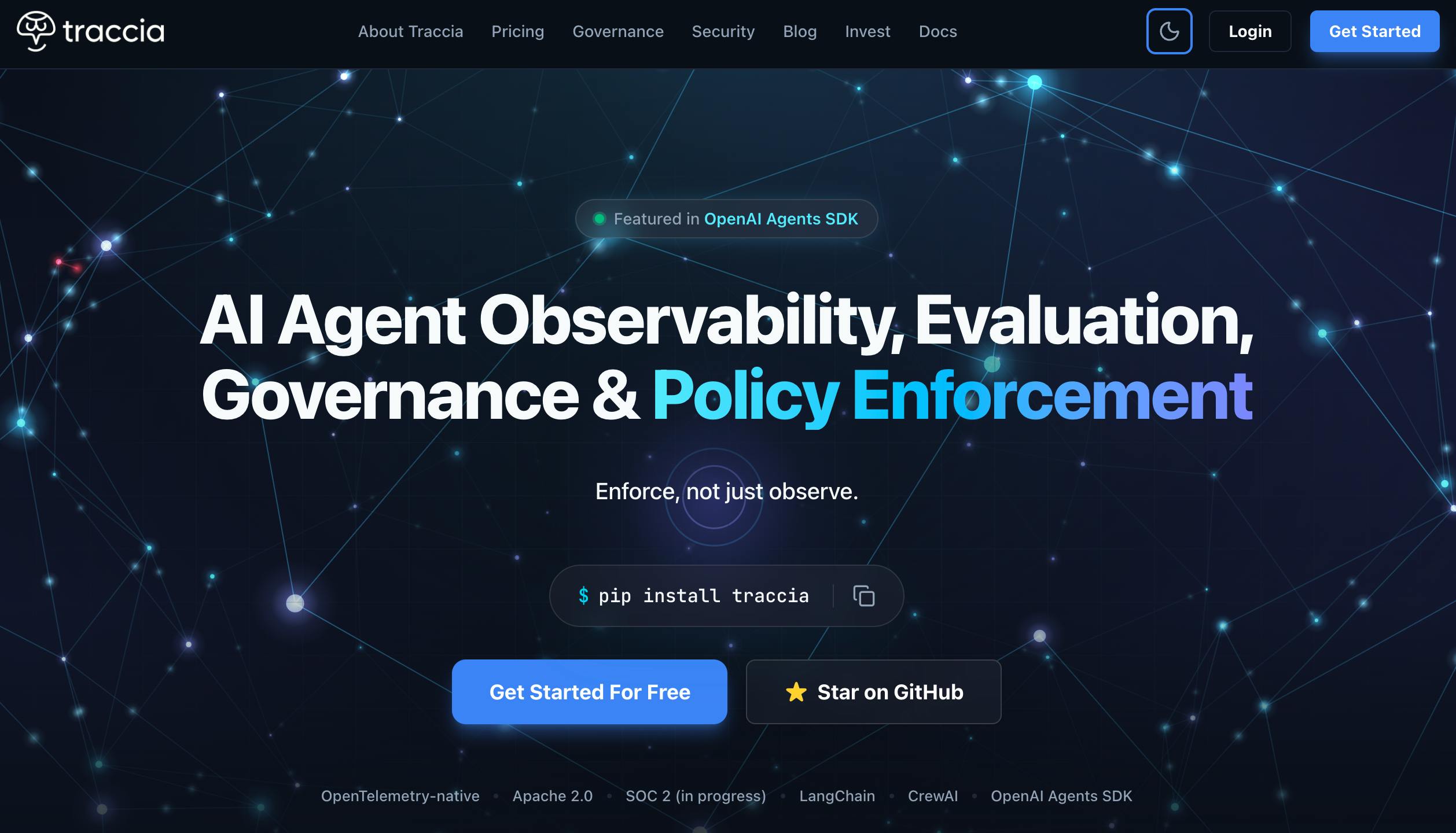
Traccia is an OpenTelemetry-native platform intended to help engineering and governance teams observe, evaluate, and control autonomous AI agents. Its product combines traces, cost attribution, policy enforcement, compliance evidence, prompt management, evaluations, and operational analytics (official website; Python SDK).
The product addresses a credible emerging problem. As agents receive permission to call tools, modify records, and spend money, conventional logs do not necessarily provide sufficient accountability. IBM similarly describes observability, evaluation, security, and governance as core functions of an agent control plane (IBM). Regulatory pressure may support demand: the EU AI Act establishes risk-based obligations for AI providers and deployers (European Commission).
The strongest signal is technical execution. Traccia has published an Apache-2.0 Python SDK, uses the vendor-neutral OpenTelemetry standard, and continued shipping releases through August 2026, including evaluation and prompt-management capabilities (GitHub repository; changelog). This is stronger evidence of a functioning product than the Product Hunt launch alone.
The central concern is commercial validation. Revenue, paying customers, retention, trace volume, enterprise contracts, gross margin, and customer references are not publicly disclosed. Product Hunt attention and modest developer-package activity indicate awareness, not product-market fit.
Product quality appears promising, but company quality remains only partially verifiable. Venture-scale potential exists if Traccia becomes an enterprise governance layer rather than another interchangeable tracing dashboard. The appropriate decision is Watch, pending evidence of paid adoption and repeatable enterprise demand.
Product Overview
Traccia targets teams deploying AI agents into production. It collects agent execution events and provides cost monitoring, trace inspection, loop and anomaly detection, policy alerts, evaluations, governance records, and compliance-oriented evidence (official website). The SDK can operate in full-trace or metadata-only mode, with client-side truncation and pattern-based PII redaction; encryption and data-isolation claims are company-reported and have not been independently audited for this report (security page).
The published pricing is:
- Hobby: free; 50,000 events and seven-day retention.
- Observe: $99 monthly; 500,000 included events.
- Govern: $299 monthly; two million events.
- Scale: $799 monthly; ten million events.
- Enterprise: custom pricing and longer retention.
Overages decline from $12 to $5 per additional 100,000 events across the disclosed paid tiers (pricing). Annual self-serve contract values therefore range from approximately $1,188 to $9,588, before overages.
The product replaces custom OpenTelemetry pipelines, manual log analysis, spreadsheet-based AI inventories, and separate observability and compliance tools. Its primary benefit is consolidated operational accountability across agent frameworks and model providers.
Founder and Team Assessment
Abhishek Patel publicly describes himself as a co-founder of Algen.ai building Traccia (LinkedIn profile). Vijay Poudel is visibly associated with the Product Hunt product and public Traccia discussions (Product Hunt). Public company-directory results identify Vijay Prasad Poudel and Aditya Kumar Saroj as directors of Algen AI Private Limited, while Traccia’s privacy policy identifies that entity as the product owner (privacy policy).
A Traccia research paper lists multiple Algen.ai contributors and supports the presence of technical capability across observability and AI governance (arXiv paper). However, previous employers, exits, fundraising history, sales experience, equity ownership, full-time status, and exact team size could not be reliably verified.
Founder Assessment: Credible early technical execution, but founder history, organizational structure, and commercial capability remain insufficiently verified.
Market Opportunity
The narrow initial segment is software companies operating multiple tool-using AI agents in production, particularly where failures create financial, security, or compliance consequences. Willingness to pay should be highest among regulated enterprises and companies with material AI spending—not experimental chatbot projects.
No reliable public count of production-agent teams exists. A bottom-up scenario, rather than a verified market estimate, is:
- 10,000 target organizations globally
- $12,000 average annual initial spend
- Implied initial serviceable revenue opportunity: approximately $120 million
A more mature enterprise product reaching 20,000 organizations at a $25,000 blended ACV would imply a $500 million market. These are analyst scenarios requiring validation, not market facts.
Expansion could include AI-system inventory, authorization, audit evidence, incident response, model-risk management, and cross-agent policy enforcement. Timing is favorable, but adoption may be slower than agent-development activity because many agents remain pilots rather than mission-critical production systems.
Traction and Growth Signals
Traccia ranked #6 Product of the Day on its August 27 launch, with a daily leaderboard score of 223 (Product Hunt leaderboard). This demonstrates launch interest but not sustained usage.
The traccia-py repository recorded approximately 107 stars and 20 forks in the reviewed GitHub snapshot, while the Python package recorded 732 downloads over the preceding month (GitHub API; PyPI statistics). The repository’s August releases indicate active development, although stars and downloads may include evaluation, automation, or repeat installations.
There are no publicly verified figures for ARR, MRR, paying customers, active organizations, retained trace volume, net revenue retention, customer acquisition cost, or enterprise contracts.
Traction Assessment: Active product development and early developer interest, but commercially unverified.
Competitive Position
Direct competitors include LangSmith, Langfuse, Arize Phoenix, and AgentOps. Langfuse and Phoenix provide open-source alternatives, while LangSmith combines observability with the broader LangChain development and deployment ecosystem (Langfuse; Phoenix; LangSmith pricing). Datadog can bundle agent observability into an established enterprise monitoring relationship (Datadog).
Traccia’s potential differentiation is framework neutrality plus governance-as-code, cost accountability, and metadata-only operation for sensitive environments. OpenTelemetry reduces platform dependency but also lowers migration barriers and makes data collection less proprietary.
If a major platform reproduced the functionality within six months, customers would continue using Traccia only if it had superior cross-vendor policies, compliance evidence, incident workflows, and accumulated governance data. These advantages are not yet proven. There are no demonstrated network effects or unique proprietary datasets.
Defensibility Assessment: Low to Medium.
Business Model and Economics
Usage-based event pricing aligns revenue with customer deployment scale and avoids per-seat friction. It also permits expansion as agents generate more events and require longer retention.
Gross-margin potential could be SaaS-like because Traccia does not appear to proxy core model calls. Nevertheless, storage, event ingestion, indexing, long retention, support, and any LLM-based evaluations create variable costs. No gross-margin or infrastructure-cost data is available. The enterprise tier may produce attractive ACVs, but security reviews, compliance support, and custom deployment requirements could make sales and onboarding expensive.
Competitive pricing is material: Langfuse starts at $29 monthly for its Core plan and offers an open-source product, while LangSmith starts paid team pricing at $39 per seat plus usage (Langfuse pricing; LangSmith pricing). Traccia must therefore sell governance outcomes rather than commodity traces.
Unicorn Path
Assuming a mature, high-growth infrastructure SaaS business could sustain a 10× ARR multiple, a $1 billion valuation would require approximately:
$1 billion ÷ 10 = $100 million ARR
At the current $9,588 annual Scale price, this would require roughly 10,400 customers, before churn or discounts. At a hypothetical $50,000 enterprise ACV, it would require approximately 2,000 enterprise customers.
This is achievable only if Traccia moves substantially upmarket, proves mission-critical governance value, develops enterprise-grade security and deployment options, and builds repeatable global distribution. The current self-serve observability product alone is unlikely to support the necessary revenue scale.
Unicorn Path: Conditional
Valuation Assessment
No reliable completed funding round, investors, SAFE cap, post-money valuation, secondary transaction, or verified revenue figure was found. Traccia’s own investment page describes an open pre-seed raise, but company-reported fundraising status does not establish financing terms (investment page).
Valuation Attractiveness: Not Assessable
Assessment requires current ARR, growth, gross margin, retention, burn, runway, round size, valuation cap, post-money ownership, liquidation preferences, and the existing cap table.
Key Risks
- No verified commercial traction: paid adoption and retention are unknown.
- Intense competition: established and open-source alternatives already cover tracing and evaluations.
- Feature commoditization: OpenTelemetry-based observability can be bundled by cloud and monitoring vendors.
- Unproven enterprise readiness: the trust center states that Traccia does not currently offer a signed HIPAA Business Associate Agreement (trust center).
- Weak current switching costs: vendor-neutral data standards also facilitate migration.
- Uncertain distribution: Product Hunt and founder-led outreach do not establish a repeatable channel.
- Storage economics: high event volume and long retention may compress margins.
- Team and key-person risk: roles, size, commitment, and sales coverage are unclear.
- Sensitive-data exposure: agent traces may contain proprietary or personal data despite redaction controls.
Final Assessment
Venture Potential: 55/100
| Category | Score |
|---|---|
| Market Size and Expansion Potential | 16/20 |
| Traction and Growth Evidence | 5/20 |
| Founder and Team | 7/15 |
| Product Strength | 8/10 |
| Distribution Potential | 7/15 |
| Business Model and Economics | 7/10 |
| Defensibility | 5/10 |
| Total | 55/100 |
The strongest elements are market timing, technical execution, and a sensible usage-based model. The weakest are commercial evidence, distribution, and defensibility against better-funded platforms.
Evidence Confidence: 42/100
The product, pricing, legal owner, SDK activity, and launch are verifiable. Security architecture, roadmap, and fundraising status are principally company-reported. Revenue, customer metrics, retention, gross margin, burn, valuation, team structure, and enterprise references remain unavailable.
Final Decision: Watch
Traccia is too early for formal investment diligence based solely on public evidence. The product appears functional and addresses a potentially important infrastructure layer, but there is not yet enough evidence that customers will pay, remain, and expand.
Upgrade Conditions
- At least $500,000–$1 million ARR with documented growth.
- Multiple referenceable production customers, including regulated enterprises.
- Greater than 70% six-month logo retention and evidence of expansion revenue.
- Gross margin above 70% after ingestion, storage, and evaluation costs.
- Repeatable acquisition beyond Product Hunt and founder networks.
- Demonstrated governance or policy functionality that competitors cannot readily bundle.
Downgrade Conditions
- Development activity or package usage declines materially.
- Customers use Traccia only for short-term testing and do not convert.
- Storage and support costs prevent attractive gross margins.
- Major observability platforms replicate the governance layer.
- Security incidents, misleading traction claims, or founder disengagement emerge.
Questions for Further Diligence
- What are current MRR, paying organizations, and monthly revenue growth?
- How many organizations send production traces weekly, and how has that cohort changed?
- What are 30-, 90-, and 180-day organization retention rates?
- What percentage of free workspaces convert, and what triggers conversion?
- What are gross margin and infrastructure cost per million events?
- Which features drive paid purchases: observability, cost control, or governance?
- What are average self-serve and enterprise ACVs and sales-cycle lengths?
- Which acquisition channels have produced retained paying customers?
- What security certifications, penetration tests, and enterprise deployment options are planned?
- What are team roles, founder commitments, burn, runway, cap table, and current round terms?
- Why have customers chosen Traccia over Langfuse, LangSmith, Phoenix, or Datadog?
- What proprietary data or workflow lock-in can compound over time?