
Table of Contents
Inline Investment Report
Category: Team collaboration / messaging software with AI-agent integration
Company Stage: Pre-revenue beta (two full-time founders, product launched publicly days ago)
Founder or Founders: Mo Rajabi (Co-founder, CEO) and Dena Sohrabi (Co-founder) linkedin
Headquarters: United States (self-reported on LinkedIn; legal entity and city not publicly disclosed) linkedin
Funding: Not publicly disclosed; no evidence of institutional funding was found
Business Model: Not publicly disclosed — product is currently free with no pricing page producthunt
Product Hunt Launch Date: September 6, 2026 producthunt
Report Date: September 7, 2026
| Investment Metric | Assessment |
|---|---|
| Venture Potential | 38/100 |
| Unicorn Path | Improbable |
| Valuation Attractiveness | Not Assessable |
| Evidence Confidence | 45/100 |
| Final Decision | Watch |
Executive Summary
Inline is a thread-based team chat application for macOS and iOS, built around the premise that work chat should natively accommodate both human teammates and AI agents. The product is in beta, is open source under AGPL-3.0, and currently carries no price. It targets small, tech-forward teams dissatisfied with Slack-style channel chat, with MCP support, a CLI, and agent plugins as differentiators. inline
The company is a two-person founding team — Mo Rajabi and Dena Sohrabi — who have now spent roughly eight years and three consecutive products (There, Noor, and Inline) attempting to build a better team chat app, full-time on Inline since September 2024. This history is the report’s central tension: it demonstrates exceptional persistence and genuine technical craft, but none of the three products has, to date, shown evidence of monetization or breakout adoption. The prior app, There, was explicitly never charged for. linkedin
The strongest positive investment signal is timing. Embedding AI agents as first-class participants in threaded team chat is an emerging category that incumbents are only now productizing (e.g., Glean’s team chat beta), and Inline’s native, performance-focused architecture is a real engineering differentiator. github
The most important concern is structural: team chat is one of the most winner-take-most software categories, dominated by Slack, Microsoft Teams, and Discord, with severe switching costs and network effects. A free, unfunded, two-person product entering this market with no monetization and no distribution engine has a very narrow path to venture-scale revenue.
No revenue, user, retention, or funding data is publicly available. The valuation cannot be assessed. Venture Potential scores 38/100 — more consistent with a niche or bootstrapped business than a venture candidate — and the unicorn path is Improbable under the current model.
The final decision is Watch: the product is too early and too unvalidated for due diligence, but the agent-native chat thesis and the founders’ execution ability justify observation against specific milestones rather than an immediate pass.
Product Overview
Inline addresses a familiar complaint: modern work chat (Slack, Teams, Discord) is noisy, slow, and poorly structured for focused work. The founders’ GitHub repository states they built it because Slack, Discord, iMessage, and Telegram “never felt quite right”. github
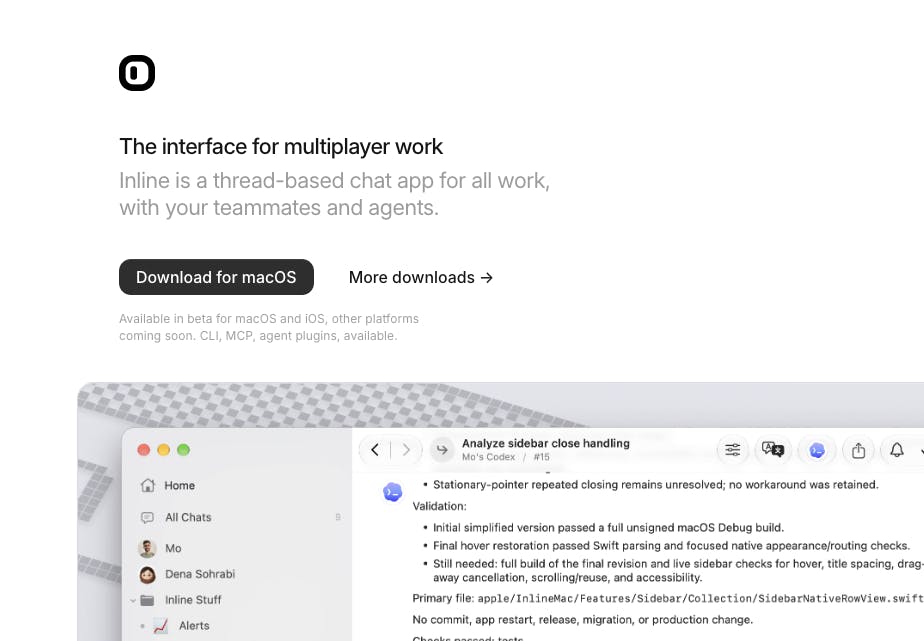
The product is a thread-based chat app in which conversations are organized into threads rather than channels, and AI agents can be brought into those threads as participants alongside humans. The website describes it as “the interface for multiplayer work,” with beta availability on macOS and iOS, plus a CLI, MCP support, and agent plugins (including OpenClaw and Hermes integrations listed on the download page). The GitHub repository emphasizes speed (120-fps rendering, sub-1% CPU usage), a public API, and low-cognitive-load design; the stack is native Swift for Apple platforms, with a Bun/Postgres server and a React web app in development. inline
Target users are small teams — the positioning straddles work and personal use (“a delightful chat app for work & friends”), which suggests the initial wedge is small teams and communities of technical early adopters rather than enterprises. Pricing is free; no paid tiers exist. The product replaces Slack or Discord for teams willing to tolerate alpha-stage software — a population the founders themselves acknowledge is limited to “enthusiastic testers”. producthunt
One verification caveat: the product is genuinely available (downloadable macOS app, iOS TestFlight, active repositories), but it is explicitly not production-ready, and platform coverage excludes Windows, Android, and Linux entirely. github
Founder and Team Assessment
Founder identities are independently verified across LinkedIn, GitHub, X, and prior product sites. linkedin
Mo Rajabi (CEO) dropped out of high school to build There HQ (2018–2019), worked as an open-source engineer, then co-founded Noor (January 2021–August 2024), and has led Inline since September 2024. There.team reached #1 on Pioneer’s global leaderboard and won its award (cash and prizes) — a meaningful early signal, though not institutional funding. Dena Sohrabi designed and built the macOS and iOS apps and previously co-created There and Noor with Mo. linkedin
Technical capability is strong and verifiable: native Swift applications, a from-scratch Rust WebRTC stack built for their previous product, and an active open-source repository with 607 stars and 25 forks. Both founders report working on Inline full-time. github
The concerns are equally clear. Commercial capability is unproven: across three products over eight years, there is no public evidence of revenue, paying customers, or a fundraise, and There was explicitly never monetized. The pattern of rebuilding the same product category three times (There → Noor → Inline) suggests difficulty converting craft into product-market fit. The team is two people with high key-person risk, no visible GTM or sales capability, and no disclosed hires. there
Founder Assessment: Exceptional persistence and technical execution in a category the founders know deeply, but commercial capability remains entirely unproven.
Market Opportunity
The initial target segment is small (roughly 5–50 person) technical teams and communities dissatisfied with channel-based chat and interested in agent-assisted workflows. Willingness to pay is untested — the product is free — but adjacent products price at $7–15 per user per month (e.g., Google Workspace Business Starter at $7/user/month, Slack’s paid tiers), implying roughly $85–180 per user annually for team chat. quikit
A rough bottom-up estimate (analyst assumption, not verified): if ~2 million such team-suitable organizations exist globally in English-speaking and developer-heavy markets, and Inline realistically reaches the tech-forward subset (perhaps 100,000–200,000 teams at maturity), at ~10 seats and ~$100 per user per year, the realistic serviceable revenue pool is roughly $100M–$200M annually — comparable to a single mid-market SaaS category, before accounting for the near-zero current share. The total collaboration market is large and growing (Slack alone is a multi-billion-dollar revenue line within Salesforce), so the market can in principle support venture-scale revenue. slack
The timing argument is the most credible part of the case: agents-as-coworkers is a genuinely new interface requirement, and established players are only now shipping it (Glean announced team chat for multiplayer AI collaboration in beta in August 2026). The problem is that this timing benefit is available to every entrant, including incumbents with existing distribution. businesswire
Traction and Growth Signals
Available evidence is thin and almost entirely pre-commercial:
- Product Hunt: launched September 6, 2026; 77 followers; a small number of launch-day comments, including a supportive beta tester and a substantive product question about agent-thread handling. Vote counts were not visible at the time of research. producthunt
- GitHub: 607 stars, 25 forks, 5 contributors on the main repository; organization has ~49–66 followers; repositories active since 2024 with ongoing commits. github
- Product activity: the download page and website are live and current; the changelog for predecessor Noor showed a disciplined two-releases-per-week cadence, indicating sustained engineering output. inline
- Commercial metrics: revenue, paying customers, registered users, active users, retention, and growth rate are all not publicly disclosed. No funding announcements, press coverage of substance, customer case studies, or partnerships were found.
Critically, launch attention must be separated from traction: the Product Hunt launch occurred one day before this report, and GitHub stars accumulated over two years of open development. Neither constitutes evidence of adoption, let alone product-market fit. The most important missing metrics are active team count, retention of onboarded teams, and any monetization intent.
Traction Assessment: Promising craftsmanship and steady shipping, but commercially unverified with effectively no adoption evidence.
Competitive Position
Direct competitors include Slack, Microsoft Teams, Discord, and Zulip (the closest structural analogue — an open-source, thread-centric team chat). Indirect competitors include Glean’s new team chat for multiplayer AI work, Roam, and the broader wave of “multiplayer AI” workspaces from enterprise AI vendors. Free alternatives are abundant: Slack and Teams free tiers, Discord, Matrix/Element, Mattermost, and Rocket.Chat. businesswire
Inline’s differentiation is real but narrow: a native, performance-observed Apple-first client, thread-first information architecture, open-source AGPL clients, and early MCP/agent integration. Pricing advantage is undefined (free versus incumbents’ paid tiers is not a durable advantage). Distribution advantage is absent. Switching costs for teams leaving Slack are high, and Inline has no network effects or proprietary data at its current scale. github
The decisive question — “if Slack or Teams shipped equivalent agent-in-thread functionality within six months, why would customers stay?” — has no strong answer. Slack is already marketing itself as an AI work platform, and Glean’s team chat announcement shows the incumbents and well-funded AI vendors converging on this exact concept. The remaining answer — superior native performance and thread ergonomics for Apple-centric teams — defines a niche, not a moat. businesswire
Defensibility Assessment: Low.
Business Model and Economics
The revenue model is not publicly disclosed. The product is free, there is no pricing page, and the founders’ eight-year history in this category contains no monetized product. Potential models include per-seat SaaS (comparable to Slack at ~$8–15/user/month), self-hosting/enterprise support (given AGPL clients), or agent usage-based fees. None has been announced. producthunt
Gross margin potential for chat SaaS is structurally high, but agent-mediated conversations introduce LLM inference costs that scale with usage; whether revenue would grow faster than inference and infrastructure costs cannot be assessed without pricing. Customer support, compliance (SOC 2, etc.), and enterprise administration requirements for team chat are material and currently unaddressed publicly. comm100
The free plan is the entire product today. Free-to-paid conversion, churn, and ACV are all not assessable. For a consumer-adjacent “work & friends” positioning, usage frequency should be high, but so is the availability of free substitutes.
Unicorn Path
Assuming the company eventually adopts a per-seat SaaS model, a 10x ARR multiple is appropriate for a high-growth collaboration SaaS at scale (consistent with how Slack and comparable SaaS companies have been valued in acquisitions and public markets). On that basis:
Required Revenue for a $1 billion valuation ≈ $1B ÷ 10 = $100M ARR.
At a plausible $100 per user per year (in line with Slack’s historical blended pricing), this requires roughly 1 million paid seats, or about 100,000 ten-person teams — against Slack’s entrenched installed base and free alternatives. Reaching this would require, simultaneously: launching monetization from zero; expanding beyond macOS/iOS to Windows, Android, and web; building an enterprise administration and compliance layer; establishing a repeatable distribution channel that no predecessor product achieved; and raising substantial external capital with a team of two.
The category has produced unicorns (Slack, Discord), so the path is not logically impossible — but for this company, in this configuration, it requires a major strategic transformation across every dimension at once.
Unicorn Path: Improbable.
Valuation Assessment
No funding history, investors, round terms, SAFE caps, or valuations are publicly known. No secondary transactions, revenue data, or comparable financings exist for this company. Revenue multiples cannot be applied without revenue.
Valuation Attractiveness: Not Assessable. Responsible assessment would require, at minimum: current ARR and growth, retention/cohort data, gross margin, burn and runway, the size and terms of any round (SAFE cap or post-money valuation), investor ownership, and liquidation preferences. A valuation range derived from product quality or Product Hunt performance would be false precision.
Key Risks
Ranked from most to least material:
- Incumbent replication: Slack, Teams, and funded AI vendors are already shipping agent-in-thread features, removing the timing wedge. businesswire
- No monetization: eight years of building chat products with zero demonstrated revenue. there
- Structurally weak distribution: chat has network effects and high team switching costs; no acquisition channel is evident.
- Serial rebuild pattern: There → Noor → Inline suggests repeated pursuit of the same thesis without commercial breakthrough. linkedin
- Platform coverage: no Windows, Android, or Linux clients; web app still in development — most teams cannot adopt it. github
- Founder/key-person risk: two people, no visible hires, no disclosed funding or runway. github
- Category commoditization: free open-source alternatives (Zulip, Matrix, Mattermost) cap pricing power. ethora
- Ambiguous positioning (“work & friends”) muddies the enterprise buying center.
- AGPL licensing may complicate future commercial or enterprise licensing strategies.
Final Assessment
Venture Potential: 38/100
| Category | Score |
|---|---|
| Market Size and Expansion Potential | 13/20 |
| Traction and Growth Evidence | 3/20 |
| Founder and Team | 8/15 |
| Product Strength | 6/10 |
| Distribution Potential | 4/15 |
| Business Model and Economics | 2/10 |
| Defensibility | 2/10 |
| Total | 38/100 |
The strongest elements are market timing (agent-native chat) and founder craft. The weakest are traction (effectively none), monetization (none), and defensibility (low). The score places Inline in the “more likely a niche, lifestyle, or bootstrapped business” band.
Evidence Confidence: 45/100
Verified: founder identities and history, team size (self-reported two founders, corroborated by LinkedIn and GitHub), product existence and platforms, free pricing, open-source activity, and prior products. Company-reported: full-time commitment, daily-driver usage, Pioneer award. Not available: funding, investors, revenue, users, retention, growth, entity details, and runway. Repeated secondary mentions of the launch do not add commercial evidence.
Final Decision: Watch
Inline is one day past its Product Hunt launch, pre-revenue, pre-funding (as far as public information shows), and unproven on every commercial dimension — too early for DD or Pass to be definitive. The decision rests on the genuine emergence of the agent-native chat category and the founders’ demonstrated execution, against a 38/100 venture score, an Improbable unicorn path, and low defensibility. This is a Watch with a short leash: it sits close to Pass under a strict venture strategy.
Upgrade Conditions
- Launching a paid tier and disclosing early conversion or paying-team data
- Sustained retention: measurable share of onboarded teams active at 90 and 180 days
- Windows/web availability removing the platform adoption barrier
- Evidence of organic distribution beyond the founders’ own audience (e.g., teams adopting without founder involvement)
- A priced round with credible investors, or enterprise/community deployments at scale
- A defensible data or agent-workflow advantage that survives incumbent replication
Downgrade Conditions
- No monetization within 12 months of launch
- High churn among onboarded beta teams
- Slack/Teams shipping equivalent agent-thread features with wide distribution
- Another product rebuild or category pivot
- Founder departure or reduced commitment
- Evidence of overstated traction claims
Questions for Further Diligence
- How many teams are currently active, and what share remain active at 30, 90, and 180 days?
- What is the intended pricing model, and what willingness-to-pay evidence (surveys, trials, waitlist segments) supports it?
- What did Noor’s adoption look like at its peak, and what specifically changed in the market or product to justify Inline rather than iterating on Noor?
- What are the monthly infrastructure and (if any) LLM inference costs today, and how do they scale with agent usage?
- How is the company funded — personal savings, revenue from prior products, or outside capital — and what is the current runway?
- What is the roadmap and timeline for Windows, Android, Linux, and web clients?
- How does the team intend to overcome Slack/Teams switching costs — which beachhead segment converts most readily, and why?
- What happened to There’s user base and the declined acquisition offers referenced on Noor’s site? noor
- What role will the AGPL license play in future commercialization (hosting, enterprise licensing, support)?
- Are there any enterprise or community pilots underway, and what retention do they show?
- What is the hiring plan, and does the team intend to raise institutional capital?
- How does Inline’s agent integration (MCP, plugins) create lock-in or proprietary data that a Slack feature update could not replicate?
Sources
- Product Hunt — Inline producthunt
- Inline official website inline
- Inline download page inline
- GitHub — inline-chat/inline repository github
- GitHub — inline-chat organization github
- Mo Rajabi on LinkedIn linkedin
- Dena Sohrabi on LinkedIn linkedin
- Mo Rajabi on X (@morajabi) x
- Noor (predecessor product) website noor
- There (prior product) donation page there
- CrabNebula interview with Mo Rajabi on Noor crabnebula
- GitHub — inline-chat/webrtc-client-rust (Noor heritage) github
- Glean team chat announcement (competitive context) businesswire
- Slack (incumbent context) slack
- Zapier team chat comparison (pricing context) zapier