
Table of Contents
Zella Investment Report
Category: On-device AI screen recording and video editing (Mac/iOS prosumer software)
Company Stage: Pre-revenue-disclosed solo-founder product, launched days ago
Founder or Founders: Nasir Uddin Shamim (solo, per the site’s terms and blog); App Store seller listed as “Md Nasir Uddin Morol” apps.apple
Headquarters: Not publicly disclosed (founder based in Dhaka, Bangladesh, per his LinkedIn profile) linkedin
Funding: Not publicly disclosed
Business Model: Free tier plus one-time-purchase licenses ($89 Pro / $299 Founder) via Apple’s App Store zellahq
Product Hunt Launch Date: September 17, 2026 hunted
Report Date: September 20, 2026
| Investment Metric | Assessment |
|---|---|
| Venture Potential | 37/100 |
| Unicorn Path | Improbable |
| Valuation Attractiveness | Not Assessable |
| Evidence Confidence | 42/100 |
| Final Decision | Pass |
Executive Summary
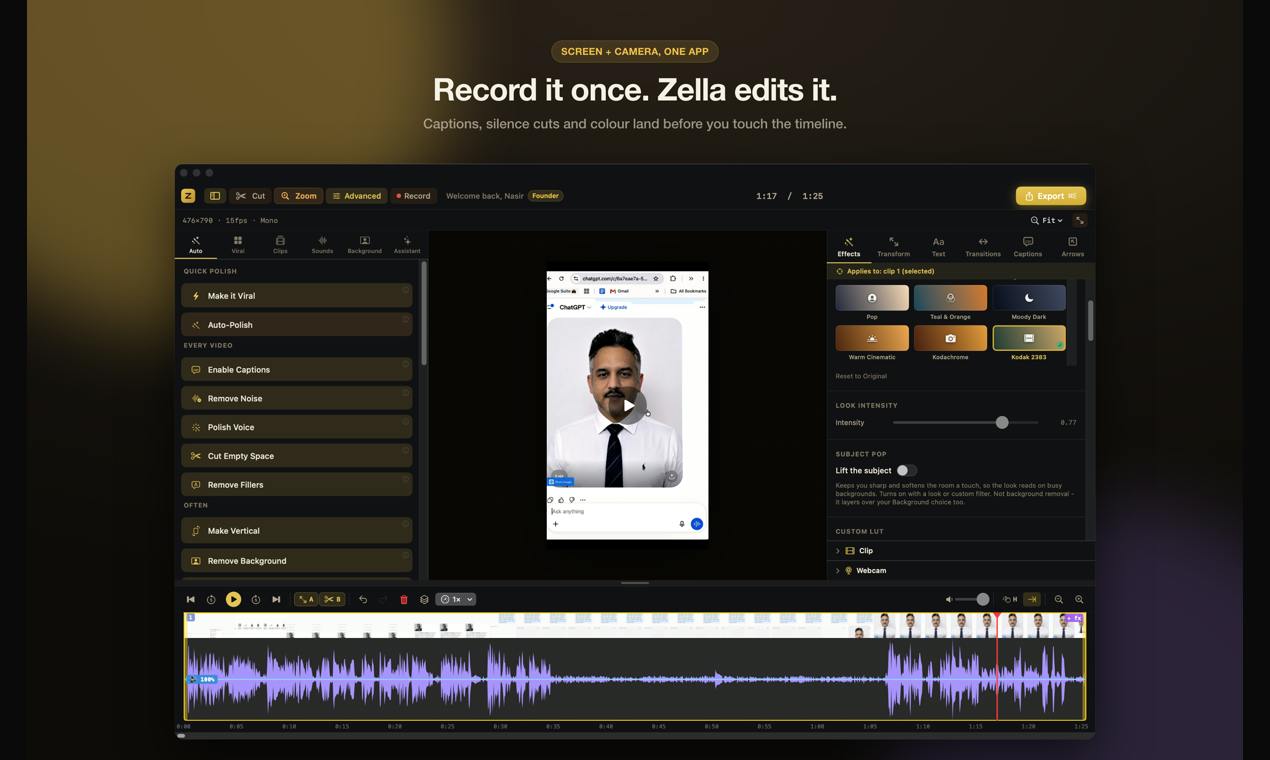
Zella is a screen and camera recorder with a built-in AI video editor for Mac and iPhone. It records a raw take and, in one tap, cuts silences, removes filler words, generates captions, polishes audio, and applies pacing, zooms, and music — with all processing running entirely on-device. Nothing uploads, no account is required, and there is no watermark. apps.apple
The product serves solo creators, founders, educators, and SMB sellers who need short-form video but lack editing skills or budget. Its positioning is unusually sharp for the category: a complete free editor (capped at 2-minute, 1080p exports), a single $89 lifetime unlock covering Mac and iPhone, and an explicit privacy promise that is verifiable by putting the device in airplane mode. zellahq
The strongest positive signal is product quality and positioning discipline. The website, pricing page, and documentation are among the most credible and transparent in the prosumer video category, and the on-device architecture eliminates cloud inference costs — a structural cost advantage over cloud-rendered competitors like Descript and Loom. zellahq
The most important investment concern is the business model. A one-time $89 license sold by a single founder, with no recurring revenue, no disclosed funding, no App Store ratings yet, and no verified commercial traction is, by construction, an indie/bootstrapped business rather than a venture-scale one. apps.apple
Venture Potential scores 37/100 — the “niche, lifestyle, or bootstrapped business” band. The unicorn path is Improbable under the current one-time-purchase model. Valuation Attractiveness is Not Assessable because no funding, revenue, or valuation information exists. Final decision: Pass — a well-executed product that does not fit a venture capital strategy, though it could be reconsidered if the company restructures toward recurring revenue with verified scale.
Product Overview
Zella addresses a concrete problem: recording a video is easy, but turning a raw take into something postable takes an evening of cutting, captioning, re-cropping, and audio cleanup. Zella collapses that workflow into “record, tap once, export.” Auto-Polish performs silence cuts, filler-word removal, keyword captions with emoji, noise removal and voice polish, hook titles, emphasis zooms, ducking music, and pattern interrupts; “Make it Viral” adds pacing, transitions, sound effects, and a music bed. zellahq
Core features include AI background removal without a green screen (live in the iPhone viewfinder), face-aware reframing to 9:16/1:1/16:9, on-device caption translation into 19 languages, an AI Assistant that edits by typed command (101 actions on Mac, 71 on iPhone, using the user’s own API key), Auto B-Roll from free stock libraries, and a full manual timeline editor underneath. apps.apple
Target users span creators, founders, course creators, freelancers, and SMBs — 32 documented use cases on the site. Pricing is a free tier (complete editor, all AI, unlimited recording, 2-minute/1080p export cap), Pro at $89 once, and a Founder supporter tier at $299 once; both paid tiers are Apple Universal Purchases covering Mac and iPhone, with 7-day “Pro Week” trials. zellahq
The product replaces manual editing in tools like iMovie or CapCut, subscription competitors (Loom at $18/user/month, Descript at $16/month, CapCut at $9.99/month), and one-time Mac-only alternatives like Screen Studio. It is live on the App Store and Mac App Store, though the App Store listing shows no ratings yet and the app is at version 1.0.2. apps.apple
Founder and Team Assessment
The legal terms identify the developer as Nasir Uddin Shamim, an individual rather than a company entity. The site’s own materials describe Zella as built by “one person,” including a pricing page note that priority support is answered by “the person who writes the code, because there is only one of him”. zellahq
Shamim’s verifiable public background is in SEO and internet marketing, not software engineering: he is the founder of NShamimPRO (an SEO training platform), co-founded DevsTeam, and runs LateNightBirds, based in Dhaka. The App Store seller is listed under a different name, “Md Nasir Uddin Morol,” whose developer account also publishes a separate animation app (Fliplo). This suggests a possible two-person founder/developer arrangement, but the team structure is not publicly documented — an important unverified point. linkedin
There is no evidence of funding, a legal entity with employees, or prior exits. The engineering achievement implied by shipping a native Mac and iPhone app with on-device AI (transcription, background removal, voice cleanup) is substantial for a solo or two-person effort, but technical capability cannot be independently verified beyond the shipped product itself. Key-person risk is total: the site openly states there is no support rota and no team to escalate to. zellahq
Founder Assessment: Strong marketing and positioning capability (verified), genuine solo execution (company-reported), but engineering depth, commercial track record in software, and team scalability are unverified.
Market Opportunity
The initial target customer is narrow: an individual Apple-device creator or SMB seller who posts short-form video (under 2 minutes for social feeds) and does not want a subscription or an upload to a cloud service.
A bottom-up estimate (analyst assumption, not verified data): Apple has on the order of 1.5–2 billion active devices globally; the subset of active short-form video creators, educators, and SMB sellers producing video regularly on Mac/iPhone is plausibly in the low tens of millions. Assuming a realistic 1–2% ever pay $89 for this tool yields roughly 100,000–400,000 lifetime buyers, or approximately $9–36 million in cumulative one-time revenue (before Apple’s 15–30% commission). That comfortably supports a profitable indie business — the comparable trajectory of Screen Studio, a similarly positioned one-time-purchase Mac recorder — but not venture-scale recurring revenue. zellahq
Expansion levers exist (long-form creators needing 4K and unlimited length, agencies, team licenses the site says do not exist today ), and the founder’s SEO background is directly relevant organic-distribution expertise. Market timing is favorable: on-device AI model quality and Apple Silicon Neural Engine capability have only recently made this architecture feasible. However, the same timing applies to every competitor, including Apple itself. zellahq
Traction and Growth Signals
Available evidence is extremely thin:
- Product Hunt: launched September 17, 2026. The PH page shows a 4.0 rating from 1 review and roughly 122 followers. PH’s awards page shows a “Launch of the Day” badge for September 17, 2026, but the third-party tracker Hunted.Space recorded the launch at #143 on the daily leaderboard with 1 comment in its final snapshot — a material conflict that cannot be resolved from public data. Either way, the launch was small. hunted
- App Store: no ratings displayed (“hasn’t received enough ratings”), version 1.0.2, 17.1 MB, listed since roughly early September 2026. apps.apple
- Revenue, downloads, users, retention, conversion: not publicly disclosed. No reliable public information was found.
- Distribution: a Facebook community, a large SEO-oriented blog on the product site, and the App Store. zellahq
- Funding: no announcements found; likely bootstrapped (analyst inference).
The most important missing metrics are paying-customer count, free-to-Pro conversion, and post-launch download trend. Nothing here demonstrates product-market fit; the launch window closed three days ago.
Traction Assessment: Launch attention only; commercially unverified.
Competitive Position
Direct competitors: Screen Studio (one-time Mac purchase, auto-zoom, no AI captioning), CapCut (free/cheap, cloud-based, ByteDance-owned), Descript, Loom, Tella ($13/month), and newer AI entrants like LazyReel on Setapp. Indirect: Apple’s free built-in tools (screen recording, Photos Audio Mix, iMovie, Final Cut). Free alternatives: CapCut’s free tier and OS-native capture. zellahq
Zella’s current differentiation is real: the combination of a genuinely complete free tier, no watermark, no account, 100% on-device processing, universal Mac+iPhone purchase, and one-time pricing is a package no major competitor matches, and the site argues a cloud-funded competitor cannot copy it without dismantling its own subscription business. The on-device architecture also removes inference costs entirely — a durable margin advantage. zellahq
But defensibility is low. On-device transcription and background removal are increasingly commodity Apple-framework capabilities; Apple could ship “Auto-Polish” as an OS feature, and CapCut’s scale gives it distribution Zella cannot match. The answer to “why would customers stay if Apple or ByteDance shipped this within six months” is “price and privacy, for a while” — not a moat.
Defensibility Assessment: Low
Business Model and Economics
Revenue is one-time IAP licenses: $89 Pro, $299 Founder, via Apple’s App Store. Key economic characteristics: apps.apple
- Gross margin is structurally high: no cloud rendering, no inference costs, no accounts. The 145 MB caption model downloads once. zellahq
- Apple takes 15% (small-business program) to 30% of each sale, so net revenue per Pro license is roughly $62–76.
- There is no recurring revenue, no seat-based expansion, no enterprise motion, and the site explicitly commits to never replacing the one-time license with a subscription. zellahq
- The free tier is so complete that the company itself states “most people never need” Pro and advises many users not to buy it. This is honest and brand-building, but it caps conversion. zellahq
- Expansion revenue depends on major-version upgrades (Pro covers 1.x only; Founder covers all versions), a model with weak, irregular monetization.
For a consumer one-time-purchase app, the critical unknowns are free-to-paid conversion, upgrade-cycle behavior, and install volume — none disclosed.
Unicorn Path
Assume a revenue multiple of 5x for a high-margin consumer software business — generous versus typical single-product app acquisitions (usually 1–3x) but below top-decile SaaS. Required revenue ≈ $1B ÷ 5 = $200 million. At a net ~$62–76 per Pro license after Apple’s commission, Zella would need roughly 2.6–3.2 million paying customers — against a realistic worldwide buyer pool for this niche estimated in the low hundreds of thousands. Even at a 10x multiple, required customers would be about 1.3–1.6 million, still far beyond credible reach for this category and pricing.
Strategically, reaching that scale would require abandoning the model the company has publicly promised never to change: moving to subscriptions, adding team/enterprise licensing, or building a platform/marketplace. The company’s own public commitments (no subscription ever, free tier never shrinks) actively foreclose the most common venture-scale paths. zellahq
Unicorn Path: Improbable
Valuation Assessment
No funding rounds, investors, valuations, SAFE caps, or acquisition interest are publicly known. There is no revenue data against which to apply any multiple. Comparable financings for solo-founder, pre-traction, one-time-purchase consumer apps are not meaningful benchmarks.
“Valuation Attractiveness: Not Assessable.” Assessing it would require: current paying-customer count and conversion, gross revenue, any financing history or round terms, and founder cap-table intent. No valuation range is responsibly supportable from product quality or Product Hunt performance.
Key Risks
- Business model forecloses venture scale — public no-subscription commitments make recurring revenue structurally impossible. zellahq
- Total key-person dependency — one person builds, supports, and markets the product. zellahq
- Commoditization by platform vendors — Apple and ByteDance can replicate the AI features with vastly greater distribution.
- Unverified engineering capability — the founder’s verified background is SEO/marketing; the developer-account/seller-name mismatch leaves team composition unclear. apps.apple
- Zero verified traction — no ratings, no revenue, no users disclosed; launch was three days ago. apps.apple
- Category price pressure — free tiers from CapCut and Apple’s native tools compress willingness to pay.
- One-time-purchase revenue plateau — license businesses saturate their buyer pool and decline without version upgrades.
- No funding or team to sustain a competitive response if a large player attacks the niche.
Final Assessment
Venture Potential: 37/100
| Category | Score |
|---|---|
| Market Size and Expansion Potential | 10/20 |
| Traction and Growth Evidence | 3/20 |
| Founder and Team | 5/15 |
| Product Strength | 7/10 |
| Distribution Potential | 6/15 |
| Business Model and Economics | 4/10 |
| Defensibility | 2/10 |
| Total | 37/100 |
The strongest elements are product strength and positioning (transparent pricing, verifiable privacy claim, structural cost advantage from on-device processing). The weakest are traction (nothing verified beyond a small launch), a business model that cannot compound, and near-zero defensibility against platform vendors.
Evidence Confidence: 42/100
Verified: founder identity, founder’s marketing background, product existence and feature set, pricing, platform availability, and PH launch date. Company-reported: solo status, on-device claims (though independently testable), and the “one person” narrative. Unknown: revenue, customers, downloads, retention, funding, valuation, legal entity, team composition beyond the founder, and the true engineering arrangement. Conflicting: PH launch performance (awards badge vs. #143 tracker ranking). apps.apple
Final Decision: Pass
Zella is a genuinely well-executed product with disciplined positioning and a real structural cost advantage, but it fails the venture test on every financial dimension: no recurring revenue by explicit design, no verified traction, a solo founder with unverified engineering depth, low defensibility, and an Improbable unicorn path. Valuation is Not Assessable, which alone rules out any stronger decision. This looks like an excellent candidate for a bootstrapped lifestyle business, not a venture investment — Pass does not mean the product is bad.
Upgrade Conditions
- Pivot to (or addition of) recurring/seat-based revenue with verified ARR, despite stated commitments.
- Demonstrated scale: e.g., 500,000+ installs with disclosed conversion, or $1M+ annual revenue.
- Team expansion beyond one person, with verified engineering hires.
- A defensible technical or data moat that Apple or ByteDance cannot trivially replicate.
Downgrade Conditions
- Product abandonment or declining update cadence after launch.
- Discovery that founder/company claims (on-device, no-upload) are inaccurate.
- Apple shipping equivalent AI auto-editing in iOS/macOS.
- Founder returning focus to SEO ventures, leaving Zella unmaintained.
Questions for Further Diligence
- What are current downloads, installs, and paying Pro/Founder customers to date?
- What is the observed free-to-paid conversion rate, and how does Pro Week affect it?
- How many of the ~122 PH followers and launch visitors converted to sustained usage?
- Who wrote the code — Shamim, Morol, or contractors? What is the actual team structure?
- Is any entity incorporated, and in which jurisdiction?
- What is current monthly revenue, and what is the trend since the App Store listing went live?
- How are major-version upgrades monetized in practice (observed upgrade rates from 1.x to future versions)?
- What is the customer acquisition model beyond SEO and Product Hunt, and what does it cost?
- Has any investor approached the company, or is external capital being considered?
- What happens to support and development continuity if the founder is unavailable?
Sources
- Product Hunt — Zella producthunt
- Zella official website zellahq
- Zella pricing page zellahq
- Zella about page zellahq
- Zella terms of service (founder identity) zellahq
- App Store — Zella: Recorder & Video Editor apps.apple
- App Store developer page — Md Nasir Uddin Morol apps.apple
- Zella blog — founder background zellahq
- Hunted.Space launch dashboard (secondary source) hunted
- Founder LinkedIn profile linkedin
- NShamimPRO — founder bio nshamimpro
- Competitor context: Tella, LazyReel on Setapp setapp