
Table of Contents
Cronloop AI Investment Report
Category: AI workflow automation / scheduled AI agents (developer & prosumer tools)
Company Stage: Newly launched (Product Hunt launch August 19, 2026); no funding found — apparently bootstrapped, not verified
Founder or Founders: Michael “Mike” Tromba (solo, per Product Hunt and LinkedIn)[1][2]
Headquarters: Not publicly disclosed; founder located in Austin, Texas per LinkedIn[2]
Funding: Not publicly disclosed; no funding announcements or database entries found. Listed on SuperPublic, an indie/bootstrapped-founder directory — a weak signal of bootstrapped status[3]
Business Model: Freemium SaaS subscription; users bring their own inference (ChatGPT/Claude subscription or API keys)[4]
Product Hunt Launch Date: August 19, 2026[5][6]
Report Date: August 22, 2026
| Investment Metric | Assessment |
|---|---|
| Venture Potential | 43/100 |
| Unicorn Path | Improbable |
| Valuation Attractiveness | Not Assessable |
| Evidence Confidence | 40/100 |
| Final Decision | Pass |
Executive Summary
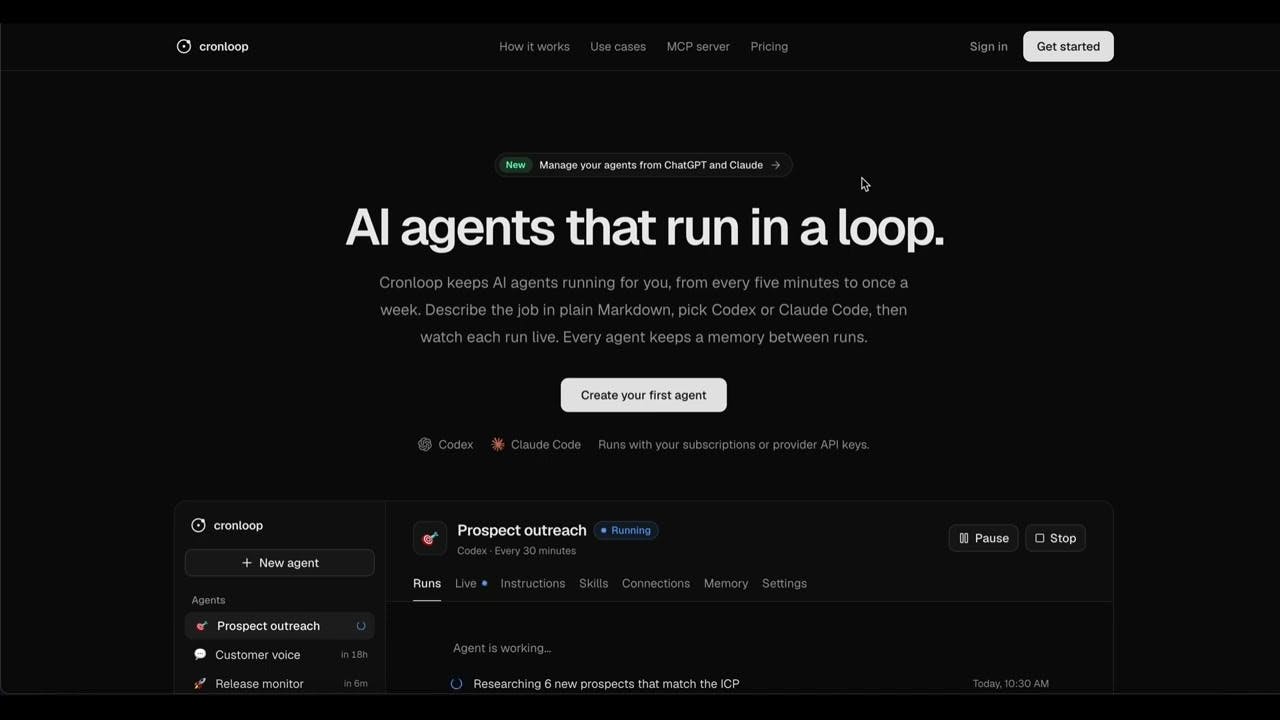
Cronloop AI is a hosted service that runs AI coding agents (OpenAI Codex or Anthropic Claude Code) on recurring schedules, from every five minutes to weekly. Users describe a job in Markdown, connect tools via 200+ connectors, and each run executes in an ephemeral sandbox with durable memory persisting between runs. A hosted MCP server lets users manage agents from ChatGPT or Claude directly. It launched on Product Hunt on August 19, 2026, finishing #10 for the day with roughly 117 upvotes.[1][4][5][6]
The product is well-conceived for a real emerging behavior: people who pay for Claude Code or Codex subscriptions want those agents to work unattended on recurring jobs — SEO updates, support triage, competitor monitoring, issue-to-PR conversion. The bring-your-own-inference design keeps the price low ($20–25/month) and removes inference costs from Cronloop’s own P&L.[4]
The strongest positive signal is the founder. Mike Tromba is a verified, prolific builder who claims 30+ shipped products reaching 27M+ users and an early exit (a web-games platform sold at 19); these figures are self-reported but the shipping cadence is independently visible across his current portfolio (Cactal, UXCanvas).[2][7][8]
The most important concern is structural, not executional: Cronloop is a scheduling and hosting layer on top of two platforms that have already shipped native scheduling. OpenAI offers Scheduled Tasks in ChatGPT and scheduled automations in Codex; Anthropic’s Claude Code ships /loop and built-in cron tools. The free alternative — cron plus the Claude Code/Codex CLI — is trivial for exactly the technical users Cronloop targets.[9][10][11]
There is no commercial evidence: no disclosed revenue, customers, retention, or funding, three days post-launch. The decision is Pass — not because the product is weak, but because the venture-scale case is improbable under the current model and the wedge is already partially absorbed by the underlying platforms.
Product Overview
The customer problem: running an AI coding agent on a recurring job today requires keeping a terminal session alive, maintaining a VPS with cron, or wiring CI schedulers — friction that breaks the “agent works while you sleep” promise. Cronloop productizes this: Markdown instructions, a schedule, sandboxed execution with live log streaming, a durable Markdown memory so agents can “self-improve” across runs, and 200+ connectors (anything with an MCP, CLI, SDK, or API).[1][4]
Pricing is verified on the official site: Free tier (3 agents, hourly-or-slower runs, 200 run-minutes/month, 10-minute run cap, 1 concurrent run) and Pro at $25/month or $20/month annual (no fixed agent limit, 5-minute intervals, 60-minute runs, 3 concurrent runs). Target users are developers, indie hackers, and technical founders already paying for Claude Code or Codex. The product replaces DIY cron-plus-CLI setups and lightweight CI automation. It is live and functional as of this report; closed-source, with run-time limits noted by an early third-party review.[4][12][13]
Founder and Team Assessment
Michael Tromba is independently verifiable via his personal site, LinkedIn, and Product Hunt. Self-reported history: self-taught at 16, built a web-games platform to a claimed 2M+ monthly users, sold it at 19, and has since shipped 30+ products reaching a claimed 27M+ people. These figures are founder-reported and not independently verified. His current focus is Cactal, an “agent-native website platform” whose about page cites an earlier product, UXCanvas, with 10,000+ users (company-reported).[2][7][8][14]
Two concerns stand out. First, split focus: Cronloop appears to be one of several concurrent products (Cactal, UXCanvas, ApplyFox), and Cronloop’s own maker comment describes it as a tool he built for himself — full-time commitment to Cronloop as a company is unclear. Second, key-person risk is maximal; there is no evidence of any team beyond the founder.[1][2]
Founder Assessment: Strong technical execution and distribution instincts, but commercial scale-up capability and single-company commitment remain unproven.
Market Opportunity
The initial customer is narrow and should be stated as such: paying Claude Code/Codex/ChatGPT subscribers who want recurring, unattended agent runs and won’t maintain their own scheduler. Anthropic and OpenAI do not disclose coding-agent subscriber counts, so any sizing is an analyst assumption. Illustratively: if 3–5M paying coding-agent subscribers exist globally, 5–10% have a recurring-automation need, and 3–5% of those would pay $240/year, the initial wedge supports roughly $1M–6M ARR; even a generous case (5M × 20% × 10%) yields only ~$24M ARR. These are assumptions, not verified figures.
The broader agentic-automation market is unquestionably large and venture-validated — n8n raised $180M at a $2.5B valuation and Gumloop raised a $50M Benchmark-led Series B — but Cronloop does not currently compete in that platform segment. Reaching venture scale requires expanding from prosumer scheduling into team/enterprise agent orchestration, where it would meet those funded incumbents head-on. Market timing is favorable; the specific wedge is small and platform-adjacent.[15][16]
Traction and Growth Signals
Verified traction is launch-attention only: #10 on Product Hunt’s August 19, 2026 daily leaderboard with approximately 117 upvotes and 4 comments, and 148 followers on the product page. The founder reports personally running ~25 agents and cites his own projects (aievents.now, Cactal-hosted sites) as use cases — company-reported, not customer evidence. Third-party coverage consists of AI directory listings and brief reviews.[1][5][6][13][17]
Missing metrics are nearly everything that matters: revenue, paying customers, registered users, retention, free-to-paid conversion, and post-launch weekly active usage. None are publicly disclosed.
Traction Assessment: Promising launch-day interest, commercially unverified.
Competitive Position
Direct competitors include general agent-automation platforms with scheduling (n8n, Gumloop, Lindy — the latter with ~$54M raised per a secondary source, Zapier Agents, Make, Relevance AI) and developer-oriented runners (Trigger.dev, GitHub Actions + Claude Code/Codex actions). The decisive threat is vertical: OpenAI already ships Scheduled Tasks in ChatGPT (with plan-based limits, e.g., runs no more than hourly on some tiers) and scheduled Codex automations, while Anthropic ships /loop and CronCreate/CronList scheduling natively in Claude Code. The free manual alternative — cron plus the CLI the user already pays for — is strongest precisely among Cronloop’s technical target users.[9][10][11][18][19]
Cronloop’s residual differentiation is real but thin: managed sandboxes that run without your laptop, cross-run durable memory, 200+ pre-built connectors, 5-minute minimum intervals, and MCP-based agent management. None of these are defensible IP; all are replicable features. If OpenAI or Anthropic extended their native schedulers with connectors and persistent memory — a plausible six-month outcome — there is no credible answer for why customers would keep paying Cronloop. Switching costs are near zero; there is no proprietary data moat or network effect.[4]
Defensibility Assessment: Low
Business Model and Economics
The model is freemium SaaS at $240–300/year per paying user, with inference costs externalized to the user’s own provider subscription or API key. That is economically clever: gross margin is not eroded by model costs, the classic killer of AI-wrapper economics. The remaining variable costs are sandbox compute and bandwidth. Notably, Pro offers “no fixed monthly run-minute limit” with 5-minute intervals and 3 concurrent runs — a heavy user could run agents ~24/7, making sandbox infrastructure a real and potentially concentrated cost; usage-based abuse controls are unknown.[4]
The structural weakness is ARPU. At $240/year, even 1,000 paying users yields only ~$240K ARR. The model needs either very high volume (expensive to acquire at this price point) or a future move to team/enterprise pricing, which does not exist today. Free-to-paid conversion, churn, and CAC are all unknown.
Unicorn Path
Assume an 8–10x ARR multiple, appropriate for a low-ARPU prosumer SaaS with unproven retention (best-in-class agentic-automation companies command more, but Cronloop is not one). Required ARR for a $1B valuation: $100M–125M. At $240/year per subscriber, that implies roughly 420,000–520,000 paying subscribers — a subscriber base on the order of the largest developer subscription products in existence, for a scheduling utility with free native alternatives.[4][11]
Reaching that scale would require a full transformation: team and enterprise tiers, owned inference margin, security/compliance posture, and a platform story competitive with n8n and Gumloop — none of which is evidenced today. Under the current model there is no realistic route; even under a transformed model, execution risk against funded incumbents and platform vendors is extreme.
Unicorn Path: Improbable
Valuation Assessment
No funding rounds, investors, valuations, or revenue figures are publicly disclosed, and none were found in funding databases or press. The product’s presence on an indie-founder directory suggests bootstrapping, but this is unverified.[3]
Valuation Attractiveness: Not Assessable. Responsible assessment would require: current MRR/ARR and growth, paying customer count, retention cohorts, sandbox infrastructure cost per user, burn and runway, and any current round terms (SAFE cap or post-money). No valuation range is offered, as there is no verified revenue or financing data to anchor one.
Key Risks
- Platform absorption: OpenAI and Anthropic already ship native scheduling; further bundling (connectors, memory) directly eliminates the wedge.[9][11]
- Free DIY substitution: the target user can replicate core value with cron and the CLI in an afternoon.
- No commercial validation: zero disclosed revenue, customers, or retention three days post-launch.
- Low ARPU economics: $240/year caps LTV and makes paid acquisition uneconomic; volume dependence is extreme.
- Founder focus: Cronloop is one of several concurrent products; commitment risk is high.[2][8]
- Key-person risk: solo founder, no evident team.
- Funded competition: n8n ($2.5B valuation) and Gumloop ($70M raised) own the adjacent platform category.[15][16]
- Sandbox cost exposure: unlimited-run Pro plans could concentrate infrastructure costs among the heaviest users.
- Security/trust burden: agents hold OAuth credentials to users’ entire SaaS stack; any breach is existential at this stage.
- Churn: prosumer dev tools with low switching costs historically churn heavily.
Final Assessment
Venture Potential: 43/100
| Category | Score |
|---|---|
| Market Size and Expansion Potential | 11/20 |
| Traction and Growth Evidence | 3/20 |
| Founder and Team | 8/15 |
| Product Strength | 7/10 |
| Distribution Potential | 7/15 |
| Business Model and Economics | 5/10 |
| Defensibility | 2/10 |
| Total | 43/100 |
The strongest element is the founder’s demonstrated shipping ability; the weakest is defensibility, with scheduling already native to both underlying platforms. The 35–49 band applies: more likely a niche or bootstrapped business than a venture-scale company.
Evidence Confidence: 40/100
Verified: product existence and functionality, pricing, launch date and ranking, founder identity, and platform-level competition. Company-reported: founder track record, personal usage, UXCanvas user counts. Unavailable: revenue, users, retention, funding, legal entity, team size, and burn. Significant material unknowns remain.
Final Decision: Pass
Cronloop is a good indie product and a weak venture case. The wedge is narrow, the ARPU is low, defensibility is minimal against platforms that have already shipped the core feature, and there is no commercial traction to underwrite. This is a judgment about venture fit, not product quality. The company could be reconsidered if it demonstrates paid traction and a credible expansion into team/enterprise orchestration.
Upgrade Conditions
- Reaching $500K–$1M ARR with verified paying-customer counts
- Evidence of >70% six-month subscriber retention
- Launch of team/enterprise tiers with signed contracts
- Sustained post-launch growth independent of Product Hunt traffic
- A defensible moat (proprietary cross-run memory data, exclusive integrations) that survives platform bundling
Downgrade Conditions
- OpenAI or Anthropic adding connectors/persistent memory to native schedulers
- Flat or declining usage after launch-week attention fades
- Founder publicly deprioritizing Cronloop for Cactal or other projects
- A security incident involving stored customer credentials
Questions for Further Diligence
- What are current registered users, active agents, and paying customers since the August 19 launch?
- What is free-to-paid conversion so far, and which channels drive signups beyond Product Hunt?
- What is the 30/90-day retention profile of created agents (not just accounts)?
- What does sandbox infrastructure cost per Pro user at heavy usage, and what abuse limits exist on “unlimited” run minutes?
- Is Cronloop a full-time company or one product within the Cactal portfolio? What is the legal entity and cap table?
- How are customer OAuth tokens and secrets stored, and has any security review been performed?
- What is the roadmap against OpenAI’s and Anthropic’s native scheduling — what do you do when they bundle connectors and memory?
- What ARPU expansion is planned (team seats, enterprise, usage-based tiers)?
- What are monthly burn and runway, and is any round being raised, on what terms?
- Which of the ~25 agents you personally run have replaced paid tools or headcount, and what is the measured dollar value?
Sources
- Product Hunt — Cronloop AI[1]
- Cronloop official site and pricing[4]
- Product Hunt daily leaderboard, August 19, 2026[5]
- Product Hunt launch-day vote data (nodus-ai.app mirror)[6]
- Mike Tromba — personal site/about[7]
- Michael Tromba — LinkedIn[2]
- Cactal — about[8]
- OpenAI Help — Scheduled Tasks in ChatGPT[9]
- OpenAI — Codex Automations[10]
- Claude Code Docs — Scheduled Tasks[11]
- Bloomberg — n8n $2.5B valuation[15]
- TechCrunch — Gumloop $50M Series B[16]
- AFIT — Cronloop review (secondary)[13]
- TAMradar — competitor funding data (secondary)[18]