
Table of Contents
Lloyal — Investment Report
Product Hunt: Lloyal
Assessment date: October 8, 2026
| Investment Metric | Assessment |
|---|---|
| Venture Potential | 55/100 |
| Unicorn Path | Conditional |
| Valuation Attractiveness | Not Assessable |
| Evidence Confidence | 39/100 |
| Final Decision | Watch |
Executive Summary
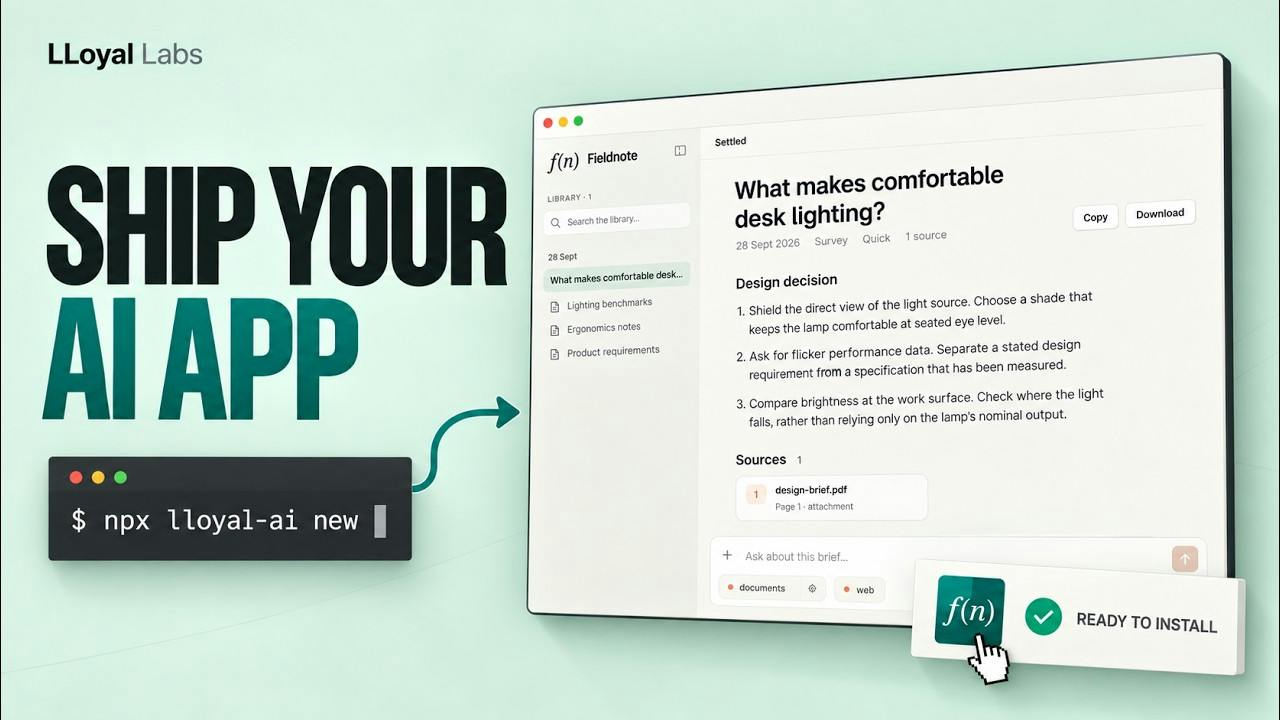
Lloyal is building a developer framework for AI applications that run open-weight models inside the application process. Its Product Hunt launch presented a TypeScript runtime for desktop, web, and terminal, with local inference and multi-agent features. Current developer materials call it a “Harness Development Kit” (HDK): developers build a TypeScript harness, ship across surfaces, and add capability modules called Abilities. The intended benefits are offline use, privacy, and control of model context without API keys (Product Hunt; HDK repository).
The technical thesis is coherent and the public scaffold and documentation indicate substantial product work. A developer framework could expand into enterprise deployments and an ecosystem of installable abilities. However, public evidence does not establish paid adoption, retention, a repeatable distribution channel, or a disclosed business model. Product Hunt interest is an early awareness signal, not product-market fit. Watch pending commercial and usage evidence.
Company and Team
Product Hunt identifies Zuhair Naqvi as Lloyal Labs’ founder and also names maker Kazim Musa. The company has published a CLI, runtime packages, templates, and documentation (Product Hunt; GitHub organization). This supports a finding of technical execution. Public sources reviewed do not establish the founders’ prior company outcomes, full-time status, team size, legal entity, headquarters, or operating history. No reliable funding or investor announcement was found.
Founder Assessment: Technical execution is visible; commercial capability, team depth, and founder commitment remain unverified.
Product and Market Opportunity
The initial customer is a developer or small software team building a specialized AI application that needs local data access, offline use, or tighter control of agent behavior. Potential use cases include internal knowledge tools and privacy-sensitive document workflows.
The HDK repository describes inference in the Node process, shared agent context, and application deployment across multiple surfaces. Documentation describes serving separate user sessions from a model loaded on one host, trading per-token API costs for machine capacity (HDK repository; serving documentation). These capabilities are company-described; independent benchmarks were not located.
Expansion could include team and enterprise deployments, OEM embedding, and a catalog of reviewed Abilities. A responsible bottom-up market estimate is not possible without pricing and evidence of how many teams prefer this architecture to hosted APIs or existing local-model tools. Large AI and developer markets do not by themselves establish Lloyal’s serviceable market.
Traction and Growth Signals
Product Hunt describes the product as free and in AI infrastructure/tools. The launch snapshot showed about 100 followers and a triple-digit point score, evidence of initial interest only (Product Hunt). Public docs and code provide evidence of product activity.
No verified revenue, paid-customer count, active users, downloads, retention, growth rate, customer reference, or enterprise contract was found. Package download estimates are incomplete proxies and are not proof of active use. The available evidence does not establish sustained post-launch momentum.
Traction Assessment: A concrete early release with launch attention, but commercial traction is unverified.
Competitive Position
Alternatives include local inference tools such as Ollama and LM Studio, interfaces such as Open WebUI, agent frameworks such as LangGraph and Mastra, and custom stacks built on llama.cpp or hosted model APIs. Lloyal’s proposed differentiation is integration: inference, agent context, application code, and deployment surfaces in one workflow (HDK repository; Product Hunt).
A trusted Ability catalog could create ecosystem value if it attracts useful modules and users. There is not yet public evidence of a large catalog, network effects, proprietary data, switching costs, or exclusive distribution. Model providers and established developer platforms could bundle comparable features. If a major platform shipped the same capability within six months, Lloyal would need to retain users through better cross-model support, a trusted ecosystem, portability, or materially better local performance; those advantages are not yet proven.
Defensibility Assessment: Low to Medium
Business Model and Economics
Product Hunt labels the product “Free.” The public materials reviewed do not disclose paid plans, pricing, or a commercial conversion path. Possible models include developer subscriptions, team and enterprise support, app distribution services, or OEM licensing; these are hypotheses, not announced revenue.
Local inference may reduce API bills but shifts cost to hardware, memory, compatibility, and support. The serving documentation notes that isolated processes require a separate model copy, illustrating a capacity trade-off (serving documentation). Economics depend on utilization, supported models, support load, and customer willingness to pay. Gross margin, CAC, conversion, and expansion data are unavailable.
Unicorn Path
A conditional route requires Lloyal to become a standard application runtime and commercial ecosystem, rather than only a useful open developer tool. For illustration, a 10× revenue multiple implies approximately $100 million ARR for a $1 billion valuation. At a hypothetical $10,000–$50,000 annual contract value, this requires roughly 2,000–10,000 paying organizations. These are scenario calculations, not current pricing or a forecast.
That scale would require production deployments, enterprise-grade support, strong retention, repeatable developer acquisition, and high-value team contracts or a broad Ability ecosystem. No paid conversion mechanism or distribution advantage has been verified.
Unicorn Path: Conditional
Valuation Assessment
No financing, round terms, valuation, or reliable revenue figure was found. Comparables across open frameworks, local inference, and commercial developer platforms have different business models. Without revenue, growth, retention, margin, and financing terms, Valuation Attractiveness: Not Assessable. Assessment requires ARR/MRR, growth, gross margin, burn, runway, round size, instrument, valuation cap or post-money valuation, and ownership terms.
Key Risks
- Demand may remain developer experimentation rather than production use.
- Monetization is unclear despite a free entry point and public code.
- Performance may vary across device, operating system, and model combinations.
- Larger platforms may bundle local inference and agent tooling.
- Developer distribution requires community, integrations, and repeat usage.
- A signed Ability catalog creates ongoing review and incident-response obligations.
- Runtime packages use FSL-1.1-Apache-2.0 with a two-year future Apache grant. The FAQ permits commercial products but restricts competing runtimes, managed services, and alternative distribution channels during the term; some procurement teams may require review (license FAQ).
- Public evidence on team capacity and founder roles is limited.
Final Assessment
Venture Potential: 55/100
| Category | Score |
|---|---|
| Market Size and Expansion Potential | 15/20 |
| Traction and Growth Evidence | 2/20 |
| Founder and Team | 7/15 |
| Product Strength | 9/10 |
| Distribution Potential | 8/15 |
| Business Model and Economics | 6/10 |
| Defensibility | 8/10 |
| Total | 55/100 |
The strongest elements are a clear technical thesis and potential expansion into vertical apps. The weakest are absent commercial proof, unknown team depth, and an unproven ecosystem moat. The defensibility score reflects the proposed architecture and signed catalog, not demonstrated market power.
Evidence Confidence: 39/100
Product scope, launch positioning, repository, documentation, and stated license are verifiable from primary sources; the maker page supports founder identity. Performance claims are company-reported. Revenue, customers, retention, growth, team size, funding, margins, and valuation remain unknown. Confidence is low despite good visibility into the product itself.
Final Decision: Watch
The product addresses a real developer problem with a coherent approach. It does not yet meet an investment threshold because traction, monetization, founder capacity, unit economics, and valuation are unknown. Seek production usage, paid conversion, and a repeatable route to developers before formal diligence.
Upgrade Conditions
- Show production deployments and cohort retention across at least two quarters.
- Disclose paid customers, ARR, growth, conversion, gross margin, and acquisition channels.
- Demonstrate cases where local execution materially improves privacy, cost, latency, or reliability.
- Show Ability adoption and a credible safety process.
- Clarify founder roles, financing terms, and enterprise license feedback.
Downgrade Conditions
- Releases stall or setup remains difficult for target developers.
- Launch experimentation fails to become repeat production use.
- Hardware variation drives high support costs or unreliable results.
- Developers choose bundled alternatives and the Ability catalog remains inactive.
- License concerns block enterprise adoption or commercial rights remain unclear.
Questions for Further Diligence
- How many weekly and monthly active developers use HDK, and how many ship apps to external users?
- What are 30-, 90-, and 180-day retention by developer cohort?
- How many customers pay, what is ARR/MRR, and how has it changed monthly?
- What is the free-to-paid conversion path?
- Which channels bring retained developers, and what are CAC and activation rates?
- What hardware/model benchmarks cover latency, memory, and reliability versus alternatives?
- What are enterprise and OEM pricing, expected gross margins, and support costs?
- What are infrastructure costs per session at realistic concurrency?
- How many Abilities are published or installed, and how do signing, review, revocation, and incident response work?
- Who works full-time on Lloyal, what are the founders’ relevant prior outcomes, and what hires are planned?
- What are funding, burn, runway, proposed valuation, and round terms?
- Have enterprise buyers raised FSL concerns, and what guidance addresses them?