
Table of Contents
Thread Investment Report
Category: AI journaling, personal knowledge management and consumer productivity
Company Stage: Pre-seed / independent product; formal company stage not publicly disclosed
Founder or Founders: Md. Jamilur Rahman
Headquarters: Not publicly disclosed
Funding: No reliable public funding information was found
Business Model: Freemium consumer subscription
Product Hunt Launch Date: September 16, 2026
Report Date: September 19, 2026
| Investment Metric | Assessment |
|---|---|
| Venture Potential | 44/100 |
| Unicorn Path | Improbable |
| Valuation Attractiveness | Not Assessable |
| Evidence Confidence | 45/100 |
| Final Decision | Watch |
Executive Summary
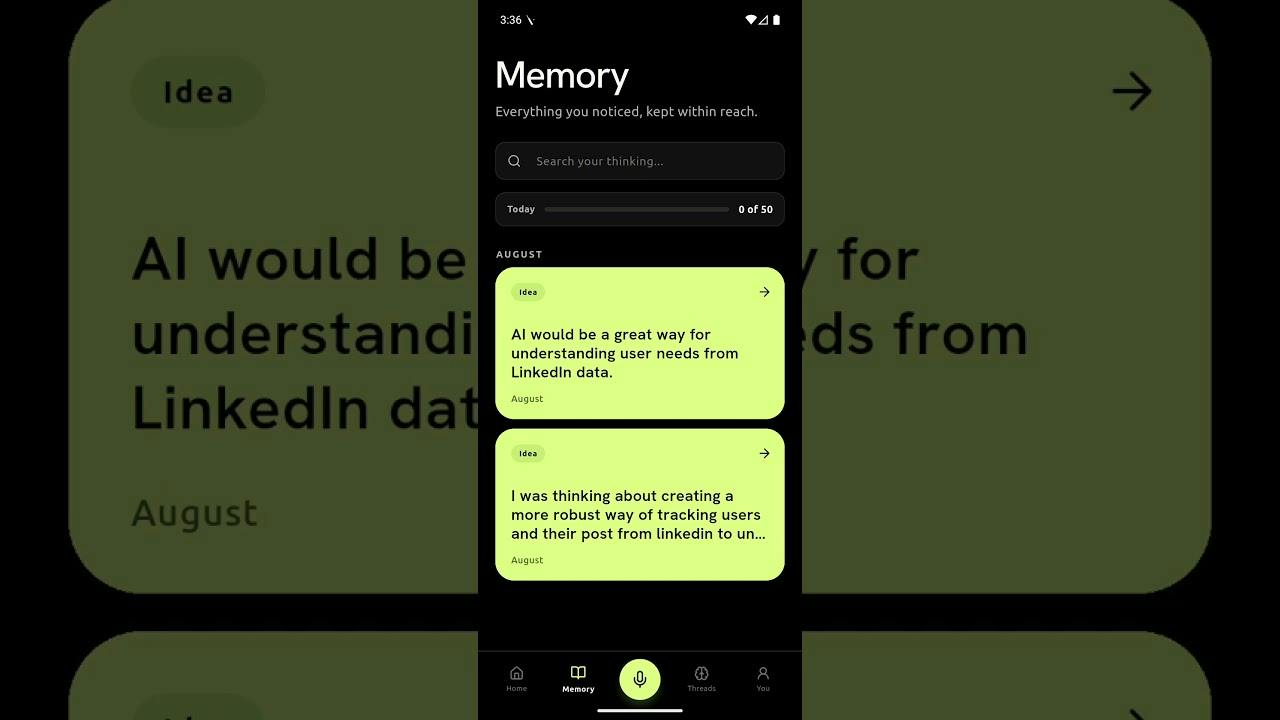
Thread is a private AI journal and “second brain” that accepts text and voice entries, connects new thoughts with relevant earlier memories, identifies recurring themes and generates daily insights. The intended user is someone who records ideas or reflections but struggles to retrieve, organize or develop them over time (official website; Google Play).
The product concept is credible. Conventional journals preserve chronological entries, while Thread attempts to build a persistent semantic memory across them. Its capture-connect-understand workflow could create more ongoing value than a static diary if the recommendations remain accurate, private and useful as the user’s archive grows.
The strongest positive signal is that a functional Android product, website, subscription infrastructure, privacy policy and early AI-memory workflow have been built by an identifiable software engineer. The product also ranked seventh on its Product Hunt launch day. This demonstrates execution but not product-market fit (Product Hunt; daily leaderboard).
The most important concern is the near absence of traction. Google Play displayed only 10+ downloads at the time of review, with no meaningful public rating history. Revenue, paying users, active users, retention and paid conversion are not disclosed. The apparent founder remains employed as a software engineer elsewhere, making full-time commitment uncertain (Google Play; founder profile).
Decision: Watch. Thread is a promising prototype in a legitimate market, but it is too early for formal investment diligence. It must demonstrate sustained journaling behavior, paid retention and differentiation from better-funded AI journals and general-purpose note applications.
Product Overview
Thread addresses a familiar personal-knowledge problem: people capture ideas, reflections and voice notes but rarely revisit or connect them. Folders, tags and search require manual organization, while chronological journals surface little context from older entries.
Thread’s workflow has four stages:
- Capture: Record a text or voice entry quickly.
- Connect: Match each entry to relevant previous memories.
- Understand: Generate daily observations about recurring patterns.
- Make real: Convert developed ideas into actionable plans.
The website says users can export or delete their data and that the product will not use advertising. The privacy policy states that Thread stores account details, written memories, voice captures, connected threads, device notification tokens and subscription status. Relevant text is transmitted to an unspecified AI-processing provider, but the company says it is not used for model training or advertising (privacy policy).
Thread is available on Android. No verified Apple App Store listing was found, despite website language suggesting broader mobile availability. This limits current distribution and creates a discrepancy that should be clarified.
The product is free to start and offers an optional auto-renewing PRO subscription through the app stores and RevenueCat. Exact pricing and free-tier limits are not publicly disclosed on the website or accessible Play Store listing (terms).
The primary benefit is passive organization of personal thoughts. It replaces manual linking in note applications, rereading old journal entries and copying ideas into separate planning tools.
Founder and Team Assessment
Product Hunt identifies Md. Jamilur Rahman as the maker, and his launch statement says that he built Thread. Google Play also identifies MD JAMILUR RAHMAN as the developer behind nexgenstudio.dev (Product Hunt; Google Play).
Rahman’s public profile shows several years of software-development experience across Flutter, Next.js and web applications. He has worked at RemitONE since 2023 and previously held software-engineering roles at Manush Tech. He has a computer-science degree from BRAC University and lists earlier personal projects involving social media, budgeting, analytics and automation (LinkedIn profile).
This background supports the ability to build and maintain a cross-platform consumer application. However, no prior startup exit, scaled consumer product, machine-learning research position or subscription-growth experience was verified.
The profile continues to list full-time employment at RemitONE. Thread may therefore be a side project, although this is not conclusively verified. No co-founders, employees, contractors, advisors or open positions were found. Commercial, marketing, privacy and security capacity appear limited based on available evidence.
Founder Assessment: Demonstrated individual product-building capability, but full-time commitment, team depth and consumer-growth experience remain unproven.
Market Opportunity
The initial segment is reflective professionals, students, founders and creators who already write or record ideas frequently but find conventional journals and note systems difficult to organize.
Consumer willingness to pay is demonstrated by established products in the category. Day One charges $49.99 annually for its Silver plan and $74.99 for Gold; Rosebud lists an annual AI-journaling subscription around $108; Reflect cites approximately $120 annually for networked AI notes (Day One plans; Rosebud; Reflect comparison).
A bottom-up scenario—not a verified forecast—is:
- 10 million globally addressable paying users;
- $60–$100 annual gross subscription revenue;
- Potential gross subscription market of $600 million–$1 billion.
The market can theoretically support venture-scale revenue, but Thread’s serviceable market is much smaller until it supports iOS, desktop and reliable cross-device synchronization.
Adjacent opportunities include coaching, goal tracking, creative-project development, team knowledge systems and an API for personalized AI assistants. Expansion into therapy or mental-health advice would create higher regulatory and safety risk; Thread currently disclaims medical, financial and legal reliance (terms).
Traction and Growth Signals
Thread ranked #7 Product of the Day on September 16 and approximately #29 for its launch week. The weekly Product Hunt page displayed limited engagement, but launch rankings should not be interpreted as customer retention or willingness to pay (daily leaderboard; weekly leaderboard).
Google Play showed only 10+ downloads at the report date and did not display a meaningful rating or review base. The listing was updated on September 9, 2026, indicating recent product activity but very limited time in market (Google Play).
The founder publicly announced the Android release and described Thread as a private, low-friction second brain. No independent customer case studies, press coverage, website-traffic data, public community, GitHub repository or hiring activity were found.
The most important missing metrics are:
- Registered, weekly and monthly active users
- Entries per active user
- 30-, 90- and 180-day retention
- PRO subscribers and conversion
- Subscription price and revenue
- Renewal and cancellation rates
- AI insight engagement
- Organic versus paid acquisition
- iOS launch status
Traction Assessment: Functional launch with negligible commercially meaningful validation.
Competitive Position
Direct competitors include Rosebud, Day One, Reflect and other AI-journaling applications. Adjacent competitors include Mem, Obsidian, Apple Journal and general-purpose AI assistants. Apple Journal supports text, photos, videos, audio, locations and suggested reflections at no separate charge, while Obsidian is free for personal and commercial use, with optional paid synchronization (Apple Journal; Obsidian license).
Thread’s differentiation is its automatic creation of longitudinal “threads” across memories and its daily synthesis. The quiet, journal-focused experience may appeal to users who find general note systems too complicated.
However, semantic search, note linking, summarization and recurring insights are increasingly standard AI capabilities. Competitors can access similar foundation models, and Thread does not disclose a proprietary model, unique dataset or technical advantage.
Switching costs could increase as users accumulate years of memories, but the website promises exportability, appropriately reducing lock-in. There are no evident network effects.
If the largest platform in this market launched the same feature within six months, why would customers continue using Thread? The only credible answer would be demonstrably better personalization, trust and long-term memory quality. Those advantages have not yet been validated.
Defensibility Assessment: Low
Business Model and Economics
Thread uses a free tier and optional PRO subscription. Exact pricing, usage limits and feature segmentation are unknown. Payments are processed by app stores and verified through RevenueCat.
Potential gross margin could be attractive for retained subscribers, but every entry may incur variable costs for transcription, embeddings, retrieval and generative inference. Daily insights create recurring costs even when users do not actively open the product, unless generation is triggered only for engaged users.
The core economic question is whether subscription revenue rises faster than the cost of processing an expanding personal archive. Long-term users are potentially the most valuable and most expensive because retrieval must operate across increasing data volumes.
App-store fees may consume approximately 15–30% of subscription revenue, depending on platform terms and developer eligibility. Storage, Firebase services, Cloudflare infrastructure and AI processing create additional costs. Actual gross margin is not disclosed.
Customer acquisition currently appears to rely on Product Hunt, founder distribution and app-store discovery. There is no evidence of scalable paid acquisition, referrals or content distribution.
Unicorn Path
Assuming a 10× ARR multiple for a rapidly growing, high-retention consumer subscription company:
Required ARR = $1 billion ÷ 10 = $100 million
At hypothetical annual pricing of:
- $60 per subscriber: approximately 1.67 million paying users;
- $80 per subscriber: approximately 1.25 million paying users;
- $100 per subscriber: approximately 1 million paying users.
After app-store commissions, discounts and churn, the required gross subscriber count would be higher. The company would also need strong gross margins after AI and storage expenses.
Moving from approximately 10 downloads to more than one million paying subscribers would require iOS and desktop availability, strong multi-year retention, trusted privacy controls, differentiated memory quality, a repeatable acquisition engine and a full-time team. This is possible in the abstract but unsupported by current evidence.
Unicorn Path: Improbable
Valuation Assessment
No reliable public information was found regarding funding, investors, accelerator participation, SAFE caps, secondary sales, acquisition offers or valuation. Current fundraising status is also unknown.
Relevant operating comparables include Rosebud, Day One, Reflect and Mem, but Thread’s revenue and retention are unavailable, making revenue-multiple comparisons unusable. No comparable acquisition provides a responsible basis for valuing a newly launched product with minimal downloads.
Valuation Attractiveness: Not Assessable
Assessment would require current MRR, subscriber growth, retention, gross margin, AI cost per user, burn, runway, cap table, round size, valuation cap and liquidation terms.
Key Risks
- Almost no verified user or revenue traction.
- Founder commitment may be part-time.
- Strong competition from established journals and free platform products.
- AI linking and summarization are readily replicable.
- Sensitive journal content is sent to an unnamed AI provider.
- No verified iOS application or desktop product.
- Low consumer willingness to maintain another subscription.
- Potentially high churn after initial journaling enthusiasm fades.
- AI and storage costs increase as user archives grow.
- Solo-founder and key-person risk.
Final Assessment
Venture Potential: 44/100
| Category | Score |
|---|---|
| Market Size and Expansion Potential | 14/20 |
| Traction and Growth Evidence | 2/20 |
| Founder and Team | 7/15 |
| Product Strength | 7/10 |
| Distribution Potential | 5/15 |
| Business Model and Economics | 5/10 |
| Defensibility | 4/10 |
| Total | 44/100 |
The strongest elements are a clear product concept, capable technical maker and an established subscription category. The weakest are negligible traction, uncertain founder commitment and low defensibility.
Evidence Confidence: 45/100
The product, founder identity, Android availability, basic architecture and privacy terms are verified. Product quality claims come primarily from the founder and website. Pricing, revenue, retention, funding, team size, legal entity and valuation remain unknown.
Final Decision: Watch
Thread is too early for formal diligence. The product should be monitored because semantic personal memory can create recurring value, but current evidence supports neither a venture-scale company nor a reliable commercial business.
Upgrade Conditions
- At least 25,000 monthly active users.
- More than 5,000 paying subscribers or $300,000 ARR.
- Six-month retained-user rate above 40%.
- Evidence that users record multiple entries per week after six months.
- Gross margin above 70% after AI and app-store costs.
- Verified iOS launch and cross-platform synchronization.
- Founder transition to full-time commitment.
- Clear disclosure of the AI provider and enterprise-grade privacy controls.
Downgrade Conditions
- Development or release activity stops.
- 90-day retention remains below 15%.
- Paid conversion remains below 2%.
- AI costs rise faster than subscription revenue.
- A platform incumbent offers equivalent memory linking for free.
- Privacy, data-loss or unauthorized-access incidents occur.
Questions for Further Diligence
- What are current downloads, registered users, DAU and MAU?
- What are 30-, 90- and 180-day retention rates?
- How many memories does a retained user capture per week?
- What are PRO pricing, paying-subscriber count, MRR and monthly growth?
- What is free-to-paid conversion, and which feature drives upgrades?
- What are transcription, embedding, retrieval and generation costs per active user?
- How does AI cost change as a user’s archive grows?
- Which AI provider processes journal entries, and what retention terms apply?
- Is personal content encrypted with user-specific keys or accessible to operators?
- Is the founder working full-time on Thread, and who else contributes?
- What are burn, runway, legal entity and cap-table structure?
- What are the current fundraising valuation and proposed round terms?