
Table of Contents
min. Investment Report
Category: AI-native relationship intelligence, meeting memory, and lightweight CRM
Company Stage: Pre-seed / early beta-stage company
Founder or Founders: Eric Wang appears to be the principal founder; Min Thant Aung and Lucas Zhao are publicly listed team members, but formal founder titles are not fully verified
Headquarters: Los Angeles, California, United States
Funding: Not publicly disclosed
Business Model: SaaS is indicated, but current public pricing could not be reliably verified
Product Hunt Launch Date: Not publicly disclosed on the accessible product page
Report Date: August 17, 2026
| Investment Metric | Assessment |
|---|---|
| Venture Potential | 54/100 |
| Unicorn Path | Conditional |
| Valuation Attractiveness | Not Assessable |
| Evidence Confidence | 48/100 |
| Final Decision | Watch |
Executive Summary
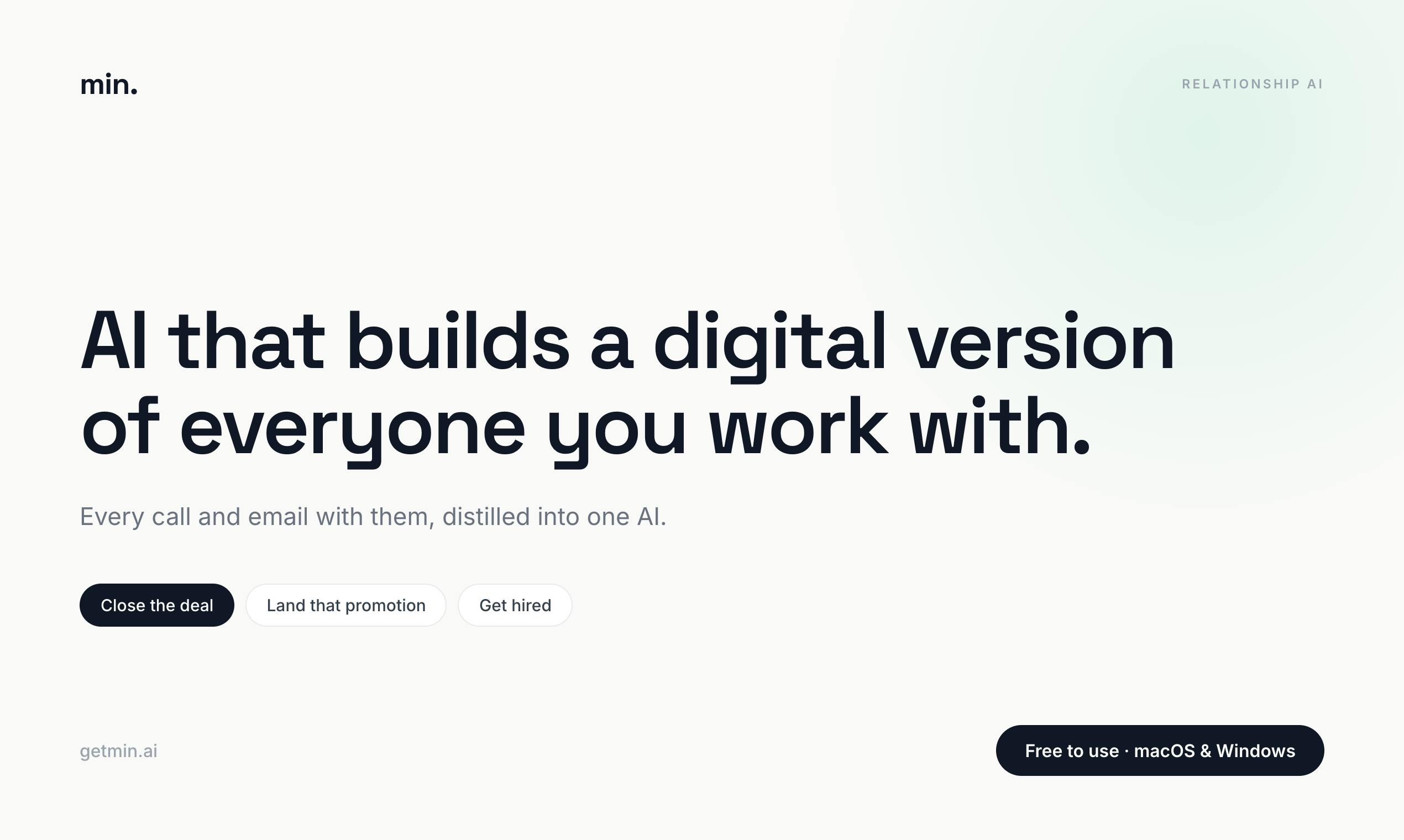
min. is a desktop relationship-intelligence product that continuously converts meetings, calendar events, and email threads into “living capsules” for each person, company, and group. A capsule summarizes relationship status, commitments, deadlines, and history, retains links to the underlying source, and lets the user ask questions or draft follow-up actions. The current positioning is “the CRM that builds itself,” with a botless notetaker for macOS and Windows. Official site Product Hunt
The customer is a founder, seller, recruiter, investor, account manager, or relationship-heavy professional who needs context before meetings and reliable follow-through afterward but does not consistently update a CRM. The product’s strongest idea is organizing data around relationships rather than isolated meetings or inbox threads. If it works accurately, it could reduce CRM entry and missed commitments.
The strongest investment signal is a real product pivot informed by user conversations. An October 2025 Hacker News post described min. as an AI-native shared inbox. LinkedIn posts later described logistics and freight-broker interest. The current site has shifted again toward broad relationship memory and a self-building CRM. These changes show responsiveness, but they also indicate that target customer and product-market fit remain unsettled. Hacker News LinkedIn
The most important concern is the absence of commercial evidence. No public pricing, revenue, paying-customer count, usage, retention, funding, or quantified case studies were verified. LinkedIn lists only 14 followers and a 2–10 employee company. The product processes highly sensitive email and meeting content, yet the accessible public security and privacy pages did not provide sufficient detail for an enterprise assessment.
Final decision: Watch. The “relationship capsule” is a useful product thesis in a large CRM market, but the company is too early and too opaque for DD. An upgrade requires a stable initial customer segment, retained paid cohorts, verified workflow outcomes, and a credible security posture.
Product Overview
min. connects to Google or Outlook calendars and can incorporate Gmail, Outlook, Zoom, Meet, Teams, Slack, Webex, Granola, Otter, Fireflies, and Fathom. It includes a botless notetaker, so no visible bot joins the meeting. The system builds a continuously updated capsule for each relationship with three main surfaces: where the relationship stands, open action items, and source-linked history. Users can ask for a meeting brief or have min. draft a follow-up and schedule a next step. Official product page
The customer problem is fragmentation. Meeting notes live in one application, email in another, calendar history elsewhere, and CRM records are incomplete. min. aims to distill this into one relationship object without manual entry. The product states that it retains distilled memory rather than raw email bodies and that sharing is explicit, scoped, and revocable. That is an important design claim, but implementation details and independent verification are unavailable. Official site
The current application supports macOS and Windows. Pricing is linked on the site, but the page content was not reliably exposed in accessible public indexing, so no price should be assumed. Earlier beta positioning and logistics-focused messaging differ from the current horizontal CRM positioning; users should verify which workflows are production-ready.
Founder and Team Assessment
Eric Wang publicly posted the original Hacker News launch using the handle associated with his profile and wrote that he built min. for his team’s email workflow. LinkedIn lists him at min. and associates him with the University of Toronto. The company page lists Min Thant Aung and Lucas Zhao as additional employees and describes a Los Angeles company founded in 2025 with 2–10 employees. Eric Wang Company profile
The team has shown product iteration and customer discovery, including public discussion of founder, freight-broker, and logistics use cases. However, formal roles, prior employers, technical achievements, full-time commitment, ownership, hiring plans, and prior exits are not sufficiently verified. Some LinkedIn posts indicate school commitments for at least one team member, increasing the need to confirm full-time capacity.
Founder Assessment: Resourceful early team with evidence of customer discovery and rapid repositioning, but background, role clarity, founder commitment, and commercial execution remain materially unverified.
Market Opportunity
The narrow initial segment should be relationship-heavy small teams that conduct frequent external calls and emails but lack disciplined CRM operations—for example boutique agencies, recruiting firms, small sales teams, and freight brokerages. These customers pay when missed follow-ups cost revenue and when automatic context reduces administrative work.
An analyst bottom-up scenario: 500,000 small relationship-driven teams globally at a hypothetical $1,200 annual account value would represent a $600 million initial pool. Moving into sales organizations at $10,000–$50,000 annual contracts could expand it substantially. These are assumptions, not min. prices or customer counts.
The broader CRM and conversation-intelligence markets can support venture-scale revenue. The challenge is differentiation and focus. A horizontal “memory for every relationship” competes with platforms that already own the inbox, calendar, meeting, and CRM record. A vertical wedge such as freight brokerage may create sharper pain and willingness to pay, but the current site no longer emphasizes that segment.
Traction and Growth Signals
Verified signals are limited. The company has a live desktop product and sign-in flow, current positioning, public founder activity, and an earlier Hacker News launch. LinkedIn shows 14 company followers and three publicly associated employees. The Product Hunt link supplied in the spreadsheet establishes a launch, but accessible public results did not reliably expose votes, rank, comments, or reviews. Official site LinkedIn
Founder-reported LinkedIn posts previously claimed interest from more than five freight brokerages, but no contracts, price, deployment status, or customer references were provided. Public product repositioning from shared inbox to logistics workflow to relationship CRM is evidence of learning, not retained demand. Missing metrics include activated accounts, connected mailboxes, weekly active users, capsules viewed, paid conversion, retention, and revenue.
Traction Assessment: Active product development and customer discovery, but almost no independently verifiable commercial traction.
Competitive Position
Direct competitors include Dex and Clay for personal relationship management, Attio for flexible CRM, Granola and Fathom for meeting memory, and emerging products that unify meetings and email. Indirect competitors include Salesforce, HubSpot, Gmail, Outlook, Notion, manual notes, and a general AI assistant connected to Workspace or Microsoft 365.
min.’s differentiation is a continuously maintained object for each relationship, source-linked conclusions, botless capture, and no manual data entry. Its advantage could deepen if shared capsules become the handoff layer across a team and the product reliably identifies commitments across email and meetings. Today, no proprietary data advantage, network effect, or switching-cost evidence is public.
If the largest platform in this market launched the same feature within six months, customers would stay only if min. delivered more accurate cross-channel relationship state, better privacy controls, and a simpler workflow than their native CRM or productivity suite. Google, Microsoft, Salesforce, HubSpot, and Zoom all have the data and distribution to bundle adjacent capability.
Defensibility Assessment: Low
Business Model and Economics
The likely model is per-user or per-team SaaS, potentially with higher tiers for shared capsules, administration, security, and integrations. Current price, free plan, usage limits, and enterprise tier are not reliably public, so annual contract value cannot be verified.
Variable costs include meeting transcription, language-model summarization, embeddings/search, email and calendar ingestion, storage, and support. A botless local recorder can improve user experience but creates cross-platform engineering and consent complexity. Gross margin depends on how often histories are reprocessed and how much long-context inference each relationship requires. Expansion revenue could come from shared team memory and enterprise controls, while consumer or solo use may have low willingness to pay and high churn.
Unicorn Path
Assumed multiple: 10× ARR, appropriate only for a high-growth SaaS company with strong retention and software-like gross margins. Required ARR for a $1 billion valuation is approximately $100 million.
At a hypothetical $20 per user per month, min. would need about 417,000 continuously paying seats. At a $15,000 enterprise ACV, it would need roughly 6,700 organizations. Both prices are analyst assumptions because current pricing is not verified.
Achieving this scale requires a stable wedge, demonstrable CRM replacement or revenue impact, enterprise-grade consent and security, integrations that survive platform changes, a repeatable sales channel, and team-level switching costs. The company may build a useful small business without meeting these conditions.
Unicorn Path: Conditional
Valuation Assessment
No reliable public funding, investors, revenue, current round, SAFE cap, post-money valuation, or acquisition comparable specific to min. was found.
Valuation Attractiveness: Not Assessable. Required information includes ARR, growth, paid seats, retention, gross margin, infrastructure cost, burn, runway, cap table, proposed round size, instrument, valuation, information rights, and liquidation preferences.
Key Risks
- No verified paid usage, revenue, retention, or price.
- Repeated positioning changes indicate the initial customer segment is unresolved.
- Google, Microsoft, Salesforce, HubSpot, and meeting platforms can bundle similar memory.
- Reading email and meetings creates significant privacy, consent, and security exposure.
- Small public team and possible part-time commitments create execution risk.
- Model and transcription costs may rise faster than seat revenue for heavy users.
- Low switching costs until capsules become trusted organizational records.
- Cross-platform desktop capture and integrations create high maintenance burden.
- Automatic conclusions about relationships may be wrong in consequential contexts.
- A broad horizontal message may weaken distribution versus a vertical wedge.
Final Assessment
Venture Potential: 54/100
| Category | Score |
|---|---|
| Market Size and Expansion Potential | 15/20 |
| Traction and Growth Evidence | 5/20 |
| Founder and Team | 7/15 |
| Product Strength | 7/10 |
| Distribution Potential | 7/15 |
| Business Model and Economics | 6/10 |
| Defensibility | 7/10 |
| Total | 54/100 |
The strongest element is a valuable product concept in a large market. The weakest are missing commercial evidence, unclear positioning, and platform competition.
Evidence Confidence: 48/100
Verified: current official product positioning, supported platforms and integrations, LinkedIn company location/size band, associated team members, and earlier Hacker News launch. Company-reported: customer interest, privacy design, and relationship outcomes. Estimated: market size, pricing scenarios, and unicorn math. Unavailable: funding, revenue, usage, retention, margins, customer references, founder ownership, cap table, and current valuation.
Final Decision: Watch
min. should be observed through several product and customer cohorts. The concept may become a strong CRM wedge, but today there is insufficient evidence for formal DD and substantial uncertainty about target market, commitment, security, and willingness to pay.
Upgrade Conditions
- A stable initial segment with at least 50 paying organizations
- More than $1 million ARR and over 50% year-over-year growth
- Six-month gross revenue retention above 85%
- Quantified evidence that users complete more follow-ups or close more business
- Gross margin above 75% after transcription and model costs
- Independent security review plus clear recording, consent, deletion, and data-residency controls
- Repeatable acquisition beyond founder outreach and launch communities
Downgrade Conditions
- Another major repositioning without retained customer evidence
- Paid conversion remains weak after public launch
- Sensitive-data incident, consent complaint, or inaccurate automated action
- Platform vendors bundle equivalent features and block integrations
- Heavy users produce structurally negative contribution margin
- Key team members do not commit full time or product cadence stalls
Questions for Further Diligence
- Who are the legal founders, what are their roles, and who is working full time?
- What are current ARR/MRR, paying teams, paid seats, and monthly growth?
- What are 30-, 90-, and 180-day activation and retention cohorts?
- Which segment is the committed initial ICP: founders, logistics, sales teams, or another group?
- Why did the product move from shared inbox to relationship CRM, and how many earlier users retained?
- What is current pricing, free-to-paid conversion, and blended ACV?
- What are transcription/model costs and gross margin per active user?
- What measurable revenue or productivity outcomes have design partners achieved?
- How are recording consent, raw email, deletion, sharing, encryption, and model training handled?
- Which integrations are official APIs versus local capture, and what platform dependencies exist?
- What funding, burn, runway, cap table, and current financing terms apply?
- What proprietary data or workflow will prevent CRM and meeting incumbents from displacing min.?