
Table of Contents
Communicate — Investment Report
Product Hunt: Communicate
Spreadsheet launch date: October 2, 2026
Assessment date: October 8, 2026
| Investment Metric | Assessment |
|---|---|
| Venture Potential | 60/100 |
| Unicorn Path | Conditional |
| Valuation Attractiveness | Not Assessable |
| Evidence Confidence | 50/100 |
| Final Decision | Watch |
Executive Summary
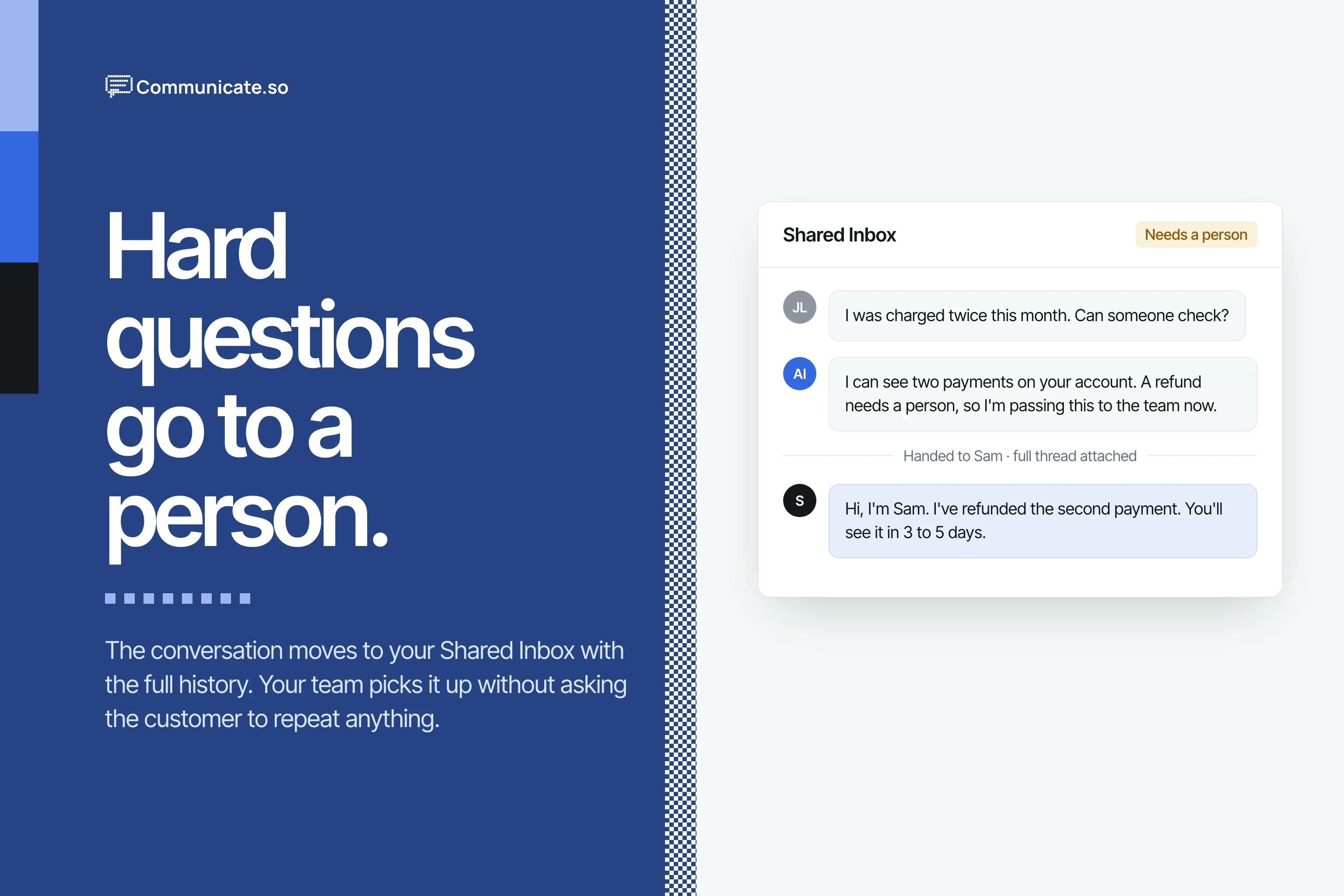
Communicate is a customer-support platform that grounds an AI agent in a company’s help content, gives it limited approved actions, and hands uncertain or sensitive conversations to a human in the same shared inbox. It offers an embeddable website widget, in-app messages, analytics, API access, and a read-only MCP endpoint (Product Hunt; About Communicate).
The product targets small SaaS companies and other teams that need customer support before hiring a larger support team. It has a defined credit-based model and a launch lifetime offer, but public sources do not disclose paying customer counts, revenue, retention, or outcomes. The agent market is crowded, and Communicate currently lacks common enterprise certifications and SSO. Watch until paid usage and resolution quality are verified.
Company and Team
Communicate is operated by TinyCheque, Inc., a Delaware corporation. Founder Udit Goenka also presents himself as founder of TinyCheque, an AI venture studio, and says he runs other products including PitchGround and Firstsales.io (Communicate About; founder profile). His prior experience building multiple software ventures and fundraising for TinyCheque could help with launch and distribution, but appears spread across a portfolio. No Communicate-specific financing or team size was found. Parent-company funding claims do not establish that capital was allocated to this product.
The company publishes detailed policies on support, privacy, responsible AI, and security. Its support policy describes the product as lean and self-serve, with email and documentation support, no guaranteed uptime or SLA (support policy).
Founder Assessment: Relevant SaaS and venture-studio experience is visible; product-specific team capacity and focus remain unverified.
Product and Market Opportunity
The first buyer is a small software company, startup, e-commerce business, or agency with repeated website or in-app support questions but limited support staffing. Teams connect help articles, product documentation, files, and past replies. The agent retrieves answers with sources, can run only explicitly approved tasks, and hands off exceptions with the full conversation history intact. Product materials show read-only account lookup and support-request creation as example actions (Communicate for SaaS; actions).
This is more differentiated than a basic FAQ chatbot if approved actions and human takeover reliably complete the support loop. Current published channels are centered on website chat and in-app messages; a company article lists no WhatsApp, Messenger, SMS, or voice support. It is therefore narrower than an established omnichannel helpdesk (channel overview).
The serviceable market includes small businesses with enough repetitive support volume to justify software but too little scale for a large support operation. No bottom-up buyer count, average contract value, or support volume data is public. Expansion to larger teams requires integrations, compliance, service levels, and administration that are not yet fully available.
Traction and Growth Signals
Product Hunt listed plans starting at $19 per month, payment required, 82 followers, and a #19 daily rank with 99 points in the launch snapshot. The maker offered a separate lifetime deal beginning at $49, with monthly credits replenished at each plan tier (Product Hunt; lifetime offer). This confirms a commercial offer, not a customer base.
The lifetime page names several businesses as already using Communicate, but provides no customer counts, references, case studies, or measured resolution results. No verified paying account count, MRR/ARR, conversation volume, AI resolution rate, retention, growth, or customer acquisition cost was found. Product Hunt comments include questions about monthly credits and integrations, but do not establish conversion.
Traction Assessment: Product is commercially available with a launch offer; paying adoption and customer outcomes remain unverified.
Competitive Position
Direct competitors include Intercom Fin, Zendesk AI, Chatbase, Kommunicate, and other helpdesk chatbots. Intercom charges $0.99 per successful AI outcome in addition to its support platform, while Zendesk sells a broader support suite across email, chat, voice, and social channels (Intercom outcome pricing; Zendesk). Communicate’s narrower self-serve focus and credit pricing may appeal to smaller companies that do not want a full helpdesk deployment.
Its main differentiator is the combination of grounded answers, explicit action permissions, and a shared inbox that preserves context at handoff. This can lower setup complexity and reduce the risk of the agent acting beyond approved tasks. Yet the core features are replicable, competitors have larger integration ecosystems, and no comparative resolution or customer satisfaction results have been published.
If a major helpdesk bundles similar grounded answers and handoff, Communicate must win on faster setup, lower total cost, and reliable approved actions. Public evidence has not yet demonstrated these advantages.
Defensibility Assessment: Low to Medium
Business Model and Economics
Communicate uses credits for AI work. Its public offers include a $1 activation with 100 test credits, monthly plans starting at $19, and one-time lifetime tiers from $49; the lifetime tiers refresh a fixed credit allowance each month, and extra credits can be purchased for $1 per 100 (Product Hunt; lifetime plan details). This lets the company match some cost to usage, but lifetime plans create a material liability: revenue is collected once while inference and hosting costs recur for as long as the customer remains active.
The product currently uses gpt-4o-mini through OpenRouter, with an average of 1.6 credits per reply stated on the lifetime page. This small model and usage credits may support low variable cost, but no measured cost per conversation, gross margin, credit utilization, or lifetime-customer usage distribution is public (privacy policy; lifetime terms). Monthly subscriptions could produce recurring revenue, but the split between recurring and lifetime sales is unknown.
Unicorn Path
At an illustrative 10× ARR multiple, a $1 billion valuation requires about $100 million ARR. At a $39 monthly plan, that is roughly 214,000 continuously paying workspaces before discounts, credit usage, churn, and payment costs. Lower-priced plans require more accounts; enterprise contracts could reduce the count but need stronger compliance, integrations, and service commitments.
The path would require high-volume support deployments, measurable resolution rates, expansion from small businesses into larger teams, international sales, and a recurring rather than lifetime-heavy customer mix. No current evidence establishes that scale.
Unicorn Path: Conditional
Valuation Assessment
No Communicate-specific funding, valuation, revenue, or round terms were found. TinyCheque’s broader funding history is not a substitute for product-level financials. Valuation Attractiveness: Not Assessable. Assessment requires paid workspaces, ARR, growth, retention, resolution quality, gross margin, lifetime-plan liabilities, and current financing terms.
Key Risks
- No verified commercial traction: launch pricing and company-listed logos do not establish paid usage or repeatability.
- Lifetime economics: one-time plans with recurring monthly credits may produce future inference costs without recurring revenue.
- Hallucination and action risk: bad answers or misconfigured actions could harm customers; the service disclaims guaranteed accuracy.
- Security/procurement gaps: the company states it has no SOC 2, HIPAA, or ISO 27001 certification, no SSO/SAML, one deployment region, and no independent penetration-test report (security page).
- Limited channel coverage: lack of major messaging and voice channels narrows the use cases.
- Incumbent bundling: Intercom and Zendesk can combine AI with mature support workflows and integrations.
- Support capacity: the company describes email-only support, no contractual uptime SLA, and a lean self-serve team.
- Parent-company focus: Communicate may compete for people and investment with other TinyCheque products.
Final Assessment
Venture Potential: 60/100
| Category | Score |
|---|---|
| Market Size and Expansion Potential | 15/20 |
| Traction and Growth Evidence | 6/20 |
| Founder and Team | 9/15 |
| Product Strength | 8/10 |
| Distribution Potential | 8/15 |
| Business Model and Economics | 8/10 |
| Defensibility | 6/10 |
| Total | 60/100 |
The strongest elements are a useful human-handoff workflow, approved actions, clear credit pricing, and an experienced parent venture studio. The biggest weaknesses are absent commercial metrics, recurring costs attached to lifetime deals, limited enterprise readiness, and strong incumbent competition.
Evidence Confidence: 50/100
Product scope, legal operator, disclosed pricing, credit mechanics, AI model, privacy, and security gaps are described in primary sources. The lifetime page lists apparent users but does not quantify paid customers or provide references. Revenue, active usage, outcomes, retention, margins, deployment scale, funding allocation, and valuation remain unknown.
Final Decision: Watch
Communicate has a plausible product for small teams and a more controlled workflow than a simple document chatbot. It is not investable on current public evidence: there are no verified customer or economic metrics, and its lifetime offer needs a clear margin analysis. Reassess after several months of paid usage and customer references.
Upgrade Conditions
- Disclose paying workspaces, ARR, retention, and AI resolution/handoff rates.
- Show gross margins by monthly, credit top-up, and lifetime customer cohorts.
- Provide referenceable deployments with measured support-time or cost reductions.
- Add enterprise security controls, independent testing, and service commitments.
- Demonstrate repeatable acquisition beyond Product Hunt and TinyCheque’s portfolio.
Downgrade Conditions
- Lifetime usage costs exceed the one-time purchase economics.
- Agent answers or actions cause material customer harm.
- Paid conversions or renewals remain weak after trial and launch offers.
- Major integrations or enterprise security requirements cannot be met.
- TinyCheque deprioritizes the product in favor of other portfolio companies.
Questions for Further Diligence
- How many paid workspaces, monthly subscribers, lifetime buyers, and active end users exist?
- What are MRR/ARR, monthly growth, paid retention, and customer concentration?
- What percentage of conversations are resolved by the agent, handed off, or reopened?
- What are inference, hosting, and support costs per AI reply and per active workspace?
- How many lifetime buyers are active, and what is their monthly credit consumption?
- What are the monthly plan limits and overage behavior, and how much revenue comes from credit top-ups?
- Which customer references can confirm setup time, response quality, and savings?
- Which action integrations exist today, and what safeguards prevent unauthorized refunds or account changes?
- When will SOC 2, SSO, multi-region hosting, and an external penetration test be available?
- How many people work on Communicate, what resources are shared with TinyCheque, and how is product priority decided?
- What acquisition channels convert into paid workspaces, and what are CAC and sales cycle?
- Has TinyCheque raised capital for Communicate specifically, and what are its current runway and financing terms?