
Table of Contents
ZooWork — Venture Investment Report
Prepared: 8 October 2026 | Stage: Early-stage, public evidence only | Decision: Watch
Snapshot
| Metric | Assessment |
|---|---|
| Product | Agent builder and managed runtime/API for deploying AI agents into team and client workflows |
| Target buyer | Domain experts, forward-deployed engineers, agencies and operating teams |
| Product Hunt | Launched this week; #1 daily rank, 330 points, 5.0/5 from one review and about 723 followers at research time |
| Public pricing | Starter $200/year, Pro $1,000/year, Ultra $2,000/year; annual billing shown after a 7-day trial |
| Revenue, paid accounts, retention | Not publicly disclosed |
| Company context | Official site identifies Serendipity One, founded 2023; product-level attribution requires confirmation |
| Main upside | Makes reusable operational expertise deployable through agents |
| Main concern | No independently verifiable product-level usage, retention, margins or customer outcomes |
| Final Decision | Watch |
Executive view
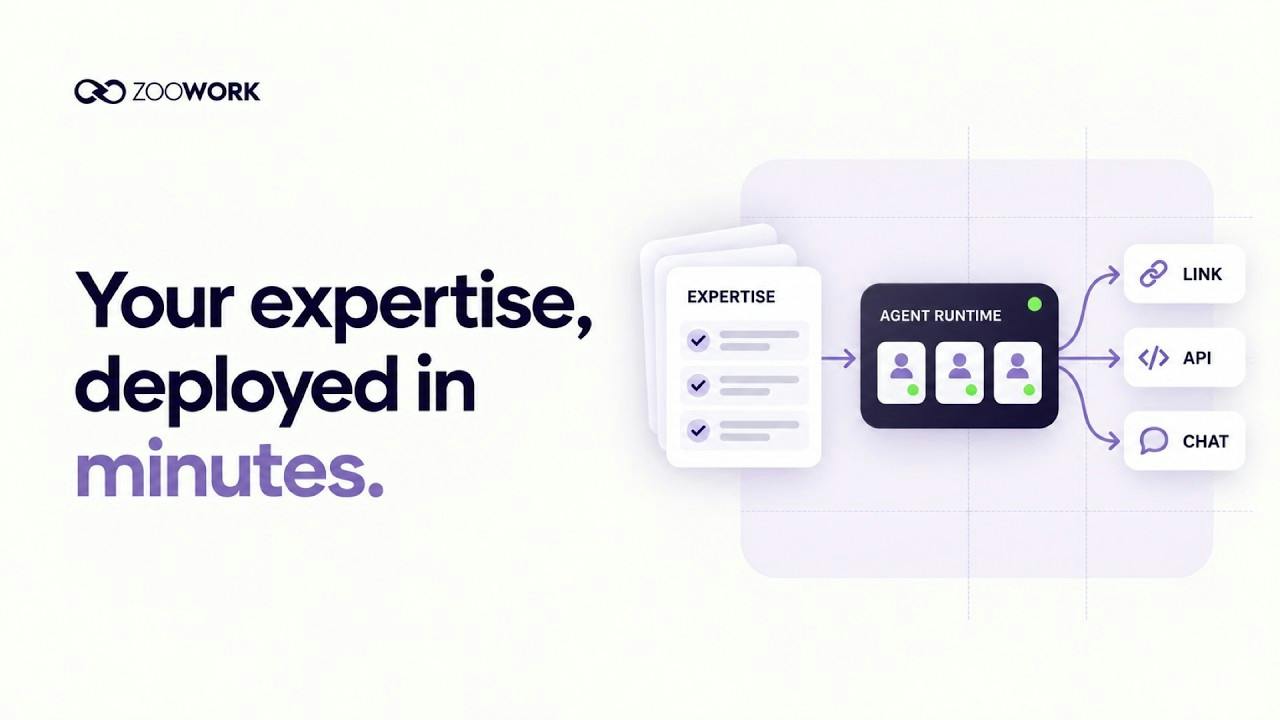
ZooWork aims to help experts encode a role, knowledge, procedures and permissions, then run and deliver the resulting agent through a managed runtime or API. This targets a genuine gap: companies want AI to complete repeatable work inside their systems, while most teams lack the engineering capacity to build and operate dependable agents. Its strongest positioning is the bridge between domain experts who understand a workflow and developers or forward-deployed engineers who need a production surface.
A public subscription page and Product Hunt launch show early commercial intent and discovery. However, launch engagement is not product-market fit. The public record reviewed here does not disclose paid customer counts, active agents, retention, expansion, realized savings or revenue. Meanwhile, model providers, cloud platforms, workflow tools and vertical software vendors are adding agent features.
The official company page describes Serendipity One’s founders and displays company-level indicators including “Early funding $70M,” more than one million downloads and a 73-million-product commerce catalog. It does not establish that these figures belong to ZooWork or its current agent product. Evaluate the opportunity on ZooWork-specific evidence, not presumed group-level traction.
Recommendation: Watch. Take a diligence meeting and track the next two to three quarters. Reconsider only after evidence of repeat production use, retained paid accounts, sound unit economics and a clear distinction between this product’s traction and other company activity.
Product and customer value
ZooWork describes an Agent Builder for domain experts and a Managed Agent API for developers. Users can package a job description, company knowledge, procedures, delivery standards and tool permissions into an agent. The product also presents common-work-system connectors, approval gates for sensitive actions, run trajectories and isolated sandboxes. This addresses real operational needs: agents require context, controlled access, observable behavior and useful handoffs, not just a capable model.
The value proposition is strongest in frequent, costly workflows with established playbooks, such as proposals, store monitoring, research or recurring reports. If an expert can define good work once and a team can review outputs or approve actions, one successful workflow could be replicated across customers.
The homepage promotes a seven-day pilot with a forward-deployed engineer. This may speed adoption and surface customer needs, but could also indicate significant human effort in connecting systems and operationalizing workflows. Measure implementation hours per deployment and whether reusable templates and integrations reduce that burden over time.
Market and competition
The market is potentially large: enterprises spend heavily on software and labor for repetitive knowledge work. ZooWork’s proposed wedge is agent delivery for experts and operations teams. It can stand apart from developer-only frameworks if nontechnical users can create useful agents, and from consumer assistants if agents reliably execute multi-step business work.
The breadth creates strategic risk. Microsoft, Google, Salesforce, ServiceNow, AWS and model vendors can bundle agent builders, orchestration and governance into existing contracts. Specialists and open-source projects compete for developers; vertical software vendors can build close to customers’ data. ZooWork needs a durable edge in time-to-value, integration depth, reliability, governance or distribution. Multi-model support alone is unlikely to defend the business.
ZooWork’s related data and industry products might enable differentiated deployments. That is an opportunity only if the company can show faster implementation or better outcomes because of this ecosystem, with clear product boundaries and sales motions.
Traction and business model
The Product Hunt page showed a launch-week product, 330 points, a #1 daily rank, one 5.0/5 review and about 723 followers when checked. These are awareness signals, not evidence of ongoing use or willingness to pay. The page also lists free options, but conversion and account costs are unknown.
The pricing page lists Starter at $200 per year after a seven-day trial, Pro at $1,000 per year and Ultra at $2,000 per year. Monthly credit allocations rise from 4,800 to 20,000 and 40,000, with higher compute and storage. The public information does not explain the economic value of a credit. It is also unclear which agent runtime, API, integrations and support entitlements are included in these general workspace plans.
A viable model could combine workspace subscriptions with metered execution, governance and enterprise deployment. ZooWork must keep inference, sandbox compute, storage and support costs below recurring revenue as usage grows. Credit limits can protect margins but may make costs unpredictable. Request cohort gross margins, credit utilization, overages, annual renewal and expansion, plus the share of deployments requiring paid services.
Team, moat and execution
Serendipity One’s official page identifies Ning Hu as founder and CEO, Gene Deng as co-founder and chief business officer, and Chris Xu as co-founder and CTO. It presents experience spanning Google, Alibaba, JD, Pinduoduo and prior technology companies. If these leaders are actively engaged with ZooWork, that background could help with execution, recruiting, commerce data and enterprise relationships. Confirm the operating entity, cap table, team allocation, product-specific financing and which leaders are full-time on ZooWork.
Potential defensibility could come from accumulated workflow knowledge, integrations, evaluations and deployment learning. Templates may shorten setup, and run histories may improve reliability. Yet customers can often recreate prompts and tools elsewhere, and foundation models are widely available. A stronger moat would be measurable improvement in task success or deployment speed across customers, with workflows that become more valuable through ongoing use.
Key risks
- Traction: Launch metrics are top-of-funnel indicators; paid usage, retention and outcomes are undisclosed.
- Attribution: Funding, downloads and commerce data on the About page may relate to other products. Verify before counting them.
- Reliability: Agents can take consequential actions. Approval gates help, but production success and incident rates are missing.
- Security: The website claims tenant isolation, encryption, no training on customer data and zero data retention, and refers to a compliance partner and annual penetration testing. These remain company claims; obtain audit reports, retention details and contractual commitments.
- Economics: Model and sandbox costs may outgrow subscription revenue; credit-to-cost mechanics and margins are not public.
- Competition: Bundled platforms and open-source tools may commoditize agent construction and orchestration.
- Services dependence: The forward-deployed pilot may require labor that does not scale.
- Corporate complexity: Confirm which entity owns IP, customer contracts, data and liabilities across the company’s products.
Investment scorecard
| Dimension | Score | Rationale |
|---|---|---|
| Team | 4/5 | Relevant stated operating experience; allocation and execution need verification |
| Problem severity | 4/5 | Productionizing repeatable knowledge work is a meaningful enterprise need |
| Product differentiation | 3/5 | Expert-first builder plus managed runtime is coherent, but unproven |
| Market potential | 4/5 | Broad opportunity with vertical entry points; crowded field |
| Traction | 2/5 | Public pricing and launch attention, with no disclosed retention or revenue |
| Business model | 3/5 | Subscription ladder is plausible; API packaging and credit economics unclear |
| Defensibility | 2/5 | Workflow assets could compound, but switching costs are unproven |
| Risk-adjusted readiness | 2/5 | Security, reliability, attribution and unit economics need diligence |
| Overall | 3.0/5 | Watch; insufficient product-specific evidence to underwrite today |
Diligence questions
- Which legal entity owns and sells ZooWork, and how is it related to Serendipity One and its other products?
- What are monthly active workspaces, active agents, production runs and paid accounts for the past six months?
- What are paid conversion, logo retention, net revenue retention and annual renewal by cohort?
- Which workflows are live, and can customers provide references and measured before-and-after outcomes?
- What share of deployments requires forward-deployed engineering, and how many staff hours does a typical one take?
- What are gross margins after inference, sandbox compute, storage, support and custom engineering?
- How do credits map to workloads, and what happens when a customer reaches plan limits?
- What are task success, escalation, rollback and harmful-action rates in production?
- Can the company provide current security assessments, penetration-test findings, data-flow maps and retention controls?
- What portion of the stated $70 million funding, downloads and commerce catalog is attributable to ZooWork, and what capital specifically funded it?
- Which integrations or workflow assets are hard to reproduce, and does performance improve with more deployments?
- What are the 12-month product and go-to-market milestones, target verticals, hiring needs and financing requirements?
Sources
- Product Hunt launch page and community metrics: https://www.producthunt.com/products/zoowork
- Official product site and company claims: https://zoowork.ai/
- Official pricing and plan limits: https://zoowork.ai/en/pricing
- Official About page and leadership: https://zoowork.ai/about
- Official enterprise page: https://zoowork.ai/en/enterprise
Conclusion: ZooWork addresses a real gap between agent demos and operational deployment, and its stated team background is relevant. Current public evidence does not support an investment decision. Revisit when management can provide product-level retention, production outcomes, customer references, credible unit economics and independently reviewable security evidence.