
Table of Contents
- Fuse AI Investment Report
Fuse AI Investment Report
Product Hunt Launch Date: October 6, 2026
Report Date: October 9, 2026
Category: Agentic sales and GTM platform
Product Hunt: Fuse AI
Decision stage: Early-stage screening; verify commercial performance before underwriting scale.
Investment Snapshot: Five Key Metrics
| Metric | Public evidence | Interpretation |
|---|---|---|
| Launch attention | Product Hunt #4 of the day, 323 points; an earlier launch ranked #5. | Attention and iteration, not proof of retention. |
| Price | Free; Solo $60/month; Team $200/month for five seats; Enterprise custom. | Paid packaging exists; realized revenue is unknown. |
| User reach | Fuse says 1,000+ sales and marketing professionals use it. | Company-reported; active and paid definitions are undisclosed. |
| Data coverage | Fuse advertises 40+ providers and 850M+ contacts. | Broad claimed coverage; cost, rights, and accuracy need verification. |
| Team | YC lists a 12-person team and Winter 2025 batch. | Credible early operating base; not proof of product-market fit. |
Executive Summary
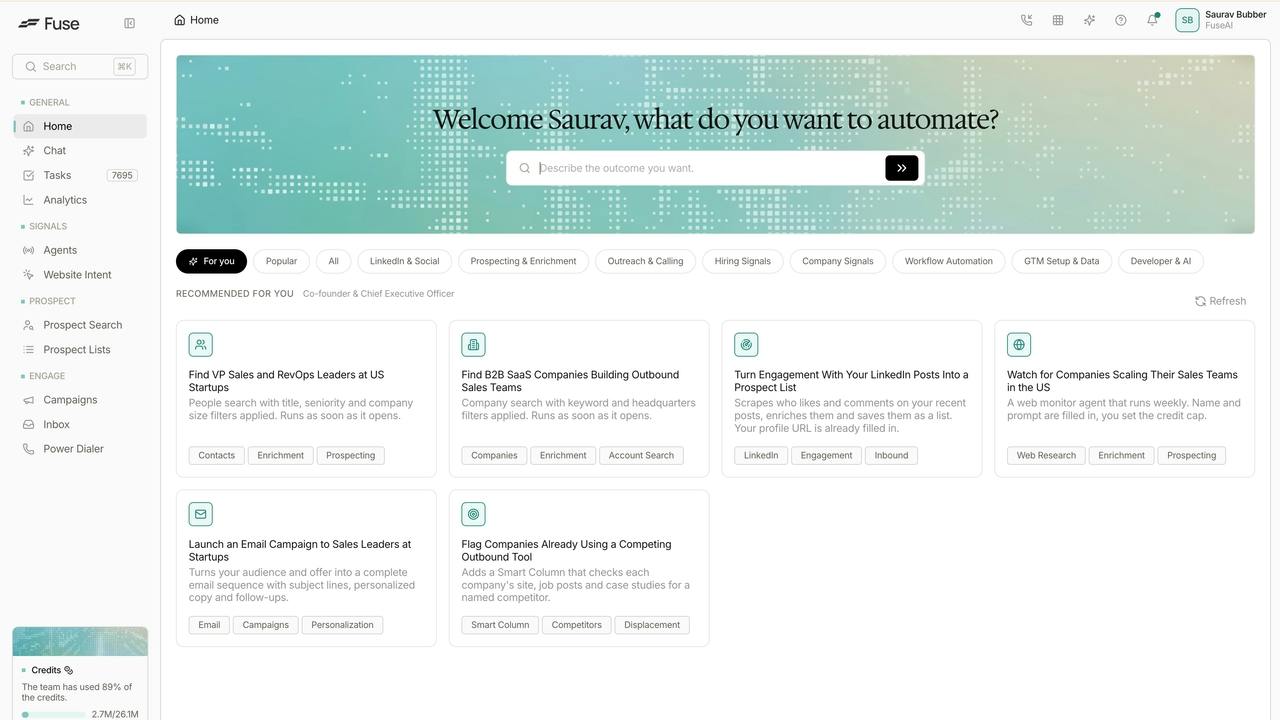
Fuse AI combines contact research and enrichment, buying signals, CRM workflows, email and LinkedIn outreach, and dialing. Its current launch also promotes an SDK and MCP interface to make GTM data and actions available from AI tools and custom applications. The problem is real: B2B teams often assemble several vendors to find prospects, research accounts, and execute outreach.
The recommendation is DD. Fuse has a defined product, public paid tiers, an experienced founding team, and company-reported reach. However, public evidence does not establish ARR, paid-customer count, retention, CAC, or gross margin. Product Hunt points and claimed user reach are not substitutes for those measures.
Competition is strong. Clay connects multi-provider enrichment and workflows to MCP; Apollo bundles data and sales engagement; HubSpot embeds prospecting in its CRM. Fuse must show better outcomes, workflow flexibility, or economics while controlling data costs, deliverability, and privacy risks.
Product and Customer Value
Fuse targets founders, SDRs, sales leaders, and RevOps teams. It describes verified data, waterfall enrichment, buying signals, email and LinkedIn sequences, parallel dialing, and AI workflows. The October Product Hunt launch emphasizes a custom GTM stack through one SDK and MCP, with 1,000+ applications and 40+ data providers cited in its description. Those are product claims, not audited coverage.
The customer value must appear in measurable contact accuracy, qualified meetings, CRM quality, or seller time saved. An agent interface may reduce manual research and integration work. Launch comments indicate interest in custom workflows, but do not quantify customer outcomes. Fuse’s key product test is whether it becomes a useful action layer for existing sales systems or a feature bundle that incumbents can reproduce.
Founders and Team
YC identifies cofounders Saurav Bubber and Imogen Low, and lists Fuse as founded in 2024, in San Francisco, with 12 team members. YC reports that Bubber worked on GTM strategy and operations at Deel during its growth from $50M to $600M+ ARR. It describes Low’s early machine-learning work at SAP, Asia-Pacific NLP/ML leadership, and prior company NWO.ai, whose forecasting product served enterprise clients before an acquisition by Growth Protocol. These are profile-reported backgrounds and should be reference-checked.
The founders’ reported sales-operations and ML experience fits the problem. Diligence should establish who owns provider partnerships, security, deliverability, and customer success, and whether the team can support the broad product without excessive burn.
Market and Competition
The initial buyer is a B2B company paying for separate prospecting, enrichment, intent, outreach, and workflow tools. Adjacent budgets include sales intelligence, engagement, RevOps, and agentic workflow software. Consolidating spend or increasing qualified pipeline could support meaningful contracts. Fuse has not published a defensible serviceable-market estimate; a large top-down TAM would be speculative.
Clay advertises 200+ providers and prospecting, enrichment, and workflows through MCP. Apollo combines contact data, signals, enrichment, sequences, email, calling, and LinkedIn tasks. HubSpot’s Prospecting Agent researches accounts, sources contacts, monitors signals, and drafts outreach inside its CRM. These incumbents compete on data, distribution, trust, and bundling. Fuse needs a durable wedge in agent usability, customization, data quality, or a specific underserved segment.
Traction and Distribution
Fuse’s Product Hunt launches ranked #5 in April 2026 and #4 with 323 points on October 6. Its website says 1,000+ sales and marketing professionals across startups and enterprises use Fuse. The company has not disclosed how many are active or paying, how “use” is defined, or cohort retention. Launch rankings indicate attention, not recurring value.
The pricing page offers free, Solo, Team, and custom Enterprise tiers. Likely channels include self-serve adoption, shared workflows, API/MCP integrations, and enterprise sales. The crucial question is whether free users convert and remain without expensive onboarding or outbound acquisition. YC participation and public hiring show company activity, not commercial validation.
Business Model and Unit Economics
Published annual credit allowances are 24,000 for Free, 480,000 for Solo at $60/month, and 1.2 million for Team at $200/month and five seats. Team adds unlimited research agents and buying signals, parallel dialing, and onboarding. Enterprise offers custom credits, a dedicated GTM engineer, and RBAC, SSO, and audit logging. Terms may change.
Gross margin is central. Data lookups, AI research, telephony, and support can have variable costs; “unlimited” features need effective usage controls. Investors should request provider cost per action, credit consumption by cohort, margin by tier, effective revenue per seat, and retention. Public materials disclose none of these.
Unicorn Path and Valuation
A venture-scale path requires Fuse to become a retained system of action for many B2B revenue teams, expand into enterprise contracts, and sustain strong margins. As an illustrative scale test, $50M ARR at a hypothetical 20x ARR multiple implies $1B enterprise value; this is arithmetic, not a forecast. At list price, $50M ARR equals about 20,833 Team subscriptions at $2,400 annual revenue each, or 69,444 Solo subscriptions at $720 each. Discounts, credits, churn, and data costs change the requirement. The unicorn path is conditional on proving paid adoption and differentiated outcomes.
No financing terms, valuation, revenue, or round size were found in the reviewed sources. YC participation does not establish them. Valuation attractiveness is not assessable from public information.
Key Risks
- Commercial validation: No disclosed ARR, paid-customer count, retention, or cohort growth.
- Data quality and cost: Provider accuracy, licenses, refresh rates, deduplication, and unit costs are unknown.
- Deliverability and platform rules: Automated outreach can harm sender reputation or depend on third-party permissions.
- Incumbent bundling: Clay, Apollo, and HubSpot already cover overlapping workflows.
- Switching incentive: Buyers may keep their stack unless Fuse proves better outcomes or lower total cost.
- Credit economics: Actual variable cost may make research-heavy accounts unprofitable.
- Privacy and security: Verify the scope of stated compliance, controls, subprocessors, and data handling.
- Execution complexity: Many providers, integrations, dialer functions, and enterprise controls raise reliability and support demands.
- Acquisition efficiency: CAC, payback, channel mix, and conversion are unpublished.
- Category convergence: CRM and sales suites can add agent features; Fuse needs a durable workflow or data advantage.
Investment Score
| Dimension | Score | Rationale |
|---|---|---|
| Market size and expansion | 15/20 | Multiple recurring B2B budgets; serviceable market not quantified. |
| Traction and growth | 8/20 | Launch interest and claimed reach; paid scale and retention unknown. |
| Founder and team | 13/15 | Relevant reported GTM and ML backgrounds. |
| Product strength | 8/10 | Broad workflow, published tiers, and API/MCP direction; outcomes unverified. |
| Distribution potential | 8/15 | Self-serve, integrations, and enterprise routes; repeatability unproven. |
| Model and economics | 7/10 | Defined subscription and credit model; costs and margins absent. |
| Defensibility | 5/10 | Integrations may compound, but features and providers are replicable. |
| Total | 64/100 | Promising, with material commercial validation required. |
Evidence Confidence: 55/100. Product scope, pricing, company identity, and profile biographies are reasonably observable. Paid adoption, retention, margin, and differentiation remain uncertain.
Final Decision: DD
Advance to focused diligence; do not yet underwrite proven product-market fit. Require verified paid cohorts, retention, gross margin after data and AI costs, and customer evidence of measurable pipeline or productivity gains.
Upgrade or Downgrade Triggers
Upgrade toward Invest if customer cohorts show durable retention, attractive gross margin, efficient CAC payback, and repeatable Solo-to-Team or Enterprise expansion, confirmed by references.
Downgrade to Watch or Pass if reach is mainly free or inactive accounts, retention is weak, provider costs erase margins, outreach creates material policy or deliverability issues, or customers view Fuse as an easily replaced interface.
Founder Diligence Questions
- How many paying companies and seats are active, and how is the 1,000+ user claim defined?
- What are ARR, growth, gross and net retention, and logo churn by cohort and plan?
- What share of free users convert within 30, 90, and 180 days?
- What are CAC, sales payback, and ARR mix across self-serve, referrals, and founder-led sales?
- What are gross margins by tier after data, inference, telephony, support, and onboarding?
- What does a credit represent, and how do customer consumption and provider costs vary?
- What are bounce, spam complaint, inbox placement, and meeting rates versus prior tools?
- Which LinkedIn actions use official interfaces, and how are account restrictions mitigated?
- What are source licenses, refresh rates, geographic coverage, and measured data accuracy?
- Which security audits are complete, what is in scope, and how are deletion requests handled?
- Which segment retains best and pays most, and what evidence supports the broader roadmap?
- What financing has been raised, on what terms, and what milestones will the next 18 months fund?