
Table of Contents
Mastra Factory Investment Report
Category: AI developer tools; agent-powered software delivery
Company Stage: Series A
Founder or Founders: Sam Bhagwat, Abhi Aiyer, Shane Thomas
Headquarters: San Francisco, with a distributed team
Funding: $35 million total company-reported funding, including a $22 million Series A led by Spark Capital
Business Model: Open-source framework plus usage-based cloud platform, paid team plan, enterprise licensing, deployment and support
Product Hunt Launch Date: September 9, 2026
Report Date: September 12, 2026
| Investment Metric | Assessment |
|---|---|
| Venture Potential | 77/100 |
| Unicorn Path | Plausible |
| Valuation Attractiveness | Not Assessable |
| Evidence Confidence | 68/100 |
| Final Decision | DD |
Executive Summary
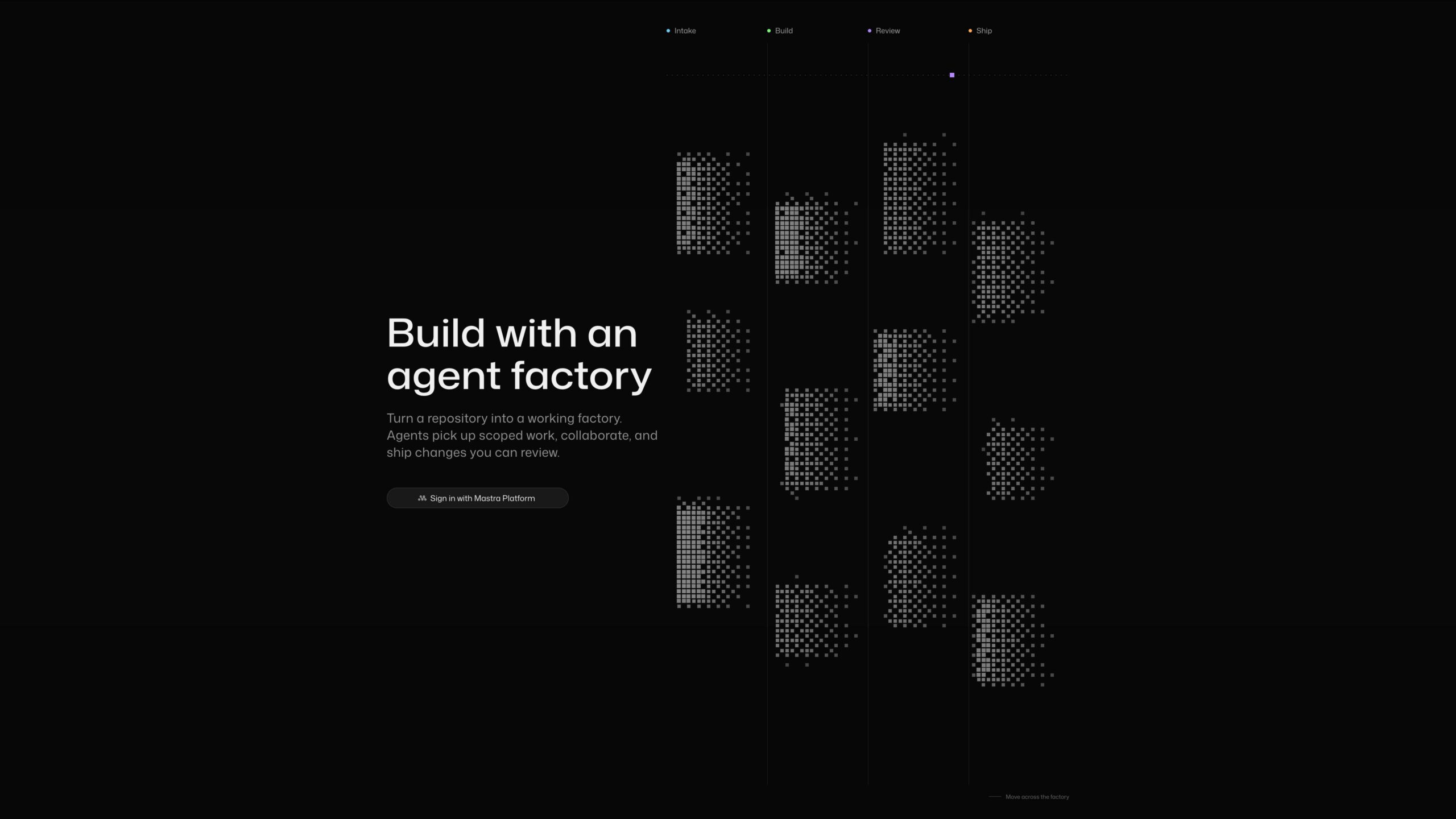
Mastra Factory is an open-source environment for moving software work from issue intake through triage, planning, implementation and pull-request review using persistent coding agents. It connects with GitHub and Linear, runs agents in repository workspaces or sandboxes, and retains human approval gates. The beta launched publicly on September 8, 2026, followed by its Product Hunt launch on September 9.
The product is aimed initially at software teams with meaningful issue and pull-request volume, rather than individual developers seeking simple code completion. Its differentiated proposition is a configurable, shared software-development pipeline rather than another IDE-based assistant. The company also owns the underlying Mastra agent framework, observability stack and deployment platform, giving it more architectural breadth than a standalone coding-agent interface.
The strongest investment signal is Mastra’s pre-existing developer distribution. As of September 12, its public repository recorded approximately 28,000 stars and 2,770 forks, while the core package generated about 1.22 million downloads during the preceding week (GitHub API; npm API). This is substantially stronger evidence than Product Hunt activity, although downloads do not establish paying usage.
Company quality appears high for its stage. The founders previously worked together on Gatsby, which was acquired by Netlify in 2023. Mastra reports a team of more than 35 and $35 million raised, including an April 2026 Series A (company announcement; team page).
The principal concern is the absence of verified commercial metrics. ARR, growth, paying-customer count, retention, gross margin, burn and current valuation are not publicly disclosed. Factory is also only days into public beta and competes with deeply distributed coding agents. Decision: DD—the company merits formal diligence, but neither an investment price nor product-market fit can be established from public evidence.
Product Overview
Mastra Factory addresses the coordination gap between generating code and operating a repeatable software-delivery process. Teams currently move issues manually between project-management tools, coding environments, CI systems and pull-request reviews, with human engineers supplying context at each stage.
Factory provides:
- Configurable stages such as intake, triage, planning, build, review and completion.
- Persistent agent sessions tied to individual work items.
- Repository workspaces and sandboxed code execution.
- GitHub and Linear issue intake.
- Plan approval, diff inspection and human review gates.
- Local, Mastra-hosted or self-hosted deployment.
The official product page offers a free tier with 100,000 observability events, 24 CPU hours and 15-day retention. The $250-per-month plan includes one million events, 250 CPU hours, six-month retention, multiple teams, SSO and access to SOC 2 documentation. Additional events and CPU hours are usage-priced; enterprise pricing is custom.
Factory replaces a combination of manual issue triage, individual coding-agent sessions, scripts, CI jobs and review coordination. Its primary benefit is governed, inspectable delegation across the development lifecycle.
Product quality: Promising and unusually comprehensive for a beta, but independent reliability, security and output-quality benchmarks are unavailable.
Founder and Team Assessment
Mastra identifies Sam Bhagwat as CEO, Abhi Aiyer as CTO and Shane Thomas as chief product officer. The company reports that Bhagwat co-founded Gatsby, Aiyer was a principal engineer, and Thomas held engineering and product leadership roles there (seed announcement). Netlify independently confirms its acquisition of Gatsby, although transaction terms were not disclosed.
This history supports strong founder-market fit: the team has prior experience building and distributing an open-source JavaScript framework and commercial platform. It also provides evidence of technical execution, developer marketing and organizational continuity.
Mastra’s team page lists 35 people, including engineering, customer engineering, growth, documentation and demand-generation functions. Its careers page lists three open roles, indicating continued investment in customer engineering, product design and developer go-to-market.
Commercial capability is less established publicly. Funding success and community distribution are positive signals, but Mastra has not disclosed revenue performance, enterprise contract values or sales efficiency.
Founder Assessment: Strong technical and open-source distribution credentials; current commercial execution remains unverified.
Market Opportunity
The initial target is software organizations with active GitHub repositories, structured issue queues and enough engineering volume to justify persistent coding agents. The buyer is likely an engineering leader, platform team or developer-productivity function.
GitHub reported more than 180 million developers in its latest available Octoverse reporting and identified TypeScript as its leading language (GitHub Octoverse). That is a broad population, not Factory’s serviceable market.
A bottom-up analyst scenario illustrates the opportunity:
- Assume 18 million ten-developer-equivalent teams from 180 million developers.
- Assume only 1% become realistic near-to-medium-term buyers: 180,000 teams.
- At the published $250 monthly plan, annual base revenue is $3,000 per team.
- Implied base opportunity: 180,000 × $3,000 = $540 million annually, before usage overages and enterprise contracts.
This is an analytical scenario, not a verified market-size estimate. Adoption could be materially lower, while enterprise contract values could be materially higher.
Expansion opportunities include enterprise governance, self-hosted deployment, observability, agent memory, API revenue and automation outside software development. International distribution is natural because the product is web-based and open source. The addressable market can support venture-scale revenue, but only if autonomous development becomes a durable budget category rather than a feature bundled into existing platforms.
Traction and Growth Signals
Factory’s Product Hunt launch generated 500 points, 118 comments, a #1 daily rank and a #2 weekly rank (launch page). This indicates launch interest, not product-market fit.
More meaningful signals exist at the company level:
- Approximately 27,959 GitHub stars and 2,770 forks as of September 12 (GitHub API).
- Approximately 1.22 million weekly downloads of
@mastra/corefor September 4–10 (npm API). - An active release cadence, including version 1.66.0 published September 11 (GitHub releases).
- $35 million in company-reported funding and a team exceeding 35 people.
- Company-reported production adoption by organizations including Replit, Brex and Marsh McLennan (Series A announcement).
For Factory specifically, Mastra claims that internal alpha usage automated 25–35% of its pull requests and closed 50–60% of issues after July 2026 (beta announcement). This is relevant dogfooding evidence but is not an independently audited customer result.
The critical missing metrics are paid Factory accounts, active teams, recurring revenue, cohort retention, expansion revenue, task success rates and cost per completed issue.
Traction Assessment: Strong open-source distribution and product activity, but Factory’s commercial traction is unverified.
Competitive Position
Direct competitors include cloud coding agents and software-delivery agents such as GitHub Copilot, Devin and Factory.ai. Indirect alternatives include IDE assistants, command-line agents, internal automation, CI scripts and engineers manually coordinating issues and reviews.
Mastra’s current differentiation is:
- Open-source and self-hostable architecture.
- Configurable stages with explicit human gates.
- Shared sessions rather than isolated developer terminals.
- Ownership of the underlying agent framework, memory and observability layers.
- Model-provider flexibility.
- Integration of issue intake, implementation and review.
Switching costs are initially moderate at best. Workflow configuration, organizational memory and integrations could create retention, but the Apache-licensed core also enables customers or competitors to fork components.
If GitHub launched an equivalent configurable issue-to-PR factory, customers might still choose Mastra for self-hosting, model independence and deeper workflow customization. However, GitHub already offers cloud agents that can take assigned work and create pull requests, giving it a major distribution advantage. Mastra therefore needs demonstrably better governance, reliability and cross-platform orchestration.
Defensibility Assessment: Medium
Business Model and Economics
Mastra uses an open-core model with free software, a metered cloud platform, a $250 monthly team tier and custom enterprise agreements. Potential expansion revenue comes from CPU usage, observability events, retention, enterprise controls, deployment and support.
The published $250 tier implies a minimum annual contract value of approximately $3,000, excluding overages. Enterprise ACV is not disclosed.
Economics depend on:
- Sandbox CPU and storage consumption.
- Observability ingestion and retention.
- Support and customer-engineering labor.
- Model inference responsibility and pricing.
- Discounts and enterprise deployment complexity.
Customers connect a model provider, which may shift significant inference expense away from Mastra. Nevertheless, long-running agents can generate substantial sandbox, storage and support costs. Gross margin, compute utilization and contribution margin per Factory task are unknown. There are no mobile-app-store fees; standard payment-processing costs would apply to self-service subscriptions.
Unicorn Path
An assumed 10× ARR multiple is appropriate as an optimistic but defensible target for a fast-growing software infrastructure company with recurring platform and enterprise revenue. Actual private-market multiples depend heavily on growth, retention and margins.
Required ARR = $1 billion ÷ 10 = approximately $100 million.
At the $3,000 annual team price alone:
$100 million ÷ $3,000 = approximately 33,300 paying teams.
A more credible route would combine:
- 10,000 self-service teams at $3,000 annually = $30 million ARR.
- 1,400 enterprise customers at an assumed $50,000 ACV = $70 million ARR.
The $50,000 enterprise ACV is an analyst assumption, not disclosed pricing. Achieving this scale requires repeatable enterprise sales, high retention, strong gross margins, security certifications and expansion from Factory into the broader Mastra platform.
The route is credible because Mastra already has substantial open-source distribution and a broader platform. It is not clear because conversion and monetization remain unknown.
Unicorn Path: Plausible
Valuation Assessment
Mastra announced a $13 million seed round and subsequently a $22 million Series A led by Spark Capital, bringing reported funding to $35 million (seed; Series A). The post-money valuation, ownership, SAFE terms and current fundraising status are not publicly disclosed.
Valuation Attractiveness: Not Assessable
A responsible assessment requires current ARR, growth, gross margin, retention, burn, runway, round valuation, option-pool treatment, liquidation preferences and pro-rata rights. Product quality and funding size are insufficient to infer valuation attractiveness.
Key Risks
- Commercial validation: No verified revenue, paying-customer or retention data.
- Platform bundling: GitHub and other coding-agent vendors can bundle similar workflows into existing distribution.
- Factory maturity: The public beta is only days old; reliability and security are not independently established.
- Low initial switching costs: Teams can use competing agents or fork open-source components.
- Compute economics: Persistent agents and sandboxes could constrain gross margins.
- Agent-error propagation: Incorrect triage assumptions can produce unnecessary or harmful code changes; Mastra acknowledges this problem.
- Open-source monetization: High downloads may not translate into cloud or enterprise revenue.
- Enterprise security: Repository access and autonomous code execution create material permission, secret-management and supply-chain risks.
- Founder and key-team concentration: Product vision remains closely tied to the three Gatsby veterans.
Final Assessment
Venture Potential: 77/100
| Category | Score |
|---|---|
| Market Size and Expansion Potential | 18/20 |
| Traction and Growth Evidence | 14/20 |
| Founder and Team | 14/15 |
| Product Strength | 8/10 |
| Distribution Potential | 13/15 |
| Business Model and Economics | 6/10 |
| Defensibility | 4/10 |
| Total | 77/100 |
The strongest elements are founder-market fit, open-source distribution and platform breadth. The weakest are unverified commercial traction, unknown economics and exposure to well-distributed competitors.
Evidence Confidence: 68/100
Verified information includes public repository activity, npm downloads, pricing, product functionality, founders, Product Hunt performance and Gatsby’s acquisition. Funding, internal automation rates and named customer usage are company-reported. Revenue, retention, gross margin, burn, valuation and cap-table information remain unavailable.
Final Decision: DD
Mastra is strong enough to justify formal due diligence. The product is differentiated, the founders are credible, the market is large and distribution is unusually strong for an early-stage developer-tool company. However, an investment decision cannot be made without verifying monetization, retention, enterprise adoption, economics and financing terms.
Upgrade Conditions
- Verified ARR above $3–5 million with sustained growth.
- Strong six- and twelve-month paid-team retention.
- Gross margin above 70% after sandbox and observability costs.
- Multiple referenceable enterprise Factory deployments.
- Repeatable conversion from open-source usage to paid platform accounts.
- Financing terms consistent with revenue and growth.
- Demonstrated security controls for autonomous repository access.
Downgrade Conditions
- Weak paid conversion despite continued download growth.
- High churn following initial Factory experimentation.
- Gross-margin deterioration from sandbox or inference costs.
- GitHub or another incumbent matching Factory’s workflow capabilities.
- Material security, code-integrity or secret-exposure incidents.
- Declining release activity or founder disengagement.
Questions for Further Diligence
- What are current ARR, MRR and monthly revenue growth?
- How much revenue comes from Factory, the broader platform, enterprise licensing and services?
- How many active and paying Factory teams exist, excluding Mastra itself?
- What are 30-, 90- and 180-day retention by customer cohort?
- What percentage of framework users convert to platform accounts and paid plans?
- What are gross margin and compute cost per successful Factory task?
- What share of tasks produce accepted pull requests without material human rework?
- Which acquisition channels generate paid customers, and what is CAC by channel?
- What security controls govern secrets, repository permissions and sandbox isolation?
- What are burn, runway, current headcount plan and founder full-time commitments?
- What are the current cap table, option pool, round valuation and liquidation preferences?
- What proprietary data or workflow advantage will prevent bundling by GitHub and other coding-agent platforms?
Sources
- Mastra Factory on Product Hunt
- Official Mastra Factory product page and pricing
- Mastra Factory beta announcement
- Mastra Series A announcement
- Mastra seed announcement
- Mastra team page
- Mastra GitHub repository
- Mastra npm download data
- Netlify’s Gatsby acquisition announcement
- GitHub Copilot pricing and capabilities