Table of Contents
- Willow Knowledge Investment Report
Willow Knowledge Investment Report
Product Hunt Launch Date: October 6, 2026
Report Date: October 9, 2026
Company / Product: Willow Voice / Willow Knowledge
Category: Personalized AI dictation and writing
Product Hunt: Willow Knowledge
Decision stage: Early-stage diligence on an add-on feature and its parent product.
Investment Snapshot: Five Key Metrics
| Metric | Public evidence | Interpretation |
|---|---|---|
| Launch | Product Hunt #7, 147 points in the observed snapshot. | Modest attention; not repeat usage. |
| User reach | Willow claims 150,000+ professional users. | Parent-product figure; active and paid shares unknown. |
| Pricing | Free; Pro $15 monthly/$12 annual; Business $35/$28 per seat; Enterprise custom. | Clear subscription tiers; conversion unknown. |
| Feature | Imports style and personal context from ChatGPT, Claude, Gemini, or another AI into Willow Scribe. | May reduce setup friction; effect unmeasured. |
| Company | YC lists Willow as active, founded 2025, seven-person team. | Small team; financing and current scale undisclosed. |
Executive Summary
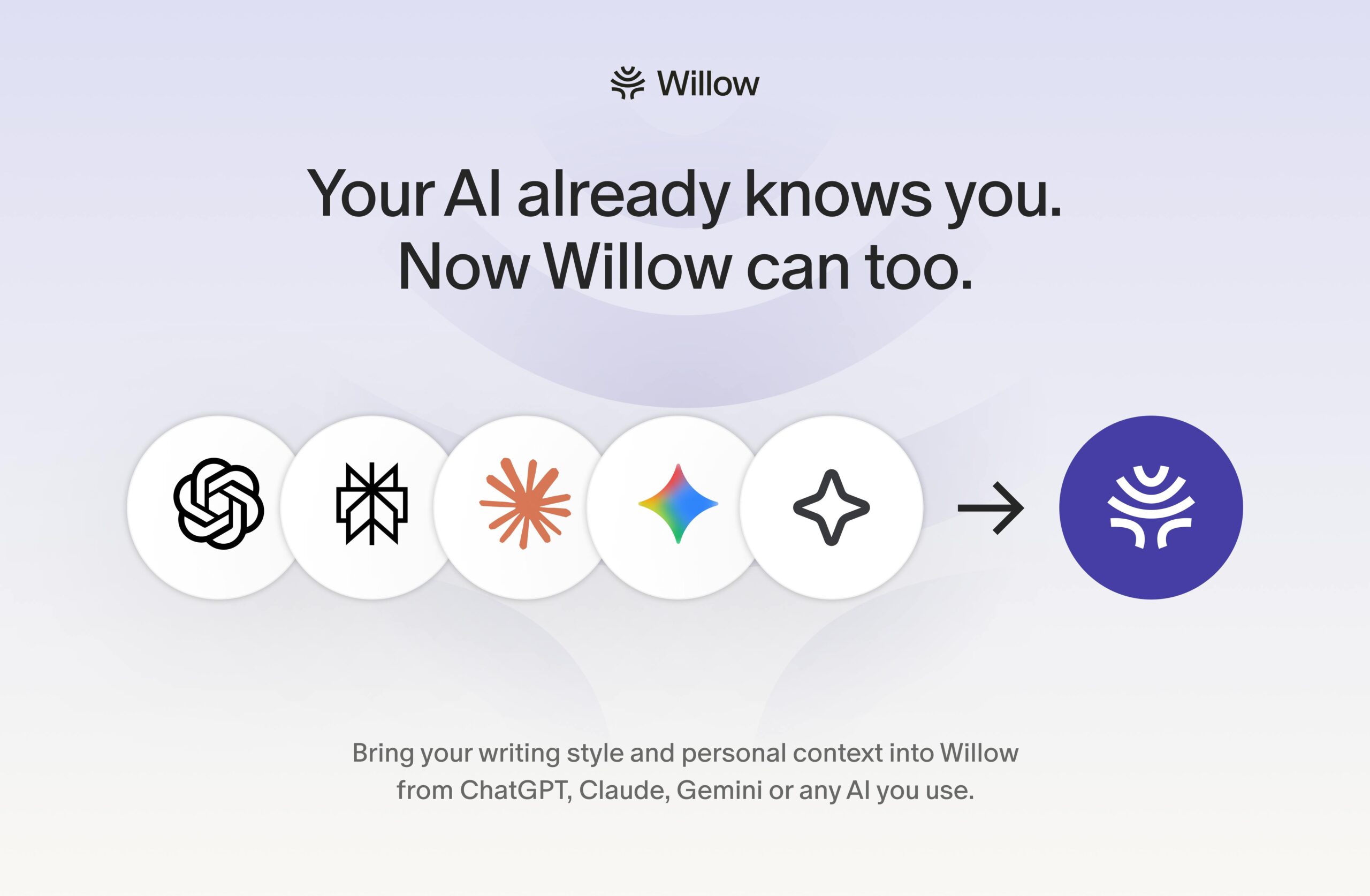
Willow Knowledge is a feature within Willow Voice, not a standalone product. Users ask an AI they already use to summarize their style and context, then paste that result into Willow. Scribe can apply those preferences when drafting text from a spoken prompt, including separate preferences by app.
The recommendation is DD. The feature bridges persistent AI context with cross-app voice writing. Willow has a free and paid product, a YC-backed team, and a 150,000+ professional-user claim. However, there is no public evidence that Knowledge increases Scribe usage, paid conversion, or retention. Nor are ARR, paid seats, churn, CAC, or gross margins disclosed.
Wispr Flow already provides app-specific styles and personal vocabulary. ChatGPT and Claude retain preferences in their own assistants. Willow’s opportunity is to carry that context into writing in other applications; the feature could be copied or made redundant as platforms connect their memories to apps.
Product and Customer Value
Willow Voice places formatted dictation in text fields across Mac, Windows, and iPhone. Scribe turns a rough spoken idea into a finished email, Slack message, or prompt. Knowledge lets users import tone, writing rules, work facts, and app-specific preferences. The Product Hunt maker says users can review, edit, and add context, such as preferred email length or sign-off.
Import is manual rather than a direct synchronization API. The benefit is portability: Willow can apply context users already built in other AI tools, without needing each tool to integrate directly. The investment test is whether imported context measurably reduces editing and increases frequent Scribe use.
Founders and Team
YC identifies Allan Guo as Willow’s Founder and CEO. Its profile reports Stanford computer-science study and machine-learning and neuroscience research, plus earlier projects in caregiving and e-commerce. YC lists an active San Francisco company founded in 2025 with seven team members. Public materials also feature Willow makers Sharath Kuruganty and Allan Guo, but provide limited detail on the broader operating team.
Willow has launched dictation, Scribe, team and developer offerings, and Knowledge. This shows product iteration around voice writing. Diligence should establish who leads speech technology, product, enterprise sales, and privacy, and whether the team has found its strongest-retaining segment.
Market and Competition
The target user writes frequently across email, chat, documents, and AI prompts. Potential budgets include individual productivity tools and team communication software. The need is broad, but the company has not published independent market sizing or verified customer savings.
Wispr Flow is a direct cross-app voice-writing competitor; its site advertises app-specific writing styles and vocabulary personalization. Apple and Windows include basic dictation, while Dragon and Superwhisper target adjacent workflows. ChatGPT memory and Claude profile preferences store context inside their own assistants. These products can serve as Willow’s context sources and its substitutes. Willow’s differentiation is voice-first entry plus user-specific context applied in other apps. Style import alone is easy to replicate, so retention must come from superior dictation, convenience, and output quality.
Traction and Distribution
Product Hunt ranked Willow Knowledge #7 with 147 points in the reviewed snapshot. Willow Voice lists eight launches, including Scribe, teams, developers, and dictation models. The website claims 150,000+ professionals, and Product Hunt describes thousands using Willow daily; these parent-product claims do not specify active periods, paid users, or retention.
The free tier can distribute Knowledge to existing users, while paid Individual and Business plans monetize higher-quality dictation and unlimited Scribe. The key question is whether Knowledge increases conversion, retention, or seats. Product Hunt feedback praised different preferences by app; one reviewer raised onboarding friction. These comments are useful signals but too few to estimate demand or satisfaction.
Business Model and Unit Economics
Willow’s pricing page lists Basic free, Individual Pro at $15/month or $12 with annual billing, Business at $35 or $28 per user, and custom Enterprise. Basic includes 20 Scribe uses per week. Business adds enforced zero-data-retention mode, SOC 2 Type II and HIPAA controls, and admin features. Enterprise adds SSO/SAML and custom terms. Willow Knowledge was listed as free at launch and is monetized indirectly through the parent plans.
The subscription model benefits from recurring voice use, but unlimited Scribe and dictation expose Willow to inference and speech-processing costs. Request gross margin by plan, usage distribution, cost per user, free-to-paid conversion, churn, and the measured effect of Scribe and Knowledge on renewal. None is public.
Unicorn Path and Valuation
Willow would need to become a frequent writing interface for a large base of individuals and teams, with strong retention and attractive model costs. Knowledge could increase stickiness by carrying style and work context across apps. The larger opportunity is a personalized voice-writing platform rather than a single context-import feature.
Illustratively, $50M ARR at an assumed 20x ARR multiple implies $1B enterprise value. At $12/month per annual Pro seat, that is about 347,000 seats; at Business’s $28/month annual rate, about 149,000 seats. Discounts, churn, and costs are excluded, so this is not a forecast. Willow’s user claim does not establish revenue. No current financing amount, valuation, ARR, or paid-seat count was verified. The unicorn path is conditional on proving expansion, retention, and margins. Valuation attractiveness is not assessable without operating metrics and financing terms.
Key Risks
- Adoption: Knowledge usage and repeat imports are not disclosed.
- Monetization: The feature is free; its effect on paid conversion and retention is unknown.
- Replication: Competitors can add similar style and context import.
- Substitution: AI platforms may apply their own memories directly in other apps.
- Context errors: Imported summaries may be stale, incomplete, or mix work and personal preferences.
- Privacy: Users transfer personal or business context across AI providers; storage and deletion controls require review.
- Variable costs: Speech and model usage may pressure unlimited-plan margins.
- Reliability: Product Hunt reviewers mention slowdowns and unintended translation of non-English dictation.
- Onboarding: One launch reviewer described setup friction; test the funnel with broader cohorts.
Investment Score
| Dimension | Score | Rationale |
|---|---|---|
| Market size and expansion | 15/20 | Broad writing use; no verified market sizing. |
| Traction and growth | 10/20 | Large parent-user claim; active and paid cohorts unknown. |
| Founder and team | 11/15 | YC-backed, small team; limited public operating detail. |
| Product strength | 8/10 | Clear context workflow; impact is unmeasured. |
| Distribution potential | 8/15 | Existing users and free tier; conversion unknown. |
| Model and economics | 7/10 | Published tiers; costs and churn absent. |
| Defensibility | 4/10 | Context habit may help; feature is replicable. |
| Total | 63/100 | Promising, with commercial impact unproven. |
Evidence Confidence: 57/100. Product, pricing, YC profile, and company-reported reach are observable. Paid scale, retention, Knowledge adoption, margins, and customer outcomes remain uncertain.
Final Decision: DD
Advance to focused diligence on Willow Voice and evaluate Knowledge as a feature of the existing product. Do not value the add-on as a standalone business until usage, monetization, and retention effects are measured.
Upgrade or Downgrade Triggers
Upgrade toward Invest if Knowledge reaches a material share of active users, reduces editing, increases Scribe use or paid conversion, improves retention, and does not materially raise costs.
Downgrade to Watch or Pass if users rarely import context, imported preferences become stale, privacy concerns deter teams, competitors match the feature, or usage costs exceed subscription value.
Founder Diligence Questions
- What does 150,000+ professional users measure: sign-ups, monthly active users, or lifetime users?
- What are WAU/MAU, paid seats, cohort retention, growth, and churn by plan?
- What share of active users imports Knowledge and returns to update it?
- Does Knowledge increase Scribe use, conversion, upgrade, or renewal? What is the measured lift?
- How do you test style match and editing reduction?
- What are gross margins and model and speech costs by plan and usage level?
- What context is transmitted to AI providers, and what does Willow store?
- Can users review, export, delete, and separate work and personal context?
- How are multilingual errors and slowdowns tracked and fixed?
- What are CAC and payback by channel?
- Which customer segment retains and pays best?
- What financing, valuation, runway, and milestones support the next stage?