
Table of Contents
Coddy — Product Hunt Investment Research Report
Company / product: Coddy
Product Hunt launch date: October 6, 2026 (sheet date)
Product Hunt listing: Coddy on Product Hunt
Research date: October 9, 2026
Final decision: DD
Evidence confidence: 58/100
Investment snapshot
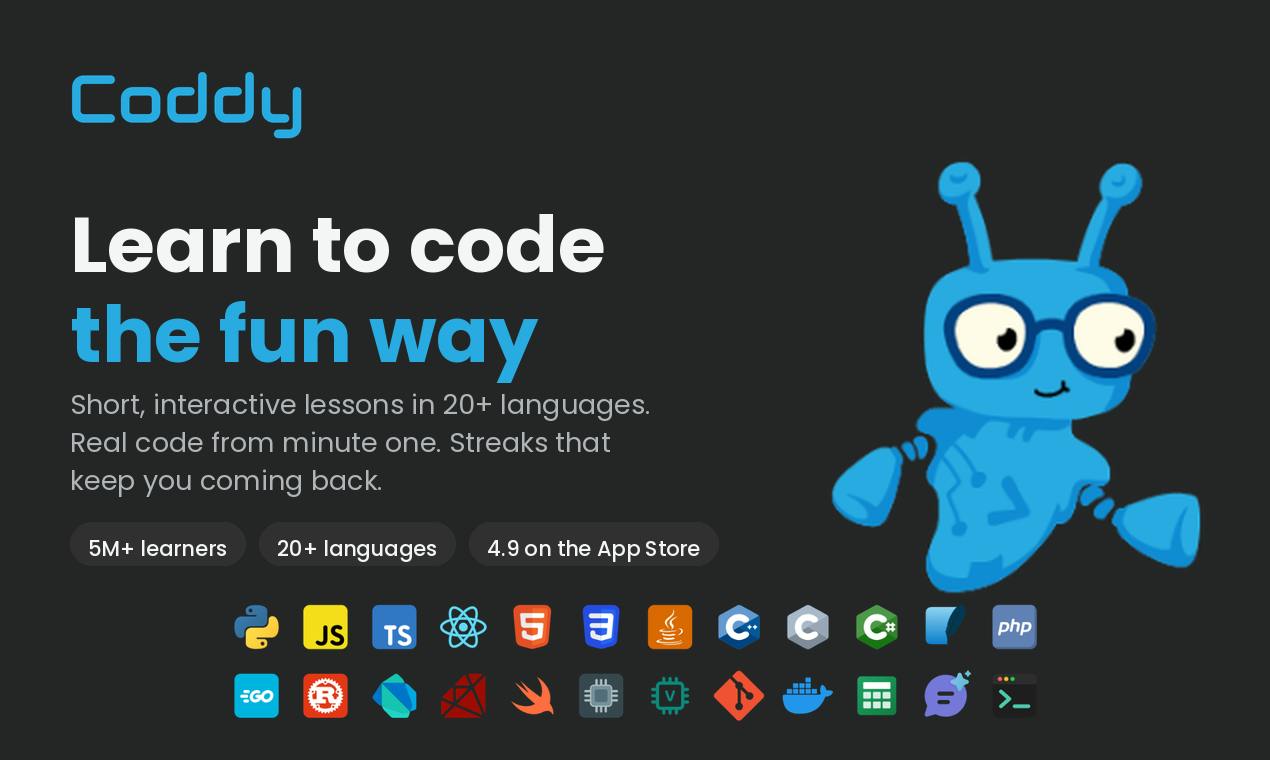
Coddy is a consumer and education coding-learning platform built around short interactive lessons, in-browser exercises, test cases, streaks, and an AI tutor that offers hints rather than answers. It serves learners on web and mobile and sells classroom tools to teachers and schools. The product lowers the setup barrier for beginners and targets a durable need: learning to code through regular practice.
The company reports more than 5 million learners, 100-plus courses, and 100,000-plus code submissions daily. Its teacher product may add efficient group distribution. These are promising reach and activity claims, but public evidence does not establish monthly active learners, paid conversion, revenue, acquisition cost, cohort retention, or learning outcomes. A founder also announced access to up to $10 million of user-acquisition financing; terms, drawdown, and campaign returns are not public. Coddy merits focused diligence, but the evidence is insufficient for an investment decision.
Product, pricing, and team
Coddy teaches more than 20 programming languages through bite-sized lessons and exercises that run in a browser or mobile app. Learners write code, run it against tests, and progress through courses without configuring an IDE. Streaks, leagues, challenges, and certificates encourage practice. The company says its AI tutor, Bugsy, considers the lesson, code, and failing test and offers guidance rather than the completed answer—a useful constraint if it reliably supports learning.
The company FAQ says free users can access courses and certificates subject to a daily energy limit. Plus removes usage limits and ads; Pro adds more capable AI, code review, and premium challenges. Lifetime purchases are also available. On the U.S. Apple App Store snapshot, monthly prices included $14.99 for Plus and $19.99 for Pro, alongside varying annual offers. Store prices are not net revenue; geography, discounts, refunds, and platform fees affect proceeds. Lifetime sales may improve cash collection but create ongoing service costs without recurring revenue. AI features can improve conversion while increasing inference costs, so margin by plan and usage tier matters.
Coddy for Teachers offers classroom setup, autograded exercises, progress tracking, and gradebook features. The public page advertises a free classroom for up to 35 students and a paid school plan with displayed entry pricing around $179.99 per year and a minimum-seat condition. The company reports more than 300 seat sales. Renewals, active paid schools, seats per account, and expansion revenue remain undisclosed.
Coddy’s press kit names Nethanel Bar (cofounder/CEO; Technion computer-science graduate and former Intel employee), Kevin Spektor (cofounder/CTO; data engineer and product builder, Ben-Gurion University), and Barak Glanz (cofounder/CMO; Technion computer-science graduate and former Meta intern). The mix suits a software learning product, though biographies do not prove educational outcomes or efficient growth. The press kit says the company was founded in 2022, while the Product Hunt founder note says the team began this concept in 2023; clarify whether these refer to formation and product start.
Market and competition
The opportunity includes beginner coding education, self-guided skill development, and coding instruction in schools. Short lessons and immediate code execution suit mobile sessions and reduce setup friction. But switching costs are low and many alternatives are free. Coddy must prove that learners return and improve, rather than relying on installs or course starts.
Mimo is a direct competitor with interactive lessons, AI assistance, projects, and career paths; its website claims more than 35 million learners. Codecademy, SoloLearn, freeCodeCamp, YouTube, school curricula, bootcamps, and general AI assistants also compete for learners’ time and budgets. Coddy combines broad free access, gamified practice, test-driven exercises, and a hint-based tutor; its classroom workflow may offer a distinct distribution wedge. None is clearly defensible alone. Content and AI interfaces can be copied, so diligence should test whether Coddy’s curriculum, learning data, habit loops, or school relationships drive superior retention and outcomes.
AI creates both opportunity and risk. A tutor can personalize hints and reduce frustration, while coding copilots and chatbots may substitute for conventional beginner instruction. Coddy should demonstrate that learners gain coding ability and can reason about code, rather than merely complete AI-assisted tasks. In September 2026 the company introduced Coddy Spaces and Chess, its first subject outside coding. This could widen the audience, but also raises focus and brand-extension questions.
Traction and evidence quality
Coddy’s press kit claims 5 million-plus learners, 100,000-plus code submissions per day, 500,000-plus mobile downloads, users in 180-plus countries, 15-plus programming languages, and 100-plus courses. Google Play showed a 4.7 rating from about 8,650 reviews and 100,000-plus downloads in the snapshot reviewed. These indicate meaningful reach and feedback, but cumulative learners, downloads, and submissions do not equal active users, retained cohorts, or paying customers.
For classrooms, Coddy reports that 76% of its students were still coding in week two, compared with 14% of other new users, based on August–September 2026 data. The public page does not define activity, disclose cohort size or selection, or show longer retention. Treat this as a company-reported signal to validate, not an established benchmark.
The Product Hunt launch snapshot showed #8 with about 138 points. Comments praised the short exercises and Bugsy’s hint-based help. This is useful early feedback, but launch votes and comments are a small, self-selected sample.
Business model and financing
Revenue may come from Plus and Pro subscriptions, lifetime purchases, and school plans. The free energy limit creates an upgrade prompt; classroom access could lower marginal learner acquisition cost. Key unknowns include conversion, net ARPU, churn, school renewal, AI cost, and contribution margin.
A founder post announced access to “up to $10M” of user-acquisition financing from PvX Partners. This is a growth-financing facility, not evidence of an equity round, valuation, or $10 million already spent. Public sources reviewed do not disclose amount drawn, cost, repayment structure, CAC, or payback. It could scale a proven channel, but creates risk if financed cohorts fail to repay acquisition cost from retained gross profit.
Venture-scale path and valuation
A plausible path combines consumer subscriptions with teacher distribution: acquire learners online and through mobile, convert a share to paid plans, and let teachers introduce Coddy to groups. A wider learning suite might expand the audience, though the company must show that adjacent subjects do not dilute coding focus.
As an illustration, $50 million of ARR at an assumed 20× ARR would imply $1 billion of enterprise value. At the U.S. App Store Plus price of $14.99 monthly, $50 million of gross annualized billings would require roughly 278,000 full-price annual-equivalent subscribers before discounts, taxes, platform fees, and churn. This is arithmetic, not a forecast. Current revenue, growth, paid users, retention, financing obligations, and equity terms are unknown, so a present valuation cannot be supported.
Key risks
- Metric quality: Cumulative learners and daily submissions may overstate active or monetizable usage.
- Retention and outcomes: Independent cohort data, completion, skill gains, and long-term usage are missing.
- Acquisition financing: Facility terms, drawdown, CAC, payback, and repayment risk are unknown.
- Unit economics: Conversion, net ARPU, refunds, lifetime liabilities, and plan-level margins are undisclosed.
- AI quality and cost: Inference expense or poor hints could hurt margins and learning.
- Competition: Free curricula and general AI tools are accessible substitutes.
- Schools and privacy: Renewals, sales cycles, student-data controls, and school economics need validation.
- Scope and execution: Many languages and a move into Chess could spread product and content resources thin.
- Platform exposure: App-store fees, discovery, policies, and privacy disclosures may affect growth.
Scoring rubric
Market: 16/20 — durable need, but free alternatives and willingness to pay are uncertain.
Traction: 13/20 — meaningful reported reach, with weak public evidence for active users.
Team: 12/15 — relevant technical, product, and growth backgrounds; execution needs diligence.
Product: 9/10 — low-friction practice and a thoughtful hint-based tutor.
Distribution: 9/15 — consumer reach and a school wedge, with efficiency and renewals unknown.
Business model: 7/10 — several revenue routes, with conversion and margin unproven.
Defensibility: 4/10 — habit loops and school workflows help, but features are replicable.
Total: 70/100. The score supports diligence, not an unconditional investment.
Evidence confidence and decision
Evidence confidence: 58/100. Public sources support product features, team biographies, storefront pricing, and the existence of company-reported scale claims. Confidence is low on revenue, retention, conversion, unit economics, school renewals, financing terms, and learning outcomes because they are not independently documented.
Final decision: DD. Seek underlying data before investing. Upgrade only if verified cohorts show durable retention and learning progress, both consumer and school channels have attractive contribution margins, and user-acquisition financing has manageable terms. Downgrade to Watch or Pass if active usage is far below cumulative claims, payback depends on continuing financing, AI or lifetime plans lose money, or school retention does not repeat.
Questions for the founders
- How are “5 million learners” defined, and what are current MAU, WAU, and 30/90-day retention by platform?
- Can you provide cohort retention and course completion by acquisition source, country, and free or paid tier?
- What are paid conversion, net ARPU, churn, refunds, and gross margin by plan?
- How do you measure coding proficiency and validate learning outcomes?
- What are the PvX facility terms, amount drawn, CAC, and payback for financed cohorts?
- For the 76% classroom week-two statistic, what are cohort sizes, activity definition, comparison method, and longer-term results?
- How many paying schools and seats are active, and what are renewal and expansion rates?
- What student data is collected or sent to AI vendors, and what protections apply to minors?
- What are Bugsy’s usage cost and accuracy, and how often does it give incorrect or overly complete answers?
- How do lifetime plans perform after fees and ongoing support and AI costs?
- What milestones govern expansion into Chess and other subjects?
- What equity has been raised, what are the current ownership and financing needs?
Sources
- Product Hunt listing and launch discussion
- Coddy press kit and team biographies
- Coddy FAQs and plan descriptions
- Coddy for Teachers
- Coddy Spaces: Introducing Chess
- Coddy on Google Play
- Coddy on the U.S. Apple App Store
- Founder announcement of user-acquisition financing
- Mimo courses
- Mimo homepage and claimed learner count