
Table of Contents
Databench by Alkera Investment Report
Category: Open-source collaborative data workspace and AI analytics
Company Stage: Seed-stage; Y Combinator Summer 2026
Founder or Founders: Rick Gao (CEO), Tony Li (COO), Andrew Tran (CTO)
Headquarters: San Francisco, California, per Y Combinator
Funding: YC Summer 2026; CB Insights secondarily reports a $500,000 convertible note, not verified by the company
Business Model: Open-source Apache-2.0 product, free hosted tier, paid plans, enterprise services
Product Hunt Launch Date: 2026/10/07
Report Date: 2026-10-10
| Investment Metric | Assessment |
|---|---|
| Venture Potential | 73/100 |
| Unicorn Path | Conditional |
| Valuation Attractiveness | Not Assessable |
| Evidence Confidence | 63/100 |
| Final Decision | DD |
Executive Summary
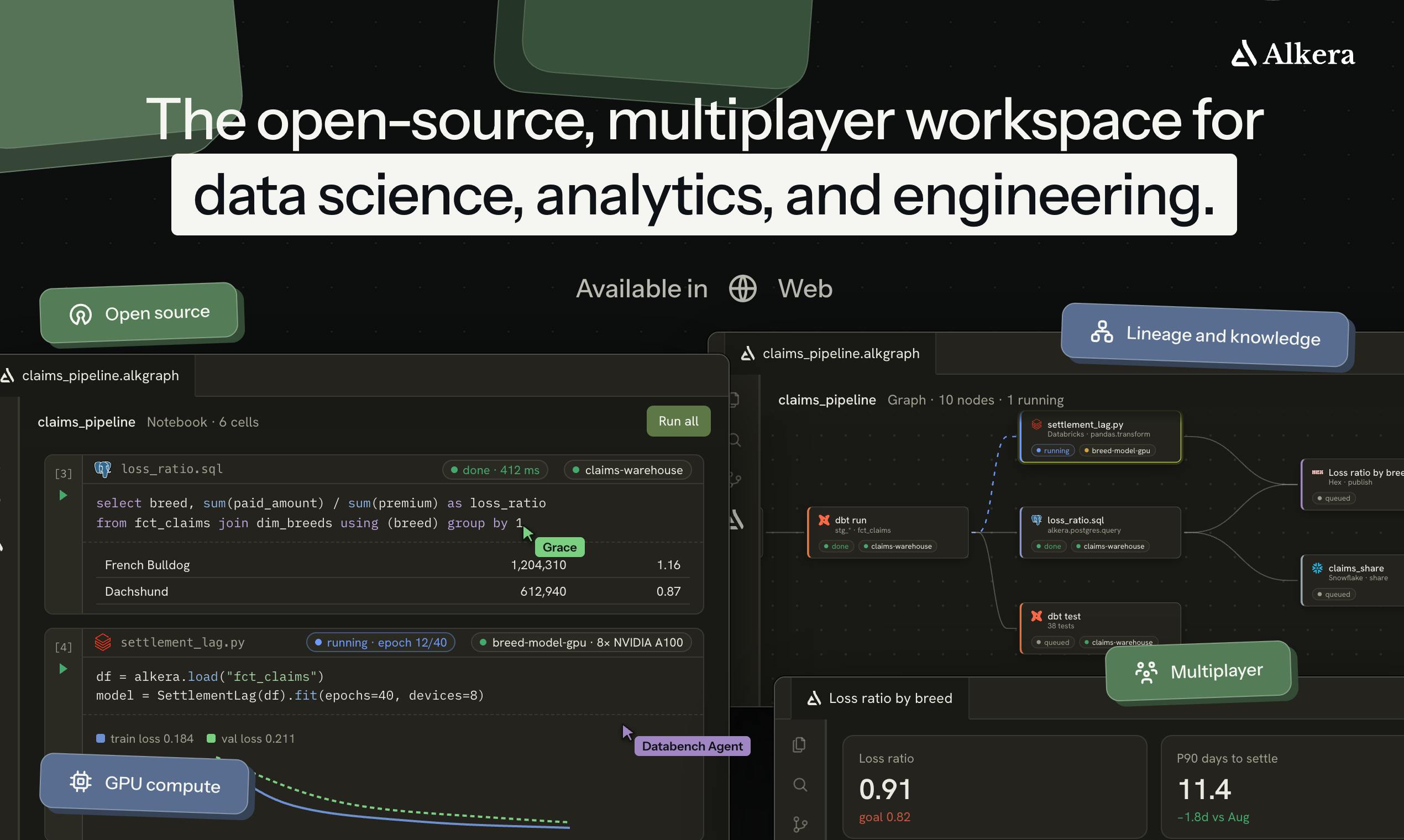
Databench is a self-hostable web workspace where data teams and AI agents collaborate in shared chats, files, and SQL/Python notebooks. It can run on local or remote machines, including GPU nodes. The code is Apache-2.0. Alkera positions Databench as an open-source workspace alongside its commercial agentic data platform.
The opportunity is to make data work more collaborative and auditable while letting teams control compute and model credentials. Alkera offers free access and lists paid Plus and Pro plans at $50 and $200 per month, with custom enterprise terms. The pricing page does not clearly define the billing unit; the terms say each license is for one individual. Databench · Pricing
Alkera is a YC Summer 2026 company with three technically relevant founders. Product Hunt showed 289 upvote points and a #4 daily rank; GitHub showed nine stars and one fork in the snapshot. These are early launch signals, not sustained usage. Revenue, customer counts, retention, and growth are not public.
The wedge is credible for data teams needing shared notebooks, remote compute, self-hosting, and agent execution. Hex and Deepnote already offer AI collaboration, while JupyterHub is a mature open-source alternative. Decision: DD. Verify adoption, product reliability, paid conversion, security, and financing before considering investment.
Product Overview
Databench combines live chats, files, notebooks, SQL connections, and agents. Its official page describes plain-Python notebooks compatible with marimo and SQLAlchemy database access. The GitHub README documents self-hosting, user-controlled model keys, compute on local or SSH machines, and a web app plus CLI. These are product and code claims, not a security audit. GitHub repository
The problem is fragmented analysis across notebooks, agent chats, code, and compute. Databench aims to keep work reproducible and tied to its code and data, including for teams that cannot send data to a general SaaS notebook. The hosted tier reduces trial friction; exact plan entitlements for Databench versus the broader Alkera platform need clarification.
Founder and Team Assessment
YC lists Rick Gao, Tony Li, and Andrew Tran as active founders and a three-person team in San Francisco. Gao worked on financial models at Verition and computational biology at Yale. Li built agentic software at ByteDance and worked as a quantitative developer at Carthage Capital. Tran has Yale computer science and ML research experience and worked with data teams at Ramp and Hudson River Trading. These are YC-provided backgrounds. YC profile
The technical and data-domain fit is strong. Commercial leadership, full-time status beyond YC’s active label, hiring plans, and prior exits are not established. Founder Assessment: Strong technical fit; commercial execution remains unproven.
Market Opportunity
The first buyer is a data engineering, analytics, or data science team using SQL warehouses, dbt, Python, and remote compute. These teams need to coordinate people and agents while preserving access controls and reproducibility. Larger organizations may pay for private deployment, governance, and support; smaller teams may stay on the open-source version.
A scenario, not a market fact: 10,000 teams buying ten licenses at an assumed $50 per license monthly would imply $60 million annual revenue (10,000 × 10 × $600). The target count and price unit are assumptions. The opportunity depends on turning a useful notebook collaboration tool into a trusted platform for production data workflows. No reliable public customer or spending figures validate the reachable market.
Traction and Growth Signals
Product Hunt showed 289 points, a #4 daily rank, and 646 followers. The GitHub snapshot showed nine stars, one fork, and one commit history entry. The company is active in YC’s Summer 2026 batch and provides a free product with published paid plans. These show launch activity, not product-market fit.
No public figures were found for deployments, weekly active teams, paid accounts, revenue, retention, or customer references. The official demo is illustrative, not a customer case study. The small repository footprint is consistent with an early launch but provides little evidence of community pull.
Traction Assessment: The product and company are active; commercial traction is unverified.
Competitive Position
Hex combines collaborative SQL/Python notebooks, AI agents, and governed analytics. Deepnote offers AI notebooks, agents, and team collaboration. JupyterHub is an established open-source multi-user notebook host; dbt supplies transformations and lineage inside many data stacks. Hex · Deepnote · JupyterHub · dbt
Databench may differentiate through live agent editing, self-hosting, compute portability, and customer-controlled model keys. Apache licensing speeds adoption but allows forks. Defensibility would need to come from reliable lineage, sandboxing, integrations, and workflow depth. If incumbents offer comparable self-hosted agent execution, Databench needs measurable cost, control, or reliability advantages.
Defensibility Assessment: Medium if the control and lineage benefits are proven; otherwise Low
Business Model and Economics
The project is Apache-2.0 and self-hostable, so users can run it without paying Alkera. The commercial pricing page lists Free with 10 GB storage, Plus at $50/month with 1 TB, Pro at $200/month with 5 TB and support, and custom Enterprise with SSO, audit logs, VPC/on-prem, data residency, and SLAs. Terms say one license is for one individual, but the plan page does not clearly state its billing unit. Confirm how these plans apply to Databench. Terms
Bring-your-own-key and self-hosting can limit model and compute costs but may also reduce recurring revenue. Hosted storage, model gateway, support, and dedicated compute carry costs. Gross margin, conversion, churn, CAC, and support burden are unknown. Enterprise contracts could raise ACV, with longer sales cycles and heavier security requirements.
Unicorn Path
At an illustrative 10× ARR multiple, a $1 billion valuation requires about $100 million ARR. At $50 monthly per paid license, that would require roughly 166,700 licenses; at $200, about 41,700. These are scenarios, not forecasts, and the plan billing unit is unclear.
A credible path requires converting open-source users into paid deployments, retaining data teams, and expanding into production data engineering and analytics agents. Enterprise plans could support larger contracts, but security, integrations, and sales execution must scale. Unicorn Path: Conditional.
Valuation Assessment
YC participation is confirmed. CB Insights reports a $500,000 convertible note from YC, but this is secondary and not company-confirmed. No primary source reviewed discloses a priced round, valuation, current fundraising status, or revenue. Valuation Attractiveness: Not Assessable. Request the note/SAFE, cap table, ARR, growth, retention, margins, burn, and runway. CB Insights
Key Risks
- Teams may prefer established notebook platforms.
- Open-source use may not convert to paid plans.
- Billing units and product-plan entitlements are unclear.
- Agents on production data create security and correctness risk.
- Self-hosting and SSH compute add deployment burden.
- Incumbents can bundle agent notebooks and lineage.
- Apache forks can copy features.
- No public customer or financial data validates demand.
Final Assessment
Venture Potential: 73/100
| Category | Score |
|---|---|
| Market Size and Expansion Potential | 16/20 |
| Traction and Growth Evidence | 8/20 |
| Founder and Team | 14/15 |
| Product Strength | 9/10 |
| Distribution Potential | 11/15 |
| Business Model and Economics | 8/10 |
| Defensibility | 7/10 |
| Total | 73/100 |
Strong points are the technical team, focused data-team problem, open-source distribution, and customer-controlled deployment. The main gaps are verified adoption and paid conversion.
Evidence Confidence: 63/100
The code license, product documentation, YC profile, pricing page, and Product Hunt metrics are publicly verifiable. Founder histories are YC-provided; the $500,000 note is a secondary claim. Revenue, retention, margins, customer references, and valuation remain unknown. Market calculations are analyst scenarios.
Final Decision: DD
Proceed to technical and customer diligence, not an investment commitment. Verify paid demand, production reliability, security, conversion from open source, and financing terms.
Upgrade Conditions
- Verify paid growth and six-month retention.
- Show recurring workflows with fewer errors or faster completion.
- Provide third-party security testing and customer references.
- Demonstrate healthy margins and repeatable enterprise sales.
Downgrade Conditions
- Paid conversion remains low despite free adoption.
- Agents make unsafe or materially wrong data changes.
- Self-hosting prevents onboarding without extensive services.
- Financing or customer claims cannot be substantiated.
Questions for Further Diligence
- How many organizations and weekly active users run Databench, and how many pay?
- What are the pricing units and conversion rates for Free, Plus, and Pro?
- What are ARR, growth, retention, churn, and gross margin?
- What share is self-hosted versus hosted, and how does each convert?
- What are model, compute, and support costs per active organization?
- How are agent changes tested against data lineage and production permissions?
- What penetration tests, vulnerability handling, and security certifications are complete?
- What are the YC note terms, cap table, burn, runway, and fundraising plans?
- Which customers can verify measurable time savings or fewer data errors?
- How does Alkera win against Hex, Deepnote, JupyterHub, and warehouse-native AI?