
Table of Contents
- Bitrise Remote Dev Environments Investment Report
Bitrise Remote Dev Environments Investment Report
Category: Cloud development environments; mobile DevOps; AI-agent infrastructure
Company Stage: Growth-stage private company; newly launched product line
Founder or Founders: Barnabás Birmacher, Viktor Benei, Daniel Balla
Headquarters: Budapest, Hungary
Funding: Company-reported $95M+ total; last publicly announced round was a $60M Series C in 2021
Business Model: SaaS plus usage-based cloud compute and enterprise contracts
Product Hunt Launch Date: September 17, 2026
Report Date: September 20, 2026
| Investment Metric | Assessment |
|---|---|
| Venture Potential | 78/100 |
| Unicorn Path | Conditional |
| Valuation Attractiveness | Not Assessable |
| Evidence Confidence | 72/100 |
| Final Decision | DD |
Executive Summary
Bitrise Remote Dev Environments, or RDE, provides persistent macOS and Linux cloud machines for developers and AI coding agents. Its main differentiation is that these environments use the same machines, software stacks, and caches as Bitrise CI and Build Hub, reducing discrepancies between development and CI environments (Bitrise RDE; documentation).
The strongest product use case is mobile development, particularly iOS, where access to current Apple hardware, Xcode versions, simulators, signing infrastructure, and reproducible CI environments remains operationally difficult. RDE supports Apple Silicon, Linux, persistent sessions, templates, browser and SSH access, IDE connections, virtual devices, APIs, and orchestration of AI agents through an open-source MCP server.
The strongest investment signal is not the Product Hunt launch. It is Bitrise’s existing distribution and infrastructure: the company reports more than 8,500 brands and 400,000 developers across its broader platform, while its 2026 report analyzed more than 19 million builds (press kit; 2026 platform report). This creates a credible cross-sell channel that a standalone remote-development startup would lack.
The principal concern is commercial evidence specific to RDE. Revenue, paid seats, enterprise adoption, utilization, retention, gross margin, and customer references for RDE are not publicly disclosed. Product Hunt ranked the launch second for the day, but the accessible page showed only two short reviews; this demonstrates launch interest, not product-market fit (Product Hunt).
The company appears strong enough for formal diligence, but not for an investment decision based only on public information. The appropriate decision is DD, contingent on establishing that RDE is generating incremental, high-retention software revenue rather than primarily reselling low-margin compute.
Product Overview
RDE addresses environment drift, local hardware constraints, slow mobile builds, and the need to give autonomous coding agents secure machines on which they can compile and test production applications.
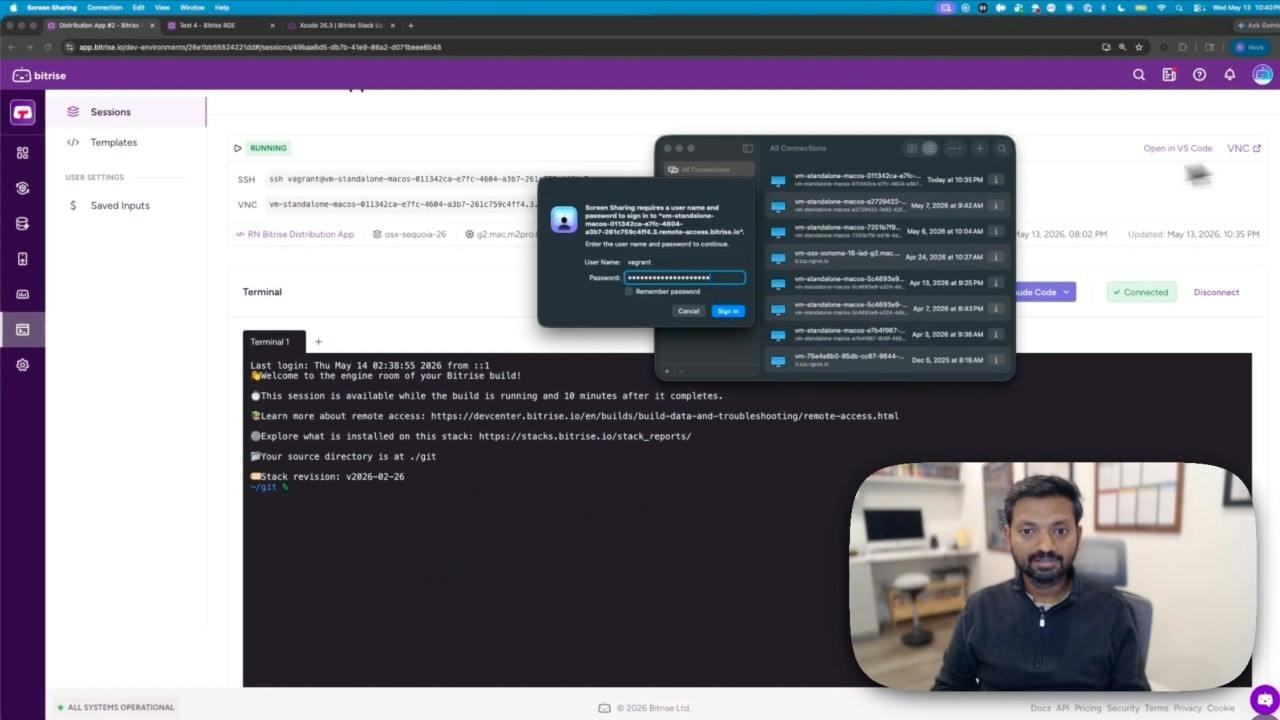
Users create a macOS or Linux session from a template, connect through SSH, a browser terminal, VS Code, Cursor, VNC, or an AI agent, and terminate or archive the session when work ends. Persistent disk state can later be restored, although disks are not backed up and may become unrecoverable when the underlying stack is retired (RDE FAQ).
Core capabilities include Apple Silicon machines, Xcode and mobile toolchains, Linux machines up to 48 vCPUs, shared CI caches, GitHub integration, session-scoped credentials, virtual iOS and Android devices, templates, APIs, and parallel agent orchestration. The open-source RDE MCP server has active releases and supports session lifecycle, command execution, file transfer, workspace-owned sessions, and macOS GUI interaction.
Self-serve pricing starts at $20 monthly for Basic and $40 for Pro, with annual discounts, included runtime and usage-based overages. Advertised monthly caps reach $495 for Basic macOS and $995 for Pro macOS; enterprise pricing is custom (RDE product and pricing page). Customers supply their own AI subscriptions or API keys, limiting Bitrise’s direct inference-cost exposure.
Product Quality: Strong architecture and a compelling mobile-specific integration, although operational reliability and usability at large scale remain insufficiently independently verified.
Founder and Team Assessment
Bitrise was founded in 2014 as a spin-off from the founders’ mobile agency. Its official materials identify Barnabás Birmacher as CEO, Viktor Benei as CTO, and Daniel Balla as co-founder and executive; the founders have therefore operated in mobile development and DevOps for more than a decade (about page; press kit).
The team has demonstrated technical and commercial execution through a multi-product platform, international enterprise customers, substantial infrastructure, and several institutional funding rounds. Bitrise also acquired monitoring company Outlyer in 2019, according to its corporate timeline.
Current team size is less certain. Bitrise’s LinkedIn description reports more than 200 people, while third-party headcount estimates are lower; the company’s careers page showed no open roles at the time of research. Exact headcount, recent retention, founder ownership, and the staffing allocated to RDE are not verified.
Founder Assessment: Strong technical founder-market fit and demonstrated organizational execution, but current ownership, team allocation, and capital efficiency require diligence.
Market Opportunity
The narrow initial segment is mobile engineering organizations already using Bitrise CI or Build Hub and needing remote Apple hardware or isolated environments for AI agents. These buyers have measurable willingness to pay because local Mac fleets, CI failures, developer downtime, and security-approved agent environments impose direct costs.
A useful installed-base calculation starts with Bitrise’s company-reported 400,000 developers. At the RDE annual base prices of approximately $216–$432 per seat, converting 10%–25% of that base would produce roughly $8.6M–$43.2M in annual base subscription revenue before usage charges and enterprise contracts. This is an analyst scenario, not a forecast; Bitrise has not disclosed how many of those developers are active, addressable, or paying.
At 100% conversion, the existing reported developer base would represent $86M–$173M in base revenue. That outcome is unrealistic but shows that the installed base is large enough to matter. Expansion opportunities include non-mobile Linux development, GitHub Actions infrastructure, virtual-device testing, preview environments, agent orchestration, governance, and developer productivity tooling.
Timing is favorable: Bitrise reports that AI-attributed mobile builds increased 161-fold year over year and overall build volume among same-store teams increased 20.9%. These are platform observations rather than proof that customers will buy RDE, but they support the underlying need for additional build and test capacity (2026 report).
Traction and Growth Signals
Bitrise reports more than 8,500 brands, 400,000 developers, and over 19 million builds analyzed during the trailing year. Its G2 listing shows a 4.8/5 rating from 242 reviews for the broader Mobile DevOps Platform, with repeated praise for ease of use and mobile specialization; some reviewers criticize pricing or documentation (G2 reviews).
These signals establish platform maturity, not RDE traction. RDE entered self-serve beta in June 2026 (launch post) and launched on Product Hunt in September. Product Hunt ranked it second for September 17, but only two launch reviews were visible during research. RDE customer count, paying seats, revenue, retention, session volume, and enterprise deployments are not disclosed.
The public MCP repository and frequent releases demonstrate active product development, but GitHub activity is an engineering signal rather than commercial validation.
Traction Assessment: Strong parent-platform traction; RDE-specific commercial traction remains unverified.
Competitive Position
Direct and adjacent competitors include GitHub Codespaces, Ona/Gitpod, Coder, MacStadium Orka, and AI sandbox providers such as Daytona. Free or lower-cost alternatives include local laptops, company-owned Mac minis, self-hosted Coder, generic cloud VMs, Dev Containers, and remote SSH workflows.
Bitrise’s strongest differentiation is the combination of genuine macOS capacity, mobile-specific stacks, shared CI caches, virtual devices, and an installed enterprise CI base. GitHub Codespaces offers broad repository-native cloud environments but emphasizes general VM configurations; MacStadium specializes in Apple infrastructure; Coder emphasizes self-hosted enterprise governance; Daytona emphasizes fast agent sandboxes.
If the largest platform launched the same feature within six months, customers could still prefer Bitrise when they already use its CI, caches, security review, mobile stacks, and Xcode infrastructure. Outside that installed base, switching costs appear lower and differentiation becomes less durable.
Defensibility Assessment: Medium
Business Model and Economics
RDE combines recurring subscriptions, metered compute, monthly spending caps, and custom enterprise commitments. Expansion revenue can come from additional developers, higher machine classes, concurrent environments, dedicated infrastructure, and cross-sales into CI, caching, release management, and Build Hub.
Gross-margin potential is uncertain. Software orchestration should carry attractive margins, but Apple hardware, storage, persistent sessions, regional capacity, and support are meaningful variable costs. Bitrise describes enterprise infrastructure as “zero-margin,” which suggests compute itself may be a retention and platform-expansion mechanism rather than the primary profit pool.
Users bring their own AI credentials, so model-inference costs should not scale directly on Bitrise’s income statement. Critical diligence metrics are compute utilization, idle-capacity cost, archive-storage cost, gross margin before and after support, and attach rates to higher-margin platform products.
Unicorn Path
Assuming an 8× ARR multiple for a scaled infrastructure SaaS company with good growth and recurring enterprise revenue:
Required ARR = $1 billion ÷ 8 = approximately $125 million.
At the $432 annual Pro base price, RDE alone would require approximately 289,000 paying seats, excluding overages. Alternatively, at an assumed blended enterprise ACV of $10,000–$50,000, it would require approximately 2,500–12,500 organizations. These ACVs are analyst scenarios; actual enterprise pricing is undisclosed.
The broader Bitrise platform has a more credible path than RDE alone because it can combine CI, Build Hub, caching, release management, CodePush, RDE, and enterprise infrastructure. Reaching unicorn economics would require strong RDE cross-sell, materially higher enterprise ACVs, sustained international expansion, high gross margin outside passthrough compute, and defensible agent orchestration.
Unicorn Path: Conditional
Valuation Assessment
Bitrise announced a $60M Series C led by Insight Partners in 2021, bringing total funding to nearly $100M (Insight Partners; founder announcement). Investors included Partech, OpenOcean, Zobito, Fiedler Capital, Y Combinator, and H14.
There is a discrepancy: Bitrise’s timeline describes the Series C as $67.5M, while the contemporaneous company and investor announcements state $60M. The company presently describes total funding as $95M+, but no valuation was announced.
Valuation Attractiveness: Not Assessable
Assessment requires current ARR, RDE revenue, growth, gross margin, net retention, burn, runway, capitalization table, round size, price or SAFE cap, liquidation preferences, and secondary-sale terms.
Key Risks
- RDE traction is unverified: no disclosed revenue, paid seats, retention, or enterprise references.
- Compute economics: Apple hardware and persistent environments may constrain gross margin.
- Bundling risk: GitHub or other development platforms could bundle similar environments.
- Installed-base dependence: differentiation is strongest only for existing Bitrise customers.
- Low switching costs outside mobile: generic Linux environments are widely available.
- Security exposure: persistent environments and agent credentials increase the impact of configuration failures.
- Platform constraints: macOS sessions do not support nested virtualization or Docker.
- Product maturity: RDE is newly launched, with limited independent reviews and operating history.
- Financial opacity: current revenue, burn, runway, valuation, and financing status are undisclosed.
- Operational concentration: maintaining current Apple hardware and Xcode stacks requires continuous capital and engineering investment.
Final Assessment
Venture Potential: 78/100
| Category | Score |
|---|---|
| Market Size and Expansion Potential | 18/20 |
| Traction and Growth Evidence | 13/20 |
| Founder and Team | 13/15 |
| Product Strength | 9/10 |
| Distribution Potential | 11/15 |
| Business Model and Economics | 7/10 |
| Defensibility | 7/10 |
| Total | 78/100 |
The strongest elements are founder-market fit, existing distribution, and differentiated mobile infrastructure. The weakest are RDE-specific traction, unit economics, and defensibility outside Bitrise’s installed base.
Evidence Confidence: 72/100
Product capabilities, pricing, founders, funding announcements, platform activity, and broader customer-review evidence are reasonably well documented. Customer and developer counts are company-reported. Market conversion and unicorn calculations are analyst scenarios. Revenue, retention, margins, valuation, cap table, burn, runway, and RDE adoption remain unavailable.
Final Decision: DD
Bitrise is an established venture-backed platform with a credible new product, meaningful distribution, and a potentially important position in mobile AI-development infrastructure. Formal diligence is justified, but investment cannot be recommended until RDE adoption, incremental economics, and current financing terms are verified.
Upgrade Conditions
- RDE reaches at least $5M ARR or demonstrates a rapid, auditable path toward it.
- More than 70% six-month paid-seat retention.
- Gross margin above 65% after hardware, storage, and support costs.
- Material cross-sell into existing enterprise accounts.
- Repeatable acquisition beyond Product Hunt and founder-led sales.
- Verified enterprise security approvals and customer references.
Downgrade Conditions
- RDE functions mainly as low-margin compute resale.
- Weak conversion after trials or high session and subscription churn.
- Major competitors replicate the CI-matched macOS workflow.
- Persistent-environment security or credential incidents.
- Declining platform usage or product-release cadence.
- Financing terms imply an excessive valuation relative to growth.
Questions for Further Diligence
- What are current company ARR and RDE-specific ARR?
- How many organizations, paid seats, and monthly active RDE users exist?
- What are 30-, 90-, and 180-day paid retention and net revenue retention?
- What percentage of RDE customers are existing Bitrise customers?
- What are average subscription revenue, compute overages, and enterprise ACV?
- What is RDE gross margin after Apple hardware, storage, networking, and support?
- How much committed infrastructure is idle during average and peak periods?
- Which acquisition channels produce the lowest CAC and fastest payback?
- What security controls specifically govern persistent disks, agent credentials, and workspace-owned sessions?
- How many engineers and salespeople are dedicated to RDE, and are all founders still full-time?
- What are company burn, cash balance, runway, and current fundraising plans?
- What are the proposed valuation, round terms, cap table, liquidation preferences, and investor ownership?