
Table of Contents
Aramb Investment Report
Category: AI agent infrastructure — all-in-one runtime, tools, and billing platform for building agentic SaaS
Company Stage: Pre-seed / private beta; public launch August 28, 2026
Founder or Founders: Sivareddy Aeddula and Ganesh Kumar J, co-founders (self-identified on LinkedIn); broader team not publicly disclosed
Headquarters: London, UK (company-stated; support operates UK business hours)
Funding: Not publicly disclosed — no funding announcement, investor, or round was found in any database or press source
Business Model: Credit-based subscription (free / $19 / $49 / custom) covering model, voice, browser, sandbox, memory, tools, and metered billing, with per-tenant usage metering
Product Hunt Launch Date: August 28, 2026
Report Date: August 31, 2026
| Investment Metric | Assessment |
|---|---|
| Venture Potential | 33/100 |
| Unicorn Path | Improbable |
| Valuation Attractiveness | Not Assessable |
| Evidence Confidence | 28/100 |
| Final Decision | Watch |
Executive Summary
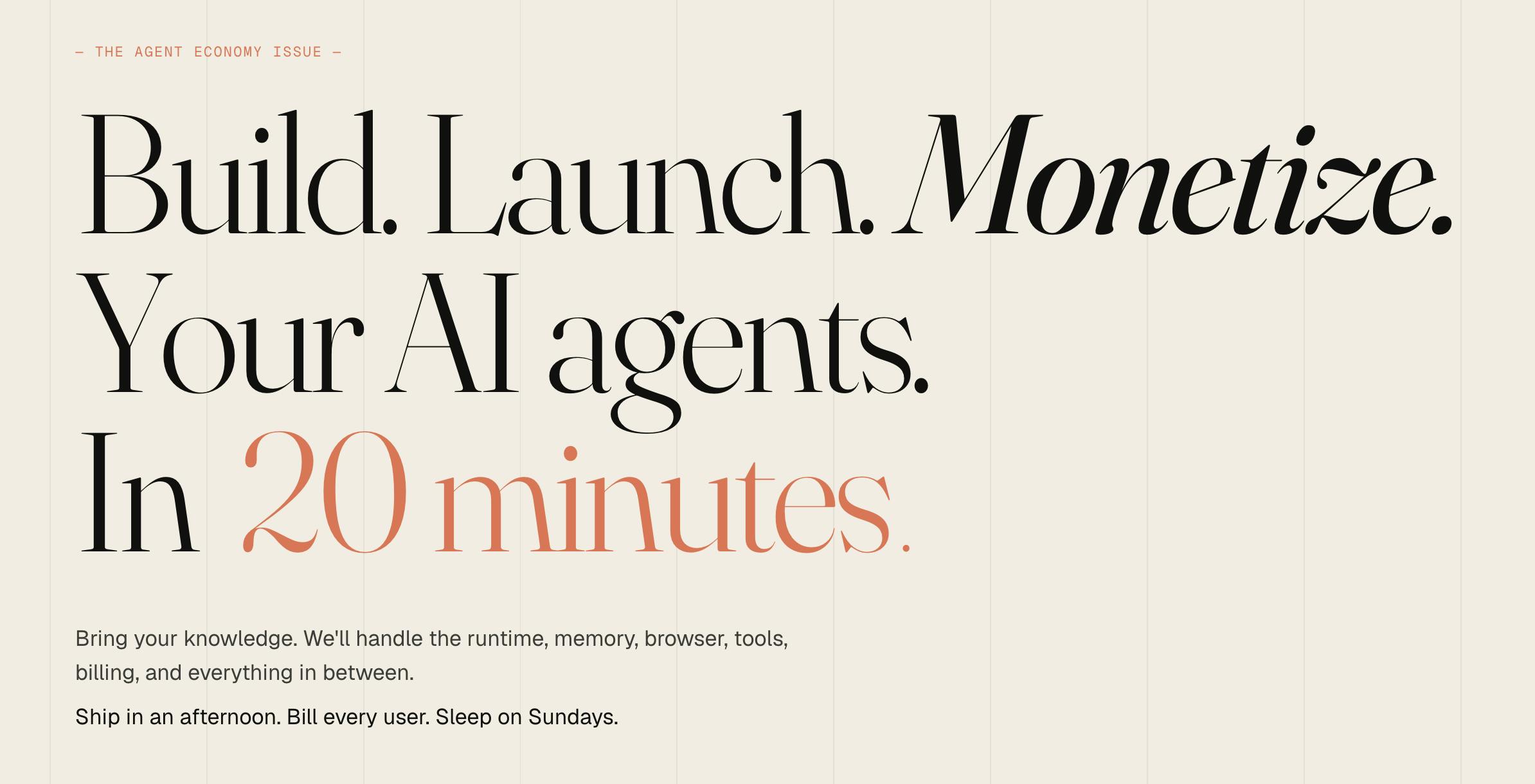
Aramb is an “operating system for AI agents”: a single API and SDK that bundles the seven services most agent products need — model routing, realtime voice, headless browser, ephemeral sandboxes, memory, 3,000+ pre-authenticated tool integrations, and usage-based billing — so a developer can build, launch, and monetize an agent “in 20 minutes” instead of stitching together nine vendors. producthunt
The target customer is the indie builder or small team shipping an agentic SaaS product, for whom the alternative is signing up for a model provider, voice API, browser vendor, sandbox provider, vector database, integration platform, metering service, and Stripe — “nine SDKs, nine sets of keys, nine invoices”. producthunt
The product is interesting because the pain it targets is real and widely felt, the positioning is unusually sharp for a launch this early, and the per-tenant metering primitive (every session tagged to an end-user ID so builders can rebill their own customers from day one) is a genuinely clever wedge into agentic business models. producthunt
The strongest positive signal is execution: a coherent, live product with public pricing, a documented field guide, and a responsive founding team, launched three days ago to a credible, well-funded category — agent infrastructure has absorbed roughly $8 billion into agent startups through late 2024, with E2B, Browserbase, and Composio raising $21M–$250M rounds. infrastartups
The most important concern is that nothing commercial or technical is verified: the company is in private beta, claims a patent-pending token compressor with up to 50% savings, has no disclosed funding, no disclosed team size, no independent reviews, and competes directly against OpenAI’s and Anthropic’s own agent platforms — which Aramb itself lists as head-to-head comparisons. producthunt
Final decision: Watch. The product merits observation, but at three days post-launch with first-time founders, no capital on record, and platform giants converging on the same space, there is nothing yet that justifies formal diligence.
Product Overview
The customer problem: shipping a production agent requires integrating and reconciling many infrastructure vendors before any differentiated work begins. Aramb collapses this into one control plane: any model (OpenAI, Anthropic, Google, xAI, Groq) behind one interface; voice providers (Whisper, ElevenLabs, Cartesia, Deepgram) behind one API; headless Chrome that survives captchas and long sessions; ephemeral Linux sandboxes fenced per end-user; unified vector/episodic/semantic memory; pre-authenticated tool integrations; and a billing layer where every primitive emits a usage event piped to Stripe or Paddle. producthunt
Core workflow: describe an agent in plain English or code, preview it, launch it on a site, schedule, or webhook, and optionally rent it out — “others run it; you keep the recipe,” an early marketplace angle. Pricing is public: Hobby free (5,000 credits/month), Studio $19/month (8,000 credits), Scale $49/month (25,000 credits, per-tenant metering), Fleet custom with SSO/SAML and compliance. One credit covers LLM tokens, CPU, memory, egress, captchas, proxies, and integrations. Platforms: web platform plus an npm SDK (@aramb-ai/sdk), whose public availability could not be independently verified in package registries or on GitHub. producthunt
The company honestly discloses that SOC 2, GDPR, and HIPAA compliance are “in progress,” and the site claims performance figures (3,041 tools, 27ms P50 tool latency, $1.98 per 1,000 credits) that are company-reported only. During launch week, one Product Hunt commenter reported the website failing to load — a small but non-trivial reliability signal for a launch built around uptime claims. producthunt
Founder and Team Assessment
Two co-founders are self-identified: Sivareddy Aeddula, who posted that he and Ganesh Kumar J “just launched Aramb on Product Hunt. First company,” and Ganesh Kumar J, who engaged builders in the launch comments. A third promoter, Dipanshu Kushwaha, amplified the launch but his role is unclear. The company describes itself as “a small founding team” writing “from a garage in London,” offering a “direct line to the founders” in support — consistent, but all self-reported. producthunt
No prior companies, exits, or verifiable professional track records for the founders were found in public sources. Technical capability is evidenced only by the product’s existence and breadth, not by independent verification; commercial capability is entirely untested. Team size, hiring, and full-time commitment are not disclosed, and key-person risk is high by definition at this stage.
Founder Assessment: Ambitious first-time founders with evident shipping ability, but no verifiable track record and an undisclosed team.
Market Opportunity
The initial segment, defined narrowly: indie developers and small engineering teams building monetized agentic SaaS — agents that answer calls, triage inboxes, chase invoices, screen candidates. Their problem is integration overhead, and their willingness to pay starts at $19–$49 per month plus credit top-ups. aramb
Bottom-up (analyst assumption): if 300,000–800,000 builders worldwide are actively shipping agent products and 2–4% adopt a bundling platform at a blended $400–600 per year including top-ups, the initial wedge supports roughly $3–20 million ARR. That is a healthy seed-stage market but not venture-terminal.
Expansion paths are real: the Fleet tier for platforms, the “hire agents” rental marketplace (a take-rate business), and API revenue as the runtime layer. The category itself is well capitalized — E2B raised a $21M Series A (Insight), Browserbase reportedly raised $250M, Composio raised $29M from Lightspeed, and agent-sector funding has run into the billions. But those comparables are specialists with venture capital; Aramb is an aggregator entering with none disclosed. infrastartups
Traction and Growth Signals
The Product Hunt launch occurred August 28, 2026. Current public metrics: 216 followers, no accumulated reviews, and a handful of comments including the website-load complaint. A secondary newsletter listed Aramb among “top AI products this week” — directory-level attention, not evidence of usage. The launch post itself is unusually well-executed, and the team responded to every substantive comment. producthunt
No registered-user, active-user, paying-customer, revenue, retention, traffic, or GitHub/npm activity data exists publicly. The SDK’s availability could not be verified outside the company’s own materials. The most important missing metrics are, effectively, all of them — the product is three days past launch and in private beta. producthunt
Traction Assessment: Launch-week attention only; no commercial evidence exists yet.
Competitive Position
Direct specialists, each better capitalized: E2B (sandboxes, $48.3M raised), Browserbase (headless browsers, reportedly $250M raised), Composio (integrations, $29M from Lightspeed), plus voice (LiveKit, Deepgram), memory (Mem0, Letta), and metering (Stripe, Orb) vendors — Aramb bundles all of their categories. Aramb’s own comparison page names ChatGPT Agent, Claude Cowork, Dust, Zapier, Make, Lindy, Gumloop, and Twin — acknowledging that OpenAI and Anthropic are absorbing this stack natively. aramb
Differentiation today is positioning, not verified technology: the one-bill aggregation story, per-tenant metering, and the claimed ATK token compression. There is no proprietary data, no network effect yet, and the company markets “no vendor lock” — which accurately signals low switching costs. The six-month question — “if OpenAI or Anthropic shipped the same bundle natively, why would builders stay?” — has no strong answer; the honest response is price and vendor neutrality, which has historically been a thin moat against platform absorption. aramb
Defensibility Assessment: Low
Business Model and Economics
Revenue model: subscriptions plus usage credits, at $1.98 per 1,000 credits (company-stated). The economics resemble a reseller: Aramb pays underlying model, browser, and voice vendors and retails a unified credit. Gross margin therefore depends on negotiating spread and on the claimed 50% token-cost reduction from ATK — both unverified. Per-tenant metering is the smartest economic primitive: it lets customers build usage-based businesses on top, which drives credit consumption and ties customer revenue to Aramb revenue. aramb
Risks specific to the model: low price points ($19/$49) require very large customer counts; heavy users may cost more to serve than they pay unless credit pricing is carefully balanced; and compliance (“in progress”) currently blocks regulated workloads — precisely where agent budgets are largest. Free-to-paid conversion, churn, and support costs are all unknown. The marketplace ambition (“rent it out”) would add take-rate revenue but does not yet exist as a product. aramb
Unicorn Path
Assume an 8–10x ARR multiple, appropriate for usage-based AI infrastructure with marketplace optionality. A $1 billion valuation requires roughly $100–125 million ARR. At a blended $500 per year per paying builder (including top-ups), that implies 200,000–250,000 paying builders — a scale no comparable specialist has reached with far more capital. The alternative paths — Fleet enterprise contracts at high ACV or a functioning agent-rental marketplace with meaningful GMV and a 15–25% take rate — would each constitute a major strategic transformation from the current $19/$49 prosumer product, and would almost certainly require significant external capital and a substantially larger team. jimmysong
Given first-time founders, no disclosed funding, and platform giants converging on the same primitives, the current model does not credibly support a unicorn outcome.
Unicorn Path: Improbable
Valuation Assessment
No funding history, investors, round size, SAFE cap, post-money valuation, or current fundraising status exists in any public record. There is no verified revenue. Comparable financings (E2B, Browserbase, Composio) describe the category’s capital requirements, not Aramb’s value.
Valuation Attractiveness: Not Assessable. Assessing it would require, at minimum: current ARR and growth, paying-customer count, gross margin per credit, retention, burn, runway, and the terms of any round in progress. Nothing should be inferred from Product Hunt performance or product polish.
Key Risks
- Platform absorption — OpenAI and Anthropic are shipping the same bundle natively; Aramb’s own comparison page names them aramb
- Unverified product claims — 27ms latency, 3,041 tools, and 50% token savings are company-reported; the “patent pending” status is unverifiable aramb
- Zero disclosed capital against specialists with $21M–$250M raises jimmysong
- Margin structure — reseller economics with a $1.98/1,000-credit retail price and heavy-use customers who may be unprofitable
- First-time founder team of undisclosed size, with high key-person risk linkedin
- Launch-week reliability — a reported website failure during the launch itself producthunt
- Compliance gap — SOC 2, GDPR, and HIPAA all “in progress,” excluding regulated buyers aramb
- Low switching costs — the company markets “no vendor lock,” which cuts both ways aramb
Final Assessment
Venture Potential: 33/100
| Category | Score |
|---|---|
| Market Size and Expansion Potential | 12/20 |
| Traction and Growth Evidence | 2/20 |
| Founder and Team | 5/15 |
| Product Strength | 4/10 |
| Distribution Potential | 4/15 |
| Business Model and Economics | 4/10 |
| Defensibility | 2/10 |
| Total | 33/100 |
The strongest elements are the category’s genuine size and the product’s coherent, well-priced bundling concept. The weakest are the total absence of commercial validation, unverified technical claims, and a structurally weak position against platform giants — hence a weak venture case today.
Evidence Confidence: 28/100
Verified: the product exists with public pricing and features, the Product Hunt launch occurred August 28, 2026, two co-founder identities are self-disclosed, and the company is London-based. Company-reported only: all performance metrics, tool counts, patent claim, and compliance status. Unavailable: funding, team size, users, revenue, retention, SDK verification, and any independent review or traffic data. producthunt
Final Decision: Watch
Aramb is interesting but three days old. The market is real and heavily funded, the product concept is sharp, and the founders are executing visibly — which satisfies the Watch criteria of promising quality with unknown commercial substance. It does not meet the DD bar because there is nothing to diligence yet: no traction metrics, no disclosed capital, no independent verification of any claim. Pass was considered and rejected because the category’s scale and the product’s differentiation idea are sufficient to justify observation rather than dismissal.
Upgrade Conditions
- Public SDK on npm/GitHub with verifiable adoption
- 5,000+ registered builders and evidence of active usage beyond the launch cohort
- $50K+ MRR or its equivalent in credit consumption, with retention data
- Completion of SOC 2 and a named Fleet-tier customer
- A disclosed funding round with credible institutional investors
- Independent verification of ATK compression savings
Downgrade Conditions
- Product inactivity or abandoned updates within two quarters
- ChatGPT, Claude, or a major cloud shipping an equivalent bundled agent runtime
- Evidence that heavy users are unprofitable at current credit pricing
- Founder departure or inability to scale the team beyond the founding pair
- Any material misrepresentation of the patent or performance claims
Questions for Further Diligence
- How many beta users and active agents are running today, and what is weekly usage growth?
- Is the SDK publicly available on npm and GitHub, and what is its adoption?
- What does it cost Aramb to serve 1,000 credits across heavy browser, voice, and model usage — what is gross margin per credit?
- What independent evidence supports the claimed 50% token savings from ATK, and what is the actual patent filing status?
- How many paying customers exist at the $19 and $49 tiers, and what is credit top-up revenue?
- What are 30- and 90-day retention for builders who ship an agent?
- Which of the seven primitives sees the most usage, and which loses money?
- What is the team size and hiring plan, and are both founders full-time?
- Has any capital been raised — from whom, at what terms, and what is the runway?
- What is the timeline to SOC 2 completion, and are any Fleet-tier conversations in progress?
- How does Aramb respond strategically if OpenAI or Anthropic ships bundled agent billing natively?
- What are the concrete plans and take-rate assumptions for the agent rental marketplace?
Sources
- Product Hunt — Aramb launch page and discussion
- Aramb official website (pricing, primitives, claims) and support page
- Sivareddy Aeddula — co-founder launch announcement (LinkedIn)
- Dipanshu Kushwaha — launch promotion post (LinkedIn)
- ExplainX newsletter — weekly AI products mention (secondary)
- Jimmy Song — E2B and Browserbase infrastructure analysis (secondary)
- StartupIntros — E2B funding history (secondary)
- LinkedIn — Composio $29M Lightspeed round coverage (secondary)
- InfraStartups — agent runtime sector deep dive (secondary)