
Table of Contents
PixVerse R2 Investment Report
Category: AI video generation (consumer app and API), now expanding into real-time “world models” for interactive games and entertainment
Company Stage: Late-stage private company (Series C). It became a unicorn in March 2026
Founders: Wang Changhu (Co-Founder and CEO) and Jaden Xie (Co-Founder and President)
Headquarters: Singapore, according to the company. Press describes the operator as Beijing-based AIsphere (see Founder section)
Funding: Series C of $439M total (company), after a $60M Series B (company). Total raised is more than $550M (secondary)
Business Model: Credit-based consumer subscriptions, an API billed by usage, and enterprise plans
Product Hunt Launch Date: R2 was announced September 22, 2026 (Business Wire). It was featured among Product Hunt’s top launches around September 24 (Product Hunt newsletter). Its exact ranking was not verified
Report Date: September 29, 2026
| Investment Metric | Assessment |
|---|---|
| Venture Potential | 74/100 |
| Unicorn Path | Plausible |
| Valuation Attractiveness | Not Assessable |
| Evidence Confidence | 60/100 |
| Final Decision | DD |
Executive Summary
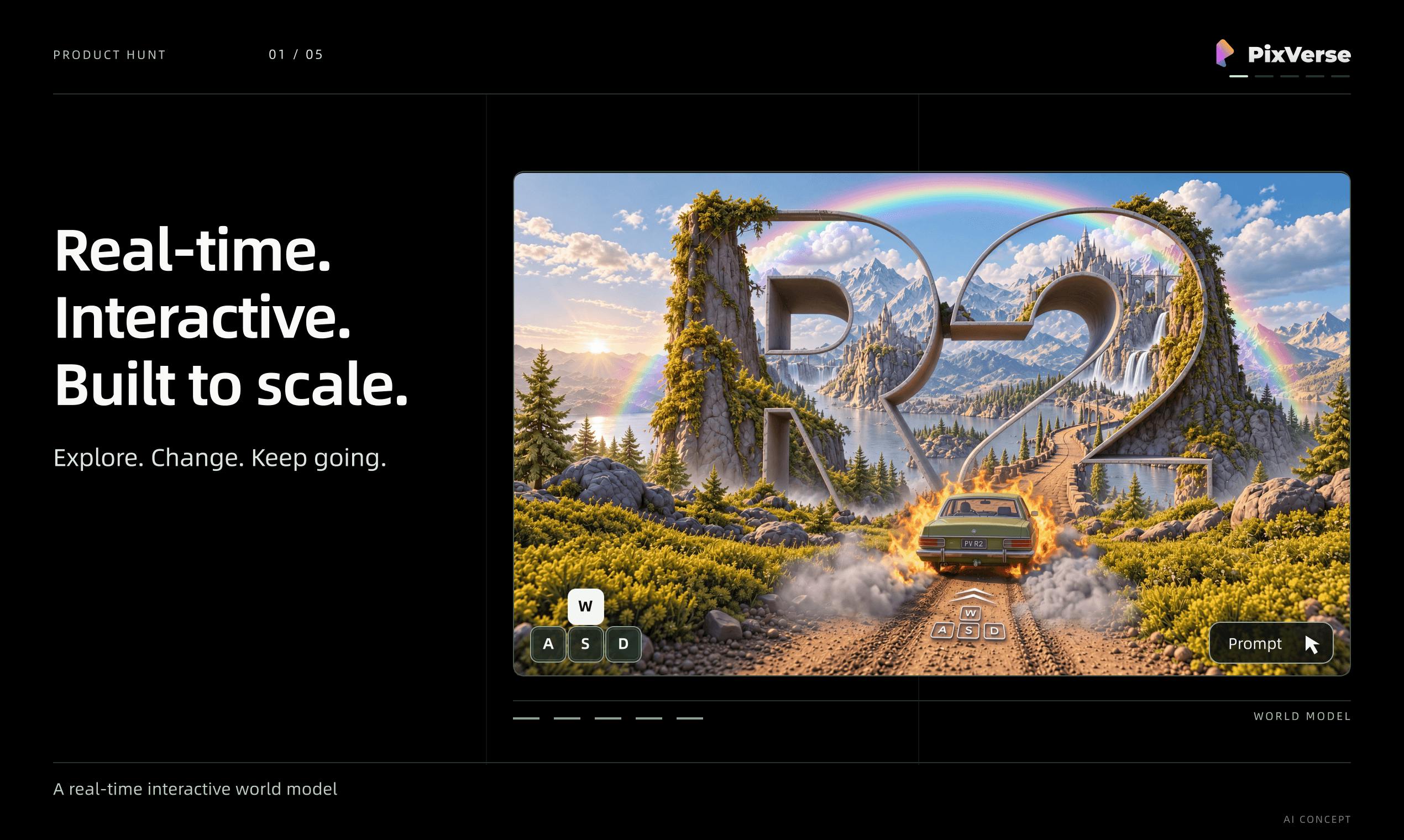
PixVerse R2 is a “real-time world model.” Instead of producing a fixed video clip, it generates an explorable scene that keeps running. The user moves through it with WASD keys, and can change it with text prompts while it is being generated (Product Hunt). The company says the central advance over R1 is persistence: earlier actions stay true later in the same session. PixVerse’s game engine, launched in July 2026, now runs on R2 (Business Wire).
R2 is a feature of an established company, not a startup product. PixVerse’s main business is a consumer video generator that reports more than 150 million registered users and more than 15 million monthly active users. It also sells API access and professional-grade models.
The strongest positive signal is verified capital and scale. The company confirmed the $439M Series C, TechCrunch reported the valuation at more than $2B, and Alibaba is a returning strategic investor. Annualized revenue was about $40M as of October 2025, per CNBC, as cited in secondary coverage.
The biggest concern is price relative to disclosed revenue. $2B against the last disclosed ARR of $40M is roughly 50x trailing revenue. That compares with about 36x for Kling and about 7.7x for Higgsfield (secondary analysis). No updated revenue figure came with the July round. World models are also contested by Google, Decart and Runway, and video generation is expensive to run.
Decision: DD. This is appropriate for an investor considering a late-stage or secondary position. It should focus on current ARR, gross margin after compute costs, and whether world models generate any revenue.
Product Overview
The problem. Video generators produce clips once and stop. A world model aims to produce continuous, interactive environments for games, interactive stories and live entertainment.
How it works. R2 has two stages. “Omni Causal AR” pretraining builds the model’s capability. A separate acceleration layer compresses the same model so it runs live. PixVerse reports a 35.8% reduction in visual drift over long sessions, but that comes from its own internal evaluations and is not independently verified (Business Wire).
Inputs include text, reference images, audio and action controls. Characters keep a consistent identity and memory within a session. The public demo is at world.pixverse.video, and a product page is available.
Wider platform. The platform includes:
- V-Series video models for consumers and the API. The flagship is V6.
- C-Series models for film and commercial work.
- R-Series world models.
- Real-time interactive livestreaming with AI characters (company).
It runs on the web and on iOS and Android (pixverse.ai).
Pricing (subscription page, from search snippets; secondary summaries by Magic Hour):
| Plan | Monthly (annual) price |
|---|---|
| Free | Signup and daily credits |
| Standard | $10 ($8) |
| Pro | $30 ($24) |
| Premium | $60 ($48) |
| Ultra | Up to $249 |
| Team Ultra | Listed |
The API charges about $4.80 per minute for image-to-video (TechCrunch via Yahoo). No separate price has been published for R2 or the game engine.
What R2 replaces: traditional game production pipelines for prototypes (modeling, animation, scripting), and pre-rendered interactive video.
Founder and Team Assessment
Wang Changhu was previously at ByteDance, where he worked on the computer-vision technology used in TikTok (Eminence; TechCrunch). Secondary sources add a USTC PhD, work at Microsoft Research Asia from 2004, and directing ByteDance’s AI Lab from 2017 (ValueAdd VC). The specific titles are not verified against primary records.
Jaden Xie was an executive director at Lighthouse Capital. That background brings fundraising and commercial skill.
Founder-market fit is strong. The company has shipped several model families (V, C and R) in about three years, and launched both R1 and R2 in 2026.
Team size is not reliable. A secondary estimate of about 27 employees (Getlatka) does not fit the scale of the operation and is disregarded. The company says its teams are spread across Asia and the US.
Corporate structure. PixVerse describes itself as based in Singapore. Press describes the operator as AIsphere, a Beijing company, which also runs a separate app for China (SCMP). The legal and IP structure is not publicly disclosed, and it matters for regulatory risk.
Founder Assessment: The founders appear to be strong technical and fundraising leaders with a track record of shipping; the corporate structure and headcount still need to be verified.
Market Opportunity
Core segment. Consumer and prosumer creators making short-form AI video, plus marketing teams and developers using the API.
Bottom-up check (analyst assumptions):
- 15M monthly active users × 3–6% paying ≈ 450K–900K subscribers.
- At an assumed $120–300 in annual revenue per subscriber, that gives about $55M–$270M in subscription revenue.
- API and enterprise revenue would come on top.
The range is wide on purpose. Kling’s reported run rate of about $500M, with roughly 75% from outside China (Digital Applied, citing Kuaishou disclosures), shows the category can support revenue in the hundreds of millions.
The R2 segment is less clear. It includes game prototyping, user-generated interactive games, interactive film, and AI livestreaming. How much customers will pay for these is not known. Google’s Project Genie, available to subscribers, shows a large platform is interested but has not shown a commercial market (Wikipedia); Google). R2 is best treated as an option on a possible new market, not the basis of the investment case.
Traction and Growth Signals
Verified (company or reputable press):
- More than 150M registered users across more than 177 countries, and more than 15M MAU (company-reported, repeated by TechCrunch).
- More than 100M users at the September 2025 Series B.
- $300M initial Series C in March 2026, led by CDH (Bloomberg). Extended to $439M in July (company).
- A steady release pace: R1 in January 2026, shared worlds three months later, the game engine in July, and R2 in September.
Third-party figures:
- About $40M ARR as of October 2025 (CNBC, via secondary sources).
- Roughly 80% of revenue from overseas consumer subscriptions (ARR Club, secondary).
- ARR reportedly growing “more than tenfold” year over year (StartupFortune citing Bloomberg, secondary).
Conflicts:
- ARR Club says $410M “led by Alibaba,” while the company confirms $439M across CDH and extension investors. The company figure is used.
- User counts differ between sources (100M+ and 16M MAU vs. 150M+ and 15M MAU).
R2-specific traction: no metrics are disclosed. The Product Hunt feature is launch attention only.
Missing: current ARR, number of paying users (the company declined to disclose it), retention, API revenue mix, and any R2 or game-engine usage.
Traction Assessment: Consumer scale is strong and verified; revenue is not current, and R2 has no commercial traction yet.
Competitive Position
Video generation competitors:
| Company | Latest valuation | Disclosed ARR |
|---|---|---|
| Kling | $18B | ~$500M run rate |
| Higgsfield | $5.4B | ~$700M |
| Runway | $5.3B | Not disclosed |
| Luma | $4B | Not disclosed |
Source: ValueAdd VC table, secondary. Veo is also a competitor.
World-model competitors: Google DeepMind’s Genie 3 / Project Genie, and Decart, which has raised more than $450M in total.
A strategic-investor conflict. Alibaba backs both Kling and PixVerse.
Differentiation:
- An early claim to the “real-time world model” category, with R1 in January 2026.
- Proprietary models built entirely in-house.
- An existing base of 15M MAU to distribute new features to.
- Pricing at the lower end of the market.
- An expertise in labeling video data, which management says is its advantage (TechCrunch).
Six-month test. If Google shipped Genie widely inside YouTube or Gemini, PixVerse would keep its installed creator base, low prices and fast release cycle. The model quality lead would be hard to hold against Google’s compute. Switching costs for consumers are low, and there are no network effects yet. Shared worlds and games made by users could create some later.
Defensibility Assessment: Medium in video generation (scale and brand); Low in world models, where larger players are ahead on compute.
Business Model and Economics
Revenue comes from credit-based subscriptions, API usage and enterprise plans. Secondary sources describe enterprise API plans from about $100 to $6,000 a month (Somake).
The main economic question is compute cost. Generating video at up to 4K with audio is costly to run. A real-time world model is harder still, because it has to stream generated frames continuously for the whole session, not render once. Two points matter:
- Free credits given away daily to a very large user base are a cost of acquiring users.
- Unless R2 sessions are priced by the minute, more usage could raise costs faster than revenue.
Sora’s reported shutdown in March 2026 (Digital Applied, secondary) shows that consumer AI video can lose money at scale.
Gross margin is not disclosed. Alibaba’s dual role as investor and likely cloud-compute supplier could reduce compute costs or create dependence on one supplier (an analyst inference).
Acquisition appears to be organic and viral through social video. Paid marketing spend is unknown.
Unicorn Path
PixVerse already has a private valuation above $1B, reached in March 2026 and more than $2B by July. The more useful question is whether its revenue can justify that valuation.
Assumed multiple: 10–15x ARR. This fits a high-growth AI application company whose gross margins are held down by compute costs. It sits between Higgsfield’s reported ~7.7x and Kling’s ~36x.
- $1B ÷ 10–15x = $67–100M ARR
- $2B (current mark) ÷ 10–15x = $130–200M ARR
- At a blended $180 a year per subscriber, $130–200M ARR requires about 720K–1.1M paying users. That would be 5–7% of current MAU.
- Gross margin of at least 50–60% would be needed after compute costs.
If the reported tenfold growth is accurate, current ARR may already be at these levels, but that is not verified. The following would strengthen the case:
- A larger share of revenue from enterprise and API customers.
- Paid game-engine or R2 revenue, either through creator subscriptions or a share of revenue from games.
- Lower compute cost per minute.
Unicorn Path: Plausible. The private valuation is already above $1B, but the revenue needed to support it has not been verified.
Valuation Assessment
Funding history (company and press):
| Round | Date | Amount | Lead / key investors |
|---|---|---|---|
| Series A | 2024 | $55M+ (secondary) | Ant Group, Lighthouse Capital, Beijing AI Fund |
| Series B | September 2025 | $60M | Alibaba |
| Series C (initial) | March 2026 | ~$300M | CDH |
| Series C (extension) | July 2026 | Brings total to $439M | Alibaba, Mirae Asset, BlueFocus, others; iGlobe and OCBC LionX returning |
The post-money valuation is “more than $2B,” as the company told TechCrunch.
Implied multiples:
- About 50x the last disclosed ARR ($40M, October 2025).
- If the reported tenfold growth is real, the current multiple could be in the 10–20x range.
Valuation Attractiveness: Not Assessable. The valuation is known. What is missing is current revenue, which the round did not update. On the last disclosed revenue, the valuation looks expensive compared with Kling and Higgsfield. A responsible assessment would need:
- Current ARR and its monthly trend.
- Revenue split by consumer, API and enterprise.
- Gross margin after compute costs.
- Paid retention by cohort.
- Burn rate.
- Series C preferences and terms.
- The terms of the Alibaba relationship.
- The cap table across the Singapore and Beijing entities.
Key Risks
- Revenue may not support the valuation. The last disclosed revenue gives a ~50x multiple, and no update came with the July round.
- Compute costs. Real-time streamed generation may carry low or negative gross margin as usage grows.
- Competition from Google. Genie 3 and Veo are backed by far more compute and distribution.
- Better-funded rivals. Kling ($18B, ~$500M ARR), Higgsfield and Runway compete for the same creators and budgets.
- Regulatory and geopolitical exposure. A Beijing-linked operator and a China-facing sister app create the kind of US access risk TikTok faced (ValueAdd VC).
- R2 revenue is unproven. There is no pricing, usage data or disclosed paying customers for world models or the game engine.
- Consumer churn. Credit-based creative apps often see novelty-driven usage and low switching costs.
- Conflicted strategic investor. Alibaba backs Kling as well, and Alibaba Cloud may be a key supplier.
- Content and IP liability. Generated video and worlds raise copyright, likeness and moderation issues at scale.
Final Assessment
Venture Potential: 74/100
| Category | Score |
|---|---|
| Market Size and Expansion Potential | 17/20 |
| Traction and Growth Evidence | 14/20 |
| Founder and Team | 13/15 |
| Product Strength | 8/10 |
| Distribution Potential | 11/15 |
| Business Model and Economics | 5/10 |
| Defensibility | 6/10 |
| Total | 74/100 |
The strongest parts of the case are verified consumer scale, an institutional-grade capital base, strong technical founders, and fast model releases. The weakest are unknown margins, revenue figures that are out of date, and competition in world models.
Evidence Confidence: 60/100
Verified: the funding rounds and investors, the >$2B valuation, founder identities, user counts (company-reported and repeated by TechCrunch), product releases, and pricing.
Third-party: ARR figures and the tenfold growth claim.
Conflicting: headquarters and entity, user totals, and the Series C figure ($410M vs $439M).
Unavailable: current revenue, paying users, retention, gross margin, burn, R2 usage, team size, and round terms.
Final Decision: DD
PixVerse is a real, scaled company with verified capital and consumer reach. That justifies formal diligence for a late-stage or secondary investor. An Invest decision is not possible, because current revenue, margins and terms are unknown and the price looks high against disclosed revenue. R2 itself should be treated as an unpriced strategic option, not the core of the investment case.
Upgrade Conditions
- Verified ARR of at least $150M with growth of at least 3x year over year. That would make the $2B+ mark about 13x or less.
- Gross margin of at least 55% after compute, including for real-time products.
- At least 12-month paid retention by cohort showing durable (non-novelty) usage.
- Revenue from R2 or the game engine, from paying creators or studios.
- A clear corporate and IP structure that reduces US regulatory risk.
Downgrade Conditions
- ARR found to be well below $100M.
- Negative gross margin on real-time products.
- A broad Genie or Veo release that erodes PixVerse’s position.
- US regulatory action against China-linked apps.
- Paid churn rising as prices across the category fall.
- A down round, or a repricing to secondary-market levels.
Questions for Further Diligence
- What are current ARR and monthly revenue, split between consumer, API, enterprise, and China versus rest of world?
- How many paying subscribers are there, what is free-to-paid conversion, and what are 3-, 6- and 12-month paid retention by cohort?
- What is gross margin by product, and what is the compute cost per minute of R2 real-time generation?
- How will R2 and the game engine be priced, and what is usage since the July beta?
- What are the terms of the Alibaba relationship (cloud credits, exclusivity, data), and what does Alibaba’s investment in Kling mean for it?
- What is the legal structure between PixVerse Singapore and AIsphere Beijing, and which entity holds the model IP?
- What would the company do if US regulators restricted China-linked AI apps?
- What are the Series C liquidation preferences, and what are the valuation terms for each tranche?
- How is the 35.8% drift reduction measured, and has it been benchmarked externally against Genie 3 or Decart?
- What is monthly burn, and how many months of runway does the $439M provide at current compute spending?
- What content-moderation and copyright protections apply to generated worlds and livestreams?
Sources
- Product Hunt: PixVerse R2
- PixVerse R2 model page; Business Wire R2 announcement
- PixVerse Series C extension announcement; Series B announcement
- PixVerse subscription pricing; API pricing docs
- TechCrunch via Yahoo Finance: $439M raise, $2B+ valuation
- Bloomberg: $300M raise, unicorn status
- ValueAdd VC valuation analysis (secondary; ARR and comparables)
- Digital Applied: Kling $18B raise and revenue (secondary; competitor comparable)
- Google DeepMind Genie 3; Decart $300M raise
- SCMP on AIsphere origins