
Table of Contents
Snitch Investment Report
Category: Slack application / organizational chart automation (AI agent)
Company Stage: Early-stage product launched days ago, built inside an existing three-partner AI-native agency (Sweetspot°)
Founder or Founders: Stefan Szakal, Managing Partner at Sweetspot° (with partners Marius Orzaru, engineering, and Alen Todorov, marketing) snitchforslack
Headquarters: Cluj-Napoca, Romania; operating through Sweetspot°, with a Romanian legal entity (Boon IT SRL, per a secondary review of the terms of service) linkedin
Funding: Not publicly disclosed; no reliable public information was found on external funding for this product
Business Model: Flat-fee SaaS priced by company size — €19/month (up to 50 people), €39/month (51–100), €59/month (101–200); 45-day free trial, no card snitchforslack
Product Hunt Launch Date: September 4, 2026 launly
Report Date: September 7, 2026
| Investment Metric | Assessment |
|---|---|
| Venture Potential | 40/100 |
| Unicorn Path | Improbable |
| Valuation Attractiveness | Not Assessable |
| Evidence Confidence | 50/100 |
| Final Decision | Watch |
Executive Summary
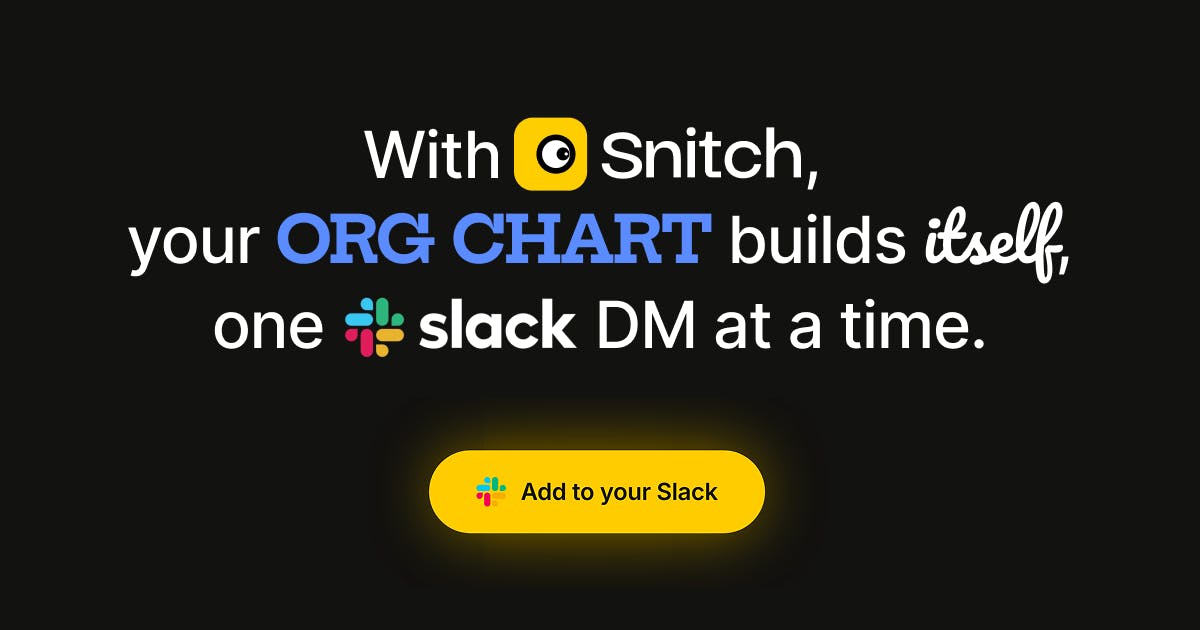
Snitch is a Slack application that builds and maintains a company’s organizational chart by asking every workspace member one question — “who do you report to?” — via DM, then answering natural-language questions about the structure in any channel: reporting chains, team sizes, who owns what. It requires no HR system integration and no manual data entry, verifies changes nightly, and flags anomalies such as reporting loops and departed managers. snitchforslack
The product targets companies of roughly 20–200 people: large enough that nobody knows the full org chart, small enough that no HRIS exists to import one from. The wedge is genuinely clever — it crowdsources ground-truth data from the people who have it, with a privacy design (self-reporting only, admin-approved wording before any DM is sent) that shows unusual product judgment. snitchforslack
The strongest positive signal is the combination of a verified, coherent commercial foundation: real published pricing, a credible serial founder with 20+ years of company-building experience and claimed exits, a small senior team, and a warm launch (~96 upvotes, top-11 daily, 4.7 rating from early reviews). linkedin
The most important concern is structural: this is a low-ACV utility (€228–708 per year) with a hard ceiling at 200 employees per the published pricing, in a category where Slack itself is actively building agent capabilities including org-chart-aware agents, and where funded HRIS org-chart vendors (ChartHop, Pingboard, Rippling) serve the larger end of the market. slack
No revenue, trial conversion, or retention data is publicly available. Venture Potential scores 40/100 — more consistent with a niche or bootstrapped business than a venture candidate. The unicorn path is Improbable under the current model, and valuation is not assessable. The final decision is Watch, with specific milestones that would justify a re-rating.
Product Overview
The problem: in companies past roughly twenty people, the org chart exists in nobody’s head and nowhere in particular. Asking three people who someone reports to yields two answers and a shrug; fixing it means a week of someone’s time in a spreadsheet, and the chart rots again after the next reorg. Existing solutions assume an HR system as the source of truth — which companies in this size band often lack. snitchforslack
Snitch’s approach: a Slack OAuth install, an admin-approved “round” (the exact DM wording is reviewed and anyone can be excluded), then a single two-tap question to each member. The chart assembles itself, updates nightly against Slack directory changes, flags loops and departed managers, and answers questions in-channel via natural language (“how many people report up to me at all levels,” “who owns billing”). Everyone answers only for themselves; there is no mechanism to report on someone else — a deliberate privacy boundary. snitchforslack
Pricing is flat by company size — €19/€39/€59 per month for tiers up to 200 people, all features in every plan, 45-day trial without a card; beyond 200 people customers must email, with the site candidly citing AI conversation costs. The product replaces manual chart maintenance in spreadsheets, Lucidchart, or generic org-chart tools, and partially replaces the “ask HR” workflow. makerstack
The product is live and installable, with an unusually honest about page acknowledging early-stage rough edges. snitchforslack
Founder and Team Assessment
Founder identity is verified across the product’s about page, LinkedIn, and X: Stefan Szakal, Managing Partner at Sweetspot°, Cluj-Napoca, with 20+ years building companies, previously founder of X3 Studios (a Romanian digital agency dating to the early 2000s) and several other startups. His LinkedIn claims “seven companies, two exits”; his X bio says “built 8 startups — 5 failed / 3 exits” — a minor company-reported inconsistency worth noting; the exits are claimed, not independently verified. snitchforslack
Sweetspot° is a three-partner AI-native agency: Szakal (commercial), Marius Orzaru (CTO-level engineer, 15 years), and Alen Todorov (former CMO). This gives Snitch full-stack execution capability — product, engineering, and marketing — without hires. The trade-off is structural: Snitch appears to be one productized output of a consultancy, alongside other projects (Promptr.ai, ClipCEO, CooperAIQ are referenced in Szakal’s profiles), which implies divided attention rather than a single-company focus. No dedicated Snitch team, hiring signals, or funding were found. sweetspotpartners
Founder-market fit is decent: the about page articulates the problem from apparent firsthand operating experience, and the product’s tone and privacy choices suggest genuine customer empathy. Key-person risk is high — the about page states support emails “usually” reach Szakal personally. snitchforslack
Founder Assessment: Credible, commercially experienced serial operator with a capable senior team, but running a portfolio-style studio rather than a dedicated, funded company.
Market Opportunity
The initial segment is narrow: Slack-first companies of roughly 20–200 employees without an HRIS. The problem is real and recurring, and willingness to pay is demonstrated only by the price list (€228–708 per year), not by observed conversions.
Bottom-up estimate (analyst assumption): there are likely hundreds of thousands of companies globally in the 20–200 employee band using Slack, but the realistic paying subset — those motivated enough to install an org-chart bot rather than tolerate ambiguity or use free diagramming — is plausibly 1–5% at these price points, or roughly 5,000–50,000 customers. At €300–500 average annual revenue, that implies a realistic market ceiling of roughly €2M–€25M ARR — a sound bootstrapped or small-acquisition business, not venture scale, unless the product moves upmarket.
Expansion opportunities exist but change the competitive picture: an enterprise tier above 200 people (already gated by AI costs), Microsoft Teams support, and adjacent people-ops data (ownership, headcount planning). Upmarket expansion collides directly with ChartHop, Pingboard, Sift, and the org-chart features of modern HRIS platforms. Timing is favorable — Slack’s own positioning as an agent-first workspace validates in-channel agents as a category. goprofiles
Traction and Growth Signals
- Product Hunt: approximately 96 upvotes, #11 daily and #64 weekly ranking, 4.7 rating across 3 reviews, 16 comments, 131 followers. launly
- Comment substance was positive, including a genuine customer endorsement (“This tool was exactly what I needed”) and a sharp retention question about chart drift, which the founder answered concretely (nightly verification; scheduled re-asking on the backlog). producthunt
- The product is live with functioning OAuth install, trial flow, and published pricing. snitchforslack
- Not available: trial starts, conversions, paying customers, MRR, retention, or any usage data. No press coverage, partnerships, or enterprise deals were found. No funding history exists in public databases for this product.
Two independent review sites published detailed analyses within days of launch — unusual attention for a small tool, and a positive signal for the product’s clarity, but not evidence of adoption. makerstack
Traction Assessment: Warm launch reception and credible product readiness, but zero disclosed commercial traction.
Competitive Position
Direct competitors are the established org-chart category: ChartHop, Pingboard (Workleap), GoProfiles, Sift, OrgChart Now, Organimi, and the org-chart modules of HRIS platforms like BambooHR and Rippling — most of which sync from HR systems and target exactly the companies above Snitch’s 200-person ceiling. Free alternatives include draw.io/diagrams.net and manual Lucidchart/Visio work. Indirect competition is the fast-growing wave of Slack AI agents that answer business questions from company data, including HR-focused deployments. goprofiles
The largest platform risk is Slack itself: Salesforce is actively positioning Slack as an agent-first workspace, and its own materials describe Slack AI agents surfacing “rich profiles and org charts” — the exact function Snitch monetizes. slack
Snitch’s differentiation is real but thin: a self-maintaining, crowdsourced source of truth with zero setup, versus HRIS-synced charts that presuppose an HRIS. The privacy-by-design flow and the brand’s candor are genuine product advantages. Pricing is aggressive (€19/month undercuts most org-chart SaaS). Distribution via the Slack Marketplace is a plausible low-cost channel. Switching costs are low; there are no network effects; the crowdsourced chart is proprietary per-customer but creates no cross-customer moat. snitchforslack
The decisive question — “if Slack shipped native, self-maintaining org charts within six months, why would customers keep paying Snitch?” — has only a partial answer: Slack’s version would likely draw from directory data, not ground-truth self-reporting, and Slack has historically left such niches to marketplace apps. That is a hope, not a moat.
Defensibility Assessment: Low.
Business Model and Economics
The revenue model is verified from the official pricing page: flat monthly fees by company-size band, all features included, 45-day trial. Estimated ACV is €228–708. The band structure creates sharp price cliffs (one hire from 50 to 51 people doubles the bill — a 105% jump), which invites downgrades or churn at band edges. Gross margin should be high: the core product is a Slack integration plus a modest data store, with the main variable cost being Anthropic API calls for natural-language answers — a cost the company explicitly manages by capping the published product at 200 people. makerstack
Customer acquisition is product-led (Slack App Directory, trial without a card), which suits the low price point; paid acquisition is likely uneconomic at €19/month. Expansion revenue is structurally limited — every plan includes everything, so the only growth lever is customer count and upmarket movement. Enterprise potential is untested and currently deferred. Support is founder-provided. snitchforslack
The critical unknowns are trial-to-paid conversion and post-reorg retention — the moments when the chart either proves or loses its value.
Unicorn Path
Assume Snitch remains a self-serve SaaS. A 10x ARR multiple is appropriate for a small-business SaaS at scale (arguably generous for a single-purpose utility, but consistent with SaaS norms).
Required Revenue for a $1 billion valuation ≈ $1B ÷ 10 = $100M ARR.
At the published price points (€228–708 per customer per year), this requires roughly 140,000–440,000 paying companies — an implausible share of the realistic paying population (see market estimate: plausibly 5,000–50,000 customers). Even at the top of Scale, per-customer revenue is €708; the model’s flat pricing and 200-person cap mathematically exclude venture scale.
Reaching $100M would require a major transformation: per-seat or usage pricing, an enterprise tier with SSO, compliance, and HRIS integrations — directly competing with ChartHop, Pingboard, and Rippling — plus Teams and multi-platform support, dedicated GTM, and external capital. That is a different company from the one currently shipping.
Unicorn Path: Improbable.
Valuation Assessment
No funding, investors, round terms, or valuation are publicly known for this product. Note a research hazard: several “Snitch” entities exist in funding databases (a Bengaluru fashion e-commerce company that raised $53M, and others) that are unrelated to this product and must not be conflated. startupfundraising
Valuation Attractiveness: Not Assessable. There is no financing event to evaluate and no revenue data. Assessment would require: paying-customer count and MRR, trial conversion, retention (especially through reorgs), gross margin net of Anthropic API costs, any round size and terms, and comparable financings for Slack-ecosystem or people-ops SaaS. The product’s polish and launch reception cannot substitute for these.
Key Risks
Ranked from most to least material:
- Slack platform replication: Salesforce is actively building agent-first workspace capabilities including org-chart-aware agents. slack
- Low ACV with a hard size ceiling: flat €19–59 pricing caps revenue per customer and the product explicitly stops at 200 people. snitchforslack
- Band-edge churn: 51–105% price jumps at hiring boundaries create rational cancel moments. makerstack
- Divided founder attention: Snitch is one product inside a three-partner agency with multiple other ventures. sweetspotpartners
- Unproven retention through reorganizations — the product’s core promise of a self-maintaining chart is exactly where drift risk lives. producthunt
- HRIS vendor squeeze as customers grow into BambooHR/Rippling, which bundle org charts. goprofiles
- GDPR exposure as an EU company processing employment-relationship data and routing queries through the Anthropic API. makerstack
- Name collision with unrelated “Snitch” companies, a minor brand and search-discovery liability. startupfundraising
Final Assessment
Venture Potential: 40/100
| Category | Score |
|---|---|
| Market Size and Expansion Potential | 8/20 |
| Traction and Growth Evidence | 3/20 |
| Founder and Team | 8/15 |
| Product Strength | 7/10 |
| Distribution Potential | 7/15 |
| Business Model and Economics | 5/10 |
| Defensibility | 2/10 |
| Total | 40/100 |
The strongest elements are product design (a genuinely elegant wedge with honest privacy mechanics), verified pricing, and an experienced, senior founding team. The weakest are a low-ACV market with a built-in size ceiling, near-zero commercial validation, and low defensibility against both Slack and the HRIS category.
Evidence Confidence: 50/100
Verified: product existence and mechanics, official pricing, founder identity and team composition, launch metrics, and the studio’s structure. Company-reported: founder exit history (with a minor internal inconsistency between “two” and “three” exits). Secondary-sourced: the legal entity registration. Estimated: market sizing above. Unknown: revenue, trials, conversions, retention, team size beyond three partners, funding, and burn. linkedin
Final Decision: Watch
Snitch is a well-executed, honestly marketed product from a credible team — but at 40/100 Venture Potential with an Improbable unicorn path and no commercial data, it does not yet justify due diligence. Watch is appropriate because, unlike typical pre-traction launches, the commercial foundation is verified (real pricing, real trial flow) and the team has the capacity to iterate quickly; the open question is purely whether customers convert and retain, which the next two quarters will answer. It sits above Pass because of founder credibility and commercial readiness, and below DD because nothing yet demonstrates paying demand.
Upgrade Conditions
- Disclosed or verifiable traction: several hundred paying workspaces or €100K+ ARR within 6–12 months
- Trial-to-paid conversion above ~25% with retention through at least one reorg cycle
- A credible enterprise tier (SSO, 200+ people, HRIS sync as an option) with signed customers
- Evidence of organic Slack Marketplace distribution beyond Product Hunt
- Founder dedication of a full team or spun-out company with external investment
- A defensible data or workflow advantage that survives Slack’s native agent roadmap
Downgrade Conditions
- Slack shipping native self-maintaining org charts or org-aware agents in Slackbot/Agentforce
- Weak trial conversion or high churn at band edges
- Product going unmaintained amid the studio’s other ventures
- No enterprise tier emerging within 12 months
- GDPR or employment-data complaints surfacing
- Evidence that launch claims or pricing transparency erode
Questions for Further Diligence
- How many workspaces have started trials since launch, and how many have converted to paid?
- What is 90-day retention, and specifically what happens to charts during reorganizations?
- What is monthly churn at the 50-person and 100-person band edges?
- What are current MRR and growth rate, if any?
- How is the team split between Snitch and Sweetspot°’s other ventures, and would Snitch be spun out?
- What are Anthropic API costs per customer per month, and how do they scale with question volume?
- How is employment-relationship data handled under GDPR, and what is the data-processing agreement with Anthropic?
- What is the roadmap for the 200+ person tier — pricing, SSO, HRIS integrations — and what would that ACV be?
- How much of current acquisition is Product Hunt-driven versus Slack Marketplace search?
- Has Slack’s platform team given any signal about native org-chart features, and what is the contingency?
- What were the terms and outcomes of the claimed prior exits?
- Is external capital being sought, and at what valuation and structure?
Sources
- Product Hunt — Snitch producthunt
- Snitch — official website snitchforslack
- Snitch — About page snitchforslack
- Stefan Szakal — LinkedIn linkedin
- Stefan Szakal — X x
- Sweetspot° — team page sweetspotpartners
- Launly — launch metrics mirror (secondary) launly
- Makerstack — Snitch review (secondary) makerstack
- ChatGate — launch analysis (secondary) chatgate
- Slack — AI agents including org charts (competitive context) slack
- Slack — agent-first workspace (competitive context) slack
- GoProfiles — org chart software comparison (market context) goprofiles
- Gitnux — org chart software ranking (market context) gitnux