
Table of Contents
Datastory — Venture Investment Report
As of: 8 October 2026
Product Hunt launch date (sheet field B): 30 September 2026
Product Hunt page: Datastory on Product Hunt
Company / product: Datastory / Datastory.tech
Category: AI-assisted data visualization and storytelling SaaS
Location: Stockholm, Sweden (company contact address)
Stage, financing, valuation: Not publicly verified
Business model: Freemium per-seat SaaS plus custom-priced enterprise work
Investment score: 57/100 | Evidence confidence: 48/100 | Final Decision: Watch
Executive Summary
Datastory is a data-storytelling platform attached to a company with a longer operating history than its September 2026 Product Hunt launch suggests. Its no-code product combines interactive charts, AI assistance, open data, and publishing or embedding. Its thesis is that journalists, researchers, public agencies, NGOs, and communications teams should be able to move from data to a public-facing explanation without assembling separate tools and specialists.
The founding story and customer references fit the problem. Founder Daniel Lapidus describes work with Hans Rosling at Gapminder and data-platform projects for organizations including the Red Cross, Brookings, and the UN. The company lists institutional customers and examples. These materials show domain experience and delivery capability, but do not disclose recurring software revenue, customer counts, retention, or gross margin. Product Hunt recorded about 114 points and a #8 daily rank on the page reviewed; this is a discovery signal, not proof of sustained usage.
The investment case depends on converting a specialist workflow and services history into repeatable software. Established competitors offer generous free tiers. At Datastory’s listed $15 per user per month Professional price, a software-only path to venture scale requires hundreds of thousands of paid seats unless enterprise contracts contribute materially. Public evidence is not yet sufficient to distinguish a scalable SaaS business from a useful product supported by bespoke implementation. Decision: Watch pending operating data.
Product and Customer Problem
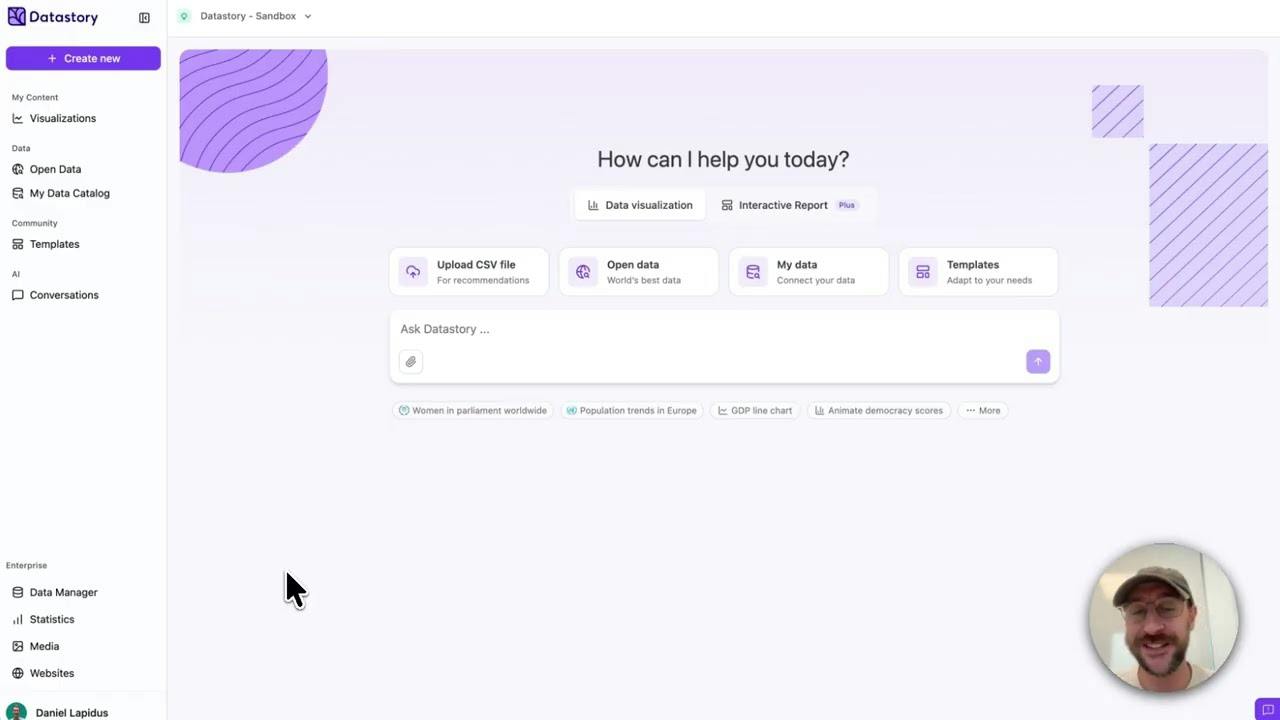
Datastory says users can create interactive charts, websites, and reports, bring their own data or use a curated open-data catalog, and use AI to draft visualizations and narratives. Examples include public-interest and research visualizations. The workflow targets people who need to explain complex data to a broad audience, rather than only monitor internal business metrics.
Producing a trustworthy data story can require data preparation, charting expertise, web production, and editorial review. Datastory’s strongest product thesis is reducing those handoffs while making narratives reusable and embeddable. A catalog of open data may shorten setup for public-interest work. Product Hunt feedback covered Excel upload, mobile usability, and whether linked charts refresh; the launch page records several shipped feature requests. This suggests active iteration, but does not demonstrate product-market fit.
Diligence should test messy-data handling, integrations, collaboration, privacy, accessibility, versioning, and refresh reliability. AI must not silently change a dataset’s meaning. Clear provenance and visible transformations are especially important for journalists, researchers, and public agencies.
Founders and Team
The company identifies Daniel Lapidus as founder and CEO. Its materials describe his work with Hans Rosling and Gapminder and data projects for the International Federation of Red Cross and Red Crescent Societies, Brookings, the UN Statistics Division, and others. The listed team spans visualization, engineering, design, data journalism, and product; Arek Mytych is identified as CTO and Chris MacTaggart as COO. This is a relevant mix for a product where craft and data correctness matter.
These details are primarily company-authored and do not independently establish current team commitment, technical ownership, or hiring depth. Datastory’s own pages describe its history across different dates: a workshop page says Lapidus founded Datastory in 2013, while its about page describes a nonprofit from 2016 and platform development in 2018. Treat the 2026 Product Hunt event as a launch of the current self-serve product, not evidence that the business itself is new. Confirm the legal entity, ownership, IP, financing history, and relationship between platform, nonprofit, and services work.
Market and Competitive Position
The broad need spans visualization, business intelligence, digital publishing, and storytelling, so the budget category and buyer are not yet precise. A plausible beachhead is organizations that repeatedly publish data externally: newsrooms, research groups, NGOs, public agencies, and corporate communications teams. Their needs include accuracy, branding, embeds, refresh, support, and privacy; procurement may slow self-serve adoption.
Substitutes are established. Flourish’s free plan includes 50+ templates, private unpublished work, and publishing/embedding; paid organizational plans are custom-priced, and Canva Business/Enterprise includes a Flourish presenter workflow. Datawrapper lists free publishing plus Pro at $21 and Business at $39 per user per month. Infogram lists free, Pro at $19, and Business at $67 per month on annual billing, with team and enterprise tiers. Tableau Public is free and has a large creator community, but published work is public and refresh is limited. These offers set a high bar for basic chart creation and sharing.
Datastory’s wedge would be its combined open-data context, AI-assisted authoring, end-to-end narrative flow, and expert implementation. Its enterprise offering includes data integration and modeling, white-label applications, and a project team. References to AI Sweden, the Tax Justice Network, and Swedish House of Finance support a plausible institutional channel. Yet custom delivery can lower margins and distract product teams. The key test is whether enterprise projects create reusable product capabilities and recurring platform contracts rather than one-off agency revenue.
Traction and Business Model
The official pricing page lists Starter at $0, with 10 visualizations, three team members, and 100 monthly AI credits; Professional at $15 per user per month, with unlimited visualizations and 1,000 monthly AI credits; and custom-priced Enterprise with integrations, data modeling, white labeling, and an account manager. The Professional page notes an annual discount. This creates an accessible trial path, but reveals nothing about conversion, expansion, or cost to serve.
Product Hunt showed about 114 points, a #8 day rank, and fewer than 100 followers when reviewed. This is a modest launch signal. Customer names and testimonials on Datastory’s site support a history of institutional delivery, but do not prove those organizations subscribe to the current SaaS product. No verified ARR, paid-seat count, retention cohort, usage frequency, CAC, gross margin, or financing round was found in the reviewed sources. Traction is the weakest part of the case.
Per-seat subscriptions can scale efficiently; enterprise contracts can monetize integration and support but may depend on labor. Separate recurring software revenue from implementation revenue and measure delivery hours per account. AI credits require a clear cost and overage policy. A defensible moat is not yet demonstrated. It could develop from trusted linked-data models, workflow integration, reusable templates, and publishing infrastructure, but those advantages need evidence of repeated use and retention.
Venture Scale, Valuation, and Risks
At $15 per seat per month, one Professional seat yields $180 of annual list-price revenue before discounts. As an illustrative scale check, $100 million ARR would require about 556,000 such seats if seat revenue alone carried the business; $83–125 million ARR would equate to roughly 462,000–694,000 seats. This arithmetic is not a forecast or valuation multiple. Enterprise deals could reduce the seat count, but their contract values and margins are unknown. Public evidence does not support a reliable market-size estimate.
No financing round, valuation, or reliable revenue disclosure was found, so an entry price cannot be assessed. Company age and prior institutional work make it essential to clarify whether the investable business is an established services/platform company, a new SaaS line, or a reorganized venture entity.
Key risks are free competition; low conversion from occasional publishing; bespoke work limiting software margins; AI errors harming trust; gaps in privacy, data provenance, and governance; reliance on third-party open-data quality; and unclear ownership or financing. A domain-experienced team and coherent product direction are positive, but the decisive question—repeatable, high-retention software economics—remains unanswered.
Score Breakdown
| Dimension | Score | Rationale |
|---|---|---|
| Team and domain expertise | 15/20 | Relevant founder background and multidisciplinary team are described; ownership and current commitment need verification. |
| Product and differentiation | 15/20 | Coherent data-to-story workflow; comparative quality and defensibility are unproven. |
| Market and scale potential | 12/20 | Recurring cross-sector need, but buyer, budget, and serviceable market remain diffuse. |
| Traction and distribution | 6/20 | Launch activity and institutional references; no verified SaaS revenue, retention, or repeatable acquisition. |
| Business model and economics | 9/20 | Clear pricing and enterprise path; conversion, AI costs, margins, and service mix are unknown. |
| Total | 57/100 | Watch |
Evidence confidence: 48/100. Product, list pricing, founder claims, and launch activity are visible in primary materials. Financial, cohort, ownership, and customer-level evidence is missing.
Final Decision and Decision Triggers
Final Decision: Watch. Request operating evidence before investment consideration. Upgrade to DD if Datastory demonstrates meaningful paid SaaS adoption, strong 6–12 month retention, repeatable free-to-paid conversion, attractive software gross margins after AI and support costs, and enterprise renewals with limited bespoke effort. Confirm the investable entity, ownership, financing, and customer references.
Move toward Pass if revenue is mostly one-off implementation, users do not return after publishing, free alternatives prevent willingness to pay, or data controls fail target buyers’ requirements. The score rises if shared data models produce repeated team use; it falls if the product mainly fronts labor-intensive agency projects.
Priority Due-Diligence Questions
- Which legal entity owns the platform, IP, customer contracts, and brand, and how does it relate to Datastory.org and services work?
- What are ARR, services revenue, paid accounts and seats, gross margin, cash, and burn, split by product and geography?
- What share of Starter accounts publish, convert to Professional, and remain active after 3, 6, and 12 months?
- What are net revenue retention, logo churn, expansion, and contract-value distributions for SaaS and Enterprise?
- Which named customers subscribe to the current platform, and can investors speak with two references?
- What share of enterprise delivery is reusable software versus custom modeling, design, and engineering?
- What are average AI and hosting costs per active account and gross margins by tier?
- How are sources, transformations, refreshes, and AI-generated claims documented for audit?
- Where is customer data stored, how are access and deletion handled, and what security certifications and agreements are available?
- Which segment has the shortest sales cycle and strongest repeat use, and what channel has measurable CAC?
- What is planned for private data, integrations, CMS embedding, collaboration, accessibility, and refresh?
- What financing has been raised, what ownership and option structure exists, and what terms are being sought?