
Table of Contents
siift Investment Report
Category: AI business strategy, founder productivity, and decision-support software
Company Stage: Early-stage / open beta
Founder or Founders: Samim Safaei
Headquarters: Vancouver, Canada
Funding: Not publicly verified
Business Model: Freemium, credit-based SaaS subscriptions; custom enterprise plans
Product Hunt Launch Date: September 15, 2026
Report Date: September 18, 2026
| Investment Metric | Assessment |
|---|---|
| Venture Potential | 51/100 |
| Unicorn Path | Conditional |
| Valuation Attractiveness | Not Assessable |
| Evidence Confidence | 42/100 |
| Final Decision | Watch |
Executive Summary
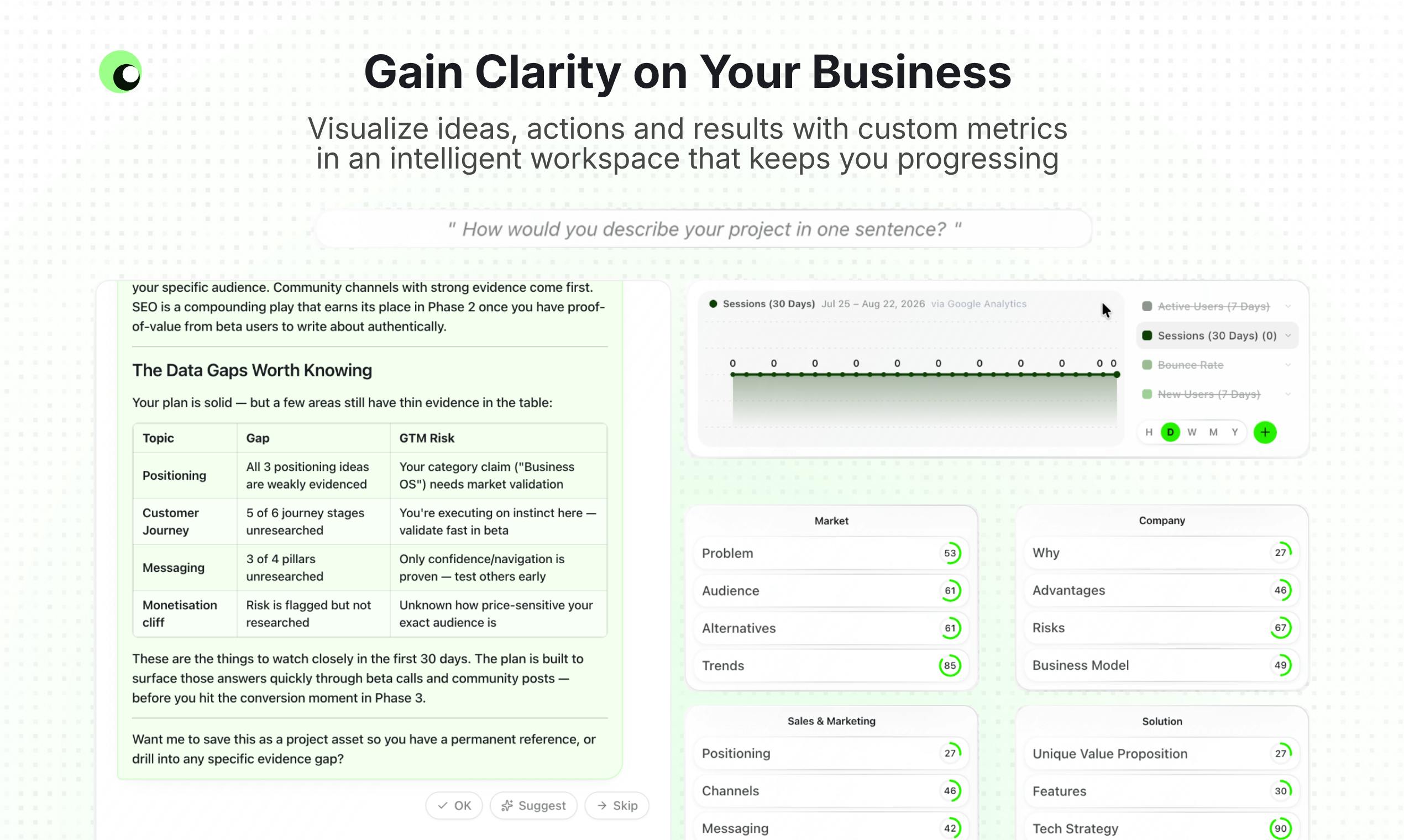
siift is an AI business-strategy workspace intended to help founders and innovation teams connect assumptions, evidence, decisions, priorities, and results. Instead of providing another general-purpose chat interface, it presents the business through a visual canvas, maintains persistent context, and recommends next actions across ideation, validation, product development, go-to-market, and growth (official website; Product Hunt).
The initial customer is an early-stage founder or small startup team seeking a structured alternative to scattered AI conversations, documents, spreadsheets, and project-management tools. Paid plans range from $131 to $449 per user annually before the temporary launch discount, while an enterprise tier adds private infrastructure, governance, pooled credits, custom frameworks, and analytics (pricing).
The strongest positive investment signal is founder-market fit. Founder Samim Safaei has a technical education, verifiable participation in fire-safety research, prior product-management experience, and self-reported experience across several startups. His prior work includes a heat-flux technology recognized by Worcester Polytechnic Institute and a product-strategy role at TELUS (WPI; LinkedIn). This provides greater domain credibility than a founder entering entrepreneurship software without operating experience.
The principal concern is commercial validation. No reliable public data was found for revenue, paying users, retention, active projects, enterprise customers, gross margin, or customer acquisition. Product Hunt engagement and company-hosted testimonials demonstrate attention, not durable product-market fit. The product also competes against general AI assistants, dedicated founder platforms, business-planning products, consultants, accelerators, and existing collaboration software.
The final decision is Watch. siift may become a valuable vertical AI application or sustainable founder-focused SaaS business, but the evidence does not yet support a venture-scale conclusion. An upgrade to DD requires verified paid retention, repeatable distribution, and evidence that teams use siift continuously after initial business planning.
Product Overview
Founders frequently distribute strategic thinking across AI chats, notes, documents, task managers, customer interviews, and analytics systems. siift attempts to consolidate that information into a persistent operating model for the business.
Its principal capabilities include:
- An “Intelligent Business Canvas” that maps the business through strategic filters
- A persistent or “living” memory system
- Evidence-backed feedback on assumptions and strategy
- Prioritization and recommended next actions
- Collaborative and shareable workspaces
- Human-in-the-loop automation across a company-reported 80-plus applications
- Deliverables such as product requirements, website briefs, business plans, and go-to-market plans
- Enterprise infrastructure, governance, analytics, and customization
The product is currently a web application. No native mobile application, public API, or public GitHub repository was identified. The core product is available, but its underlying decision quality, factual reliability, and integration depth cannot be independently assessed from public materials.
Pricing is credit-based. The free plan includes 50 credits per user per month. Discover costs $20 monthly or $131 annually and includes 200 credits. Focus costs $69 monthly or $449 annually and includes 1,000 credits. Individual agent turns consume between one and 20 credits depending on inference and tool usage; additional credits can be purchased separately (pricing).
The customer benefit is greater continuity and discipline than a general chatbot. The existing alternative is a combination of ChatGPT or Claude, Notion, a business-model canvas, spreadsheets, project-management software, customer-research notes, and human advisors.
Product Quality: Conceptually coherent and more structured than standalone AI chat, but recommendation quality and integration reliability remain unverified.
Founder and Team Assessment
The Product Hunt launch identifies Samim Safaei as founder. His public profile describes him as a five-time entrepreneur with more than ten years of startup experience and prior responsibilities as an engineer, CEO, and product leader. These broader claims are primarily founder-reported through his website and siift’s content (founder account; siift founder article).
Some elements are independently supported. Worcester Polytechnic Institute lists Safaei as a 2016 graduate participant in Fire Protection Engineering and an honorable-mention recipient for a radiant heat-flux gauge. Public patent listings also associate his name with a multi-band heat-flux gauge assigned to WPI (WPI award record; patent directory). LinkedIn indicates that he held a senior product role at TELUS and led generative-AI product strategy, although this has not been corroborated through a TELUS source.
Safaei reports previous involvement with Global Fire Products, AMPL Energy, and the music/IoT venture Aloom. No previous acquisition, institutional funding outcome, or independently verified exit was found.
LinkedIn classifies siift as having 2–10 employees, but no complete team roster was found. The presence of co-founders, senior engineers, commercial staff, and current hiring is not publicly disclosed. Key-person risk is consequently high.
Founder Assessment: Strong technical and founder-problem familiarity, but prior commercial outcomes and current organizational depth remain insufficiently verified.
Market Opportunity
The narrow initial segment consists of pre-revenue and early-revenue founders who actively use AI for strategy, validation, planning, and go-to-market work but need persistent context and structured decision-making.
A bottom-up scenario can be constructed as follows:
- 100,000–500,000 reachable English-speaking founders and innovation professionals
- $200–$500 in annual realized revenue per paying user
- Resulting serviceable revenue opportunity of approximately $20 million–$250 million
This is an analyst scenario, not a verified market estimate. It illustrates that the initial individual-founder market can support a meaningful SaaS company, but the lower end is not necessarily venture-scale.
Adjacent expansion opportunities include startup studios, accelerators, venture funds, entrepreneurship programs, corporate innovation teams, product-management groups, and consultants. Enterprise accounts could generate higher annual contract values if siift becomes the system of record for assumptions, experiments, and strategic decisions.
Market timing is mixed. More entrepreneurs now use AI for planning, creating demand for structured context and verification. Conversely, the underlying capabilities of general-purpose AI products are improving quickly, reducing the differentiation of standalone wrappers.
Traction and Growth Signals
siift launched on Product Hunt on September 15, 2026. Product Hunt’s daily leaderboard displayed approximately 434 votes and 93 comments, while the product page accumulated more than 500 followers shortly afterward (daily leaderboard; Product Hunt page). These figures indicate launch interest but not paid adoption.
Other visible signals include:
- A functioning web application with free and paid plans
- An extensive library of founder-focused content
- An earlier open-beta offer
- Public legal, privacy, and pricing documents
- Company-hosted user testimonials
- Enterprise packaging and claimed integrations with more than 80 applications
No independent review base was found on G2 or Capterra. No reliable website-traffic estimate, application download count, public usage dashboard, named enterprise case study, or verified partnership announcement was identified.
The critical missing metrics are MRR, paid accounts, active workspaces, credit utilization, conversion, three- and six-month retention, expansion revenue, customer acquisition cost, and the percentage of users who progress beyond initial idea validation.
Traction Assessment: Positive launch attention, but sustained usage and commercial traction are unverified.
Competitive Position
Direct competitors include Buildpad, IdeaBuddy, Upmetrics, Strategyzer, FounderPal, and other AI business-planning or startup-validation platforms. Buildpad, for example, offers a guided founder workflow for $39 per month and claims more than 100,000 users (Buildpad; Buildpad pricing). Upmetrics offers AI-assisted planning beginning at $14 per month annually, while IdeaBuddy’s lower tiers begin below siift’s paid plans (Upmetrics pricing; IdeaBuddy pricing).
Indirect competitors include ChatGPT, Claude, Notion, Miro, project-management platforms, Lean Canvas templates, spreadsheets, accelerators, coaches, and consultants. These alternatives can be combined cheaply and may already be embedded in customers’ workflows.
siift’s differentiation is the combination of persistent business context, visual strategy mapping, separation of evidence from assumptions, and action prioritization. If the system can reliably track decisions and outcomes over time, accumulated context may create switching costs.
However, no independently benchmarked recommendation quality, proprietary dataset, network effect, or exclusive distribution channel was found. The company references a patent-pending “Founder Intelligence Platform” on the founder’s LinkedIn profile, but the scope and defensibility of that application are not publicly verifiable.
If the largest platform launched the same feature within six months, why would customers continue using siift? The best answer would be superior startup-specific workflows, accumulated company memory, integrations, and demonstrably better decisions. Those advantages are plausible but not yet proven.
Defensibility Assessment: Low to Medium
Business Model and Economics
siift monetizes through per-user subscriptions and usage credits. Approximate annual contract values are:
- Discover: $131 per user annually
- Focus: $449 per user annually
- Enterprise: Custom
- Additional credits: Price not publicly specified
The credit model protects the company against unlimited inference costs. Each agent turn costs one to 20 credits, giving siift a mechanism to align consumption with model and tool expenses.
Gross-margin potential is not assessable. Variable costs include language-model inference, web research, third-party tools, workflow integrations, cloud hosting, customer support, and potentially human review. The terms state that the platform relies on third-party AI technologies, while the privacy policy says user data is not shared with AI inference providers such as OpenAI or Anthropic. The exact model architecture and data-routing arrangement therefore require clarification (terms; privacy policy).
Customer churn may be structurally high if users need siift only during ideation or fundraising. Continuous value must extend into execution, customer learning, operating reviews, and growth.
Unicorn Path
An 8× ARR multiple is assumed for a growing vertical AI SaaS company. The multiple requires strong retention and attractive gross margins.
Required ARR:
$1 billion ÷ 8 = $125 million
At the current annual prices:
- $131 Discover plan: approximately 954,000 paid seats
- $449 Focus plan: approximately 278,000 paid seats
- Assumed blended $300 ARR per seat: approximately 417,000 paid seats
These requirements are aggressive for a founder-focused application. A more plausible route would require enterprise expansion. At a hypothetical $25,000 enterprise ACV, siift would need 5,000 enterprise customers to generate $125 million ARR; that ACV is an analyst assumption, not a current price.
The company would need to evolve from an individual planning tool into a persistent strategy-and-operations system for accelerators, venture portfolios, product organizations, and corporate innovation teams. It would also need high retention, proprietary decision data, enterprise security, API access, repeatable distribution, and a materially larger team.
Unicorn Path: Conditional
Valuation Assessment
No company announcement or reliable investor source disclosed funding, investors, current fundraising terms, or valuation.
A Caplight page attributes several funding rounds, $67 million in funding, and a $274 million valuation to “Siift AI Inc.” However, it provides no underlying documents or round amounts and conflicts with siift’s own pricing statement that the company is not subsidized by large investors (Caplight listing; siift pricing). These figures are therefore treated as unverified and potentially caused by entity matching errors.
Valuation Attractiveness: Not Assessable
Assessment requires verified ARR, revenue growth, retention, gross margin, burn, runway, cap table, round size, SAFE or note terms, post-money valuation, and liquidation preferences.
Key Risks
- No verified revenue, retention, or paying-customer evidence.
- Episodic founder usage may produce high churn.
- General AI platforms can replicate structured strategy workflows.
- Low willingness to pay among pre-revenue founders.
- Heavy dependence on one founder and an undisclosed team.
- Recommendation accuracy is difficult to benchmark objectively.
- Third-party model and integration costs may constrain gross margin.
- No demonstrated proprietary data or network effect.
- Privacy and model-routing architecture require clarification.
- Unverified third-party funding data creates evidence uncertainty.
Final Assessment
Venture Potential: 51/100
| Category | Score |
|---|---|
| Market Size and Expansion Potential | 13/20 |
| Traction and Growth Evidence | 5/20 |
| Founder and Team | 9/15 |
| Product Strength | 7/10 |
| Distribution Potential | 6/15 |
| Business Model and Economics | 6/10 |
| Defensibility | 5/10 |
| Total | 51/100 |
Founder-market fit and a coherent product concept are the strongest elements. Commercial evidence, distribution, repeat usage, and defensibility are the weakest.
Evidence Confidence: 42/100
Verified information includes pricing, legal terms, privacy practices, the founder’s WPI affiliation, product availability, and Product Hunt activity. Founder history and product benefits are largely self-reported. Revenue, funding, customers, retention, team composition, margins, burn, and valuation remain unavailable or materially disputed.
Final Decision: Watch
siift is too early and commercially unverified for DD. The product could become a useful vertical SaaS platform, but the current evidence is equally consistent with a smaller founder-productivity or bootstrapped subscription business.
Upgrade Conditions
- At least $1 million ARR with supporting records
- More than 1,000 paying accounts or equivalent enterprise revenue
- Six-month paid retention above 70%
- Evidence that usage persists beyond initial planning
- Gross margin above 70% after inference and tool costs
- Three or more referenceable accelerator or enterprise contracts
- Repeatable acquisition outside Product Hunt and founder content
- Verifiable proprietary-data or workflow advantage
Downgrade Conditions
- Low usage after initial business-plan generation
- Weak free-to-paid conversion
- High three- or six-month subscription churn
- General AI platforms replicate the core canvas and memory workflow
- Excessive model or integration costs
- Failure to build a team beyond the founder
- Material privacy or security issues
- Misleading funding, customer, or performance claims
Questions for Further Diligence
- What are current MRR, paid accounts, and monthly revenue growth?
- How many users are active weekly, and how many projects remain active after six months?
- What are free-to-paid conversion and 30-, 90-, and 180-day retention?
- What percentage of users remain after completing initial validation?
- What is average revenue and credit consumption per paid account?
- What are gross margin and inference cost per agent turn?
- Which models and third-party tools power research and recommendations?
- How is customer data isolated from external model providers?
- Which of the claimed 80-plus integrations are production-ready?
- What proprietary data or algorithms make recommendations superior to ChatGPT or Claude?
- What are the current team structure, monthly burn, and runway?
- Has siift raised external capital, and what are the cap table and current round terms?