
Table of Contents
Ito Investment Report
Category: AI code review / autonomous software testing / developer tools
Company Stage: Early stage; commercial validation stage following a pivot from Demox Labs
Founder or Founders: Barron Caster, Co-founder/CEO; Evan Marshall, Co-founder/CTO
Headquarters: San Francisco, California, United States
Funding: Ito-specific funding not publicly disclosed. Predecessor Demox Labs raised a $4.5 million pre-seed round in 2023; the amount transferred to or remaining for Ito is unknown.
Business Model: Per-developer SaaS subscription plus usage-based review charges; custom enterprise pricing
Product Hunt Launch Date: August 13, 2026
Report Date: August 16, 2026
| Investment Metric | Assessment |
|---|---|
| Venture Potential | 67/100 |
| Unicorn Path | Conditional |
| Valuation Attractiveness | Not Assessable |
| Evidence Confidence | 56/100 |
| Final Decision | DD |
Executive Summary
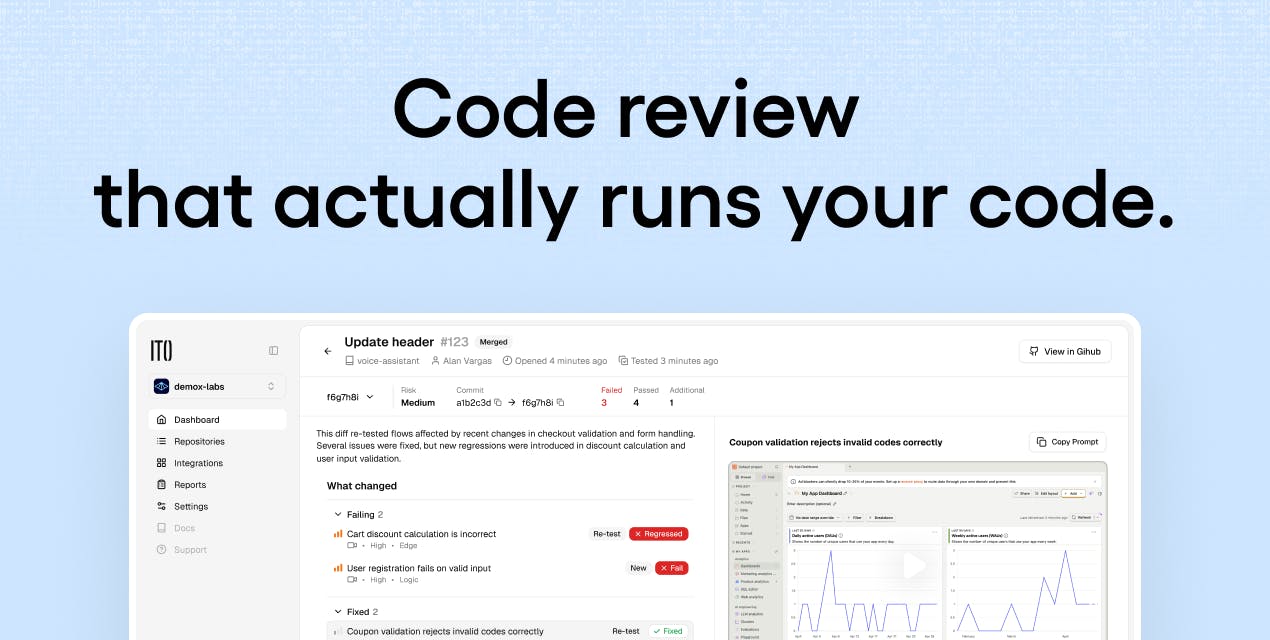
Ito is an AI-assisted code-review and quality-assurance product that executes an application before reviewing a pull request. It creates an isolated environment, attempts affected user workflows, and attaches runtime evidence—including video, screenshots, logs, and reproduction details—to the pull request. The initial customers are software teams for which manual regression testing or maintaining end-to-end test suites has become a release bottleneck (Ito; Product Hunt).
The product is more differentiated than a conventional LLM reviewer that only analyzes source code and diffs. Runtime execution may identify behavioral, integration, authentication, and visual defects that static review cannot observe. The trade-off is considerably higher infrastructure complexity and cost: Ito must build customer applications, provision test data and dependencies, execute browser sessions, and operate AI agents securely.
The strongest investment signal is the founding team’s demonstrated ability to build, finance, and sell a previous technical product. Caster and Marshall previously founded Demox Labs, which raised $4.5 million for privacy-focused blockchain infrastructure and Leo Wallet (DCVC). Provable subsequently acquired Leo Wallet, although the transaction value was not disclosed (Provable). This is meaningful execution evidence, but not proof that Ito has found product-market fit.
The central concern is the absence of verified commercial metrics. Revenue, paying customers, retention, review volume, conversion, gross margin, growth, burn, and runway are not publicly disclosed. Ito presents customer logos and testimonials and says more than 100 engineers use the product, but it does not disclose how many are paying or retained (engineering-teams page).
Final decision: DD. The market, team, and runtime-review differentiation justify a founder meeting and data-room request. An investment decision is premature until commercial retention, infrastructure economics, funding structure, and proposed valuation are verified.
Product Overview
Ito addresses the gap between reviewing what code appears to do and validating how the resulting application actually behaves. After connecting a repository, Ito starts on pull requests, provisions a single-use environment, navigates relevant workflows, and reports defects with runtime evidence directly in the development process (Ito). The company says initial setup can produce a tested pull request within 60 minutes (security page).
The principal value proposition is reducing manual verification and brittle test-script maintenance. Ito describes capabilities covering browser execution, data seeding, external-service mocking, authentication flows, visual evidence and pre-merge testing (Why Ito). These are company-reported capabilities; no independent benchmark establishing defect-detection accuracy, false-positive rates, or performance across technology stacks was found.
Current public pricing is $40 per developer per month, including 20 reviews per seat, followed by usage-based overages of $0.18 per review-minute. A seven-day trial and custom enterprise plan are offered (pricing). For a 25-developer team, base subscription revenue would be approximately $12,000 annually before overages. The publicly evidenced integration is GitHub pull requests; support for GitLab or Bitbucket was not verified.
The product appears active and commercially available. However, the need to execute untrusted customer code and access repositories, credentials, test data, and deployment environments creates a higher security threshold than ordinary static-analysis SaaS.
Founder and Team Assessment
Barron Caster is identified as co-founder and CEO, while Evan Marshall is co-founder and CTO. Both previously built Demox Labs. Caster’s public profile reports experience at Rev.com and Copy.ai, while Marshall’s profile reports engineering leadership at Rev and an MIT computer-science degree; these employment and education details are primarily profile-reported rather than independently documented (Caster; Marshall).
Demox Labs raised $4.5 million in 2023 from Hack VC, DCVC, Amplify Partners, Coinbase Ventures, CRV, OpenSea and others (DCVC announcement). Its principal product, Leo Wallet, was later acquired by Provable. Terms were not disclosed, so the outcome cannot be characterized as financially successful, but it demonstrates an ability to ship technically complex software and complete a strategic transaction.
LinkedIn categorizes Ito as a small private company headquartered in San Francisco. Exact full-time headcount, role distribution, hiring plans and founder ownership are not reliably disclosed. The pivot from blockchain infrastructure to AI quality assurance also raises questions about legal-entity continuity, investor consent, remaining capital and cap-table complexity.
Founder Assessment: Strong technical and product-building evidence with a prior product sale, but Ito-specific commercial execution and organizational depth remain unproven.
Market Opportunity
The initial segment is venture-backed and mid-market software companies with approximately 20–200 developers, frequent web-application releases, meaningful regression risk, and inadequate dedicated QA capacity. These teams can plausibly pay if Ito measurably reduces engineering time or production incidents.
A bottom-up scenario—not a verified market statistic—is:
- 25,000–100,000 target organizations globally
- $12,000–$60,000 annual contract value, depending on seats, usage and enterprise features
- Indicative addressable revenue: $300 million–$6 billion annually
The broad range reflects uncertainty about how many organizations can provide Ito with reproducible development environments and are willing to allow third-party execution of their code. Expansion opportunities include mobile testing, API testing, enterprise release governance, autonomous test generation, multi-repository analysis and integrations beyond GitHub.
Timing is favorable because AI coding systems can increase pull-request volume while shifting the bottleneck toward review and validation. However, willingness to pay will depend on measurable defect prevention rather than the general growth of AI software development.
Traction and Growth Signals
Ito launched on Product Hunt on August 13, 2026 and received a Launch of the Day designation (Product Hunt awards). This establishes launch interest but does not establish revenue, retention or sustained use.
Ito’s website displays customer or user logos including Truemed, DoltHub, Chatwoot, Inkeep, Cnaught, Sybill and SignalFire and publishes attributed testimonials from several engineering leaders (Ito; engineering teams). It also claims more than 100 engineers are using its QA agent. These are useful qualitative signals but remain company-reported; contract size, payment status, duration and referenceability are unknown.
No reliable public figures were found for ARR, MRR, paid accounts, active repositories, monthly reviews, retention, expansion revenue or growth. No public repository exposes product-development activity, and no substantial body of independent customer reviews was identified.
Traction Assessment: Credible early customer interest, but commercially unverified and insufficient to establish product-market fit.
Competitive Position
Direct competitors include AI code reviewers such as CodeRabbit and Greptile, and autonomous testing products such as Momentic and mabl. Indirect alternatives include GitHub Copilot, Cursor, conventional CI pipelines, Playwright, Selenium, manual QA and internal test infrastructure. Greptile, for example, offers team code review at $30 per seat per month plus overages (Greptile pricing), while Momentic offers usage-based autonomous browser testing (Momentic pricing).
Ito’s differentiation is combining pull-request context, isolated application execution and evidence-rich behavioral review without requiring a manually authored test for every workflow. If reliable, that is more valuable than generic diff commentary.
Defensibility is less certain. GitHub, Microsoft, GitLab, Cursor, CodeRabbit or a testing platform could bundle runtime agents into an existing developer workflow. Ito’s potential defenses are accumulated application knowledge, proprietary execution infrastructure, defect data, integration depth and superior reliability—but public evidence does not yet show that these advantages are durable.
If the largest platform launched a similar feature within six months, customers would continue using Ito only if it demonstrated materially better environment setup, defect detection, lower false-positive rates and cross-platform independence. Those advantages have not been independently benchmarked.
Defensibility Assessment: Medium-Low
Business Model and Economics
Ito combines a $40-per-developer monthly subscription with usage charges after included review capacity. This creates both predictable seat revenue and potential expansion as pull-request volume increases.
Variable costs are material: cloud compute for builds and ephemeral environments, browser sessions, storage, logs, networking, AI inference and support for failed setups. Usage growth creates value only if incremental review revenue exceeds these costs by a healthy margin. Gross margin, cost per review-minute and support burden are not disclosed.
Enterprise opportunities could raise ACV through SSO, audit controls, private networking, service-level agreements and dedicated support. Ito reports SOC 2 Type II compliance, AWS hosting, encryption at rest and in transit, and controlled production access (security; Trust Center). The audit report itself is available only on request and was not independently reviewed.
Unicorn Path
An 8× forward-ARR multiple is assumed for a fast-growing, high-retention developer-tools SaaS company. This is deliberately conditional: weaker growth, low gross margin or services-heavy deployment would warrant a lower multiple.
\[
\$1\text{ billion} \div 8 = \$125\text{ million required ARR}
\]
At a $12,000 annual base contract—equivalent to 25 seats at current pricing—Ito would need approximately 10,400 customers. At a hypothetical $50,000 enterprise ACV, it would need approximately 2,500 customers. These calculations exclude discounts and include no assumption for overage revenue.
Reaching that scale requires repeatable enterprise sales, strong retention, support for heterogeneous environments, gross margins likely above 70%, expansion beyond small web teams, and credible differentiation from bundled platform products. Ito also needs to prove that setup and support do not become services-intensive.
Unicorn Path: Conditional
Valuation Assessment
The $4.5 million financing was raised by Demox Labs in 2023, before Ito’s current positioning. Whether Ito operates within the same financed entity, how much capital remains, and how prior investors are treated are not publicly clear. Leo Wallet’s acquisition price was not disclosed.
Current ARR, growth, cash balance, financing instrument, valuation, dilution and proposed round terms are unknown. Consequently, no responsible attractive/fair/expensive range can be calculated.
Valuation Attractiveness: Not Assessable
Required information includes current ARR, cohort growth, gross margin, burn, runway, cap table, acquisition proceeds, outstanding SAFEs, option pool, round size, post-money valuation and liquidation preferences.
Key Risks
- Commercial traction is unverified: paid adoption and retention may be substantially lower than website usage claims imply.
- Infrastructure economics: executing complete applications may produce lower margins than conventional code-review SaaS.
- Environment reliability: complex dependencies, test data and authentication may make zero-configuration execution difficult.
- Competitive bundling: GitHub, Cursor or larger review platforms could distribute comparable functionality rapidly.
- Security exposure: Ito executes customer code and handles sensitive repository and environment access.
- Low switching costs: teams can replace the product if it does not accumulate unique workflow knowledge.
- Pivot and cap-table complexity: predecessor funding and the Leo Wallet disposal may complicate ownership and investor rights.
- False-positive risk: noisy or inconsistent reviews could reduce developer trust and retention.
- Small-team execution risk: enterprise security, infrastructure and sales requirements may exceed current organizational capacity.
Final Assessment
Venture Potential: 67/100
| Category | Score |
|---|---|
| Market Size and Expansion Potential | 17/20 |
| Traction and Growth Evidence | 8/20 |
| Founder and Team | 12/15 |
| Product Strength | 8/10 |
| Distribution Potential | 9/15 |
| Business Model and Economics | 7/10 |
| Defensibility | 6/10 |
| Total | 67/100 |
The strongest elements are a relevant problem, technically differentiated product and founders with prior financing and product-sale experience. The weakest elements are missing commercial data, uncertain gross margins and exposure to well-distributed platform competitors.
Evidence Confidence: 56/100
Founder identities, product availability, pricing, security representations, predecessor funding and the Leo Wallet acquisition are publicly documented. Customer use, product performance and security effectiveness are mainly company-reported. Revenue, retention, paid-customer count, growth, margins, burn, runway, valuation and financing terms remain unavailable.
Final Decision: DD
Ito is strong enough to justify formal diligence but not a public-information investment recommendation. The decision reflects potentially venture-scale demand and credible founders, balanced against weak traction verification, conditional defensibility and an unassessable valuation.
Upgrade Conditions
- Verified recurring revenue with consistent monthly growth.
- Cohort evidence showing strong six- and twelve-month customer retention.
- Reference calls confirming material reductions in defects or QA labor.
- Gross margin above 70% after compute, inference and support costs.
- Repeatable acquisition beyond founder relationships and Product Hunt.
- Multiple enterprise contracts with meaningful expansion.
- Clear evidence that application knowledge or execution data improves performance over time.
Downgrade Conditions
- Low trial-to-paid conversion or rapid post-trial churn.
- High manual onboarding or customer-specific engineering requirements.
- Infrastructure expense rising as fast as, or faster than, usage revenue.
- Material false-positive rates or inconsistent environment provisioning.
- Rapid replication by GitHub, Cursor or major code-review platforms.
- Unfavorable legacy investor rights or an excessive financing valuation.
- Material security, privacy or code-isolation failures.
Questions for Further Diligence
- What are current ARR, MRR and monthly recurring-revenue growth?
- How many organizations and repositories are active, and how many are paying?
- What are 30-, 90- and 180-day customer and repository retention?
- What percentage of trials successfully execute a first pull request, and what percentage convert?
- What are gross margin and fully loaded cloud, inference and support costs per review-minute?
- How often does Ito require manual intervention to configure or repair an environment?
- What are the measured false-positive rate, defect-confirmation rate and review latency?
- Which acquisition channels have produced retained customers, and what is CAC by channel?
- What are average contract value, sales cycle and net revenue retention?
- How are Ito Inc., Demox Labs, prior investors and the Leo Wallet transaction legally connected?
- What are current burn, cash runway, cap table and founder ownership?
- What valuation and terms are being proposed in the current financing?