
Table of Contents
CAT ME App Investment Report
Category: Consumer AI photo generation and entertainment
Company Stage: Not publicly disclosed
Founder or Founders: Not publicly disclosed
Headquarters: Not publicly disclosed
Funding: No reliable public funding information was found
Business Model: One-time consumable in-app purchases
Product Hunt Launch Date: September 16, 2026
Report Date: September 19, 2026
| Investment Metric | Assessment |
|---|---|
| Venture Potential | 28/100 |
| Unicorn Path | No Credible Path |
| Valuation Attractiveness | Not Assessable |
| Evidence Confidence | 42/100 |
| Final Decision | Pass |
Executive Summary
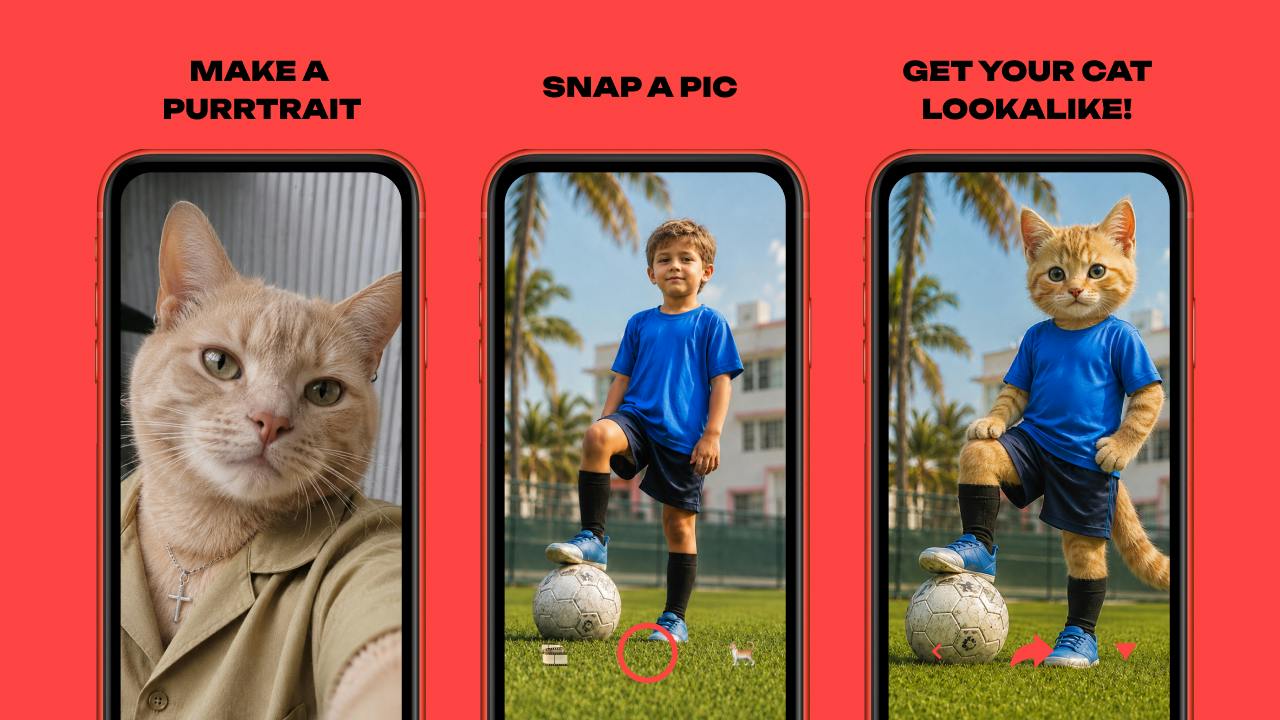
CAT ME is an iPhone application that uses generative AI to transform a photograph of a person into a cat character. It attempts to preserve recognizable characteristics such as facial expression, hairstyle and accessories. Users pay for individual transformations, called “Purrtraits,” and can share the resulting images (Apple App Store; Product Hunt).
As a product, CAT ME is simple, understandable and suited to social sharing. Its low transaction price reduces purchase friction, and the developer has demonstrated an ability to release multiple adjacent consumer applications. The portfolio includes Dog Me, Cubism Cat, Dancing Cats, Dancing Dogs and Stadium Selfie (developer website).
The available traction, however, is almost entirely launch-level. CAT ME had only one US App Store rating at the report date. No downloads, revenue, active-user data, repeat-purchase behavior or organic-sharing metrics were found. Its fifth-place Product Hunt ranking indicates initial interest but is not evidence of product-market fit (Product Hunt leaderboard).
The most important investment concern is structural rather than merely evidentiary. This is a narrow, one-use novelty feature that competes with broad AI image generators, established photo applications and free prompt-based alternatives. Switching costs, network effects and proprietary data advantages are absent or unverified. The economics depend on continuously acquiring users for low-value purchases while paying app-store and AI-generation costs.
Decision: Pass. CAT ME may become a profitable small consumer application or contribute to a portfolio of novelty apps, but there is no credible venture-scale path under its current product scope and revenue model. Reconsideration would require evidence that the developer can repeatedly launch viral applications and retain users within a broader consumer-creation platform.
Product Overview
CAT ME addresses an entertainment-oriented question: what would a person look like as a cat? A user takes or selects a photograph, purchases a transformation credit, and receives an AI-generated cat intended to reflect the source person’s appearance and personality.
The core workflow is:
- Select or capture a photograph.
- Purchase or consume a transformation credit.
- Generate a cat portrait.
- Save or share the result.
The product is available only for iPhone and requires iOS 26.0 or later. The US App Store lists version 1.3, released on September 16, following the application’s initial release on August 25, 2026. The latest update added additional cat breeds (Apple’s iTunes metadata).
Pricing is transactional rather than subscription-based:
- One cat: $0.99
- Five cats: $4.99
- Ten cats: $6.99
The customer benefit is immediate amusement and shareable content. Existing alternatives include manually prompting a general-purpose image generator, using social-media filters or purchasing avatar packs from broader photo applications.
The current product appears functional and actively maintained. Its required operating-system version substantially limits the immediately addressable iPhone installed base, however, and no Android version was found.
Founder and Team Assessment
The App Store identifies the legal seller as Do Something Good LLC, and the company’s terms state that its applications are owned or controlled by that entity (App Store; terms).
No reliable public information was found identifying the founder, executive team, employee count, technical staff, headquarters or full-time commitment. No company LinkedIn page, founder interview, public GitHub repository or hiring page was located.
The developer is not entirely new to consumer applications. Its official website links to six current apps, while its older BabyName application has accumulated approximately 21,000 US App Store ratings (developer website; BabyName App Store listing). This provides evidence of prior app-distribution experience, but it does not reveal CAT ME’s team, revenue or development capacity.
No founder exits, institutional investors or commercial leadership qualifications were verified. Key-person risk is therefore not assessable but could be substantial if this is a solo or very small development operation.
Founder Assessment: Relevant consumer-app publishing experience is visible at the company level, but the founders, team and commercial capabilities remain unverified.
Market Opportunity
The initial customer segment is iPhone users who enjoy cats, novelty AI content and social-image sharing. The problem is entertainment rather than recurring workflow pain, which generally lowers usage frequency and long-term willingness to pay.
A narrow bottom-up scenario illustrates the current opportunity:
- 10 million users acquired over the product’s lifetime;
- 5% making at least one purchase;
- $4 average gross spending per purchaser;
- Resulting gross lifetime revenue: approximately $2 million.
This is an analyst scenario, not a prediction or verified company forecast. More favorable conversion or viral reach could produce higher revenue, but the present pricing and one-purpose experience constrain average revenue per user.
The broader market of AI-generated photos is large, but CAT ME does not address that entire market. It offers one transformation concept. Expansion into dogs, animation, art styles and event-specific images is already visible across the developer’s separate applications, but splitting each concept into a standalone app may fragment users, reviews and monetization.
Potential expansion paths include a unified AI-character platform, subscriptions, social profiles, user-generated templates, physical merchandise or branded licensing. None is currently disclosed.
The realistic market may support a profitable independent studio, but CAT ME’s current addressable use case does not support venture-scale revenue.
Traction and Growth Signals
CAT ME ranked #5 Product of the Day on September 16 and approximately #22 for its launch week. Reliable vote and comment totals were not available from the primary Product Hunt page (daily leaderboard; weekly leaderboard).
The US App Store showed a 5.0 rating based on only one rating. That sample is too small to assess satisfaction. Apple does not publicly disclose download totals, and no independent download estimate was considered sufficiently reliable.
Product activity is visible: the application launched on August 25 and reached version 1.3 by September 16. The developer’s release pace is positive but covers less than one month and therefore does not establish sustained momentum.
No evidence was found for:
- Registered or active users
- Paying customers
- Revenue or revenue growth
- Repeat-purchase rates
- Sharing or referral rates
- Customer acquisition cost
- Organic search traffic
- Android adoption
- Partnerships or media coverage
- External funding
The developer’s broader portfolio and BabyName’s historical ratings indicate some consumer-distribution capability, but traction from another application should not be attributed to CAT ME.
Traction Assessment: Early launch attention with almost no commercially meaningful validation.
Competitive Position
Direct competitors include AI avatar applications, pet-portrait generators and novelty photo filters. Lensa sells broader avatar packs and photo-editing subscriptions, while CatCamera and other App Store products generate AI pet portraits (Lensa App Store; CatCamera).
Indirect competitors are more threatening. ChatGPT Images, Google Gemini and Adobe Firefly let users upload or generate images across many styles, including personalized and pet-related concepts (ChatGPT Images; Gemini image generation; Adobe Firefly pet portraits). Social networks and smartphone photo editors can also bundle comparable filters.
CAT ME’s advantages are speed, a purpose-built interface and consistent cat-themed output without prompt engineering. Its low price can outperform a subscription for a user who wants only one image.
Those benefits do not create meaningful switching costs. The product has no verified network effects, proprietary model, exclusive content, brand advantage or distribution partnership. Its privacy policy says it uses third-party providers including OpenAI and Venice AI, confirming dependency on external generation infrastructure (privacy policy).
If the largest platform in this market launched the same feature within six months, why would customers continue using CAT ME? No strong reason is currently evident beyond convenience and preferred output style. A broadly distributed platform could replicate the workflow and bundle it at no additional charge.
Defensibility Assessment: Low
Business Model and Economics
CAT ME sells consumable credits through Apple’s in-app purchase system. Gross revenue per transformation ranges from approximately $0.70 in the ten-image package to $0.99 for an individual image.
After an assumed 15–30% app-store commission, net receipts before generation costs would be roughly $0.49–$0.84 per transformation. This range is an analyst estimate; the developer’s actual Apple commission rate is unknown.
Variable costs include image-generation inference, storage, content delivery, failed generations, refunds and customer support. The privacy policy identifies OpenAI and Venice AI as generation providers and Cloudflare R2 as storage. Submitted and generated media is stored until users delete it or request deletion (privacy policy).
Gross margin could be attractive if generation costs remain low, but no cost data is public. The larger problem is acquisition: paid advertising is difficult to support when lifetime gross revenue per purchaser may be only a few dollars.
There is also a disclosure inconsistency. Apple’s privacy label says “Data Not Collected,” while the developer’s policy says images are uploaded to company servers, may be sent to AI providers and are stored in Cloudflare R2 until deletion. This does not prove misconduct, but the apparent mismatch requires legal and App Store compliance review.
Unicorn Path
A 4× annual revenue multiple is appropriate for a low-retention, transaction-based consumer application without demonstrated recurring revenue. At that multiple:
Required annual revenue = $1 billion ÷ 4 = $250 million
At approximately $0.70–$0.99 of gross revenue per transformation, CAT ME would need roughly:
- 253 million transformations annually at $0.99 each; or
- 358 million transformations annually at $0.70 each.
After app-store commissions and AI costs, the required transaction volume would be higher if valuation were based on net revenue or gross profit.
This scale is unrealistic for a single-purpose cat-transformation application without extraordinary recurring virality. A broader portfolio or unified AI-entertainment platform could create a different opportunity, but that would represent a substantial strategic expansion rather than execution of CAT ME’s current model.
Unicorn Path: No Credible Path
Valuation Assessment
No reliable public evidence was found regarding funding, investors, financing rounds, SAFE terms, secondary transactions, acquisition offers or current valuation.
Comparable products range from independent novelty applications to broader AI photo editors, but no revenue information is available to normalize CAT ME against them.
Valuation Attractiveness: Not Assessable
A responsible assessment requires revenue, growth, gross margin, paid-user cohorts, acquisition costs, burn, runway, ownership, round size, post-money valuation and investor terms.
Key Risks
- The use case is narrow and likely to have low repeat frequency.
- Revenue, downloads and paying-user counts are unknown.
- General AI image platforms can replicate the feature.
- Customer acquisition may exceed low per-user lifetime value.
- There are virtually no public customer reviews.
- Founder and team identities are not publicly verifiable.
- Dependence on Apple limits distribution and exposes the business to platform fees.
- Third-party AI providers control important costs and product quality.
- The App Store privacy label appears inconsistent with the developer’s storage disclosures.
- A multi-app novelty strategy may fragment brand, ratings and retention.
Final Assessment
Venture Potential: 28/100
| Category | Score |
|---|---|
| Market Size and Expansion Potential | 5/20 |
| Traction and Growth Evidence | 3/20 |
| Founder and Team | 2/15 |
| Product Strength | 6/10 |
| Distribution Potential | 5/15 |
| Business Model and Economics | 4/10 |
| Defensibility | 3/10 |
| Total | 28/100 |
The strongest element is a clear, low-friction product supported by an experienced app-publishing entity. The weakest elements are narrow demand, negligible verified traction, unidentified leadership and minimal defensibility.
Evidence Confidence: 42/100
The product, pricing, legal seller, release history, privacy policy and developer portfolio are verified. Product Hunt ranking is visible, but founder identity, team size, funding, revenue, users, retention, costs and valuation are unavailable. The privacy disclosure inconsistency further reduces confidence.
Final Decision: Pass
CAT ME may be commercially viable as a small novelty application, but it does not presently fit a venture-capital return profile. The current model lacks recurring revenue, meaningful switching costs and a credible route to $100 million-plus annual revenue.
Upgrade Conditions
- At least 500,000 organic downloads with measurable post-launch momentum.
- More than $1 million annualized net revenue.
- Repeat-purchase rates demonstrating durable usage rather than one-time novelty.
- Profitable acquisition with short CAC payback.
- A unified portfolio strategy that increases cross-app retention and lifetime value.
- Clear, consistent privacy disclosures and verified generation-unit economics.
Downgrade Conditions
- App updates cease after the initial launch period.
- Paid acquisition is required to maintain downloads.
- Generation and refund costs materially erode gross margin.
- Larger platforms release equivalent free filters.
- Apple challenges the privacy disclosure or removes the application.
- Claims about usage or revenue prove misleading.
Questions for Further Diligence
- Who founded and currently operates Do Something Good LLC?
- How many CAT ME downloads, active users and paying users exist?
- What are current monthly revenue and month-over-month growth?
- What percentage of users purchase at least one transformation?
- How many purchasers buy a second credit package?
- What is gross profit per generated image after Apple and AI costs?
- What are customer acquisition cost and the main acquisition channels?
- How much sharing-driven or referral traffic does each generated image produce?
- Why does Apple show “Data Not Collected” when the privacy policy describes server storage?
- What contractual data-retention rules apply to OpenAI, Venice AI and Cloudflare?
- What are the company’s burn, runway, ownership and funding history?
- Will the separate novelty apps be consolidated into a broader platform?