Table of Contents
Grok 4.6 Investment Report
Category: Frontier AI foundation model and agent platform
Company Stage: Late-stage / acquired operating business
Founder or Founders: Elon Musk
Headquarters: San Francisco Bay Area, United States
Funding: xAI raised substantial private capital before being acquired by SpaceX; current standalone funding and ownership terms are not publicly available.
Business Model: Consumer subscriptions, enterprise/API usage, and platform partnerships
Product Hunt Launch Date: 2026/08/20
Report Date: August 26, 2026
| Investment Metric | Assessment |
|---|---|
| Venture Potential | 84/100 |
| Unicorn Path | Clear |
| Valuation Attractiveness | Not Assessable |
| Evidence Confidence | 76/100 |
| Final Decision | Pass |
Executive Summary
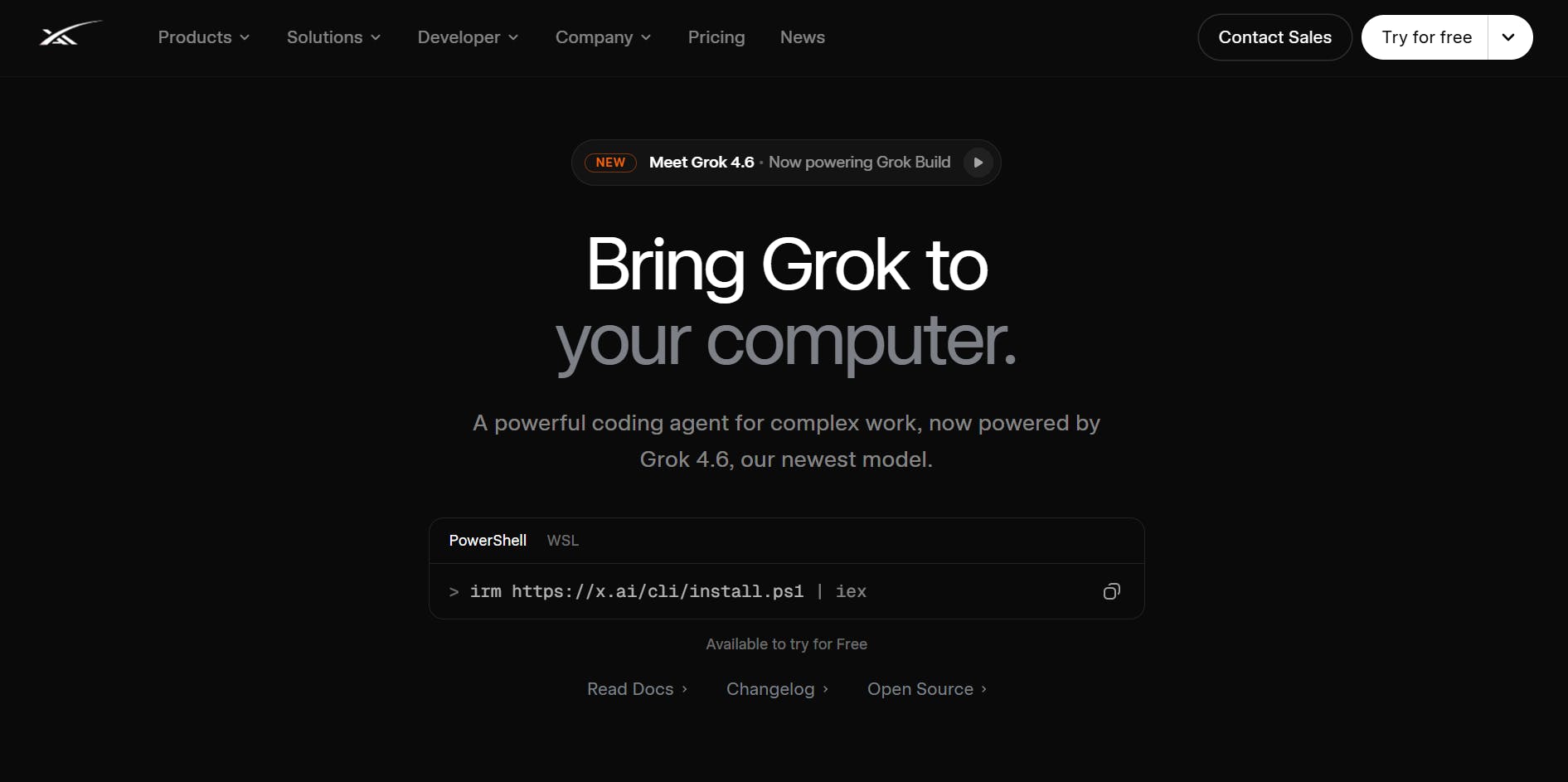
Grok 4.6 is xAI’s frontier reasoning model for software engineering, research, long-running agents, and production of complete digital artifacts. It is sold through the Grok consumer experience and API, while also reaching developers through partners including Cursor, Vercel, Cloudflare, OpenRouter, and Google’s Gemini Enterprise platform. The immediate users are developers, technical teams, researchers, and power users who value high reasoning quality and a large context window.
The product is strategically interesting because xAI is competing at the frontier rather than shipping a thin application layer. Its strongest positive signal is credible distribution combined with substantial compute and capital: Grok 4.6 is available through major developer and cloud channels, while official benchmark disclosures show competitive coding and agent performance. These measurements are useful product evidence, but they are company-reported and do not establish retention, revenue, or product-market fit.
The central investment concern is investability, not merely product quality. Grok 4.6 is not a standalone startup or security; it is a product of xAI, which was acquired by SpaceX in 2026. Public reporting has associated the transaction with very large implied values, but there is no independently verifiable current price, round structure, investor protection, or standalone financial profile available for this product.
The economic model may support enormous revenue, but it is also exceptionally capital intensive. Price competition, inference costs, continual model-training requirements, safety and regulatory exposure, and rapid performance convergence among OpenAI, Anthropic, Google, Meta, and other providers can compress returns even when usage grows.
The final decision is Pass for an early-stage venture portfolio. This is not a judgment that the product lacks technical strength; it reflects the absence of an accessible standalone investment, the combined company’s scale, insufficient public unit-economics evidence, and no defensible basis for judging entry valuation.
Product Overview
Grok 4.6 addresses the cost and time required for complex knowledge work, especially coding, research, and multi-step agent tasks. According to the official launch announcement, it is designed to sustain long-running work, navigate codebases, produce applications and other complete artifacts, and improve interactive visual outputs. The developer documentation describes a 500,000-token context window and configurable reasoning effort.
The core customer benefit is consolidating search, analysis, code generation, and execution into a capable general model. It competes with manual research, conventional search, human-written boilerplate, multiple specialist tools, and other frontier-model APIs. Current platforms include Grok’s consumer products, xAI’s API, Cursor, OpenRouter, Vercel, Cloudflare, and the Gemini Enterprise Agent Platform.
Published pricing is transparent. The xAI pricing page lists a free tier, SuperGrok at $30 per month, and SuperGrok Plus at $100 per month. API pricing is $2 per million input tokens and $6 per million output tokens for the standard model; the faster variant costs twice as much. Enterprise terms and committed-use discounts are not publicly disclosed.
Founder and Team Assessment
xAI was founded by Elon Musk, whose record includes building and financing capital-intensive technology companies at unusual scale. His ability to recruit technical talent, secure compute, attract capital, and distribute products through a broad business ecosystem is a major advantage. The organization also benefits from its combination with SpaceX and links to X, although those relationships can create governance and concentration risks.
The launch materials identify strong model and infrastructure execution but do not disclose product-level headcount, team retention, compensation, hiring efficiency, or responsibility for commercial outcomes. Musk’s prominence creates key-person and governance risk, while the breadth of his other roles can complicate management focus. No product-level founder ownership or incentive structure is available.
Founder Assessment: Exceptional capital formation and technical ambition, but governance concentration and lack of product-level operating transparency remain material risks.
Market Opportunity
The narrow initial segment is software developers and technical organizations purchasing frontier reasoning through subscriptions or APIs. A reasonable bottom-up illustration is 500,000 professional seats at $1,200 annual revenue per seat, producing $600 million of annual subscription revenue. A broader API path could serve thousands of enterprises at annual spend ranging from tens of thousands to millions of dollars, but customer counts and average spend are undisclosed.
Willingness to pay is demonstrated at the category level by widespread adoption of AI coding assistants and model APIs, not specifically by Grok 4.6 public revenue. Adjacent expansion includes enterprise agents, scientific research, customer operations, media generation, robotics, and embedded intelligence across the broader SpaceXAI ecosystem. International access through cloud and developer partners expands distribution, although regulation and data-residency requirements may limit deployment.
The realistic market can support venture-scale revenue. Timing is favorable because enterprises are moving from chat interfaces to agentic workflows, but model capabilities and prices are changing so rapidly that market growth does not guarantee durable provider-level margins.
Traction and Growth Signals
The strongest visible signals are rapid product releases, access through major developer platforms, and official benchmark performance. xAI reports 69.9% on CursorBench, 65.9% on DeepSWE, and 61.3% on FrontierCode; these figures should be treated as company-reported technical evidence, not independently verified commercial traction. Axios’s model comparison described Grok 4.6 as highly competitive with other leading models.
The Product Hunt listing provides launch-attention evidence only. Votes, rankings, and comments do not establish retention or paid demand. More meaningful distribution evidence comes from platform availability and the subsequent Google enterprise integration.
Missing metrics include model-specific active users, API consumption, paying subscribers, enterprise customers, revenue, growth, retention, gross margin, utilization, and post-launch cohort behavior.
Traction Assessment: Strong distribution and technical momentum, but model-specific commercial traction remains unverified.
Competitive Position
Direct competitors are OpenAI’s GPT family, Anthropic’s Claude/Fable models, Google Gemini, DeepSeek, Meta’s Llama ecosystem, and other frontier or open-weight models. Free alternatives include consumer chatbot tiers and locally hosted open models. Manual alternatives include search, developer forums, contractors, and internal knowledge workflows.
Grok’s advantages are access to exceptional compute, fast release cadence, brand awareness, ecosystem distribution, and potential proprietary data and product integration through X and SpaceXAI. Switching costs at the raw API layer are limited because developers increasingly use model routers and abstraction frameworks. Proprietary evaluations may show a temporary performance lead, but benchmark leadership is rarely permanent.
If the largest platform launched the same feature within six months, customers would remain only if Grok delivered consistently better task outcomes, latency, economics, unique data access, or ecosystem integration. Public evidence does not yet prove those advantages persist long enough to create strong switching costs.
Defensibility Assessment: Medium
Business Model and Economics
Revenue comes from free-to-paid consumer conversion, premium subscriptions, API usage, enterprise deployment, and partnerships. Published consumer prices imply annualized revenue of $360 or $1,200 before discounts, taxes, payment fees, and churn. Enterprise average contract value is not disclosed.
Software-like gross margins are possible at mature utilization, but frontier AI has substantial variable and semi-fixed costs: inference compute, training clusters, networking, energy, model evaluation, safety operations, storage, support, and continuous research. Faster-model pricing may offset latency-intensive compute, while cached-input pricing can improve customer economics but lower revenue per token.
The critical question is whether realized price per useful task falls more slowly than cost per useful task. Gross margin, customer acquisition cost, free-to-paid conversion, renewal, API concentration, and compute commitments are unavailable. Expansion revenue could be strong if enterprises standardize on Grok agents, but model routing also makes workloads portable and increases price pressure.
Unicorn Path
A 10x ARR multiple is a reasonable illustrative benchmark for a high-growth frontier AI platform, although capital intensity and cyclicality could warrant a lower multiple. A $1 billion valuation would therefore require approximately $100 million ARR.
At $360 annualized revenue per SuperGrok subscriber, that equals about 278,000 subscribers; at $1,200 per SuperGrok Plus subscriber, about 83,000. An enterprise route could require 1,000 customers at $100,000 annual contract value, or a blended mix of subscriptions and API usage. These are revenue-equivalent calculations, not forecasts, and ignore churn, discounts, and channel fees.
xAI has already crossed the nominal unicorn threshold according to widely reported financing and the SpaceX transaction. Reaching an attractive return from the current combined-company scale would require much more: durable enterprise adoption, improving gross margins, recurring multi-billion-dollar revenue, differentiated data or workflows, international expansion, and reduced dependence on benchmark-driven model substitution.
Unicorn Path: Clear
Valuation Assessment
xAI raised multiple large private rounds before its acquisition by SpaceX. Axios reported a combined transaction value near $1.2 trillion and an xAI implied value above $200 billion. These are secondary reported figures and do not provide a current standalone security price or investable round terms.
Comparable companies include OpenAI, Anthropic, and Google’s Gemini operation, but differing structures, strategic capital, compute commitments, and revenue quality make headline valuations poor substitutes for diligence. No responsible attractive/fair/expensive range can be produced without current ARR, growth, gross margin, burn, runway, transaction structure, ownership, liquidation preferences, and the price and rights available to the investor.
Valuation Attractiveness: Not Assessable
Key Risks
- No standalone investable asset: Grok 4.6 is a product within a combined, very large private company.
- Capital intensity: Training and serving frontier models may consume cash faster than revenue scales.
- Model commoditization: Competitive performance can converge quickly, weakening pricing and retention.
- Unverified economics: Revenue, gross margin, utilization, burn, and contractual compute exposure are undisclosed.
- Governance and key-person concentration: Strategic decisions are unusually dependent on Elon Musk.
- Safety and regulatory exposure: Generated code, misinformation, synthetic media, and cross-border data rules create liability.
- Platform and channel dependence: Cloud, developer-tool, and app-distribution partners can change placement or economics.
- Brand polarization: Association with Musk and X may expand awareness while limiting adoption in some enterprises.
- Benchmark-to-value gap: Self-reported evaluations may not predict reliability, security, or ROI in production.
- Combined-company complexity: Related-party economics and capital allocation may obscure product-level performance.
Final Assessment
Venture Potential: 84/100
| Category | Score |
|---|---|
| Market Size and Expansion Potential | 20/20 |
| Traction and Growth Evidence | 16/20 |
| Founder and Team | 14/15 |
| Product Strength | 9/10 |
| Distribution Potential | 14/15 |
| Business Model and Economics | 5/10 |
| Defensibility | 6/10 |
| Total | 84/100 |
The strongest elements are market size, technical capability, capital access, and broad distribution. The weakest are economic opacity, limited API switching costs, and the lack of a standalone early-stage investment opportunity.
Evidence Confidence: 76/100
Product features, published prices, context size, availability, and official benchmark claims are verifiable from first-party sources. Benchmark results are company-reported; transaction values come from secondary reporting. Product-level customers, revenue, retention, costs, margins, and ownership economics remain unavailable. Customer-count calculations are estimates, not operating claims.
Final Decision: Pass
Grok 4.6 has high venture potential and a clear unicorn path, but the relevant asset has already been absorbed into a very large private company. Valuation attractiveness cannot be assessed, economics are opaque, and no standalone financing terms exist. For an early-stage portfolio, the appropriate action is Pass rather than pursue a product-level investment that is not available.
Upgrade Conditions
- A clearly investable security with disclosed price, rights, ownership, and governance.
- Audited or investor-verified model-level ARR, growth, gross margin, and retention.
- Evidence that enterprise customers standardize on Grok rather than route opportunistically.
- Sustained gross-margin improvement despite falling model prices.
- Material recurring enterprise revenue independent of related-party distribution.
Downgrade Conditions
- Persistent price compression without proportional inference-cost improvement.
- Loss of major cloud or developer-platform distribution.
- Material safety, privacy, regulatory, or security failures.
- Evidence that product usage is concentrated in free or subsidized channels.
- Governance or related-party decisions that disadvantage minority investors.
Questions for Further Diligence
- What are Grok 4.6’s current monthly API revenue, consumer subscription revenue, and enterprise ARR?
- How many paying subscribers, API customers, and enterprise customers are active, and how fast are they growing?
- What are 30-, 90-, and 180-day retention and net revenue retention by customer segment?
- What is gross margin by API, consumer, and enterprise channel after inference and allocated compute costs?
- How does cost per successfully completed coding or agent task compare with GPT, Claude/Fable, and Gemini?
- What percentage of usage comes through related-party products versus independent paying customers?
- Which acquisition channels are repeatable, and what are customer acquisition cost and payback period?
- What contractual commitments exist for compute, cloud capacity, and data licensing?
- What proprietary data, tooling, or workflow integration creates durable switching costs?
- How are safety incidents, model misuse, customer data, and regulated deployments governed?
- What security, governance, and economic rights would a new investor receive in the combined company?
- What are current burn, liquidity, runway, and the next financing requirements?