
Table of Contents
Vois 2.0 Investment Report
Category: AI audio / desktop text-to-speech and voice production software
Company Stage: Pre-seed / bootstrapped, solo founder
Founder or Founders: Praney Behl (solo)
Headquarters: Melbourne (Carlton), Victoria, Australia (founder location; no legal entity disclosed)[1]
Funding: None disclosed; founder states “no team, no investors”[2]
Business Model: Consumer/creator desktop subscription (SaaS-style flat-rate), plus pay-as-you-go export credits[3]
Product Hunt Launch Date: March 5, 2026 (v1); August 19, 2026 (Vois 2.0)[4][5]
Report Date: August 22, 2026
| Investment Metric | Assessment |
|---|---|
| Venture Potential | 45/100 |
| Unicorn Path | Improbable |
| Valuation Attractiveness | Not Assessable |
| Evidence Confidence | 42/100 |
| Final Decision | Watch |
Executive Summary
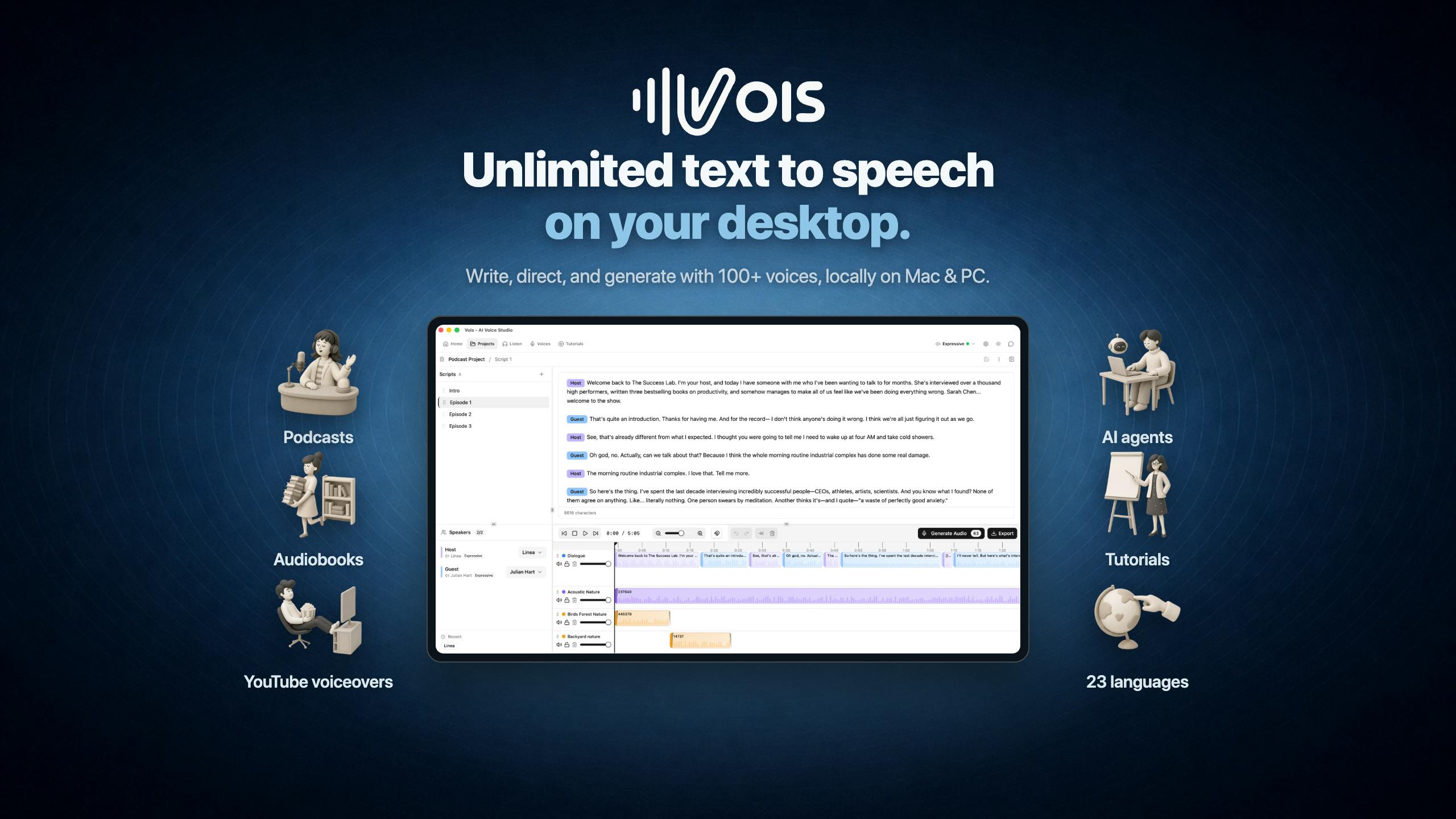
Vois is a desktop “voice AI studio” for macOS and Windows that turns scripts, ebooks, articles, and podcasts into finished audio: 100+ stock voices, voice cloning from a consented sample, a script editor with multi-speaker support, multi-track mastering, and export presets for Spotify, YouTube, and ACX — all generated locally on the user’s machine rather than in the cloud. The wedge is pricing and privacy: cloud incumbents like ElevenLabs charge per character and meter every regeneration, while Vois charges a flat subscription with “unlimited” generation because inference runs on the customer’s own hardware.[3][6][7]
The product is real, shipping, and iterates fast. Version 1 launched on Product Hunt in March 2026 with 63 voices; version 2.0 launched on August 19, 2026 with 100+ voices, four engines (Fast, Expressive, Multilingual, and a Pro-only “Omni” model covering 646 languages plus Voice Design), and finished #13 for the day with roughly 102 upvotes. The founder, Praney Behl, is a ~20-year software engineer who built the product alone and states he went full-time on it this month.[1][4][5][8][9]
The strongest positive signal is genuine product-market wedge logic: heavy TTS users (audiobook producers, course creators, faceless YouTube channels) do feel real pain from per-character pricing, and at least two on-the-record 5-star reviews and one anecdotal subscriber with a SpaceX email suggest some strangers are paying. The most important concern is that this looks like a well-executed indie product rather than a venture-scale company: low price points ($10–$14/month at launch pricing), a solo founder splitting attention across at least three other products, free open-source local TTS alternatives (Kokoro, Chatterbox), and zero disclosed revenue, retention, or user metrics.[2][3][6][10][11]
Because nothing about revenue, retention, or valuation is publicly verifiable, the correct posture is Watch: a promising bootstrappable business that would need demonstrated commercial traction and a much larger ambition to become venture-backable.
Product Overview
The customer problem is cost anxiety and privacy friction in AI voice production. Cloud TTS platforms charge per character, so every preview, typo fix, and re-generation burns credits; a 50,000-word audiobook can cost ~$72 per iteration pass at typical cloud rates, and scripts are uploaded to third-party servers. Vois replaces that workflow with a single desktop app: write or paste a script, cast voices per speaker, generate locally, retake lines, master on a multi-track timeline, and export platform-ready files.[3][6][12]
Core features: 100+ curated voices across 21 categories, local voice cloning with a consent step, Voice Design (describe a voice in text), the Omni engine with 646 languages (Pro tier, GPU required), CLI automation, and export presets. Target users are podcasters, audiobook and course creators, indie game developers, and accessibility users; the founder notes he is partially dyslexic and built it partly for himself. Pricing is Subscriber at $29/month list ($10/month with launch code PHVOIS2 through August 31, locked for life) and Pro at $49/month list ($14/month launch), with a 7-day free trial (10 generations/day, no card) and pay-as-you-go export credits. The product is available and verifiable today as a desktop download (v2.0.1).[3][13][14][15]
Founder and Team Assessment
Praney Behl is independently verifiable via LinkedIn, Product Hunt, and Reddit: a Melbourne-based engineer with roughly 20 years in software, now describing himself as building “AI-operated companies”. He built Vois alone, shipped two Product Hunt launches in five months, responds substantively to reviews, and turned a full site redesign around in ~1.5 days — evidence of strong technical execution and high velocity. He states Vois became his main focus in August 2026.[1][9][16][17]
Concerns are material. He is a solo founder with no team, creating extreme key-person risk, and his own profiles list at least three other active products (Konvy, Volant, heynyx), so “full-time” commitment is recent and historically divided. Commercial capability — sales, marketing beyond launch channels, pricing strategy — is unproven. There is no evidence of prior exits.[1][10]
Founder Assessment: Strong solo technical execution and genuine founder-market fit, but commercial capability, focus, and organizational capacity remain unproven.
Market Opportunity
The initial segment is narrow: independent audio content producers (audiobook self-publishers, podcasters, course creators, faceless YouTube operators) who generate enough TTS volume that per-character cloud pricing hurts. The broad text-to-speech market is large but estimates conflict: 2026 market size ranges from ~$4.36B (Mordor Intelligence) to ~$5.83B (The Business Research Company), with CAGRs quoted anywhere from 3.7% to 22.4%. This report treats ~$4.5–5.8B as the plausible 2026 range and flags the variance.[18][19][20]
Bottom-up, Vois’s realistic addressable market is a fraction of that: the TTS total is dominated by enterprise API, accessibility, automotive, and contact-center spend that a desktop creator app cannot capture. A reasonable analyst assumption: a few million English-speaking creators worldwide produce long-form audio regularly; if 1–2% of them would pay ~$120–$350/year for a local studio, the serviceable market is roughly $10–$50M/year — enough for an excellent indie business, marginal for venture. Expansion paths exist (teams, localization at 646 languages, API/CLI automation, game studios), and market timing is genuinely good: ElevenLabs’ growth to a reported ~$500M+ ARR proves exploding demand for voice content. But the realistic near-term market supports a strong niche business more obviously than a venture-scale one.[21]
Traction and Growth Signals
Verified: Vois 2.0 launched on Product Hunt on August 19, 2026, finishing #13 of the day with ~102 upvotes and 12 comments; the product page shows 262 followers and a 5.0 rating from 2 reviews. The founder claims paying subscribers exist, including one with a SpaceX email address (June 2026), and states users “kept paying,” justifying full-time commitment. Product velocity is high: v1 (March, 63 voices) → v2.0 (June/August, 100+ voices, 4 engines) → v2.0.1.[2][4][5][8][9][15][16]
Not disclosed: revenue, MRR/ARR, subscriber count, trial-to-paid conversion, retention, churn, traffic. Launch pricing “locked for life” at $10–$14/month suggests the company is still buying its first cohort of paying users. Product Hunt attention here is launch attention, not sustained traction — a #13 finish with ~102 votes is modest.[3]
Traction Assessment: Promising product velocity and early payment anecdotes, but commercially unverified.
Competitive Position
Direct competitors: ElevenLabs (from $5/month, ~$500M+ ARR, $11B valuation), Murf ($19–29/month), Speechify, Resemble AI, LOVO. Indirect: cloud TTS APIs (Google, Azure, Amazon Polly at $4–16 per million characters). Free alternatives are the sharpest threat: open-source local models like Kokoro (Apache-2.0 weights) and Chatterbox deliver free, local, clonable TTS to any technical user. Notably, PlayHT shut down in December 2025 via Meta acquihire — evidence that mid-tier voice tools get squeezed.[11][22][23][24][25][26][27]
Vois’s differentiation is the integrated local studio (editor + mastering + unlimited generation + privacy), not the models themselves. If ElevenLabs shipped a local or flat-rate unlimited tier — or if a free open-source GUI wraps Kokoro with a decent editor — Vois’s core pitch weakens substantially. Switching costs are low (audio files are portable), there are no network effects or proprietary data, and the moat is workflow polish plus price.
Defensibility Assessment: Low
Business Model and Economics
Flat-rate subscription ($29/$49 list; $10/$14 launch, lifetime-locked) with unlimited local generation, plus export credits. The clever economic property: inference runs on the customer’s hardware, so gross margin is not eroded by AI compute — costs are payment processing (~3%), distribution, and support. That is a genuine structural advantage over cloud TTS, where usage growth scales inference cost.[3]
The weakness is the other side of the same coin: unlimited generation at $10–$14/month caps revenue per customer precisely where usage is highest. Heavy users — the ones who love the product — are the cheapest to serve but also the ones a usage-based competitor monetizes 10–50x better. With lifetime-locked launch pricing, early ARPU is fixed low forever. Consumer/creator subscriptions also carry high churn and seasonality risk. No data exists on conversion, churn, or support load; the key assumption to verify is whether blended ARPU can rise (teams, Pro mix, credits) above ~$15/month.
Unicorn Path
Assume a 10x revenue multiple — appropriate for a mature subscription software business; even granting ElevenLabs’ current ~20x growth multiple changes little. Required revenue for $1B: $100M ARR. At Vois’s pricing:[21]
- At launch pricing ($10/mo Subscriber): ~830,000 paying subscribers
- At list pricing ($29/mo): ~287,000 paying subscribers
- At Pro list ($49/mo): ~170,000 paying subscribers
For context, even category-leader ElevenLabs reached ~$500M ARR only by shifting to enterprise contracts (up to $2M each) and API usage — not consumer subscriptions. A solo-built desktop utility acquiring 170K–830K paying subscribers against free open-source alternatives is not a realistic route. A unicorn outcome would require a wholesale transformation: enterprise licensing, an API platform, or embedded OEM deals — none of which exist today.[21]
Unicorn Path: Improbable
Valuation Assessment
No funding rounds, investors, valuations, or revenue figures have been disclosed; the founder describes the company as bootstrapped. There is no basis for a responsible valuation range.[2]
Valuation Attractiveness: Not Assessable
Required to assess: current MRR/ARR, growth rate, churn, blended ARPU (including the lifetime-locked launch cohort), refund rates, and any intended round terms. For calibration only: comparable bootstrapped creator-tool businesses commonly transact at 3–5x ARR in micro-acquisitions, while venture pricing would require growth evidence that does not yet exist.
Key Risks
- Free open-source commoditization — Kokoro/Chatterbox-class models make local TTS free; only the studio workflow is paid[11][26]
- Solo-founder key-person risk, with attention historically split across 3+ other products[10]
- Unverified commercial traction — no disclosed revenue, subscribers, or retention
- Low, lifetime-locked launch pricing caps ARPU and signals weak willingness-to-pay discovery[3]
- Competitive replication — ElevenLabs or a free GUI could bundle “local + unlimited” quickly
- Hardware dependency — best performance needs Apple Silicon/GPU; Windows lacks GPU acceleration (founder-acknowledged)[16]
- Voice-cloning legal/deepfake exposure despite consent steps
- Distribution relies on launch channels (PH, Reddit, SEO); no viral loop, desktop install friction
- Underlying model provenance/licensing undisclosed — potential IP constraint on commercial use
- Creator-segment churn and low usage frequency after project completion
Final Assessment
Venture Potential: 45/100
| Category | Score |
|---|---|
| Market Size and Expansion Potential | 12/20 |
| Traction and Growth Evidence | 5/20 |
| Founder and Team | 7/15 |
| Product Strength | 7/10 |
| Distribution Potential | 6/15 |
| Business Model and Economics | 5/10 |
| Defensibility | 3/10 |
| Total | 45/100 |
Strongest element: a genuinely well-built, fast-iterating product attacking real cloud-TTS pain with structurally better gross margins. Weakest: no verified traction, low defensibility, and a price point that caps venture-scale revenue.
Evidence Confidence: 42/100
Verified: founder identity, product existence and functionality, pricing, launch history and ranking. Company-reported: paying subscribers, “main thing I do” commitment, bootstrapped status. Unavailable: all financial metrics, user counts, retention, team/entity structure, model licensing.
Final Decision: Watch
Vois is a credible indie software business and a weak venture candidate today. The product is good; the venture case is not yet evidenced. Per the framework, lack of information plus a structurally small-price consumer model points to Watch rather than DD or Pass — the company could plausibly prove $500K+ ARR as a bootstrapped business, at which point the conversation changes.
Upgrade Conditions
- Disclosed MRR/ARR crossing ~$40K MRR with month-over-month growth
- 1,000+ paying subscribers with >70% six-month retention
- Evidence of organic acquisition beyond Product Hunt/Reddit (search, referrals, YouTube)
- Team/Pro tiers lifting blended ARPU above ~$20/month; Windows GPU support shipped
- Founder full-time with other projects wound down or staffed
Downgrade Conditions
- Stalled releases or founder refocusing on Konvy/Volant
- Weak trial-to-paid conversion or high churn once disclosed
- A credible free open-source studio GUI, or an ElevenLabs local/unlimited tier
- Model-licensing or voice-cloning legal issues
Questions for Further Diligence
- What are current MRR and paying subscriber count, split by Subscriber vs. Pro and by launch vs. list pricing?
- What share of subscribers locked lifetime $10–$14 pricing, and what is blended ARPU?
- What is the 7-day trial-to-paid conversion rate and 90/180-day cohort retention?
- What are monthly churn and refund rates?
- Which acquisition channels drive paying users today, and what is CAC by channel?
- Are the underlying TTS models proprietary, licensed, or open weights — and do those licenses permit commercial redistribution?
- What are support and infrastructure costs per subscriber (effective gross margin)?
- Is there any legal entity, and what does the cap table look like?
- Are you raising capital, and on what terms?
- What is the plan for Windows GPU acceleration and mobile?
- How do you respond if ElevenLabs launches a flat-rate or local tier?
- What happens to Konvy, Volant, and heynyx now that Vois is “the main thing”?
Sources
- Product Hunt — Vois product page[16]
- Product Hunt — Daily leaderboard, August 19, 2026[5]
- Nodus — PH launch-day tracker, Aug 19, 2026 (#13, ~102 votes)[8]
- Vois — official site[6]
- Vois — pricing[3]
- Vois — download[15]
- Praney Behl — LinkedIn profile[1]
- Praney Behl — full-time announcement[9]
- Praney Behl — bootstrapped / SpaceX subscriber post[2]
- Reddit r/macapps — Vois 2.0 launch post[7]
- TechCrunch — ElevenLabs crosses $330M ARR[24]
- Sacra — ElevenLabs revenue and valuation[28]
- The Business Research Company — TTS market report[19]
- Mordor Intelligence — TTS market[18]
- OCDevel — open-source TTS landscape (Kokoro, Chatterbox)[11]
- AIProductivity — ElevenLabs alternatives incl. PlayHT shutdown[27]