
Table of Contents
iFixAi Investment Report
Category: AI agent auditing, evaluation, governance, and security
Company Stage: Early-stage commercialization; financing stage not publicly disclosed
Founder or Founders: Dimitrios (Dim) Neocleous identifies as a co-founder. Product Hunt also lists makers Sebastian Gozner and Nikos Papaioannou; formal roles are undisclosed
Headquarters: Wilmington, Delaware is iFixAi Inc.’s registered address; operating headquarters not publicly disclosed
Funding: Not publicly disclosed
Business Model: Free Apache-2.0 self-hosted tool plus paid hosted audits, priced per agent per month
Product Hunt Launch Date: September 29, 2026 (spreadsheet column B)
Report Date: October 8, 2026
| Investment Metric | Assessment |
|---|---|
| Venture Potential | 61/100 |
| Unicorn Path | Conditional |
| Valuation Attractiveness | Not Assessable |
| Evidence Confidence | 48/100 |
| Final Decision | DD |
Executive Summary
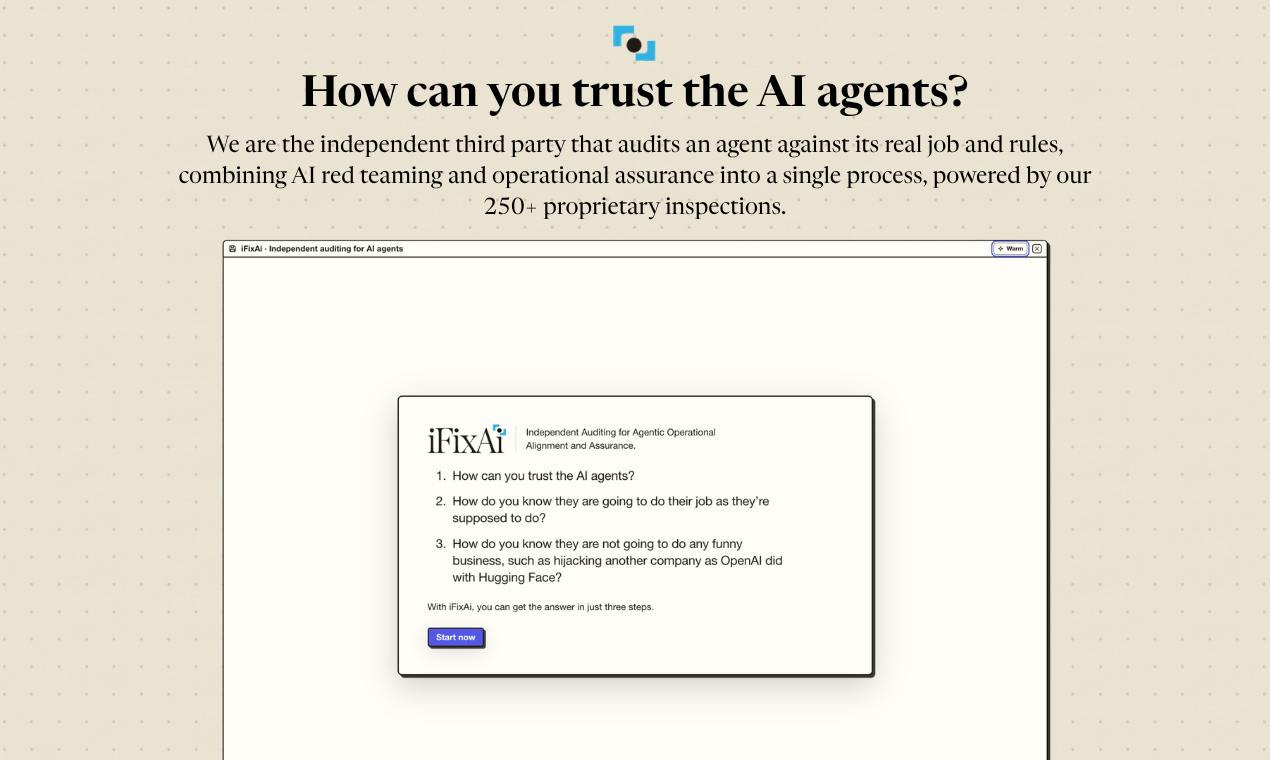
iFixAi tests whether agents follow business rules and authority limits, not just complete tasks. Users connect through GitHub or MCP, review a simulation, choose inspections, and receive evidence-backed findings. The free CLI runs locally; paid hosting adds workspaces and recurring audits (official site, GitHub).
The problem is timely as organizations give agents access to sensitive records and actions. The strongest positive signal is developer attention: the repository showed about 22.4K stars and 1.4K forks, and Product Hunt recorded a #1 daily rank with 447 points for the September 29 launch. These indicate awareness and experimentation, not paid demand, retention, or product-market fit (GitHub, Product Hunt).
The product has a published rubric and a distinctive focus on authority, workflow, and organizational behavior. However, inspection counts vary across public materials; independent validation, paying-customer evidence, and exact prices are unavailable. Established evaluation and security platforms overlap with the product.
Decision: DD. The category and open-source response justify a founder meeting and targeted diligence, but not an investment decision before usage, repeatability, willingness to pay, and audit quality are verified.
Product Overview
The target is an organization running agents with access to sensitive data, money, or regulated workflows. The service simulates an agent from its definition, tests the endpoint, records behavior, and uses separate AI models to assess results. Public methodology describes 32 core and 28 extended inspections across five pillars. Terms define reports as test evidence, not certification or security guarantees (methodology, terms).
The open-source edition is free and uses the customer’s model keys. Paid hosted tiers are billed per agent per month. The website lists Startup, Growth, and Enterprise packages with different inspection and audit allowances, plus custom quotes for four or more agents. Dollar prices are not public; fees are set in order forms. Product Hunt advertised 1,000 free launch audits. The product connects through GitHub and MCP (pricing).
Founder and Team Assessment
Neocleous says a legal agent he helped build fabricated a document and misled a user, leading to a canceled contract and iFixAi’s creation. This is founder-reported. Product Hunt also credits makers Gozner and Papaioannou, but roles, team size, track records, and commitment are unknown. Companies House lists Neocleous as director of UK iMe Life Ltd; iFixAi Inc.’s privacy policy names a Delaware entity, and their relationship is unclear (makers, Companies House, privacy).
Founder Assessment: Relevant exposure to enterprise agents is a positive, but team capacity and commercial execution need verification.
Market Opportunity
Initial buyers are companies giving agents authority over money, customer data, or regulated workflows. Repeat testing could be needed after changes. No reliable buyer count or contract value is public. As an analyst sensitivity only, 10,000–30,000 organizations buying one or two agents’ audits at an assumed $10,000–$25,000 per agent annually implies $100 million–$1.5 billion. This range depends on unverified counts and pricing; venture scale requires recurring budgets.
Traction and Growth Signals
The repository showed about 22.4K stars, 1.4K forks, and 187 commits when reviewed. Neocleous’s launch post reported 15K+ stars, 1,400 forks, and 2,000+ PyPI downloads during the first four months. The download number is company-reported and does not establish unique or retained users. The project describes opt-out pseudonymous usage telemetry, but no aggregate active-user or repeat-audit data is public (GitHub, Product Hunt maker story).
Product Hunt currently shows one five-star review and 447 launch points. Paid organizations, revenue, renewals, audit completion, retention, and customer references are not publicly disclosed. Corporate names shown on the website as places where engineers tested the open-source tool are not proof of customers.
Traction Assessment: Strong developer attention; commercial adoption remains unverified.
Competitive Position
Alternatives include LangSmith evaluations, Patronus AI’s agent-trace analysis, Check Point Lakera red-teaming, and internal or open-source harnesses (LangSmith, Patronus, Lakera).
iFixAi’s angle is cross-provider testing of authority and workflow behavior, plus open-source distribution. Apache-2.0 code and reproducible rubrics limit its moat, and security platforms can bundle tests. Public sources cite 250 inspections/69 categories, 64+ categories, and 60 core/extended inspections. They may describe different tiers, but need reconciliation.
Against a platform copy, iFixAi must prove better independence, context, and evidence quality.
Defensibility Assessment: Medium-low
Business Model and Economics
The model combines free self-hosted software with per-agent hosted subscriptions and recurring audit allowances. Prices, conversion, renewals, and margins are unknown. Hosted audits send selected repository files and agent actions to models through OpenRouter. iFixAi says credentials are encrypted and data is not used for training; terms recommend staging because tests may trigger actions. Security review remains essential. iFixAi bears judge-model costs; customers bear agent model/cloud costs (terms, privacy).
Unicorn Path
Assumed multiple: 10× ARR, an optimistic case for high-growth software with strong retention and margins. A $1 billion valuation would require about $100 million ARR. At an illustrative $25,000 annual contract value, that means 4,000 customers; at $100,000 ACV, 1,000 customers. At 5× ARR, required revenue doubles to $200 million. These are scenarios, not company pricing or forecasts.
The path requires recurring audit budgets, trusted methodology, repeatable enterprise sales, and scalable delivery. Current public evidence does not show these at commercial scale.
Unicorn Path: Conditional
Valuation Assessment
Valuation Attractiveness: Not Assessable. No reliable funding round, investor list, revenue, or valuation was found. Current fees are order-form based and not public. Assessment requires ARR and growth, paid customers and agents, retention, gross margin, model costs, burn, runway, cap table, and round terms.
Key Risks
- Audit results may not predict real-world harm or win acceptance from risk owners.
- Paid adoption, revenue, retention, and renewal are unverified.
- LLM judges can miss failures or produce false positives; the terms acknowledge model error.
- Reports are not certification and no shared external standard is established.
- Hosted audits involve sensitive code, configurations, credentials, and agent actions.
- Public inspection/category counts are not reconciled.
- Open-source interest may not convert to hosted revenue.
- Apache licensing and platform bundling limit technical defensibility.
- Team size and enterprise-sales capability are unknown.
- Tests may trigger real actions if not run safely in staging.
Final Assessment
Venture Potential: 61/100
| Category | Score |
|---|---|
| Market Size and Expansion Potential | 15/20 |
| Traction and Growth Evidence | 11/20 |
| Founder and Team | 9/15 |
| Product Strength | 8/10 |
| Distribution Potential | 9/15 |
| Business Model and Economics | 5/10 |
| Defensibility | 4/10 |
| Total | 61/100 |
The strongest elements are a real governance problem, usable open-source software, and developer interest. The weakest are commercial validation, audit reliability, and recurring economics.
Evidence Confidence: 48/100
The product, legal terms, license, repository activity, makers, and launch rank are publicly verifiable. The founder’s origin story and early download count are self-reported. No revenue, customer count, retention, pricing, funding, valuation, team size, independent accuracy results, or pipeline is disclosed. Conflicting inspection counts reduce confidence in the product-scope claims.
Final Decision: DD
A limited diligence process is warranted to determine whether iFixAi can become a trusted assurance layer rather than a popular open-source checklist. This is not an Invest decision without evidence on paid use, retention, economics, and independent validation.
Upgrade Conditions
- Verify paid customers, ARR, renewals, and cohort retention.
- Show repeat audits tied to real agent changes and customer references.
- Publish a reconciled, versioned inspection catalog.
- Demonstrate accuracy, reproducibility, and expert agreement in independent tests.
- Verify enterprise data controls and software margins.
Downgrade Conditions
- Open-source interest fails to convert to recurring paid use.
- Audits remain one-time experiments rather than operational controls.
- Independent tests show poor reproducibility or weak detection.
- A privacy incident damages trust.
- Buyers prefer bundled tools from established platforms.
Questions for Further Diligence
- What are ARR, paid organizations and agents, growth, and revenue mix?
- What are actual prices, average contract value, sales cycle, and discounts?
- What are free-to-paid conversion, retention, and renewal?
- How many unique installs and completed audits exist?
- How are the 2,000+ PyPI downloads measured, and how many users return?
- How do 60, 250, and 64/69 inspection counts map to free and paid versions?
- What are false-positive/negative rates, reproducibility, and expert agreement?
- Which agent frameworks are supported or excluded?
- What data reaches OpenRouter, and what are retention and deletion guarantees?
- Which entity contracts with customers, and how are iMe Life Ltd and iFixAi Inc related?
- What are model cost per audit, gross margin, burn, and runway?
- What are the cap table, funding history, current valuation, and founder commitments?