
Table of Contents
kōdlo — Venture Investment Report
| Company field | Assessment |
|---|---|
| Category | AI sales workspace / sales engagement software |
| Company Stage | Early commercial, pre-seed/seed-like (inferred; financing undisclosed) |
| Founder(s) | Not independently verified. Product Hunt names Ivan Telnov, Jakub Borkowski, and Andriana Oprysko as makers. |
| Headquarters | Warsaw, Poland (operator’s registered address) |
| Funding | No public funding round or amount identified |
| Business Model | Subscription SaaS: Starter $49/user/month; Pro $199/month for up to three seats; custom plans |
| Product Hunt Launch Date | 2026/10/11 |
| Report Date | 2026/10/14 |
| Investment metric | Assessment |
|---|---|
| Venture Potential | 56 / 100 |
| Unicorn Path | Conditional |
| Valuation Attractiveness | Not Assessable |
| Evidence Confidence | 48 / 100 |
| Final Decision | Watch |
Executive Summary
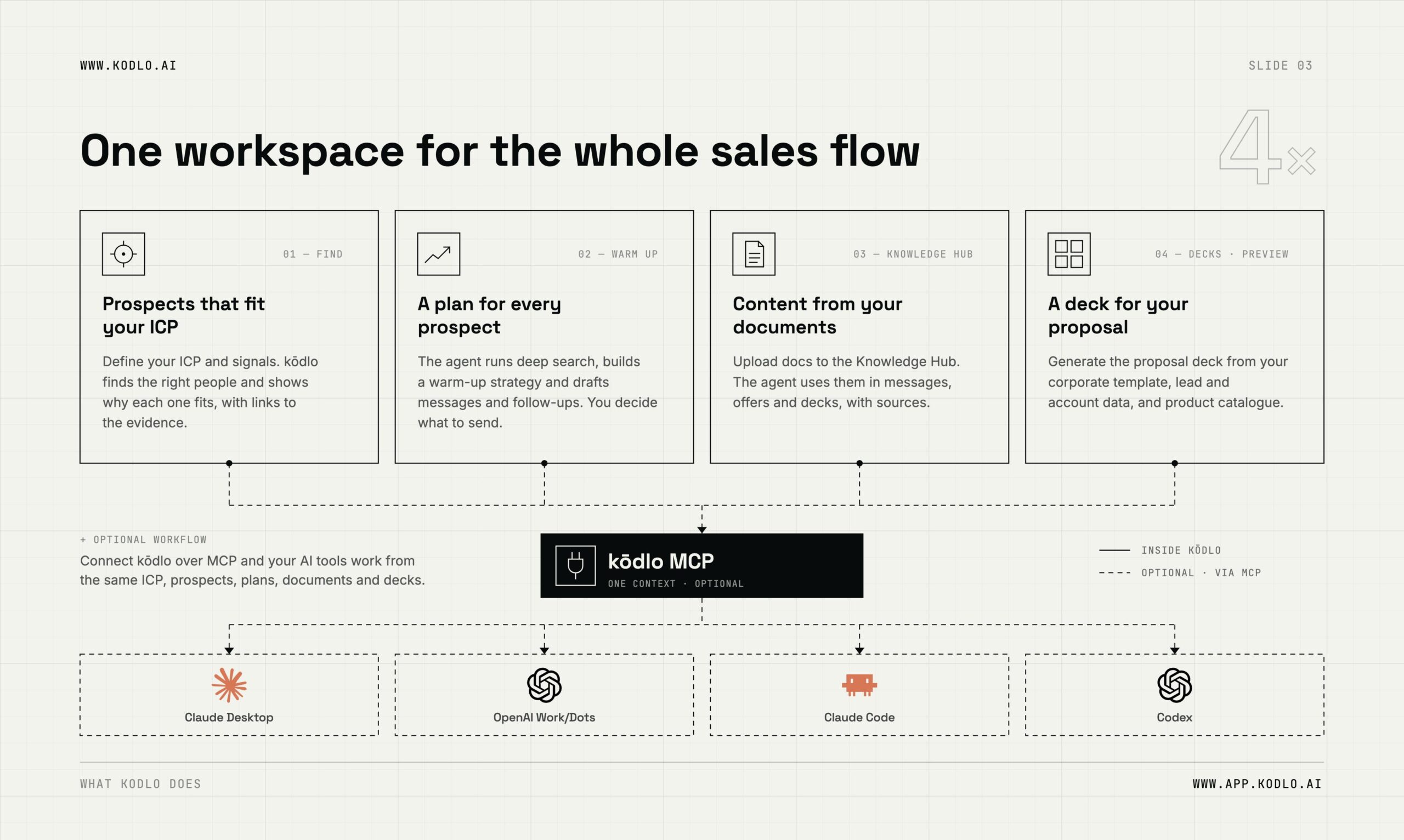
kōdlo is building an AI workspace for small teams selling complex B2B software and IT services. Its workflow combines ICP definition, prospect discovery, source-linked account research, outreach drafts, CRM records, and sales collateral.
The product has a live application and public pricing. The team says it built the product for its own sales and closed deals with it, but that statement is not independently verified or supported with customer and revenue metrics (Product Hunt launch page). Public pricing starts at $49 per month for one Starter seat and $199 per month for up to three Pro seats (official pricing).
The central question is whether kōdlo can become the system of record for a narrow sales motion, rather than an AI layer that incumbent CRMs and sales platforms can reproduce. Apollo offers AI prospecting agents; Clay combines data enrichment, research, and sequencing (Apollo agents, Clay plans). kōdlo’s integrated context and research-first approach may differentiate it, but no proprietary data or distribution advantage is evident.
No independently verifiable revenue, paid-customer count, retention, pipeline conversion, gross margin, CAC, financing, or valuation was found. The company’s internal-use claim merits testing through CRM records and customer references, but does not establish repeatable demand.
Recommendation: Watch. Revisit after kōdlo demonstrates paid usage, repeated weekly workflows, measurable customer outcomes, and retention beyond the launch cohort. Current evidence is insufficient to underwrite an investment at an unknown price.
Product Overview
kōdlo describes an end-to-end sales workspace: define an ICP, discover and qualify prospects, review research briefs with citations, draft outreach in the company’s tone, and retain contacts, campaigns, notes, and generated materials in one workspace (company website). Its plans list prospect finding, CRM/contact management, web research, OCR knowledge hub, Telegram and Google Chat connections, and ticketing. Pro adds collaboration, longer-term session memory, and higher usage limits (plan comparison).
The company says workspace data is not used to train models and core data is EU-hosted; those claims require technical and contractual validation before sensitive use (pricing, privacy policy).
Founder and Team Assessment
The operator is REINODE SOFTWARE sp. z o.o., registered in Warsaw. Product Hunt lists Ivan Telnov, Jakub Borkowski, and Andriana Oprysko as makers; one maker says kōdlo began as an internal sales tool. Public sources do not independently establish founder roles, ownership, prior startup outcomes, full-time team size, or hiring capacity (privacy policy, Product Hunt).
Founder Assessment: The team shows first-hand workflow exposure, but public evidence is too limited to assess founder-market fit or execution depth confidently.
Market Opportunity
The initial wedge—founder-led B2B software and IT-services teams selling considered purchases—is meaningful but narrower than the overall sales-software market. The U.S. Census reports 18,425 employer establishments in software publishing (NAICS 511210, 2023); this is a reference universe, not a count of eligible buyers, and it excludes nonemployers, other countries, and adjacent services firms (Census profile).
As a transparent scenario, assume 10%–30% of those establishments fit kōdlo’s ICP and would buy Pro. That implies about 1,843–5,528 accounts. At $199 monthly ($2,388 annualized), the segment would represent $4.4M–$13.2M in annual subscription revenue. The ICP filter is an analyst assumption, not measured demand; this estimates a narrow U.S. wedge, not total addressable market. Global and adjacent-market expansion could be larger but remains unproven.
Traction and Growth Signals
Product Hunt showed 288 points and marked kōdlo as launched that week. This is launch attention, not customer count or product-market fit (Product Hunt). A Starter discount and calls for feedback are consistent with early customer discovery. The team’s claim of internal use and closed deals is promising but lacks customer names, deal values, or outcome data (maker statements).
Key missing indicators are paid accounts, conversion, retention, customer outcomes, and gross margin.
Traction Assessment: Launch interest and internal-use claims are positive discovery signals; commercial traction and retention remain unverified.
Competitive Position
kōdlo overlaps with CRM, sales engagement, enrichment, research, and AI agents. Apollo’s agents discover prospects and recommend sequences from company context; Clay combines enrichment providers, AI research, and sequencing. Product Hunt also lists folk and Jeeva AI as alternatives (Apollo, Clay, alternatives).
kōdlo’s potential wedge is continuity: shared company knowledge, cited research, generated content, and deal history in one workspace. Its privacy positioning may appeal to EU customers, although its privacy policy says some AI, search, and storage subprocessors may operate outside the EU (privacy policy).
If the largest platform in this market launched the same feature within six months, why would customers continue using this product? The answer must be workflow fit, trusted research, accumulated context, and measurable outcomes—not foundation models alone.
Defensibility Assessment: Low. Workflow history could create switching costs, but no proprietary data, exclusive distribution, or network effect is visible.
Business Model and Economics
The offer is a seven-day trial, Starter at $49 monthly for one user, Pro at $199 for up to three users, and custom pricing for larger teams. Custom includes integrations, security/procurement options, onboarding, and BYOK (pricing). A fully occupied Pro workspace yields $2,388 annualized before VAT, discounts, churn, and usage expenses.
Research and agent costs could pressure margins unless quotas or BYOK contain usage. The terms describe quotas and custom-plan BYOK; diligence should compare plan caps with provider bills (terms). Custom work may raise contract values but also add services burden.
Unicorn Path
A $1B outcome requires expansion from a founder-led utility into a retained sales operating layer. Software Equity Group reported a 4.0x median EV/TTM revenue multiple for SaaS M&A in Q2 2026; this is a transaction reference, not a venture valuation rule (SEG report). At 4x revenue, $1B implies $250M annual revenue; at an aggressive illustrative 8x ARR, it still requires $125M ARR.
At $2,388 annualized per Pro workspace, those targets require roughly 104,690 or 52,345 fully paid workspaces, respectively, before discounts and churn. Custom contracts and expansion could reduce the customer count, but neither is evidenced today.
Unicorn Path Classification: Conditional. The path depends on proving a repeatable segment, then expanding into adjacent workflows, seats, and enterprise contracts.
Valuation Assessment
Valuation Attractiveness: Not Assessable. No round terms, post-money valuation, cap table, or financing history was found. Attractiveness requires price, dilution, preferences, and ownership data; the sector multiple above is only context.
Key Risks
- Unproven demand: no public paid-customer, retention, or conversion data.
- Incumbent bundling: CRM and sales platforms can add similar agents with better distribution.
- Weak data moat: prospecting depends on third-party data, search, and models.
- Unit economics: research usage may exceed subscription revenue.
- Channel/compliance exposure: outreach depends on email and LinkedIn policies, deliverability, and privacy rules.
- Accuracy and trust: bad research or messages can damage a seller’s reputation.
- Security: sales workspaces hold sensitive customer and pipeline data; subprocessors require review.
- Team/key-person risk: roles, team size, and execution capacity are unclear.
- Services creep: custom integrations and onboarding may reduce SaaS margins.
Final Assessment
| Factor | Score |
|---|---|
| Problem intensity and product relevance | 14 / 20 |
| Market size and expansion potential | 12 / 20 |
| Differentiation and defensibility | 9 / 20 |
| Traction and product-market-fit evidence | 5 / 20 |
| Team, economics, and execution evidence | 16 / 20 |
| Venture Potential | 56 / 100 |
Evidence Confidence: 48 / 100. Operator, product scope, pricing, and launch are visible; adoption, retention, margins, founder credentials, funding, and valuation are not independently documented.
Final Decision: Watch.
Upgrade conditions: verify 20–30 paying teams across cohorts; 90-day logo retention above 80%; customer references showing measurable time or pipeline gains; gross margin above 70%; and a clear data/compliance posture.
Downgrade conditions: weak launch-cohort conversion or weekly use, high research cost, dependence on manual services, or unresolved data concerns.
Due Diligence Questions
- How many paying companies and active seats exist, excluding the founding team?
- What are trial conversion, 30/90/180-day retention, and net revenue retention?
- Can three customers quantify time saved, meetings, or pipeline versus prior tools?
- What is gross margin by plan after model, search, storage, and support costs?
- Which prospect-data sources and outreach integrations are licensed, and what if terms change?
- How are hallucinated or stale research claims detected and corrected?
- Where does customer data go across models and subprocessors, and what deletion terms apply?
- What funding, runway, valuation, and security terms are being offered?
- How much custom-plan revenue requires implementation or ongoing services?
- What usage caps prevent high-volume accounts from becoming unprofitable?
Sources
- Official website
- Pricing
- Privacy policy
- Terms of use
- Product Hunt launch and maker statements
- Product Hunt alternatives
- U.S. Census software-publisher profile
- Apollo agent documentation
- Clay pricing
- SEG quarterly SaaS report
Conclusion
kōdlo addresses a real workflow problem and merits monitoring. Maintain Watch pending evidence of retention, attractive unit economics, and financing terms.