
Table of Contents
- Semos.ai Manager Agents Investment Report
Semos.ai Manager Agents Investment Report
Category: Enterprise HR technology / AI management enablement
Company Stage: Established HR-tech parent; product-specific stage not disclosed
Founder or Founders: Filip Misovski, identified as Semos.ai CEO and founder
Headquarters: Lewisville, Texas (legal head office); Semos Cloud also lists Skopje, North Macedonia
Funding: No reliable public round, investor list, or valuation found
Business Model: Credit-limited individual subscriptions and custom-priced enterprise deployments
Product Hunt Launch Date: September 29, 2026 (spreadsheet date, confirmed by Product Hunt archive)
Report Date: October 8, 2026
| Investment Metric | Assessment |
|---|---|
| Venture Potential | 57/100 |
| Unicorn Path | Conditional |
| Valuation Attractiveness | Not Assessable |
| Evidence Confidence | 53/100 |
| Final Decision | Watch |
Executive Summary
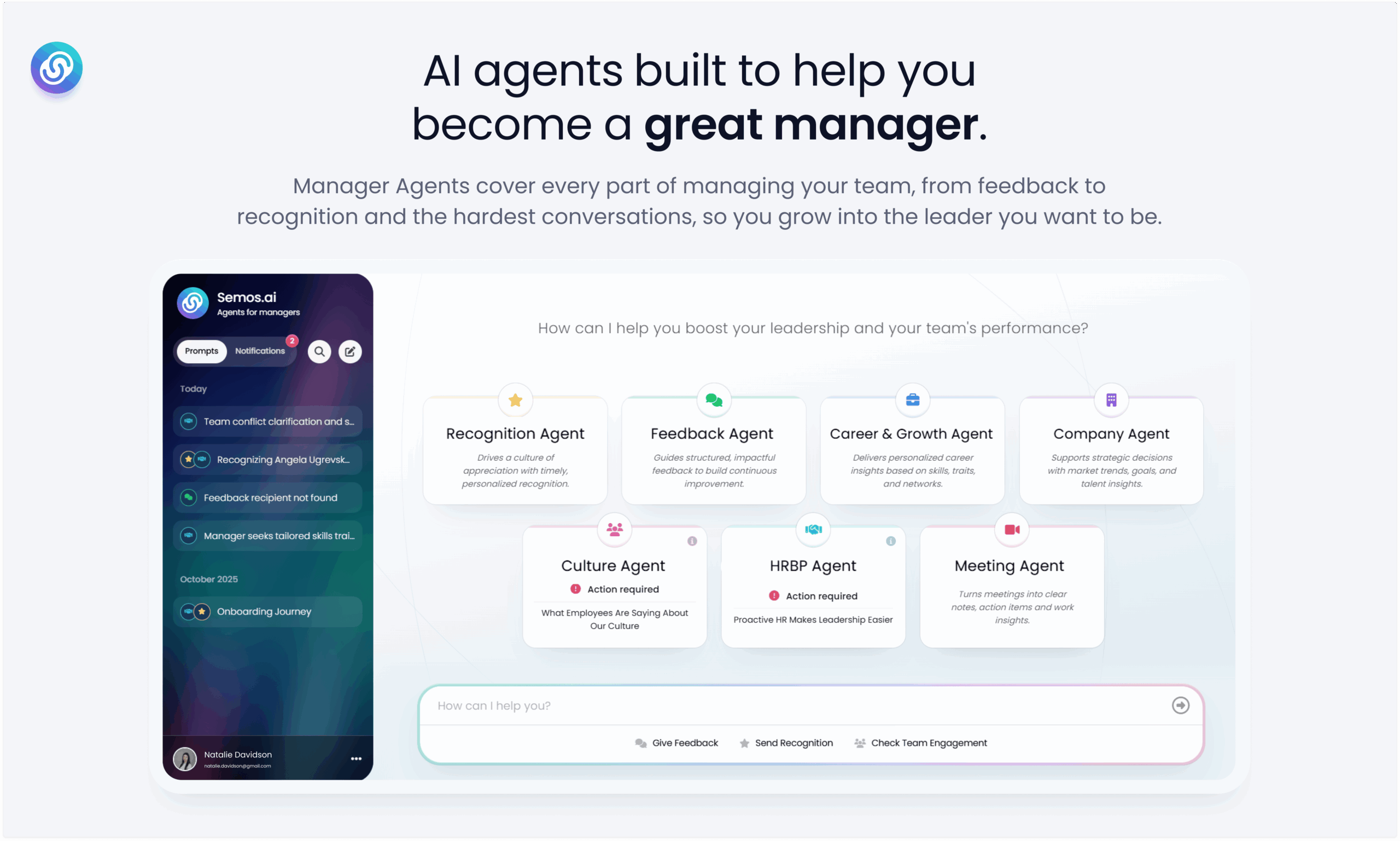
Semos.ai Manager Agents uses meeting and work context to prompt managers about feedback, recognition, difficult conversations, follow-up, and employee development. It targets managers with limited HR support and offers an enterprise version connected to HR systems. Its ambition is to turn context across conversations into action, not just summarize meetings.
The strongest positive is Semos Cloud’s decade-plus HR-tech experience and enterprise relationships. The parent reports 150+ enterprise deployments and SAP, Workday, and Oracle partnerships, plus pilot results for a Recognition Agent. These are parent-company claims, not proof of paid users or retention for this self-serve product. Company profile · 2025 review
Plans are listed at $39 and $69 monthly, but product-specific revenue, paid conversion, usage, retention, customer references, and margin are not disclosed. Product Hunt ranked it fifth on September 29 with 216 points—launch interest, not product-market fit. Product Hunt archive
The key question is whether managers and employers will repeatedly trust an agent handling sensitive employee conversations, instead of existing HR platforms or general AI. With commercial validation and financing terms unknown, Watch is appropriate pending retention, paid-seat, enterprise-conversion, and privacy evidence.
Product Overview
The problem is managerial follow-through: commitments, recognition, and feedback get scattered across meetings and notes. The Meeting Agent transcribes and extracts topics, decisions, owners, and deadlines; Feedback, Recognition, HRBP, and Culture agents use shared context to suggest actions and wording. The company says signals may include calendars, meetings, public work tools, and check-ins; exact live self-serve connectors need verification. How it works · Product Hunt
The web product has Free ($0, 250 credits/30 days, about 5–10 “moments”), Pro ($39, 500 credits, about 15–20), and Power ($69, 1,000 credits, about 30–40); 100 extra credits cost $15. Custom Enterprise Connected Mode lists SAP SuccessFactors/Workday, SSO/SCIM, Google and Microsoft 365 data, analytics, and deployment support. Pricing
It replaces manual notes, reminders, HRBP consultation, and generic AI prompts. Value must mean fewer missed commitments or better people management—not simply a useful answer. No public App Store listing or open GitHub repository was located.
Founder and Team Assessment
Semos.ai names Filip Misovski as CEO and founder. Semos Cloud lists leaders across technology, operations, engineering, marketing, and customer success. The parent says it launched enterprise recognition software in 2014 and expanded into employee communications, listening, and talent development. This suggests relevant domain experience, but public evidence on Misovski’s prior exits, commitment to this product, and its dedicated team is limited. The parent reported 26 hires in 2025, not Manager Agents team size. Founder announcement · Leadership
Founder Assessment: Strong apparent HR-tech fit through the parent; product-specific team capacity and execution remain unverified.
Market Opportunity
The initial user is a manager with several direct reports who needs help preparing and following through on 1:1s; the enterprise buyer is HR leadership. Pricing tests willingness to pay at $39–$69 monthly, but addressable seats and enterprise price are unknown. Expansion could include reviews, HR knowledge, training, and people analytics.
A scenario, not TAM: $39/month equals $468 annualized per Pro seat before discounts, churn, payment costs, and AI expense. About 214,000 seats would be needed for $100M ARR; at 500 managers per organization, roughly 428 customers. Semos Cloud reports 150+ enterprise deployments but no Manager Agents conversions or seat counts. Enterprise pricing could raise revenue per account, but adoption and attach rates are unproven. The market may support scale; a repeatable path to hundreds of deployments is not yet evidenced.
Traction and Growth Signals
Product Hunt records a September 29, 2026 launch, fifth place, and 216 points. This is attention, not proof of customers, satisfaction, or retention; there is no substantial independent review base. Product page · Leaderboard
There is a timing ambiguity: Product Hunt presents a 2026 launch, while Semos Cloud’s December 2025 review says Manager Agents were introduced through Semos.ai in 2025 and describes early deployments. Enterprise pilots may predate the self-serve launch, but the milestones are unreconciled. The review claims pilot Recognition Agent users saved three hours weekly and quality scores rose 40%; no sample or methodology is disclosed. This is not independently verified commercial traction for the PH product.
No product-specific revenue, paid users, active usage, conversion, retention, growth, margin, or customer references were found. Parent deployments are possible distribution, not product traction. Traction Assessment: Positive launch and parent context, commercially unverified.
Competitive Position
Culture Amp’s AI Coach uses engagement and performance data for coaching and review support; BetterUp sells AI-enabled manager development. Both have enterprise distribution and can bundle adjacent features. Substitutes include Microsoft 365 Copilot, general AI, meeting-note products, HR business partners, training, and manual notes. Culture Amp · BetterUp
Semos.ai’s potential edge is cross-meeting context, specialized agents, and Semos Cloud HR integrations. But proprietary-data rights, switching costs, network effects, and better outcomes are not established; sensitive data may impede adoption.
“If the largest platform launched the same feature within six months, why would customers stay?” The answer must be demonstrated through superior follow-through, trusted integration, measured outcomes, and governance—not specialized prompts alone.
Defensibility Assessment: Medium-low.
Business Model and Economics
Self-serve subscriptions are per manager and credit-limited; Enterprise is custom-priced. Pro is $468 annualized and Power $828 at list price. Free can lower trial friction, but “moments” do not prove renewal or value. Enterprise may raise contract values, while sales cycles and deployment burden are unknown.
Margins depend on transcription, inference, storage, and support per active seat; none are disclosed. Credit metering could align price with use, but frequent meeting analysis could raise costs. Customer acquisition and conversion are unknown. Verify contribution margins by plan and enterprise deployment economics before assuming scalable SaaS margins.
Unicorn Path
At an illustrative 10x ARR for high-growth SaaS, a $1B valuation implies $100M ARR; this is an assumption, not company valuation. That requires about 214,000 Pro-equivalent seats at $39/month or 121,000 Power seats at $69, before discounts and churn—roughly 242–428 organizations at 500 seats each.
A path is conditional on converting parent relationships into paid deployments, proving repeatable sales, expanding internationally, and raising contract value while preserving margins and privacy. The parent’s deployments do not establish these conversions. Unicorn Path: Conditional.
Valuation Assessment
No reliable public funding, investors, round, valuation, revenue, or fundraising status was found for Semos.ai/Semos Software LLC. Its terms identify Semos Software LLC as provider and say enterprise subscriptions use separate agreements. Parent scale cannot establish this product’s valuation. Valuation Attractiveness: Not Assessable. Required data: product ARR/growth, retention, margin, burn/runway, cap table, round size, and terms. Terms
Key Risks
- Employee privacy/consent: Inputs may include audio, communications, files, and third-party employee data. The policy describes legitimate-interest processing and an objection right; terms place permission responsibility on users. Verify consent, retention, deletion, subprocessors, and employee rights. Privacy · Terms
- Trust and employment impact: Biased or incorrect coaching could affect feedback; terms disclaim accuracy and bias-free output.
- Missing traction: Parent customers and pilot claims do not establish product revenue or retention.
- Bundling: Culture Amp, BetterUp, HRIS vendors, and general AI can replicate adjacent features.
- Adoption friction: Employees, legal teams, works councils, or IT may resist analysis of 1:1s.
- AI economics: Transcription and inference may erode margins; cost data is absent.
- Enterprise execution: Integrations may lengthen procurement and add services costs.
- Unclear maturity: 2025 pilots and the 2026 public launch are unreconciled.
Semos Cloud’s security page claims ISO 27001, encryption, and enterprise controls; verify certification scope for standalone Semos.ai. Security
Final Assessment
Venture Potential: 57/100
| Category | Score |
|---|---|
| Market Size and Expansion Potential | 14/20 |
| Traction and Growth Evidence | 3/20 |
| Founder and Team | 11/15 |
| Product Strength | 8/10 |
| Distribution Potential | 9/15 |
| Business Model and Economics | 7/10 |
| Defensibility | 5/10 |
| Total | 57/100 |
Strengths are a concrete workflow, recurring-use potential, relevant HR-tech experience, and possible enterprise distribution. Weaknesses are absent product-specific proof, sensitive-data adoption risk, and bundleable capabilities.
Evidence Confidence: 53/100
Public sources identify the product, CEO/founder, legal entity, pricing, ranking, and parent history. Pilot results and deployments are company-reported, not independently audited. Seat counts are analyst arithmetic. Revenue, usage, retention, margin, dedicated team size, funding, and valuation are unavailable; launch timing is unresolved.
Final Decision: Watch
The product merits monitoring, not formal DD or investment yet. The paid offer is testable, but usage, retention, enterprise conversion, unit economics, and financing terms are unknown. Valuation cannot be assessed.
Upgrade Conditions
Upgrade to DD after 90-/180-day paid-seat retention, repeat weekly usage, meaningful free-to-paid conversion, and referenceable enterprise deployments with live seat counts. Require measured outcomes, inference-adjusted margins, consent/deletion controls, and reconciliation of launch milestones.
Downgrade Conditions
Move to Pass if conversion or retention is weak, managers stop using it, employers reject meeting-data capture, or costs prevent attractive margins. Reassess negatively if pilot claims cannot be substantiated or material privacy/security issues emerge.
Questions for Further Diligence
- What are product ARR/MRR, growth, paid seats, and free-to-paid conversion?
- What are 30-, 90-, and 180-day retention and weekly active rates?
- How many enterprise customers and live seats use Manager Agents? Can we speak with three?
- How do the 2025 deployments differ from the 2026 public launch?
- What sample and methodology support the pilot savings and quality claims?
- Which meeting connectors are live versus roadmap?
- How are consent, employee objections, deletion, retention, and data transfers handled?
- Which LLM/transcription vendors receive content, and what are their retention/training terms?
- What are inference, transcription, support costs, and gross margin by plan?
- What are burn, runway, cap table, financing status, and round terms?
- What dedicated team owns the product, and what resources are shared with Semos Cloud?
- What advantage remains if HR or productivity platforms bundle similar agents?