
Table of Contents
Wisry Investment Report
Category: AI advertising creative and campaign automation
Company Stage: Early commercial / product launch; financing stage not publicly disclosed
Founder or Founders: Ruta Jaskunaite is identified as a co-founder; complete founding structure not publicly verified
Headquarters: Not publicly disclosed
Funding: Not publicly disclosed
Business Model: Credit-based SaaS subscription with usage top-ups; higher-volume plans referenced
Product Hunt Launch Date: September 11, 2026
Report Date: September 14, 2026
| Investment Metric | Assessment |
|---|---|
| Venture Potential | 56/100 |
| Unicorn Path | Conditional |
| Valuation Attractiveness | Not Assessable |
| Evidence Confidence | 38/100 |
| Final Decision | Watch |
Executive Summary
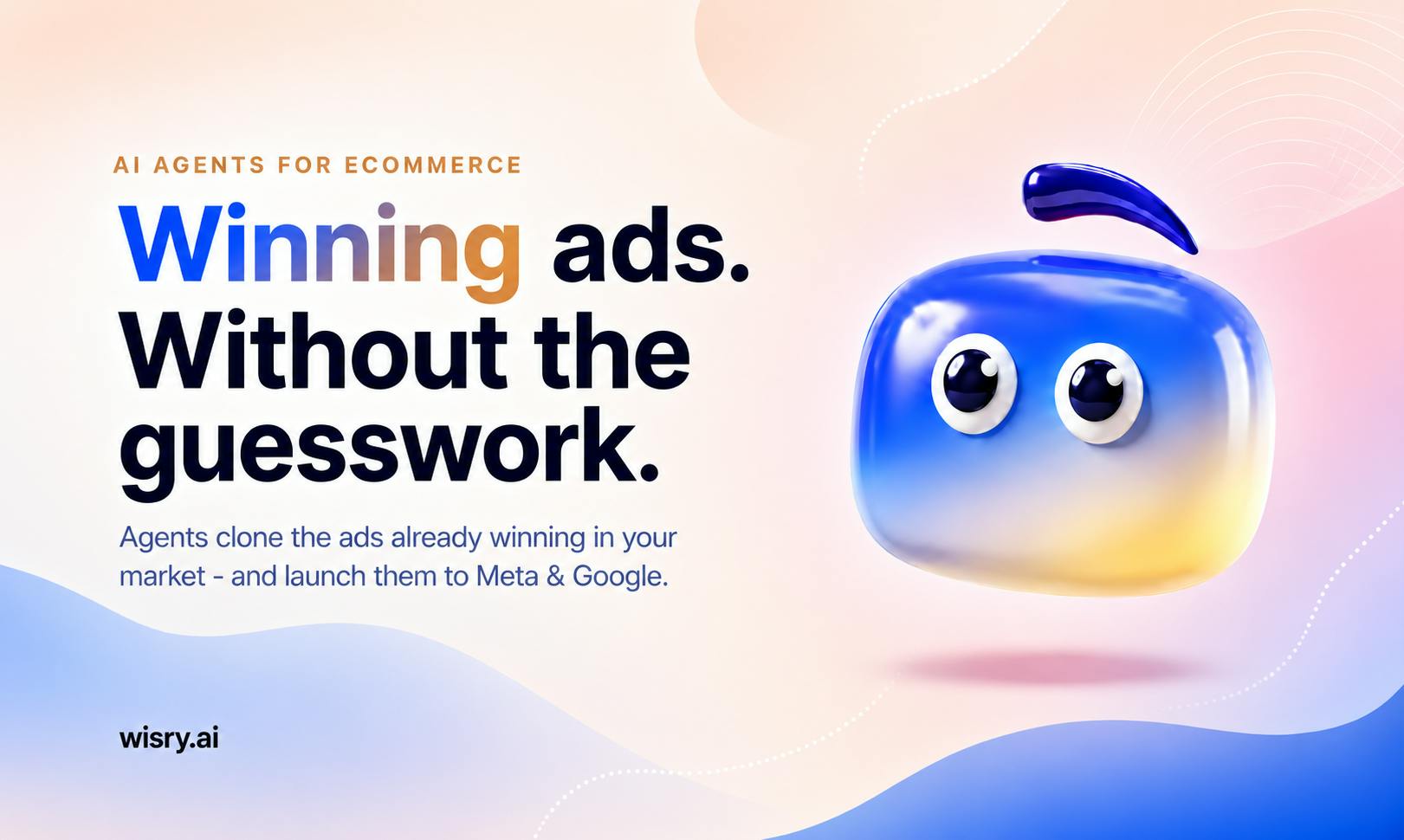
Wisry is an AI advertising platform for direct-to-consumer ecommerce brands and agencies. Its agents examine competitor advertising in Meta and TikTok libraries, infer persistent formats and messages, generate branded static and video variants, and help launch approved campaigns to Meta and Google (official website; Product Hunt).
The product is interesting because it combines several workflows—competitive research, creative strategy, image and video generation, and campaign deployment—rather than offering only another AI image or avatar generator. The current $99 introductory subscription includes 2,000 monthly credits, sufficient for a representative mixture of videos, static ads, and research runs (pricing).
The strongest investment signal is market validation from adjacent companies. Creatify reports reaching $9 million ARR, 1.5 million users, and more than 10,000 teams before raising a $15.5 million Series A; these figures are company-reported but indicate that AI ad-production software can support meaningful recurring revenue (Creatify announcement).
The principal concern is that Wisry’s core signal—identifying “winning” competitor ads—may often be inferred from ad longevity, variant counts, visibility, and public engagement rather than verified competitor ROAS. Public advertising libraries do not generally provide complete conversion economics for every commercial advertiser. Consequently, the quality of Wisry’s ranking methodology and the claimed training exposure to more than $1 billion of ad spend require direct validation.
Product quality appears promising, but company quality is difficult to assess because revenue, retention, customers, funding, legal entity, team structure, and founder commitment are not disclosed. The decision is Watch, with an upgrade to DD dependent on verified customer economics and evidence that Wisry improves campaign outcomes rather than merely increasing creative volume.
Product Overview
Wisry targets ecommerce operators that need frequent ad variations but cannot continuously hire agencies, creators, editors, and media buyers. The existing workflow involves manually searching public ad libraries, preparing briefs, sourcing footage, producing variations, uploading assets, and monitoring performance.
A user provides a store URL and competitor context. Wisry’s agents then research available Meta and TikTok advertising, identify recurring hooks and formats, propose evidence-linked angles, and generate branded static or video creatives. Users retain approval over what is launched, and the product supports connected Meta and Google campaign workflows (pricing).
The current Studio plan costs an introductory $99 per month, versus a stated regular price of $199. It provides 2,000 monthly credits. Published consumption rates are six credits per static ad and 68, 135, or 270 credits for approved 15-, 30-, or 60-second videos. Additional credits can be purchased and expire after 365 days (pricing).
The product is browser-based. No native mobile or desktop application was identified. The principal benefit is faster research-to-launch cycles and more creative tests per campaign—not guaranteed ROAS. Wisry itself explicitly states that results depend on the offer, audience, budget, and market.
Product-quality assessment: A coherent end-to-end workflow with clear operational value, but output quality and performance uplift remain insufficiently independently tested.
Founder and Team Assessment
Ruta Jaskunaite identifies herself as a Wisry co-founder on Product Hunt. The launch team also includes Fardad Zand and Jonno Riekwel (Product Hunt). LinkedIn associates Fardad Zand, engineering leader Mohammad Mahini, and Chief Product Officer Kasra Vafaey with the company (Wisry LinkedIn).
Public profiles suggest potentially relevant investing, product, engineering, and previous startup experience. However, exact roles, employment status, equity ownership, time commitment, and responsibility for the current product were not verified. LinkedIn presents a sparse company profile with only two associated members while search results identify additional personnel, making team size unreliable.
No public hiring page, technical publications, model documentation, previous Wisry operating record, or verified exit linked to the founding team was found. The website’s privacy policy identifies the service only as “Wisry” and does not disclose the underlying legal entity or jurisdiction (privacy policy).
Founder Assessment: Relevant-looking product and technical capabilities, but leadership structure, commercial track record, and full-time commitment require verification.
Market Opportunity
The narrow initial customer is a DTC brand or performance-marketing agency spending enough on Meta, TikTok, or Google advertising to need weekly creative testing. This excludes ecommerce stores that do not run paid acquisition or lack sufficient spend to measure creative performance.
As an analyst scenario, assume 100,000–300,000 globally reachable brands and agencies with both recurring paid-social budgets and willingness to pay approximately $1,200 annually. That implies a narrow serviceable market of approximately:
100,000–300,000 customers × $1,200 = $120 million–$360 million annual revenue.
This is an analytical range, not a verified customer count. The opportunity expands if Wisry can sell multi-brand agency accounts, enterprise campaign governance, API access, media optimization, additional ad networks, or usage-based generation.
Timing is favorable because video-ad production costs are falling and brands need more format-specific assets. Conversely, the same model improvements make basic creative generation widely available, including inside advertising platforms themselves. Google already provides AI-generated images, videos, headlines, asset resizing, and campaign-level creative enhancements (Google Ads documentation).
The market can support a venture-scale business, but likely only for vendors that own performance feedback loops, enterprise workflows, or differentiated distribution—not generation alone.
Traction and Growth Signals
Wisry launched on Product Hunt on September 11, 2026. Its page showed 538 followers, but the launch was marked as a paid or promoted placement, and no reliable organic daily ranking or vote count was established (Product Hunt; daily leaderboard).
The company’s LinkedIn page showed only 26 followers as of its captured September profile and relatively low engagement on July–August product posts (LinkedIn). This is consistent with an extremely early product, not sustained commercial traction.
One Trustpilot review claims more than 40% lower customer-acquisition cost and describes the product favorably, while criticizing video-generation expense. It is marked “unprompted” but not established as a verified purchase; one review is insufficient evidence of repeatable results (Trustpilot).
No reliable public information was found for revenue, customer count, paid conversion, active users, retention, ad spend managed, campaign volume, independently verified ROAS improvement, or enterprise contracts.
Traction Assessment: Product is commercially accessible, but traction and outcome improvements remain unverified.
Competitive Position
Direct competitors include Creatify, AdCreative.ai, Arcads, Zeely, and Omneky. Creatify is particularly close: its $99 Pro plan includes competitor-ad tracking, ad cloning, AI actors, automation, campaign launching, and multiple brand spaces (Creatify pricing). This significantly overlaps with Wisry’s product and price point.
Indirect alternatives include creative agencies, freelance editors, in-house media buyers, public Meta and TikTok research tools, and generic image/video models. TikTok itself provides high-performing ad discovery through its Top Ads dashboard and offers commercial-content data including publication dates, last-seen dates, targeting, and reach for available jurisdictions (TikTok Top Ads; Commercial Content API).
Wisry’s differentiation is the connected research-to-creation-to-launch workflow, with source citations attached to creative concepts. However, “winning” is not necessarily observable from public libraries. An ad’s longevity can indicate continued spend, but it does not prove profitability, incrementality, or suitability for another brand.
If Meta, Google, or Creatify launched the same research-and-remix workflow within six months, customers would stay only if Wisry possessed proprietary cross-customer performance data, materially better creative ranking, or superior campaign automation. None is publicly demonstrated.
Defensibility Assessment: Low to Medium
Business Model and Economics
Wisry earns subscription and credit top-up revenue. At the introductory price, base annual contract value is approximately $1,188; at the stated regular price, it would be approximately $2,388, excluding top-ups.
The credit structure helps align revenue with variable costs. Video generation is materially more credit-intensive than static creation, suggesting an attempt to protect margins against model-provider expense. However, gross margin cannot be assessed without the cost per generated minute, regeneration rate, provider mix, storage, support burden, and top-up behavior.
The privacy policy says Wisry processes prompts, uploaded files, workflows, and generated media and may use anonymized information to train proprietary algorithms where permitted. It also uses third-party hosting, analytics, payment, and marketing providers (privacy policy). Enterprise customers may require clearer data-isolation terms, security certifications, IP indemnification, and controls over model training.
The most valuable expansion revenue would come from multi-brand agency plans, campaign-management fees, APIs, or enterprise contracts. No marketplace or transaction revenue is currently evident.
Unicorn Path
Assume an 8× ARR multiple, reflecting a competitive AI SaaS category with potentially attractive growth but meaningful inference costs and platform dependency.
Required ARR = $1 billion ÷ 8 = approximately $125 million.
At the introductory $1,188 annual subscription:
$125 million ÷ $1,188 ≈ 105,000 subscribers.
At the regular $2,388 annual subscription:
$125 million ÷ $2,388 ≈ 52,000 subscribers.
That is demanding relative to the estimated narrow market and would require substantial international adoption. A more credible route would combine several thousand agencies and larger brands at materially higher annual contracts with a broad self-service base.
Necessary strategic developments include proprietary performance feedback, multi-client agency controls, enterprise security, additional ad platforms, API revenue, repeatable paid or partner distribution, and gross margins above approximately 70% after generation costs.
Unicorn Path: Conditional
Valuation Assessment
No reliable funding history, investors, round terms, valuation, or current fundraising status were found.
Creatify’s reported $15.5 million Series A and $9 million ARR demonstrate investor interest in the category, but they do not establish a valuation for Wisry because Wisry’s revenue and growth are unknown (Creatify announcement).
Valuation Attractiveness: Not Assessable
Assessment requires verified ARR, growth, retention, gross margin, burn, runway, financing amount, SAFE cap or post-money valuation, investor ownership, and liquidation preferences.
Key Risks
- No verified revenue, retention, customer count, or campaign-performance evidence.
- Core “winning ad” classifications may rely on imperfect public proxies rather than ROAS.
- Heavy feature overlap with better-capitalized competitors, particularly Creatify.
- Meta and Google can bundle generation and optimization into their ad platforms.
- Low switching costs unless Wisry accumulates proprietary performance data.
- Video-generation and regeneration costs may constrain gross margin.
- Copyright, trade-dress, platform-policy, and reputational risk around “cloning” ads.
- Unverified $1 billion ad-spend training claim and unclear provenance of that dataset.
- Unclear legal entity, founder responsibilities, team size, and commitment.
- Sensitive customer assets and campaign information create enterprise privacy requirements.
Final Assessment
Venture Potential: 56/100
| Category | Score |
|---|---|
| Market Size and Expansion Potential | 17/20 |
| Traction and Growth Evidence | 5/20 |
| Founder and Team | 7/15 |
| Product Strength | 8/10 |
| Distribution Potential | 7/15 |
| Business Model and Economics | 7/10 |
| Defensibility | 5/10 |
| Total | 56/100 |
The strongest elements are a real customer pain point, clear pricing, and an end-to-end product in a validated market. The weakest are unverified traction, methodological uncertainty around “winning” ads, and substantial competitive duplication.
Evidence Confidence: 38/100
Product capabilities, pricing, credit consumption, public launch activity, and privacy practices are documented. Founding roles and the $1 billion training claim are company-reported. Market size and unicorn customer requirements are analyst estimates. Revenue, growth, retention, funding, gross margin, team size, legal entity, and valuation remain unavailable.
Final Decision: Watch
Wisry is more developed than a simple product concept, but its current public evidence does not justify formal investment due diligence. The venture case depends on proving that its recommendations improve paid-ad economics and that customers retain the service after initial creative experiments.
Upgrade Conditions
- Verified $1 million ARR or comparable sustained commercial scale.
- More than 70% six-month logo retention.
- Gross margin above 70% after video-generation costs.
- Controlled customer studies showing statistically credible CAC or ROAS improvement.
- At least 50 referenceable brands or agencies with recurring usage.
- Proprietary campaign-performance feedback unavailable to basic generation competitors.
- Verified team, legal entity, cap table, and financing terms.
Downgrade Conditions
- Customers use Wisry only for one-off generation and churn rapidly.
- Public-library signals fail to predict campaign performance.
- Competitors or ad platforms replicate the research workflow.
- Video costs require economically unattractive pricing.
- Material IP complaints or advertising-platform restrictions.
- Misleading claims concerning training data or customer outcomes.
Questions for Further Diligence
- What are current MRR, paying customers, and monthly revenue growth?
- What are 30-, 90-, and 180-day logo and revenue retention?
- How many generated ads are ultimately launched and repeatedly used?
- How does Wisry determine that a competitor ad is “winning” without private ROAS data?
- What evidence supports the claim of training on more than $1 billion of ad spend?
- What customer experiments show incremental CAC or ROAS improvement?
- What are gross margin and inference cost by static, 15-, 30-, and 60-second video?
- What are customer-acquisition cost, payback period, and primary acquisition channels?
- Who are the founders and full-time employees, and how is equity divided?
- What are burn, runway, current round size, valuation, and financing terms?
- What IP reviews and safeguards prevent generated ads from copying protected expression?
- What performance data can Wisry legally retain and use to build a proprietary feedback loop?