
Table of Contents
Olostep Investment Report
Category: Developer infrastructure; web-data APIs for AI agents
Company Stage: Early stage / commercial product
Founder or Founders: Hamza Ali and Arslan Ali
Headquarters: Dover, Delaware, according to the company’s LinkedIn page; both founders list San Francisco
Funding: Vento portfolio investment confirmed; amount and financing terms not publicly disclosed
Business Model: Usage-based API subscriptions, prepaid credits, and custom enterprise contracts
Product Hunt Launch Date: August 30, 2026
Report Date: September 2, 2026
| Investment Metric | Assessment |
|---|---|
| Venture Potential | 63/100 |
| Unicorn Path | Conditional |
| Valuation Attractiveness | Not Assessable |
| Evidence Confidence | 58/100 |
| Final Decision | Watch |
Executive Summary
Olostep provides APIs for searching, scraping, crawling, monitoring, and structuring public web data. Its principal customers are AI-product teams, developers, data teams, and workflow-automation platforms that would otherwise maintain browsers, proxies, parsers, and retry infrastructure internally. The product includes Python and JavaScript SDKs, an MCP server, a command-line interface, and integrations with automation frameworks (official website; documentation).
Product quality appears promising. Olostep presents a broad, coherent API surface rather than a single scraping endpoint, including batch jobs, maps, cited answers, monitoring, structured extraction, and AI research agents. Public SDKs and documentation provide tangible evidence that the product is operational. However, performance, reliability, and cost-advantage claims remain largely company-reported rather than independently benchmarked.
The strongest investment signal is embedded distribution. Olostep reports that Gumloop uses it behind Gumloop’s default web-data node, with billing and API-key management handled at the platform level. If verified through the customer, this is strategically more meaningful than a logo or testimonial because one integration can aggregate demand from many downstream users (Gumloop case study).
The central concern is missing commercial evidence. Revenue, growth, request volume, paying-customer count, retention, gross margin, concentration, burn, and current financing terms are not publicly disclosed. Product Hunt recognition—daily #3 and “Launch of the Day” on August 30—shows launch interest, not product-market fit (Product Hunt awards).
The company could become venture-scale if platform integrations produce repeatable high-volume revenue and if Olostep can defend reliability and economics against established web-data platforms. At present, the correct decision is Watch, with an upgrade to DD contingent on verified revenue, retention, gross margin, and customer references.
Product Overview
Olostep addresses the operational burden of obtaining reliable, structured web data. The alternative is typically an internal stack combining browser automation, proxy rotation, CAPTCHA handling, crawling, parsing, storage, retries, and monitoring—or another managed data provider.
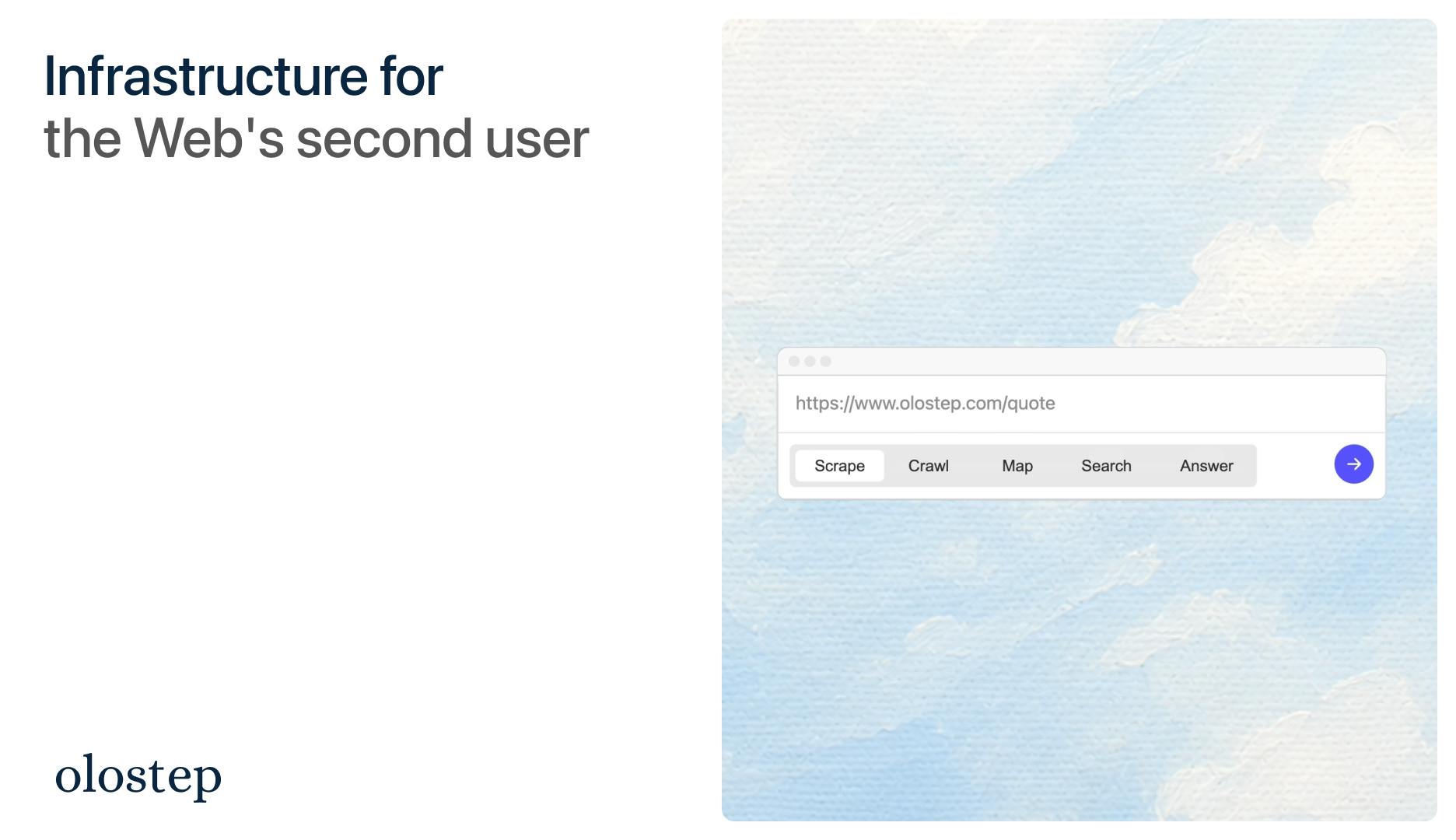
The product converts URLs into Markdown, HTML, text, screenshots, PDFs, or structured JSON. It also discovers URLs, crawls sites, processes batches, conducts web searches, produces cited answers, and monitors pages for changes. The official site says batch jobs can contain up to 10,000 URLs; its SDK examples demonstrate typed clients and asynchronous workflows (official website; GitHub organization).
Pricing is accessible but strongly usage-oriented:
- Trial: 500 successful requests
- Starter: $9 monthly for 5,000 requests
- Standard: $99 monthly for 200,000 requests
- Scale: $399 monthly for one million requests
- Enterprise: custom pricing for substantially higher volume
The company says failed requests are not charged, while LLM-based endpoints may incur underlying model costs (pricing). The primary customer benefit is therefore reduced engineering maintenance and predictable access to rendered, structured web content.
Product Quality Assessment: Strong early developer product, but reliability and price-performance claims need independent testing.
Founder and Team Assessment
Hamza Ali and Arslan Ali are publicly identified as co-founders. Hamza’s company biography says he previously co-founded Zecento, an AI e-commerce productivity product, although scale and outcomes for that company are not independently documented (Hamza Ali biography).
Arslan’s LinkedIn profile reports software-engineering experience at early-stage technology companies, work on web-data ingestion at Legora, a Founder-in-Residence position at Afore Capital, and computer-science studies at Stanford (Arslan Ali). Hamza’s profile reports a Founder-in-Residence position at Afore and full-time involvement in Olostep since 2024 (Hamza Ali).
The company’s LinkedIn profile lists a 2–10 employee range and five associated profiles, but LinkedIn headcount is directional rather than audited. A careers page and a 2026 developer-relations posting indicate hiring intent, not completed team expansion (company LinkedIn; careers).
The founders demonstrate relevant technical and product exposure, but evidence of enterprise sales leadership, scaled infrastructure operations, prior exits, or managing a large organization is limited.
Founder Assessment: Relevant technical founder-market fit, with commercial and organizational scaling capability still unproven.
Market Opportunity
The initial segment is AI-native software and automation companies that need recurring, production-grade public web data. These customers can have material willingness to pay because internal scraping systems require specialized engineering and continuous maintenance.
A reliable bottom-up customer count is unavailable. Pricing nonetheless illustrates the revenue structure. Ten thousand Standard customers would produce approximately $11.9 million in ARR at the listed $99 monthly price; 10,000 Scale customers would produce approximately $47.9 million at $399 monthly. Reaching venture-scale revenue therefore likely requires enterprise contracts, high-volume embedded platforms, or substantial expansion revenue—not primarily $9 developer subscriptions.
Adjacent markets include sales intelligence, recruiting, e-commerce monitoring, SEO, financial research, RAG ingestion, and competitive intelligence. The service is API-delivered and geographically scalable, although proxy, privacy, and website-access rules vary by jurisdiction.
Demand is credible, but this is also an established and competitive category. Firecrawl offers scraping, crawling, mapping, search, monitoring, and agent functions under usage-based pricing, while Apify combines scraping infrastructure, proxies, and a marketplace of reusable “Actors” (Firecrawl pricing; Apify pricing).
Market Assessment: Large enough for a venture outcome, but market size does not establish Olostep’s ability to capture it.
Traction and Growth Signals
The best public traction signal is Olostep’s company-authored Gumloop case study. It says Gumloop uses Olostep as its default web-data node through a central account, allowing Gumloop users to invoke web-data functions without separate Olostep credentials. This should be verified directly with Gumloop, including request volume, contract value, duration, and alternatives evaluated.
The official site displays customer statements from Gumloop, Openmart, Aurium, CivilGrid, Merchkit, and other teams. These are useful leads for reference calls but remain company-selected testimonials rather than independent retention or revenue evidence (official website).
Product activity is visible. The public Python and JavaScript SDKs were pushed in July 2026; each showed six GitHub stars when checked. This supports active maintenance but does not demonstrate broad developer adoption (Python SDK; JavaScript SDK).
Product Hunt reported 639 followers, one review, a 4.0 rating, and a daily #3 award. These figures indicate awareness but are too limited to establish satisfaction or commercial momentum (Product Hunt awards).
Traction Assessment: Credible product and integration signals, but commercially unverified.
Competitive Position
Direct competitors include Firecrawl and other managed scraping/search APIs; broader competitors include Apify, proxy providers, browser-automation platforms, search APIs, and internal open-source stacks.
Olostep’s present differentiation is the combination of web extraction, search, structured answers, monitoring, parsers, SDKs, MCP, and embedded integrations in one product. Its pricing is competitive on listed request allowances, but requests and credits are not necessarily equivalent across providers, so headline comparisons should not be treated as normalized benchmarks.
Switching costs may emerge from custom parsers, schemas, monitoring configurations, historical jobs, and deeply embedded APIs. However, basic scrape and crawl endpoints are substitutable. Public GitHub adoption is modest, and there is no verified proprietary dataset or network effect.
If a leading platform launched equivalent functions within six months, customers would stay only if Olostep delivered measurably better success rates, latency, coverage, support, or total cost—and if integrations were costly to migrate. Those advantages have not yet been independently demonstrated.
Defensibility Assessment: Low to Medium
Business Model and Economics
The model combines subscriptions with usage limits, top-ups, and custom enterprise volume. Listed annualized contract values range from $108 for Starter to $4,788 for Scale; enterprise ACV is not disclosed.
Variable costs likely include residential proxies, browser compute, bandwidth, storage, anti-bot services, and—on Answers or LLM extraction—model inference. Payment processing and technical support add further cost. Olostep’s site claims infrastructure is included in the per-request price and advertises 99.5% uptime and cost savings of up to 70%, but these are company-reported claims without an independent benchmark (official website).
Usage growth can improve revenue only if pricing exceeds incremental infrastructure, proxy, and inference costs by a durable margin. Gross margin, contribution margin by endpoint, discounts, overage economics, and customer-support burden are not publicly disclosed.
Unicorn Path
An analyst assumption of 10× ARR is used for a high-growth software-infrastructure company with strong retention and healthy gross margins. This is a scenario assumption, not Olostep’s current or verified valuation multiple.
Required ARR = $1 billion ÷ 10 = $100 million.
Using current list pricing:
- Starter at $108 annually: approximately 925,926 customers
- Standard at $1,188 annually: approximately 84,175 customers
- Scale at $4,788 annually: approximately 20,886 customers
- Hypothetical enterprise ACV of $50,000: approximately 2,000 enterprise customers
The Starter route is unrealistic as the primary path. A credible outcome would require larger embedded accounts, enterprise contracts, usage expansion, low churn, and strong gross margin. For example, an illustrative—not forecast—mix of $50 million from 1,000 customers at $50,000 ACV and $50 million from roughly 10,443 Scale-equivalent accounts would reach $100 million.
Olostep would also need repeatable developer distribution, international infrastructure, security and compliance maturity, lower customer concentration, and defensibility through performance data, custom parsers, workflow lock-in, or proprietary indexing.
Unicorn Path: Conditional
Valuation Assessment
Vento publicly welcomed Olostep to its portfolio, confirming an investment relationship, but did not disclose the amount, instrument, valuation, or ownership (Vento announcement). Some commercial databases provide inconsistent funding descriptions; the primary investor announcement is preferred, while round size remains unknown.
No verified current ARR, financing valuation, SAFE cap, acquisition offer, secondary transaction, or fundraising terms were found. Operational competitors provide category validation, but their pricing alone cannot support an Olostep valuation.
Valuation Attractiveness: Not Assessable
Assessment requires current ARR, growth, gross margin, retention, customer concentration, burn, runway, round size, valuation or SAFE cap, cap table, liquidation preferences, and pro-rata terms.
Key Risks
- Commercial traction opacity: No verified revenue, growth, retention, or paying-customer data.
- Commoditization: Core scraping and crawling functions are available from well-funded competitors and internal tools.
- Unproven margins: Residential proxies, browsers, retries, and LLM inference may compress contribution margin.
- Customer concentration: Embedded platform relationships could create substantial dependence on a few accounts.
- Weak switching costs: Standard API workloads may be portable to competitors.
- Legal and platform exposure: Scraping must comply with website terms, privacy rules, robots.txt, and applicable law; Olostep places substantial compliance responsibility on users (terms).
- Small-team execution risk: A limited team must manage infrastructure reliability, sales, security, and support.
- Evidence-quality risk: Most customer and performance evidence originates from Olostep itself.
Final Assessment
Venture Potential: 63/100
| Category | Score |
|---|---|
| Market Size and Expansion Potential | 17/20 |
| Traction and Growth Evidence | 10/20 |
| Founder and Team | 10/15 |
| Product Strength | 8/10 |
| Distribution Potential | 8/15 |
| Business Model and Economics | 6/10 |
| Defensibility | 4/10 |
| Total | 63/100 |
The strongest elements are product breadth, relevant founder experience, API-based expansion revenue, and the potential for embedded distribution. The weakest are absent commercial metrics, uncertain margins, and limited demonstrated defensibility.
Evidence Confidence: 58/100
Pricing, product functionality, founders, public SDKs, Vento’s involvement, and the Product Hunt launch are verifiable. Customer use, performance, and cost advantages are mostly company-reported. Revenue, retention, margins, financing terms, burn, runway, and concentration remain unavailable.
Final Decision: Watch
Olostep is a promising product in a venture-relevant market, but a 63/100 venture score and unavailable valuation do not yet justify formal DD. The company should be monitored for evidence that integrations convert into durable, high-margin recurring revenue.
Upgrade Conditions
- Verified ARR above $1 million with sustained growth.
- At least 70% six-month logo retention or strong usage-based cohort retention.
- Gross margin above 65–70%, including proxy and inference costs.
- Multiple independently confirmed enterprise or embedded-platform customers.
- No single customer representing more than 25% of revenue.
- Evidence of a measurable success-rate, cost, or latency advantage.
- Disclosure of financing terms and a defensible valuation.
Downgrade Conditions
- Material churn after initial integrations.
- Gross margin persistently below 50%.
- Loss of Gumloop or another major embedded customer.
- Major competitors matching price and reliability without meaningful switching friction.
- Declining SDK and product activity.
- Material scraping-related legal, privacy, or security incidents.
- Misleading customer, performance, or funding claims.
Questions for Further Diligence
- What are current ARR, MRR, and monthly growth by self-service and enterprise revenue?
- How many paying organizations exist, and how many generate more than $1,000 or $10,000 annually?
- What are 30-, 90-, and 180-day revenue and usage retention by cohort?
- What percentage of revenue and request volume comes from Gumloop and the five largest customers?
- What are gross and contribution margins by Scrape, Crawl, Search, Answers, and Agent endpoints?
- What are proxy, browser-compute, bandwidth, storage, and LLM costs per successful request?
- What independently measured reliability or latency advantage does Olostep have over Firecrawl and Apify?
- Which acquisition channels generate paid customers, and what are CAC and payback period?
- What security certifications, data-retention controls, and enterprise SLAs are available?
- What are burn, runway, current headcount, hiring plan, and founder compensation?
- What amount did Vento invest, and what are the complete cap table and existing investor rights?
- What are the proposed round size, valuation or SAFE cap, dilution, and liquidation terms?