
Table of Contents
Treg Investment Report
Category: AI agent infrastructure — unified API/tool gateway (“OpenRouter for tools”)
Company Stage: Pre-seed / bootstrapped (no funding found; product launched days ago)
Founder or Founders: Jason Zhou (Sydney, Australia) — founder of Superdesign Dev
Headquarters: Sydney, Australia (per founder’s LinkedIn; legal entity not publicly disclosed)
Funding: Not publicly disclosed — no funding announcements, investor lists, or database entries found
Business Model: Usage-based API aggregation; pay-per-call at “0% markup,” with revenue claimed to come from vendor volume pricing; BYOK calls unmetered
Product Hunt Launch Date: Week of August 17, 2026
Report Date: August 20, 2026
| Investment Metric | Assessment |
|---|---|
| Venture Potential | 46/100 |
| Unicorn Path | Conditional |
| Valuation Attractiveness | Not Assessable |
| Evidence Confidence | 40/100 |
| Final Decision | Watch |
Executive Summary
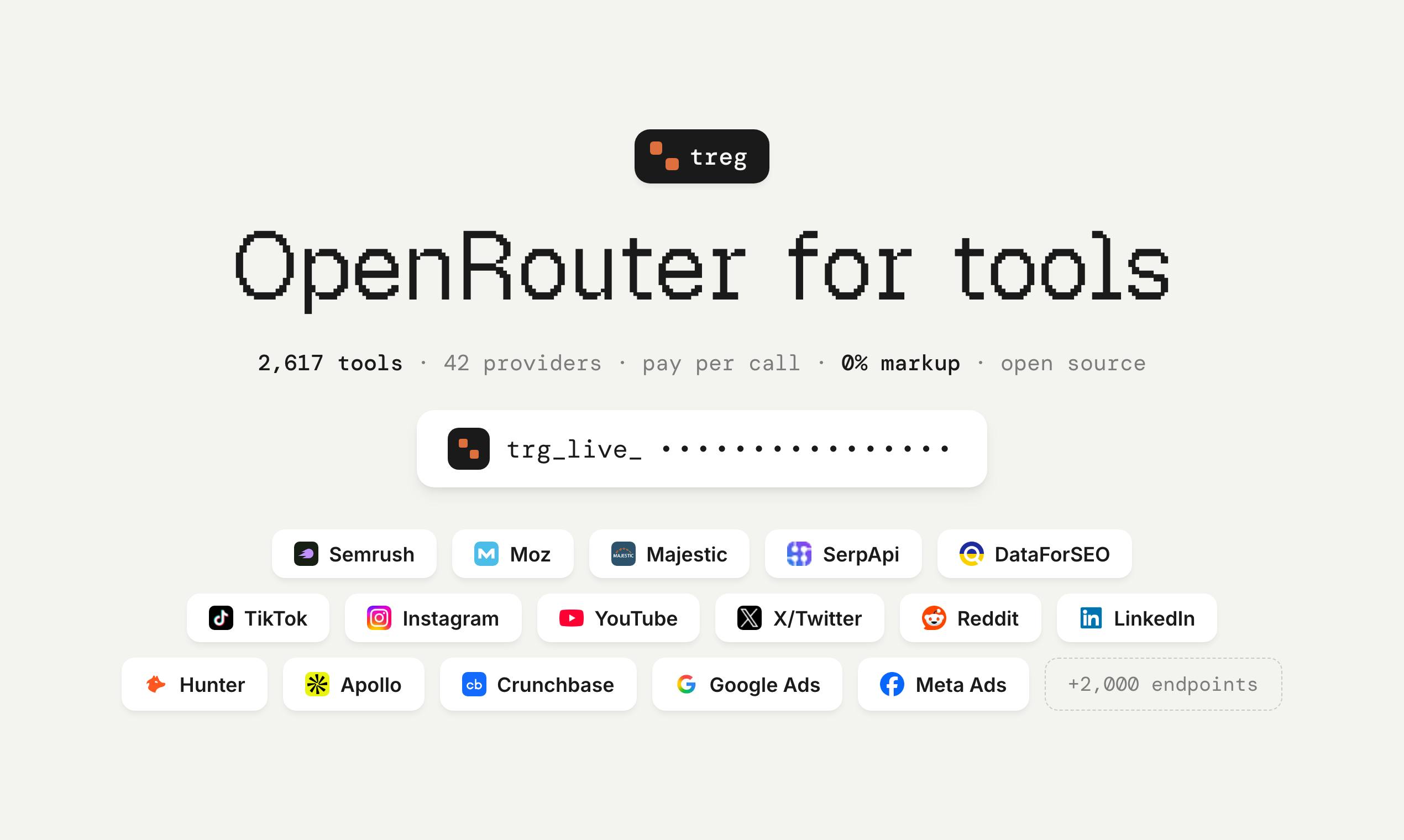
Treg is a unified API gateway that gives AI agents access to roughly 2,600 paid endpoints across ~42 providers — SEO data, backlinks, social publishing, lead enrichment, ad libraries, and scraping — behind one URL and one token, with per-call pricing displayed before execution (Product Hunt; official site). It positions itself as “OpenRouter for tools,” replacing dozens of human-priced SaaS subscriptions (Semrush at $139/mo, Moz at $99/mo, etc.) with fractional-cent per-call access, plus server-side OAuth credential injection so agents never hold secrets.
The product began as an internal tool for Superdesign, the founder’s AI design product. It launched on Product Hunt in mid-August 2026 with modest attention (≈233 followers, 4.0 rating, 1 review) but attracted a substantive comment from Product Hunt founder Ryan Hoover and a handful of credible early-user testimonials.
The strongest positive signal is the founder. Jason Zhou was head of product design at Relevance AI (a Bessemer-backed Series B agent platform), runs a ~200k-subscriber AI YouTube channel, and previously shipped Superdesign, an open-source design agent with ~5.1k GitHub stars (GitNation; GitHub). This is a credible founder-market fit with genuine distribution assets.
The most important concern is the business model and its legal underpinnings. “0% markup” means Treg’s net revenue is only the spread between vendor volume pricing and list price — a thin, unverified margin. More fundamentally, reselling per-call access to subscription products like Semrush, Moz, and Crunchbase (“treg carries the subscriptions”) likely conflicts with those providers’ terms of service, and no vendor agreements are disclosed. Competitive pressure is severe: Composio ($29M raised), Arcade.dev ($72M raised), and multiple MCP gateways are attacking adjacent problems with far more capital.
Final decision: Watch. The product is real, well-executed, and addresses a genuine pain point, but there is no verified commercial traction, the monetization model is unproven and possibly structurally thin, and the aggregation legality question is unresolved. Specific upgrade milestones are listed below.
Product Overview
Problem: Developers building agents that do real marketing/sales work (keyword research, backlink analysis, ad-library checks, email enrichment) face dozens of vendor signups, OAuth app approvals, and seat-based subscriptions priced for humans, not agents.
How it works: An agent searches Treg’s catalog by task (“backlinks for a domain”), sees each provider’s per-call price, measured success rate, and latency, then executes the call. Treg proxies the real upstream request and injects credentials server-side. Users pay per call with a prepaid balance ($1 free credit); BYOK calls are unmetered. It also handles OAuth flows for Google/Meta ads and social posting. The software is open source and self-hostable, with a hosted version at treg.to.
Pricing: Free to start; per-call prices from ~$0.004–$0.020 for common endpoints. “0% additional fee” — the company claims it earns on vendor volume pricing, not customer markup (official site).
Platforms: Web dashboard, CLI, MCP/skill integrations for coding agents (Claude Code, Cursor, etc.).
Replaces: Direct subscriptions to Semrush, Moz, Hunter, Apollo, SerpApi, DataForSEO, Postiz, and similar tools, plus custom OAuth integration work.
Note: a licensing inconsistency exists — the Product Hunt page and website say AGPL, while the GitHub repo is described as “Apache 2.0 with additional terms” prohibiting hosted resale (dsh plugin listing). Minor, but worth clarifying in diligence.
Founder and Team Assessment
Jason Zhou is publicly verifiable and credible: founder of Superdesign Dev since October 2025, previously head of product design at Relevance AI (which raised a $24M Series B led by Bessemer in May 2025 — TechCrunch), former SafetyCulture designer, Blackbird mentor, angel investor, and operator of the “AI Jason” YouTube channel (~200k subscribers) and ~25k X followers (GitNation; X profile; eitl.show interview).
Team size is not publicly disclosed. Treg appears to be a small team effort within Superdesign, and Zhou runs at least three public projects (Superdesign, Treg, AI Builder Club), which raises questions about focus and key-person concentration. No co-founder for Treg is identified. Commercial capability — enterprise sales, vendor negotiation, fundraising — is unproven, though the founder’s product and distribution skills are demonstrated.
Founder Assessment: Strong product and distribution credentials with verified pedigree, but commercial execution, team depth, and full-time focus on Treg remain unproven.
Market Opportunity
Initial segment (narrow): Indie developers and small teams building marketing/sales agents who need ad-hoc access to SEO, enrichment, and social APIs without subscriptions. Realistic initial population: tens of thousands of agent developers globally; at even $50–$500/year in pass-through spend each, this is a low-eight-figure gross-spend opportunity — and Treg’s net revenue under 0% markup is only a fraction of that.
Expansion: The larger thesis is agent-native API commerce — if agents become primary API consumers, a routing/billing/discovery layer for the long tail of data APIs is genuinely valuable, analogous to OpenRouter’s position for models (OpenRouter raised $113M at a ~$1.3B valuation — TechCrunch). Adjacent expansion includes teams (shared OAuth, private registries), enterprise governance, and a two-sided catalog where providers list tools.
Timing: Favorable — agent frameworks are proliferating and MCP-tooling infrastructure is an active investment theme (Composio; Arcade).
Bottom-up realism: the market can support venture-scale revenue only if Treg captures broad agent tool spend with a real take rate — not under its current 0%-markup model.
Traction and Growth Signals
- Product Hunt: ~233 followers, 4.0 rating, 1 review, launched days ago; a thoughtful comment from Ryan Hoover and several positive early-user comments (Product Hunt).
- An independent YouTube review confirmed the product works as advertised (YouTube).
- GitHub star count for the Treg repo could not be verified (page inaccessible during research); the sibling Superdesign repo has ~5.1k stars.
- Revenue, paying customers, call volume, retention: not publicly disclosed. The product is free to start and new; there is no evidence of sustained post-launch usage yet.
- Founder claims active work with “harness & agent platforms” as distribution partners — company-reported, unverified.
Most important missing metrics: weekly call volume, paying-user count, gross spend through the platform, and net revenue per dollar of spend.
Traction Assessment: Genuine early interest and a working product, but commercially unverified; launch-week attention only.
Competitive Position
Direct: Composio ($29M raised, 10,000+ tools, Lightspeed-backed — Lightspeed), Arcade.dev ($72M total, agent auth focus — WSJ), Pipedream/Zapier MCP servers. Indirect: MCP gateways from Docker, Kong, Tray; OpenRouter itself could extend from models to tools; agent harnesses (LangChain, Claude Code ecosystems) could bundle tool catalogs. Free/manual: direct provider APIs with BYOK — which Treg itself supports unmetered.
Differentiation: task-based semantic search with measured per-provider success/latency data, transparent per-call pricing, and the marketing-data focus (most competitors target SaaS actions, not SEO/ads/enrichment data). The measured-performance dataset could become a mild data moat.
Platform-replication test: If OpenRouter or Composio launched an identical catalog in six months, Treg’s answer would be its niche data-provider depth and measured-quality dataset — plausible but not strong. Switching costs are low (one URL/token), and the open-source self-host option further commoditizes the hosted offering. Capital asymmetry with competitors is extreme.
Defensibility Assessment: Low–Medium.
Business Model and Economics
Pay-per-call reseller model at 0% markup; claimed revenue source is vendor volume discounts. Critical unknowns:
- Whether the spread exists. For many listed providers, no wholesale/volume resale program is publicly known; “carrying subscriptions” (one Semrush seat resold per-call to many users) typically violates provider ToS. This is the single largest economic and legal question.
- Take rate. If net margin is 10–20% of pass-through spend, $1M net revenue requires $5–10M of customer spend — plausible only at significant scale.
- Costs: proxy infrastructure, OAuth app maintenance across Google/Meta/etc., credential custody (a security liability — every request/response body transits Treg’s servers; the company has not published a logging/retention policy), and support.
- BYOK unmetered is good UX but gives away the highest-intent segment.
Gross margin, CAC, and conversion are all not assessable. The model’s viability depends entirely on formalizing vendor relationships or moving to an explicit take rate.
Unicorn Path
Assumed multiple: 8–12x forward net revenue, appropriate for high-growth usage-based infrastructure with marketplace characteristics (benchmark: OpenRouter at ~$1.3B on usage-based revenue — Menlo Ventures).
Required net revenue ≈ $1B ÷ 10 = ~$100M. Under the current 0%-markup model with an assumed 10–20% volume-discount spread, that implies $500M–$1B of annual customer API spend routed through Treg. For context, the entire global SEO-tools market is only a few billion dollars; Treg would need to become the default purchasing rail for a broad swath of agent-consumed data APIs. With average early users spending cents per session, this requires millions of active agents or deep enterprise adoption — not credible under the current model alone.
Strategic changes required: (1) introduce an explicit take rate or paid gateway tier; (2) formal vendor agreements enabling legitimate resale; (3) expansion from marketing data into general tool routing; (4) team/enterprise features (governance, private registries, audit) with seat or platform pricing; (5) two-sided catalog monetization.
Unicorn Path: Conditional — achievable only with a business-model change away from 0% markup plus successful expansion into a general agent-commerce rail.
Valuation Assessment
No funding rounds, investors, valuations, or fundraising announcements were found for Treg or Superdesign Dev. Current fundraising status: not publicly disclosed.
Valuation Attractiveness: Not Assessable. Required to assess: current ARR/call volume, growth, net take rate, gross margin, retention, round size, SAFE cap or post-money, and cap table. Given pre-revenue status and the unresolved vendor-terms risk, any entry valuation above a modest pre-seed level (~$5–8M post, analyst judgment based on comparable pre-seed agent-infra rounds, not verified data) would be difficult to justify on evidence.
Key Risks
- Vendor ToS / resale legality — per-call resale of Semrush/Moz/Crunchbase-type subscriptions likely breaches provider terms; accounts could be terminated, breaking the catalog.
- Funded competition — Composio, Arcade, and platform players can replicate the catalog with far more resources.
- Structurally thin monetization — 0% markup + unmetered BYOK leaves little revenue surface; the volume-discount spread is unverified.
- Security/credential custody — Treg holds OAuth tokens and proxies all request/response bodies; no published retention policy; one breach is existential.
- Founder focus / key-person risk — solo-visible founder splitting attention across Superdesign, Treg, and a community business.
- Low switching costs / self-host cannibalization — open source undercuts the hosted revenue stream.
- Regulatory/privacy exposure — GDPR/EU AI Act questions raised publicly remain unanswered; enrichment data resale carries compliance obligations.
- No verified traction — one week post-launch; no revenue, retention, or usage data.
Final Assessment
Venture Potential: 46/100
| Category | Score |
|---|---|
| Market Size and Expansion Potential | 12/20 |
| Traction and Growth Evidence | 4/20 |
| Founder and Team | 9/15 |
| Product Strength | 7/10 |
| Distribution Potential | 8/15 |
| Business Model and Economics | 3/10 |
| Defensibility | 3/10 |
| Total | 46/100 |
Strongest: founder pedigree, product execution, market timing. Weakest: monetization structure, traction evidence, defensibility.
Evidence Confidence: 40/100
Verified: founder identity/background, product existence and functionality, launch details, competitor funding. Company-reported: catalog size, 0% markup economics, harness partnerships. Unavailable: funding, valuation, revenue, users, team size, entity, retention, vendor agreements. Material unknowns dominate the commercial picture.
Final Decision: Watch
The product is genuinely useful and the founder is credible, but there is no verified commercial traction, the economics are unproven and possibly legally fragile, and the company is days old. This is too early and too unvalidated for formal diligence, but interesting enough to track closely given the founder’s distribution assets and the hot agent-infrastructure category.
Upgrade Conditions (Watch → DD)
- Verified weekly call volume and gross platform spend growing for 8+ weeks post-launch
- Evidence of paying, retained users (e.g., >$50k annualized net revenue run rate or equivalent usage)
- At least one formal vendor/reseller agreement with a major catalog provider
- A published security/data-retention policy and SOC 2 roadmap
- Full-time founder commitment to Treg and a disclosed entity/cap table
Downgrade Conditions (Watch → Pass/Hard Pass)
- C&D or account termination from a listed provider (would likely push to Hard Pass on ToS grounds)
- Stalled usage after launch spike; repo/product inactivity
- Composio/OpenRouter launches a directly comparable priced catalog
- Founder publicly deprioritizes Treg
- Any credential or data-handling incident
Questions for Further Diligence
- What are current weekly call volume, gross spend through the platform, and net revenue? What is the actual per-provider spread?
- Which vendor relationships are formalized in writing, and which catalog entries rely on resold subscription seats? What happens if Semrush or Crunchbase terminates the accounts?
- What is the logging/retention policy for proxied request/response bodies, and how are OAuth tokens stored?
- How many paying users and teams exist today; what does 30/90-day usage retention look like?
- What is the plan for monetization beyond vendor volume discounts — take rate, gateway tier, or enterprise plan?
- Is Treg a separate legal entity from Superdesign, and what does the cap table look like?
- How many people work on Treg full-time, and how is founder time split across Superdesign, Treg, and AI Builder Club?
- What are infrastructure and OAuth-maintenance costs as a percentage of gross spend?
- Which harness/agent-platform partnerships are signed versus in discussion?
- What is the current or intended fundraising round, valuation, and runway?
- How do you respond to GDPR/EU AI Act obligations for enrichment-data endpoints?
- Why AGPL vs. Apache-with-terms — and does the licensing strategy support or undermine the hosted business?
Sources
- Product Hunt — Treg
- Official site / treg.to
- GitHub — superdesigndev/treg (inaccessible at research time; license details via dsh plugin mirror — secondary source)
- GitHub — superdesigndev/superdesign (5.1k stars)
- Founder LinkedIn · X · GitNation profile
- Founder interview — eitl.show
- Independent product review (YouTube) — secondary source
- TechCrunch — Relevance AI Series B
- TechCrunch — OpenRouter $1.3B valuation · Menlo Ventures
- Composio Series A · Lightspeed investment note
- WSJ — Arcade.dev $60M Series A