
Table of Contents
Inferock Bench Investment Report
Category: LLM reliability, billing-integrity, and inference-observability infrastructure
Company Stage: Pre-seed / pre-commercial hosted-product launch; open-source benchmark is publicly available
Founder or Founders: Bharath Koneti and Himashwetha Gowda
Headquarters: Not publicly disclosed
Funding: Not publicly disclosed
Business Model: Free source-available local benchmark; planned hosted inference gateway with Bring Your Own Keys and managed-inference modes, including bounded credits for eligible failures; pricing is not publicly disclosed
Product Hunt Launch Date: August 15, 2026
Report Date: August 18, 2026
| Investment Metric | Assessment |
|---|---|
| Venture Potential | 50/100 |
| Unicorn Path | Conditional |
| Valuation Attractiveness | Not Assessable |
| Evidence Confidence | 55/100 |
| Final Decision | Watch |
Executive Summary
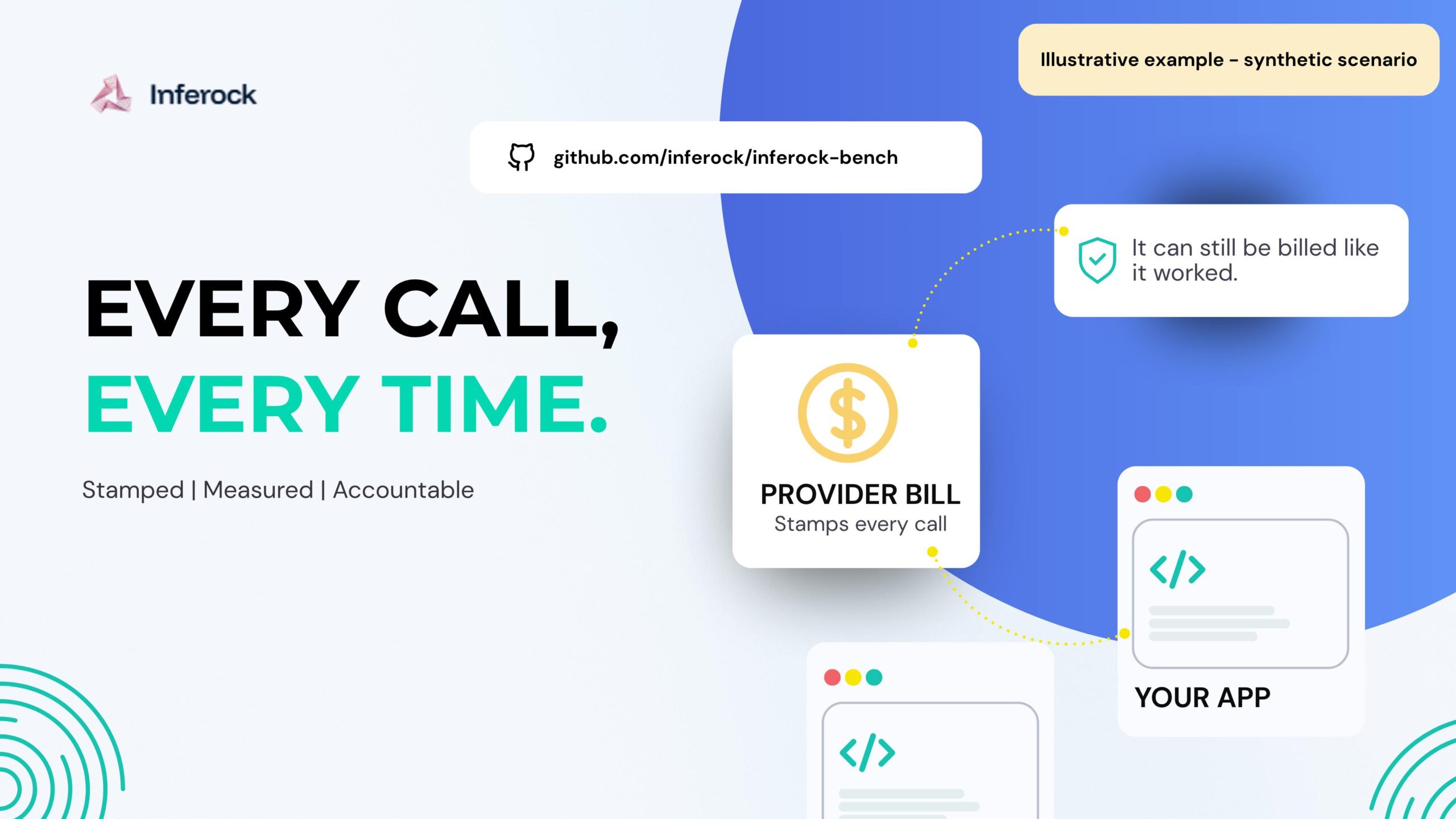
Inferock Bench is a local proxy and measurement tool that sits between an application and metered LLM APIs. It records provider-reported usage, request and response metadata, latency, retries, failure signals, and pricing evidence, then produces per-call “receipts” intended to show what was spent, what failed, and which billing questions deserve investigation. It currently supports OpenAI, Anthropic, Gemini Developer API, and selected pinned OpenRouter endpoints. The product is tangible, installable through npm, and documented in a public repository. GitHub
The broader company, Inferock, proposes an accountable inference gateway: route calls through one path, independently measure every call, fail over when a provider degrades, and issue bounded credits for eligible objective failures in managed mode. The official site currently offers invitation requests rather than public self-service pricing. The repository identifies Inferock as being built at OpiusAI by Bharath Koneti and Himashwetha Gowda. Official site Founder disclosure
The strongest investment signal is unusually rigorous product documentation for such an early project. The repository explicitly separates observations from interpretations, describes threat boundaries, publishes its measurement standard, labels synthetic examples, and discloses that Inferock authored the standard used to grade its own receipts. The public cumulative ledger cited in the repository covers 1,303 measured calls, although only $8.43 of provider spend was observed; this validates implementation more than customer demand. Measurement documentation
The most important concern is that the commercial thesis remains unvalidated. No revenue, paying customers, retained usage, production traffic volume, funding, team size, current round, or valuation is public. The hosted gateway and Reliability Index are described as pre-launch. Mature observability and gateway vendors already offer cost tracking, routing, caching, evaluations, and monitoring, while cloud and model providers can improve their own billing detail. Product Hunt exposure is launch attention, not product-market fit.
Final decision: Watch. Inferock addresses a credible and growing infrastructure problem, and the founders have shipped a thoughtful instrument. However, formal due diligence should wait for evidence that engineering teams will route material production traffic through an independent intermediary and pay enough to support the operational and credit risk of an accountable inference service.
Product Overview
Inferock Bench runs locally and proxies real API traffic. A user installs it with npx inferock-bench, stores provider keys locally, points an SDK’s base URL at localhost, and receives receipts for observed calls. The tool measures only traffic that passes through it; it cannot reconstruct calls made elsewhere or replace a provider invoice. It distinguishes provider spend, bill-bounded money loss, time loss, and invoice-check exposure rather than collapsing unlike measures into one headline. Quickstart
The product targets developers, AI platform teams, and finance or FinOps owners responsible for LLM spend. Its customer value is an independent evidence trail across providers, especially for incomplete outputs, retries, token discrepancies, latency, and cache-pricing questions. Provider keys are stated to remain local in Bench. The hosted product is intended to add routing, failover, and service credits. Inferock FAQ
The benchmark is free for local use under FSL-1.1-ALv2 with conversion to Apache-2.0 after two years; the measurement library is Apache-2.0 and the standard is CC-BY-4.0. This is source-available rather than immediately permissive open source for the full application. Public pricing, contractual SLA terms, credit caps, and supported production scale are unavailable.
Founder and Team Assessment
The repository names Bharath Koneti and Himashwetha Gowda as founders building Inferock at OpiusAI. Koneti publicly explains the thesis as replacing provider-graded monthly uptime with independent per-call evidence and separate money and time ledgers. This is company-reported positioning, but it is consistent with the shipped code and documentation. Founder post
The founders demonstrate strong attention to measurement integrity, documentation, developer experience, and adversarial review. The repository has 16 commits, 138 stars, and 49 forks in the accessible GitHub snapshot; those numbers are early technical-interest signals, not organizational scale. Prior employers, previous exits, full-time commitment, ownership, team composition, sales capability, and security credentials were not reliably verified.
Founder Assessment: Strong evidence of thoughtful technical execution, but founder background, commercial capability, and organizational capacity remain insufficiently verified.
Market Opportunity
The initial customer is a software company with meaningful multi-provider LLM API spend, production reliability requirements, and enough billing complexity to justify an independent measurement layer. Willingness to pay should correlate with inference spend and the economic cost of failed or delayed calls.
An analyst scenario illustrates the opportunity: 10,000 production AI companies paying an average of $25,000 annually for gateway, reliability, and audit services would create a $250 million revenue pool. Expansion into enterprise governance, contractual reliability, procurement analytics, and model-routing economics could make the addressable market larger. These are assumptions, not Inferock customer or pricing data.
The timing is favorable because AI workloads increasingly use several models and providers. The challenge is that gateways and observability are crowded, and the narrow “recover failed-call cost” wedge may not justify a separate vendor unless Inferock proves savings, operational resilience, or audit value materially above existing telemetry.
Traction and Growth Signals
Verified traction consists primarily of product activity: a public package and repository, detailed integration guides, current documentation, a public measurement ledger, and early GitHub interest. The repository reports 1,303 measured calls and 598 findings across a small $8.43 observed-spend sample. That proves the pipeline can process traffic, but the sample is far too small to demonstrate enterprise utility or broad provider failure rates. Public ledger description
The hosted gateway has a waitlist, and the Reliability Index is pre-launch. No paying customer, production traffic, retention, revenue, case study, independent review, or partnership was verified. Product Hunt listing confirms launch activity but does not establish commercial demand.
Traction Assessment: Credible early engineering and transparency, with no verified commercial traction.
Competitive Position
Direct and adjacent competitors include Helicone, Portkey, LangSmith, Arize Phoenix, and open-source telemetry built on OpenTelemetry. Cloud gateways, model providers, and internal platform teams are indirect alternatives.
Inferock’s differentiation is a receipt and accountability model rather than only dashboards: evidence grading, bill-bounded loss, separate invoice-check exposure, and potentially contractual credits. That positioning may resonate with FinOps and regulated buyers. However, routing is technically reproducible, the standard is company-authored, and competitors can add similar reports. Switching costs exist only after Inferock becomes embedded in production routing and audit workflows.
If the largest platform launched the same feature within six months, customers would remain only if Inferock were trusted as a neutral cross-provider adjudicator and consistently recovered more value than it cost. That trust and economic proof do not yet exist.
Defensibility Assessment: Low to Medium
Business Model and Economics
The expected model combines a free benchmark with paid BYOK observability and managed inference. Revenue might be subscription-, usage-, or spend-based. Managed credits could differentiate the product but introduce adverse-selection, fraud, reserve, and provider-dispute risk. Gross margin depends on routing architecture, telemetry storage, support, and the ratio of credits issued to revenue.
Enterprise customers may pay meaningful ACV for reliability and auditability, but pricing and contract terms are unavailable. Critical diligence items include gross margin before and after credits, provider discounts, credit caps, traffic concentration, and whether customers will trust a young intermediary with production prompts and metadata.
Unicorn Path
Assumed multiple: 12× ARR, appropriate only for a fast-growing infrastructure SaaS company with strong net retention and high software gross margin. Required ARR for a $1 billion valuation is about $83 million. At a hypothetical $50,000 blended ACV, Inferock would need roughly 1,660 customers; at $200,000, about 415 customers. These are analyst assumptions because public pricing is absent.
The path requires moving from a developer diagnostic to a production control plane, demonstrating measurable savings and uptime improvements, earning enterprise security certifications, negotiating provider economics, and building a trusted neutral standard. It is possible but depends on a substantial strategic and organizational expansion.
Unicorn Path: Conditional
Valuation Assessment
No reliable funding history, investors, revenue, round size, SAFE cap, post-money valuation, or current fundraising terms were found.
Valuation Attractiveness: Not Assessable. Assessment requires ARR, growth, production traffic, gross margin, credit-loss ratio, retention, burn, runway, cap table, financing instrument, price, and liquidation preferences.
Key Risks
- No verified revenue, customers, retention, or production traffic.
- Established observability and gateway vendors can copy receipt-like reporting.
- Model providers may improve billing transparency and reduce the wedge.
- Routing sensitive prompts through a startup creates security and procurement friction.
- Company-authored standards may struggle to become neutral industry standards.
- Managed credits introduce underwriting and adverse-selection risk.
- Public evidence is based on very small observed provider spend.
- Founder and team capacity are not sufficiently public.
- Source-available licensing may limit community adoption versus permissive alternatives.
- Production gateways require high availability before they can sell reliability.
Final Assessment
Venture Potential: 50/100
| Category | Score |
|---|---|
| Market Size and Expansion Potential | 15/20 |
| Traction and Growth Evidence | 5/20 |
| Founder and Team | 8/15 |
| Product Strength | 7/10 |
| Distribution Potential | 5/15 |
| Business Model and Economics | 5/10 |
| Defensibility | 5/10 |
| Total | 50/100 |
The strongest element is the rigorous product and an economically legible accountability thesis. The weakest elements are absent commercial validation, crowded competition, and the trust burden of becoming production infrastructure.
Evidence Confidence: 55/100
Verified: product functionality, supported integrations, repository activity, licensing, named founders, public measurement methodology, and pre-launch status of some features. Company-reported: gateway behavior, planned credits, and reliability positioning. Estimated: market size, ACV, and unicorn math. Unavailable: funding, revenue, customers, retention, margins, team size, security certifications, and valuation.
Final Decision: Watch
The product is credible enough to monitor, but not yet strong enough for formal DD. An upgrade requires independent production evidence and a repeatable commercial model.
Upgrade Conditions
- At least $1 million ARR with multiple production customers
- More than $100 million of annualized inference spend measured or routed
- Documented customer savings or reliability outcomes
- Gross margin above 70% after credits and infrastructure
- Enterprise security certification and independent penetration testing
- Six-month gross revenue retention above 90%
- Repeatable distribution beyond Product Hunt and founder networks
Downgrade Conditions
- Hosted gateway remains pre-launch
- Providers or incumbents bundle equivalent accountability features
- Security incident or disputed receipt methodology
- Credit costs make managed inference structurally unprofitable
- Development activity or founder commitment declines
Questions for Further Diligence
- What are current ARR, paying customers, production traffic, and monthly growth?
- How many waitlist organizations have committed to pilots?
- What are current pricing, blended ACV, and contract length?
- What percentage of measured spend produces eligible credits, and who funds them?
- What are gross margin and infrastructure cost per million routed tokens?
- How does Inferock prove neutrality when it authored the standard and sells the service?
- Which receipt findings have resulted in actual provider credits?
- What security architecture, data-retention policy, certifications, and incident plan protect production prompts?
- What are 30-, 90-, and 180-day customer retention and routed-volume expansion?
- What prevents Helicone, Portkey, LangSmith, or a cloud provider from replicating the feature?
- What are founder roles, full-time commitments, team plan, burn, and runway?
- What are the cap table, current round size, valuation, and investor rights?