
Table of Contents
Screenify Studio Investment Report
Category: Prosumer productivity software — Mac screen recording and product-demo production with AI automation
Company Stage: Bootstrapped indie product (no evidence of any funding or incorporated entity)
Founder or Founders: “Brjan” (@mrbrjan) — solo founder; full legal identity not publicly disclosed
Headquarters: Ho Chi Minh City, Vietnam (founder-reported) producthunt
Funding: None found — no rounds, investors, or funding announcements in any public source
Business Model: Freemium software — free tier with unlimited recordings; Pro from $9/month or a $149 one-time license sourceforge
Product Hunt Launch Date: August 27, 2026 (product active since approximately February 2026) producthunt
Report Date: August 29, 2026
| Investment Metric | Assessment |
|---|---|
| Venture Potential | 37/100 |
| Unicorn Path | Improbable |
| Valuation Attractiveness | Not Assessable |
| Evidence Confidence | 35/100 |
| Final Decision | Pass |
Executive Summary
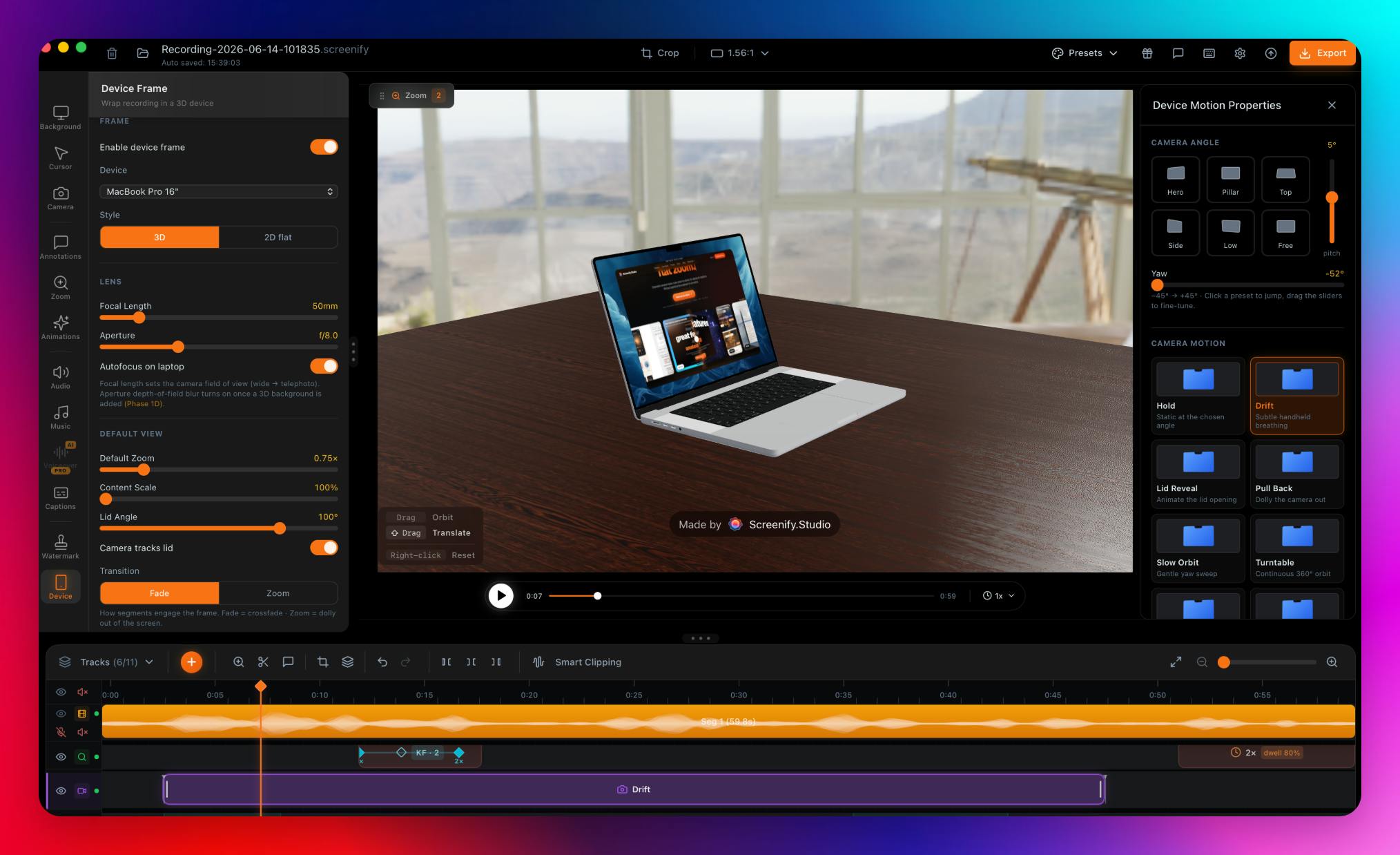
Screenify Studio is a macOS screen recorder that converts rough captures into polished product demos: automatic zoom, on-device AI captions, photorealistic 3D MacBook/iPhone/iPad staging with cinematic camera moves, and — its most distinctive feature — an AI agent that drives a real browser via Playwright to record demos from a plain-English script, plus a CLI and MCP server so tools like Claude Code can produce recordings autonomously. producthunt
It serves indie hackers, technical founders, and small product teams who need professional-looking demos without video-editing labor. The product is genuinely well-built: it is Mac-native, runs on-device on Apple Silicon, exports up to 4K/60fps, and the founder’s Product Hunt comment responses demonstrate unusual technical depth (cursor-sampling mechanics, 2FA session handling, deterministic re-recording). producthunt
The strongest positive signal is product craft combined with a forward-looking distribution angle: MCP integration positions the tool to be invoked by AI coding agents, a clever and timely channel. The launch also surfaced qualified interest — including a commenter currently paying for competitor Clueso who called it too expensive. producthunt
The decisive concern is venture fit. This is a solo-founder, bootstrapped utility priced at $9/month or $149 lifetime, in a category — screen recording — that is crowded, commoditized, and historically low-ACV. There is no revenue, user, or funding data, the founder’s full identity is not publicly verifiable, and the ceiling outcome for the category (Loom’s $975M acquisition) required viral PLG scale this product shows no mechanism for. It is a promising indie business, not a venture-scale company.
Verdict: Pass for venture purposes, while noting this looks like a healthy bootstrapped product in the making.
Product Overview
The customer problem: product demos are tedious to produce and go stale every time a UI changes; editing is the “tax” on shipping. Screenify records any screen/window/webcam, auto-applies smart zoom and cursor cleanup, stages footage inside 3D device mockups with cinematic camera paths, generates on-device captions, and exports polished MP4s — or, given a URL, an AI agent drives a real Chromium browser through the demo flow, so re-recording after a UI change means re-running a script. Authentication is handled via persistent named browser profiles; native Mac-app automation is explicitly not supported yet (browser only). Pricing: free tier with unlimited recordings; Pro at $9/month or $149 one-time. Platform: macOS only. It replaces Screen Studio, Clueso, Tella, or a Loom-plus-editing workflow, and undercuts Clueso substantially on price. producthunt
Founder and Team Assessment
The founder identifies only as “Brjan,” a solo founder shipping in public from Ho Chi Minh City. No LinkedIn profile, full name, prior employment history, or incorporation record could be verified; secondary directory listings corroborate only the HCMC location and solo operation. Technical capability is directly evidenced by the product itself — Metal-accelerated export, a 3D rendering pipeline, ScreenCaptureKit integration, Playwright-based agent recording, and an MCP server represent serious solo engineering. Commercial capability is unproven; the founder does engage prospects adeptly in launch comments (offering Pro codes to competitor users). Key-person risk is maximal by definition: one person is the entire company. producthunt
Founder Assessment: Demonstrably strong solo technical execution, but identity, commercial capability, and organizational capacity are all unverified — the highest possible key-person risk profile.
Market Opportunity
Initial segment, narrowly: Mac-using indie hackers, solo founders, and small SaaS teams producing marketing demos, Product Hunt launch videos, and tutorial content. Willingness to pay is modest — the anchor competitor Screen Studio charges $108/year and competitor commentary pegs Clueso as “too expensive” for this segment. Bottom-up: even an optimistic 200,000 reachable Mac demo-makers at a ~$100/yr effective price implies a ~$20M serviceable niche — and that assumes near-total category capture against entrenched rivals. Adjacent expansion exists and is the interesting part: scripted, re-runnable demo recording points toward demo automation for sales/solutions teams (Supademo, Arcade, Navattic territory, where ACVs are 50–100× higher) and toward agent-generated video documentation. Geographic reach is inherently global via digital distribution. As launched, however, the realistic addressable market supports a strong lifestyle business, not venture-scale revenue. producthunt
Traction and Growth Signals
Verified signals are early but real: the product has existed publicly since at least February 2026 with an active content-marketing blog (February and April 2026 posts), listings on MacUpdate (July 2026) and SourceForge (August 2026), an X account active since March 2025, and a Product Hunt launch on August 27, 2026 that drew 90 followers and a small but technically substantive comment thread, including interest from a current Clueso customer. No app-store presence (direct distribution), no disclosed downloads, revenue, or user counts, and no third-party reviews beyond directory summaries. The most important missing metrics: installs, active users, free-to-paid conversion, and any revenue figure. producthunt
Traction Assessment: Authentic early-stage indie activity with engaged niche interest, but zero verified commercial traction.
Competitive Position
Direct competitors: Screen Studio (the category-defining Mac recorder at $108/yr with thousands of users), Tella, Clueso (funded AI product-video platform), Descript, ScreenCharm, FocuSee, CleanShot X. Free alternatives: macOS native recording, OBS, Screenity. Adjacent, higher-ACV players: Supademo, Arcade, and Navattic in interactive demos; Loom in async video. Differentiation today: agent-driven browser recording with deterministic re-runs, MCP/CLI automation, on-device processing (privacy angle), and 3D multi-device staging — a genuinely fresh combination. None of it is structurally defensible: Playwright automation is commodity infrastructure, MCP servers are trivial to add, and Screen Studio or Clueso could replicate the agent-recording feature within months. If Apple or Screen Studio shipped equivalent AI recording, the only remaining answer is price and the CLI/agent-native posture — thin. No network effects, proprietary data, or switching costs exist. producthunt
Defensibility Assessment: Low.
Business Model and Economics
Freemium with Pro at $9/month or $149 one-time. The on-device architecture is the economic bright spot: AI captions and processing run locally on Apple Silicon, so inference costs are near zero and gross margins approach software ideals. The constraint is the ceiling: ~$108/yr ARPU with no seat expansion, no team tier, and a $149 lifetime option that caps LTV. Estimated annual contract value is $0–$108 per user; there is no enterprise motion. Customer acquisition is founder-led content marketing, directories, and launch platforms — zero-cost but unscalable beyond niche audiences. There is no evidence of conversion rates, churn, or support load. For the model to work at venture scale, the company would need usage-based or B2B pricing tied to automated demo pipelines — not the current prosumer utility pricing. producthunt
Unicorn Path
Assume an 8× forward-revenue multiple, standard for healthy SaaS with strong margins but modest growth. Required revenue ≈ $125M ARR. At the current $108/yr maximum ARPU, that implies roughly 1.15 million paying subscribers — a number no screen-recording tool has ever approached (Loom reached ~25M users across free and paid tiers at its peak with a viral collaboration loop this product lacks). At a $149 lifetime price the math is worse. The only conceivable route is transformation into B2B demo automation — agent-recorded, continuously refreshed demo and documentation infrastructure sold to sales and solutions teams at $10K+ ACV, requiring roughly 12,500 such customers; that is a different product, different buyer, and different go-to-market than what exists today, from a solo founder with no capital. Realistic outcome distribution: a $1M–$3M ARR indie business.
Unicorn Path: Improbable.
Valuation Assessment
There is no funding history: no rounds, investors, accelerators, or valuations appear in any public source; the company is apparently bootstrapped and possibly unincorporated. No revenue exists to anchor a multiple. Comparable outcomes — Screen Studio’s bootstrapped success, Loom’s $975M acquisition at viral scale, Clueso’s venture raises — describe the category’s range but cannot price this company without financials. producthunt
Valuation Attractiveness: Not Assessable. Required information: revenue (if any), install base, conversion, churn, founder’s incorporation and fundraising intent, and any proposed terms.
Key Risks
- No venture-scale market as defined: ~$20M niche ceiling at current pricing and positioning.
- Solo-founder key-person risk: development, support, and marketing all depend on one unverified individual.
- Commoditization: Screen Studio, Clueso, or Apple can replicate the feature set; Playwright-based recording has no moat.
- Zero traction data: no verified users, revenue, or retention six months into public availability.
- Name collision: an unrelated Windows recorder also trades as “Screenify,” and a separate AI-interview startup used the name — brand and trademark confusion risk. apps.microsoft
- Platform risk: macOS-only distribution depends on Apple’s APIs (ScreenCaptureKit) and notarization policies.
- Low-price trap: $9/mo and $149 lifetime pricing cannot fund paid acquisition or a team.
- Unverifiable founder identity complicates any investment, contracting, or IP assignment.
Final Assessment
Venture Potential: 37/100
| Category | Score |
|---|---|
| Market Size and Expansion Potential | 8/20 |
| Traction and Growth Evidence | 3/20 |
| Founder and Team | 5/15 |
| Product Strength | 7/10 |
| Distribution Potential | 6/15 |
| Business Model and Economics | 5/10 |
| Defensibility | 3/10 |
| Total | 37/100 |
Strongest: product engineering and the agent-native recording concept. Weakest: market ceiling, solo-founder structure, and absence of any commercial evidence.
Evidence Confidence: 35/100
Verified: product existence, features, pricing, launch history, platform listings. Company-reported: founder location and solo status. Unavailable: founder’s full identity and background, revenue, users, retention, funding, legal entity, team. The product is real; the company, as an investable entity, is barely documented.
Final Decision: Pass
Screenify Studio is a credible indie product with admirable engineering, but it fails the venture test on market size, organizational structure, defensibility, and evidence simultaneously. Nothing here suggests misconduct or a bad product — it suggests a good bootstrapped business. Reconsideration would make sense only if the founder incorporates, builds a team, and converts the agentic re-recording capability into a B2B demo-automation platform with verified paying customers.
Upgrade Conditions
- Verified revenue approaching $250K–$500K ARR with organic growth
- A B2B pivot toward demo automation with paying teams at $5K+ ACV
- Founder incorporation, full identity disclosure, and at least one additional senior hire
- Adoption of the MCP/CLI interface by recognizable AI-coding communities as a default recording tool
- Demonstrated free-to-paid conversion above 5% and low churn at meaningful scale
Downgrade Conditions
- Update cadence stalling (no releases for a quarter)
- Screen Studio or Clueso shipping agentic re-recording
- Founder abandoning the project or taking full-time employment elsewhere
- Trademark conflict with the other “Screenify” products forcing a rebrand
- Any misrepresentation of downloads, users, or reviews
Questions for Further Diligence
- What are total installs, weekly active users, and paying customers today?
- What revenue has the product generated since February 2026, and what is the free-to-paid conversion rate?
- What is your full legal identity, and is a corporate entity with clean IP assignment in place?
- Is the $149 lifetime license cannibalizing subscription revenue — what share of buyers choose it?
- What are monthly churn and refund rates on the $9/month plan?
- Which acquisition channel has produced the most paying users — Product Hunt, SEO blog, directories, or X?
- What percentage of recordings now come through the CLI/MCP interface versus the GUI?
- Do you intend to raise capital and build a team, or remain an indie business?
- What is the roadmap for native Mac-app automation, and what demand have you measured for it?
- How would you respond to Screen Studio shipping an equivalent AI record-and-rerun feature?
- Have you assessed the trademark situation around the “Screenify” name?
- What would a B2B demo-automation offering look like, and have any teams requested it?
Sources
- Product Hunt — Screenify Studio
- Screenify Studio official site
- Screenify Studio blog — launch and workflow
- Screenify Studio blog — recorder comparison
- MacUpdate — Screenify Studio listing
- SourceForge — Screenify Studio listing
- Stork.ai — Screenify Studio review (secondary)
- X — @ScreenifyStudio
- Screen Studio — primary competitor
- ScreenCharm — competitor
- Microsoft Store — unrelated “Screenify” Windows recorder (name collision)