
Table of Contents
Timeless Code Investment Report
Category: Developer productivity; AI meeting memory and agent workflows
Company Stage: Seed-stage operating platform; Timeless Code is a new integration
Founder or Founders: Tommy Barav (CEO) and Eilon Mor (CTO), per current launch statements; older records also name Tal Peretz as timeOS co-founder
Headquarters: Israel-connected team; precise HQ not confirmed. Legal entity: Supertools, Inc., a Delaware corporation
Funding: Third-party database lists a $3.3 million 2021 seed and later undisclosed rounds; totals and terms unverified
Business Model: Freemium subscriptions; Pro $29/month, Max $39/month
Product Hunt Launch Date: 2026/09/29 (spreadsheet column B)
Report Date: 2026-10-08
| Investment Metric | Assessment |
|---|---|
| Venture Potential | 66/100 |
| Unicorn Path | Conditional |
| Valuation Attractiveness | Not Assessable |
| Evidence Confidence | 56/100 |
| Final Decision | DD |
Executive Summary
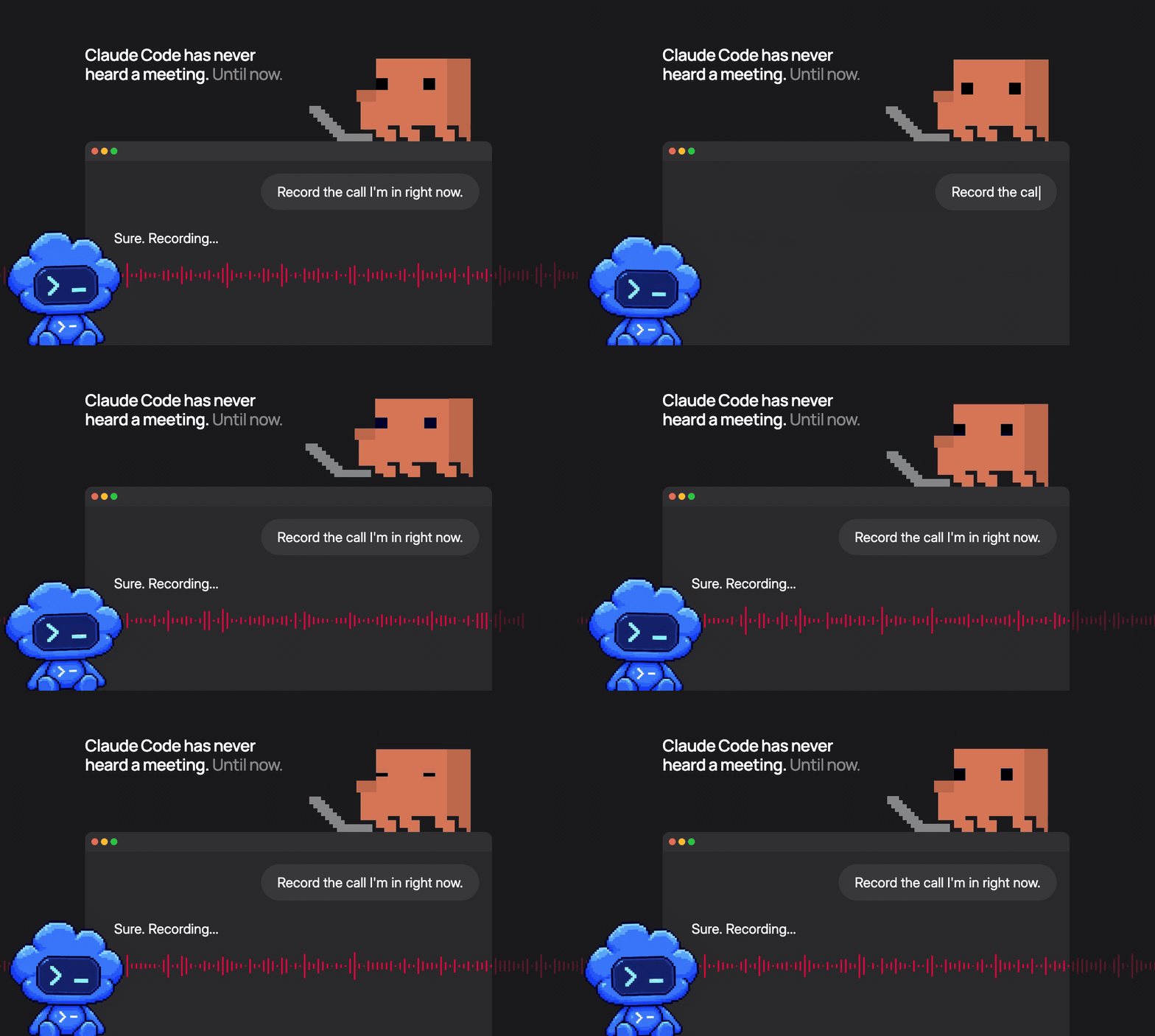
Timeless Code connects Timeless meeting memory to Claude Code. Users can start recording, search past conversations, retrieve cited answers, and turn decisions into issues from a coding-agent workflow. It is an extension of an existing meeting product, not a new company. Product Hunt Official product page
The developer wedge is clear, but value depends on recording accuracy, permissions, and whether teams trust agents to act on meeting content. The company has a history of nine Product Hunt launches since 2022; its current listing shows 5.1K followers and 4.8/5 across 23 overall reviews. The Timeless Code launch itself shows #8 and 107 points. None proves revenue or retention. Barav reports using Timeless for 2,400 meetings and says its largest customer standardized it company-wide; both are founder claims. Product Hunt
The key diligence issue is sensitive meeting data. Timeless markets SOC 2 Type II, Frankfurt residency, and no model training, while the public Privacy Notice names multiple processing regions and consent-based engineering access. The Terms allow broad use of recordings/transcripts for service improvement and limit deletion/liability. DD is warranted to verify commercial traction, costs, and current data controls before investment consideration.
Product Overview
The product installs through Claude Code and brings meetings into the terminal. Users can record a call they attend, send a bot to a missed meeting, query past conversations, and create follow-up tasks. Answers are designed to cite the source sentence and timestamp. The service also offers desktop apps, API/MCP access, and work-tool integrations. Official page
The target buyer is a developer-heavy team using Claude Code or Codex that must translate meeting decisions into tickets and code. Free covers five meetings of up to 90 minutes. Pro is $29/month; Max is $39/month and adds unlimited API/MCP access, webhooks, and priority support. Team pricing is not displayed. Pricing
Founder and Team Assessment
Tommy Barav identifies as co-founder/CEO; Eilon Mor identifies as co-founder/CTO in the launch thread. Mor reports a six-person team. Barav’s LinkedIn lists Timeless (previously timeOS). A historical Startup Nation Central profile names Tal Peretz among timeOS’s founders, so current roles and the transition merit confirmation. The Terms identify Supertools, Inc. d/b/a Timeless. Product Hunt Barav profile Terms
Founder Assessment: Direct product involvement and sustained iteration are positive; team depth and commitments remain unverified.
Market Opportunity
Initial customers are software teams that use coding agents and hold recurring product, customer, or engineering meetings. They may pay to reduce context switching and lost decisions. Broader meeting memory and agent workflows could expand the product, but also increase privacy and integration demands.
Analyst scenario, not a measured market: 10,000–30,000 organizations × 5–10 seats × $29–$39/month implies roughly $17 million–$140 million annual subscription potential. Organization counts and seat assumptions are unverified. The wedge may support a meaningful business, but unicorn scale likely requires broader enterprise adoption.
Traction and Growth Signals
Product Hunt shows nine Timeless launches since 2022, 5.1K followers, and 4.8/5 from 23 reviews across the broader product. The current Timeless Code launch shows 107 points and #8. Parent-product reviews praise capture and summaries but mention transcript accuracy and team-feature gaps; they are not specific to Timeless Code. Product Hunt
Barav’s 2,400-meeting usage and company-wide customer claim are unverified. No ARR, growth, paid-user count, conversion, retention, CAC, or margins are public.
Traction Assessment: Product iteration and qualitative use are visible; commercial scale is unverified.
Competitive Position
Alternatives include Granola, Fathom, Fireflies, Otter, and local note tools. Granola already offers an official MCP connector for using meeting notes in Claude and Claude Code. Granola MCP
Timeless’s potential edge is the full loop: setup by an agent, recording from the terminal, cited recall, and issue creation. But MCP retrieval alone is not defensible, and inaccurate transcripts can create bad actions.
If the largest platform launches the same feature within six months, customers must stay for better capture, trusted citations, cross-meeting memory, and reliable actions. Claude, meeting providers, or note takers could bundle retrieval and ticket creation.
Defensibility Assessment: Low
Business Model and Economics
The model is freemium subscription: five free meetings, Pro at $29/month, and Max at $39/month. Max targets API/MCP users. Pricing
Transcription, inference, storage, and integrations create variable costs; unlimited plans could pressure margins. No conversion, gross margin, CAC, support cost, or team ACV is public. Recording consent also affects usage frequency.
Unicorn Path
At an illustrative 10× ARR multiple, $1 billion valuation implies $100 million ARR. At $39/month ($468/year), that requires about 214,000 individual subscriptions, or 43,000 five-seat teams at that rate. These are scenarios, not forecasts; enterprise pricing and margins are unknown. Scale requires durable enterprise expansion beyond the coding-agent integration.
Unicorn Path: Conditional
Valuation Assessment
Valuation Attractiveness: Not Assessable. Startup Nation Central lists a $3.3 million 2021 seed and later undisclosed rounds; its current profile leaves total funding undisclosed. Maccabee Ventures lists Timeless/timeOS, but current valuation and terms are unavailable. Startup Nation Central Maccabee portfolio
ARR, growth, margins, retention, burn/runway, cap table, and current financing terms are needed before assessing price.
Key Risks
- Terms leave participant-consent responsibility with users.
- Terms permit use of recordings/transcripts for improvement and do not guarantee deletion in all cases.
- Marketing claims SOC 2 and Frankfurt residency, while the Privacy Notice describes multiple regions and consent-based engineering access.
- Transcript errors may create incorrect actions.
- The Claude Code wedge depends on another platform.
- Meeting tools can copy MCP retrieval and task creation.
- Unlimited tiers face unknown inference/storage margins.
- The largest-customer claim lacks disclosed metrics.
- Terms cap liability at the lesser of $2,000 or fees paid/accrued in the prior six months.
Final Assessment
Venture Potential: 66/100
| Category | Score |
|---|---|
| Market Size and Expansion Potential | 14/20 |
| Traction and Growth Evidence | 11/20 |
| Founder and Team | 11/15 |
| Product Strength | 8/10 |
| Distribution Potential | 10/15 |
| Business Model and Economics | 7/10 |
| Defensibility | 5/10 |
| Total | 66/100 |
Product iteration, paid plans, and a focused workflow are positives. Financial proof, feature-level defensibility, and data terms are the main weaknesses.
Evidence Confidence: 56/100
Product, pricing, launch history, legal entity, and public terms are documented. Usage, team size, customer standardization, and funding details are reported or third-party claims. Revenue, retention, margins, CAC, current team commitments, and valuation remain unknown.
Final Decision: DD
The multi-year platform, paid pricing, and differentiated workflow justify a founder meeting. Do not invest without verifying paid traction, unit economics, enterprise references, privacy controls, and financing price.
Upgrade Conditions
- Verify revenue, conversion, retention, and the large-customer reference.
- Show healthy margins and sustained use of Claude Code/Codex workflows.
- Review SOC 2 scope, subprocessors, residency, consent UX, deletion, and DPA.
- Confirm repeatable enterprise sales and acceptable round terms.
Downgrade Conditions
- Weak paid conversion or retention after free usage.
- Material consent, privacy, security, or accuracy incident.
- Unprofitable unlimited plans or dependence on one agent ecosystem.
- Equivalent platform bundling with stronger distribution.
Questions for Further Diligence
- What are ARR, growth, paid seats, conversion, and 90/180-day retention?
- What revenue and usage come from the largest customer, and can it serve as a reference?
- What share of new users convert to Max, and how often do they record/query meetings?
- What are CAC, payback, churn, and expansion by individual versus team?
- What are transcription, inference, storage, and support costs per seat?
- How are cross-talk, accents, citations, and false task creation measured?
- What does the SOC 2 scope cover, and where is customer data processed?
- What consent notices, deletion guarantees, and customer opt-outs apply?
- Why do marketing, Privacy Notice, and Terms differ on residency, data use, and retention?
- Verify funding, cap table, burn, runway, and current round terms.