
Table of Contents
- Jotform Sign for ChatGPT and Claude
- Investment Snapshot
- Executive Summary
- Product Overview
- Founder and Team Assessment
- Market Opportunity
- Traction and Growth Signals
- Competitive Position and Defensibility
- Business Model and Economics
- Valuation and Unicorn Path
- Key Risks
- Scorecard
- Evidence Confidence
- Final Assessment
- Due-Diligence Questions
- Sources
Jotform Sign for ChatGPT and Claude
Product Hunt launch date: 2026/09/29
Company: Jotform, Inc. | Product: conversational e-signature integrations
Product Hunt: https://www.producthunt.com/products/jotform
Research date: 2026-10-08
Investment Snapshot
| Metric | Assessment |
|---|---|
| Category | E-signature workflow / AI productivity |
| Stage | New feature of a mature private platform; no separate entity or financing identified |
| Customer | Jotform users and SMB sales, HR, operations, finance, and legal teams |
| Business model | Jotform subscriptions; connector-specific monetization undisclosed |
| Public traction | Jotform reports 40M+ users across its suite; no connector-specific metrics |
| Product Hunt | Parent listing: 4.8/5 from 17 reviews and 4.1K followers; not feature-specific PMF evidence |
| Recommendation | Pass as a standalone venture investment; reassess on paid, repeat usage evidence |
Executive Summary
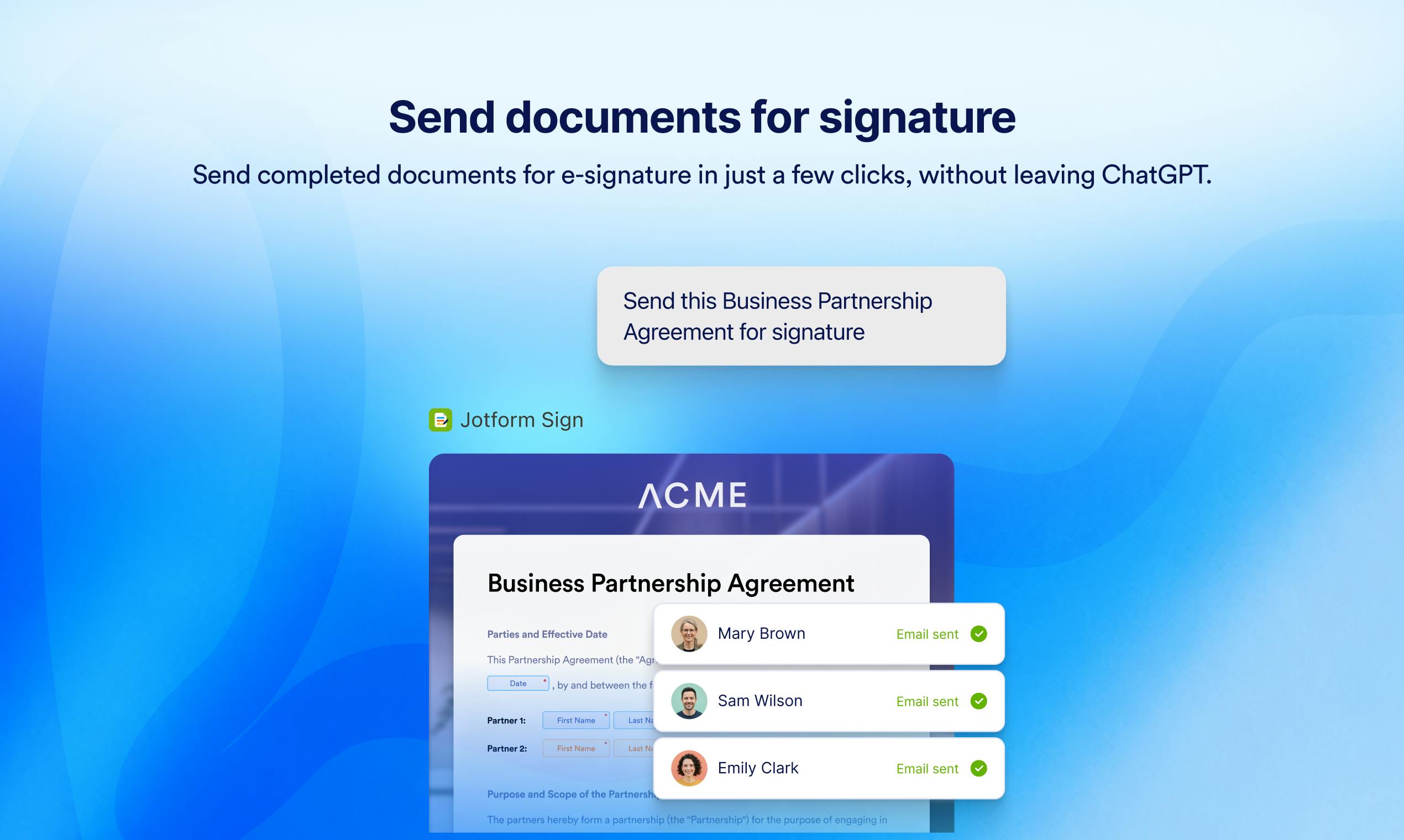
Jotform Sign for ChatGPT and Claude links conversational AI to an existing e-signature workflow. Users can start with a prompt or PDF, create or edit a signable document, add fields and recipients, set signing order, send it, and track status without leaving chat. Jotform’s September 29, 2026 announcement and support guide substantiate the workflow. The proposition is credible: reduce handoffs between AI-assisted drafting and signature collection.
This appears to be a feature inside Jotform, not an independent startup or separately investable asset. Jotform reports more than 40 million users across its product suite, and founder Aytekin Tank has described building the company without outside funding. These are parent-level signals, not proof of this connector’s adoption, willingness to pay, or incremental economics. No public figures were found for connector users, signing volume, retention, paid conversion, or revenue.
The feature enters a crowded and trust-sensitive market with DocuSign, Adobe Acrobat Sign, Dropbox Sign, and PandaDoc. Its near-term advantage is convenience plus Jotform’s existing forms and workflow ecosystem, not a demonstrated moat. I recommend Pass for a standalone investment in this feature, while viewing it as a potentially useful retention and cross-sell extension for Jotform. This is not a negative judgment on Jotform as a whole.
Product Overview
The workflow spans prompt or uploaded PDF, document editing, signature fields, signer roles/order, sending, and progress tracking. The official launch materials say users retain control over when a document is sent. Initial use cases include standardized service agreements, NDAs, releases, onboarding documents, and vendor approvals for SMBs already using ChatGPT or Claude and Jotform Sign.
The core value hypothesis is fewer context switches and less administration. It is not a replacement for legal review, complex negotiation, contract lifecycle management, or specialized enterprise controls. No independent time-saved study or third-party product evaluation was located; launch descriptions are company-authored.
Founder and Team Assessment
Founder Aytekin Tank publicly says Jotform operated for more than 12 years without outside funding. Jotform describes a 40M-plus user platform spanning forms, workflows, AI agents, payments, and e-signatures. Longevity and product breadth indicate meaningful execution and distribution at the parent level. The team specifically responsible for this connector, its roadmap, and its enterprise workflow expertise are not publicly detailed. No separate management team, cap table, or financing was identified. Founder-market fit for workflow software is credible; feature-team evidence is limited.
Market Opportunity
Electronic signatures and AI-assisted documents address recurring business activity, but this connector’s serviceable market is narrower than the entire e-signature category. The initial segment is active Jotform customers who draft agreements in ChatGPT or Claude and need lightweight routing and signatures.
A transparent scenario illustrates scale, not a forecast: if 1% of Jotform’s reported 40M platform users became active connector users, that would be 400,000 users. At an assumed $5/month incremental price, it implies $24M annualized revenue. Both adoption and price are analyst assumptions, not reported metrics or current connector pricing. If bundled, value may instead appear in retention and upgrades, which require a control-cohort analysis. A broader opportunity exists if the conversational workflow expands into repeat forms, signatures, payments, and approvals; current evidence does not establish that expansion.
Traction and Growth Signals
Jotform reports 40M+ users and offers a free entry tier, paid plans with higher usage/storage limits, and custom enterprise plans. Its public materials describe signed-document limits and enterprise features. The founder’s customer-funded-growth account supports a history of operating longevity, but is not audited financial evidence.
For this feature, the September 29 announcement confirms availability and workflow capabilities but gives no downloads, connected accounts, documents sent/completed, cohort retention, paid upgrades, or revenue. Product Hunt’s parent Jotform listing shows 4.8/5 from 17 reviews, 4.1K followers, and 50 launches; these are aggregate parent metrics, not evidence of demand for this specific integration. No feature-specific GitHub project or independent review cohort was found. Feature traction is therefore unproven.
Competitive Position and Defensibility
Alternatives include DocuSign eSignature, Adobe Acrobat Sign, Dropbox Sign, and PandaDoc. They compete with established customer relationships, integrations, enterprise procurement access, and trust. Users can also draft in ChatGPT or Claude and sign through another provider. Jotform’s wedge is combining its own signature workflow with two AI interfaces and its existing forms ecosystem.
What is defensible? Jotform’s platform distribution, templates, product breadth, and customer familiarity could support adoption and switching friction if the integration becomes part of repeat workflows. However, a connector is technically replicable; AI platforms control interface access and discovery. No exclusivity, proprietary data advantage, unique signature technology, or connector-level network effect is public. Defensibility is moderate at the parent level and weak for the feature alone.
Business Model and Economics
Jotform’s broader freemium subscription model expands through usage limits, storage, paid tiers, and enterprise controls. This provides a plausible route to monetize heavier users. It is not clear whether connector use is included in current plans, consumes existing signed-document allowances, or generates incremental charges.
Unit economics cannot be underwritten without activation, repeat signing, paid conversion, support and infrastructure costs, gross margin, retention, and expansion. If bundled, the key test is measurable lift in paid conversion or retention against a control cohort; if separately priced, willingness to pay must be demonstrated. No CAC, LTV, payback, or connector revenue data is public, and none is inferred here.
Valuation and Unicorn Path
No connector financing, revenue, or valuation was found; Jotform is private. As a feature inside a private parent, it has no observable standalone valuation or security. Inferring valuation from parent user counts would be misleading.
For scale illustration only, a hypothetical $1B company at 10× ARR requires $100M ARR. At an assumed $60/year incremental revenue per active connector customer, that implies roughly 1.67M paying customers. The $60 is an analyst scenario, not a Jotform price. If value accrues through parent retention or expansion, the required analysis is incremental revenue and churn versus a control group; no data is available. A standalone unicorn path is not demonstrated.
Key Risks
- Not separately investable: No standalone company, financing, or security identified.
- Unproven adoption: No feature-specific active users, signing volume, retention, or conversion disclosed.
- Bundled economics: Retention benefits may exist without measurable incremental revenue.
- Platform dependency: ChatGPT and Claude control access, policies, and discovery.
- Incumbent competition: Established e-sign providers have trust, integrations, and enterprise relationships.
- Low feature moat: Competitors can build similar conversational connectors.
- Legal/trust exposure: Generated terms or misconfigured signers can create costly errors; human review remains essential.
- Privacy/security: Documents may contain sensitive data passing through multiple providers; connector-specific retention and handling require diligence.
- Enterprise gaps: Identity, audit, data-residency, administration, or contract lifecycle needs may exceed a lightweight chat workflow.
- Metric attribution: Parent users and Product Hunt metrics do not establish this launch’s PMF.
Scorecard
| Dimension | Score | Rationale |
|---|---|---|
| Market | 13/20 | Large category, narrower connector wedge |
| Traction | 4/20 | Feature-level usage and economics unavailable |
| Team | 12/15 | Proven founder/platform; feature team unknown |
| Product | 8/10 | Coherent workflow and clear convenience |
| Distribution | 12/15 | Parent base and AI surfaces; incremental reach unmeasured |
| Business model | 5/10 | Subscription rails exist; connector monetization unclear |
| Defensibility | 4/10 | Parent assets help; feature is replicable |
| Total | 58/100 | Promising extension, weak standalone case |
Evidence Confidence
Medium (0.62). Primary sources confirm functionality, launch date, parent scale claims, and subscription structure. Confidence is limited by absent feature-level adoption and financial data, private-company disclosure gaps, and lack of independent reviews. Jotform’s user and bootstrapping figures are company-reported, not audited. Product Hunt figures are parent-page metrics only.
Final Assessment
Final Decision: Pass. Pass on a standalone venture investment because this is presented as a Jotform feature, not a separate company or financing opportunity; feature-specific adoption and incremental economics are undisclosed; and the connector alone has limited defensibility. It may still improve Jotform engagement, cross-sell, or retention. This is not a recommendation against Jotform’s overall business.
Upgrade to Watch/DD if: Jotform reports repeat-use cohorts and measurable conversion, retention, or expansion lift, and clarifies data handling and reliability.
Downgrade to Hard Pass if: usage is negligible, platform restrictions materially impair access, a security incident occurs, or support/legal costs exceed retention benefits.
Due-Diligence Questions
- How many unique accounts connected the integrations in the first 30, 90, and 180 days?
- What share send a document, complete signatures, and return to use the feature?
- What are repeat-use and retention cohorts by segment?
- Is access included, usage-limited, or separately priced?
- What lift in paid conversion, upgrades, attach rate, or churn is attributable to the feature?
- What are gross margin and support/infrastructure costs after connector use?
- What document data is sent to ChatGPT or Claude, and what are retention and model-training policies?
- Do connector flows preserve Jotform Sign’s authentication, consent, and audit-trail controls?
- What safeguards catch incorrect generated terms, recipients, or signing order before sending?
- What share of use comes from existing customers versus newly acquired accounts?
- What contractual and technical guarantees ensure continued connector availability and privacy?
- Is management positioning this as retention, a monetized product line, or a broader agentic workflow strategy?
Sources
- Product Hunt parent listing: https://www.producthunt.com/products/jotform
- Official launch announcement (September 29, 2026): https://www.jotform.com/newsletters/announcing-jotform-sign-for-chatgpt-and-claude-2/
- Product walkthrough: https://www.jotform.com/ai/announcing-jotform-sign-for-chatgpt-and-claude/
- Claude connector guide: https://www.jotform.com/help/how-to-create-a-signable-document-in-claude-with-jotform-sign-connector/
- Jotform Sign plans: https://www.jotform.com/products/sign/pricing/
- Jotform About: https://www.jotform.com/about/
- Aytekin Tank on customer-funded growth: https://www.jotform.com/blog/why-i-chose-customer-funded-growth-over-taking-vc-money/
- Jotform Sign security overview: https://www.jotform.com/enterprise/features/sign/advanced-security-sign/
- Adobe Acrobat business plans: https://www.adobe.com/acrobat/business/pricing-plans.html