Table of Contents
Attyn Investment Report
Category: AI productivity software (macOS cursor-level assistant: dictation, inline rewriting, screen Q&A)
Company Stage: Pre-seed / bootstrapped, ~3 days post-launch
Founder or Founders: “Rohit C” (LinkedIn: rohitattyn); full name and background not publicly verified linkedin
Headquarters: Not publicly disclosed
Funding: None — company states it is bootstrapped and self-funded with no investors attyn
Business Model: Prosumer software — freemium subscriptions ($5/$15 per month), $100 lifetime license, usage-based AI credits, BYOK attyn
Product Hunt Launch Date: Week of August 15, 2026 (Top 5 daily, founder-reported) linkedin
Report Date: August 18, 2026
| Investment Metric | Assessment |
|---|---|
| Venture Potential | 43/100 |
| Unicorn Path | Improbable |
| Valuation Attractiveness | Not Assessable |
| Evidence Confidence | 35/100 |
| Final Decision | Pass |
Executive Summary
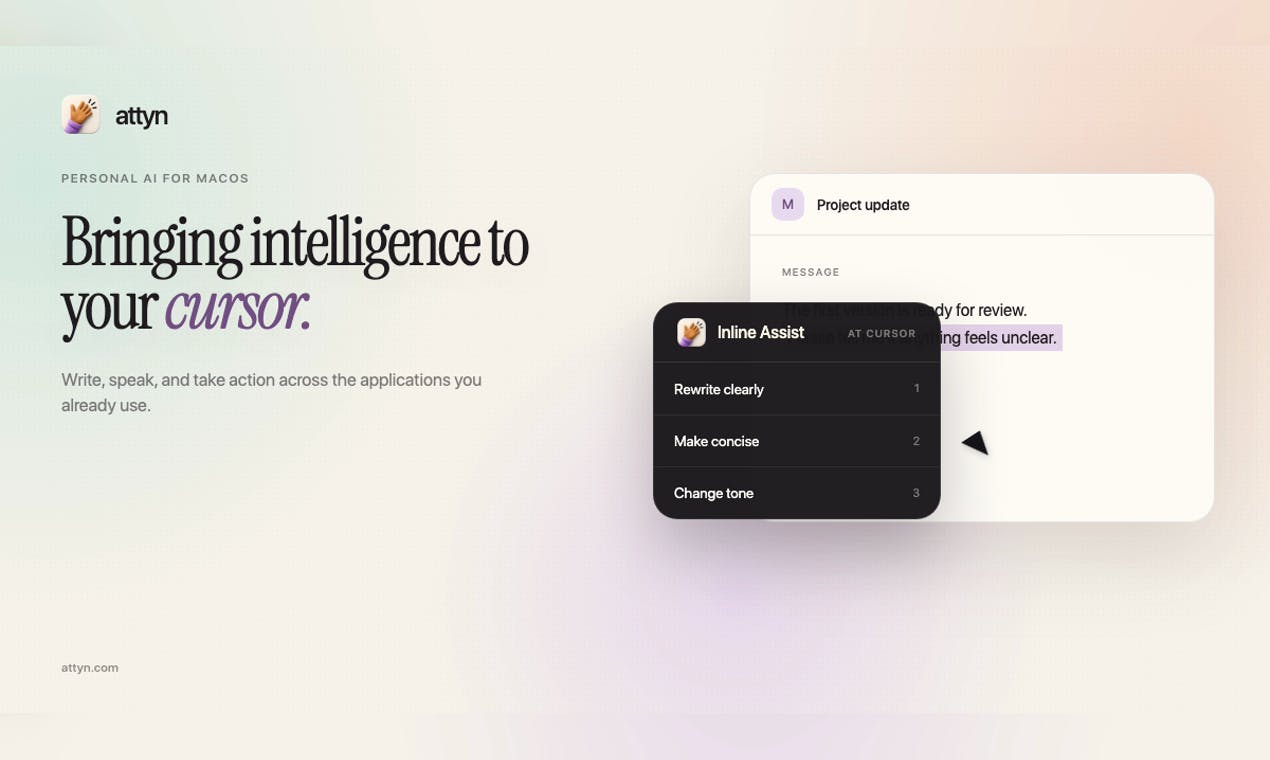
Attyn is a macOS utility that places AI assistance at the cursor inside any application: Realtime Dictation (on-device transcription in 39 languages), Inline Assist (rewrite selected text in place), Screen Assist (ask about what is on screen), and Blackboard (visual explanations). Intelligence is user-selected: Attyn Credits, a bring-your-own provider key, or a local model. It serves Mac knowledge workers who want AI help without switching to a chat window. producthunt
The product is genuinely thoughtful. Its privacy model — the gesture is the consent, with content scoped to the user’s deliberate selection or screen region — is more rigorous than most competitors’ approaches, and BYOK/local-model support gives it a credible cost and privacy story. The strongest positive signal is category validation: the AI dictation category just produced Wispr Flow’s $280M Series B at a $2B valuation, announced August 17, 2026. producthunt
The most important concern is structural, not product-related. Attyn explicitly describes itself as bootstrapped with “no investor behind it,” selling software to fund small-language-model research. That is a craft-business design, not a venture design. There is no revenue, user, or retention data; the founder is minimally identified; and the category contains a $2B competitor, several $8–15/month incumbents, lifetime-license rivals, and free platform features from Apple itself. attyn
Decision: Pass. This is a promising indie product whose current structure, economics, and stated ambitions do not fit a venture capital strategy. It is not a Hard Pass — there are no integrity concerns — and reconsideration conditions are listed below.
Product Overview
The customer problem is context switching: using AI today typically means leaving the app you are working in to visit a chat window, then copy-pasting back. Attyn’s answer is to deliver intelligence at the cursor. Select text and tap a key to rewrite it in place; hold a key and speak to drop finished, app-appropriate text at the cursor; tap a shortcut to ask about the screen (or hold and circle a region); ask for a visual explanation on a floating “Blackboard”. attyn
Pricing is unusually transparent. Realtime Dictation is now free forever (a post-launch change); $5/month (launch price, stated regular $10) adds Inline Assist; $15/month (regular $25) unlocks all four features; a $100 lifetime license (regular $199) sells the app outright. Cloud AI usage is separate: credit packs from $5 (5,000 credits) to $50 (55,000), BYOK, or local models. The product is macOS-only, Apple Silicon only, with a Windows waitlist. It replaces a patchwork of built-in macOS dictation, Apple Intelligence writing tools, and chat-app copy-paste. The product is live and downloadable; reliability at scale is unverified. attyn
Founder and Team Assessment
The founder identifies himself only as “Rohit” on the about page and “Rohit C” on LinkedIn (handle rohitattyn). His full name, professional history, technical credentials, and location are not publicly disclosed; LinkedIn profile details could not be accessed. The Attyn company LinkedIn page shows 7 followers. The about page is written in first person singular (“If something breaks, tell me and I will fix it”), and no other team members are named — team size is not disclosed, and the evidence points to a solo or very small team. linkedin
What can be verified indirectly: the product demonstrates competent native macOS engineering (on-device transcription, accessibility-level cursor integration), disciplined positioning, and strong launch copy. Full-time commitment is plausible given the product’s polish but is not verified. Key-person risk is at its maximum. No prior companies or exits are known.
Founder Assessment: Evident product craft and a clear philosophy, but identity, background, and commercial capability are all unverified — an unusually thin public founder profile.
Market Opportunity
The initial customer is narrow: a Mac-using (Apple Silicon) knowledge worker or prosumer who writes frequently and will pay $5–15/month to avoid context switching. Bottom-up: if the realistic initial pool is ~2–5 million reachable Mac power users globally, and 2–4% convert to a blended ~$120/year, that implies roughly $5–25M initial-segment ARR potential — a real business, not yet a venture-scale one. Expansion requires the Windows waitlist, teams (“Talk to sales” and private deployment are mentioned on the pricing page ), and eventually the founder’s stated ambition of a proprietary small local model. attyn
Top-down context is favorable but contested: AI voice dictation was estimated at ~$1.0B in 2024, forecast to ~$1.7B by 2031 (7.4% CAGR); broader “smart dictation systems” estimates run $5.5B (2025) to $18.8B (2035) at 13.1% CAGR. Market timing is excellent — Wispr Flow’s $2B mark proves willingness to pay — but the same validation has attracted a crowded field and free platform bundling. The realistic addressable slice for a Mac-only, low-ACV tool supports a strong indie business; venture-scale revenue requires the team/enterprise and cross-platform expansion the company has not yet evidenced. reuters
Traction and Growth Signals
Verified launch signals: Product Hunt launch week of August 15, 2026; founder-reported Top 5 daily ranking and “90+ upvotes and counting”; the product page shows 184–186 followers and a 5.0 rating from exactly 1 review. The founder engaged substantively with commenters, and at least one commenter (Manav Sehgal) praised the permission model. Minor third-party pickup exists: a LinkedIn “AI for Work” newsletter mention and inclusion in an AI-startup directory list. linkedin
Everything commercial is missing: no revenue, no download counts, no registered or active users, no paying customers, no retention, no app-store presence (direct download only), no public GitHub, no hiring signals, no press coverage. The post-launch decision to make dictation free forever suggests the team is still searching for its conversion wedge. Three days post-launch, there is no basis to distinguish durable demand from launch attention. attyn
Traction Assessment: A respectable mid-tier Product Hunt launch, commercially unverified in every dimension that matters.
Competitive Position
Direct competitors are numerous and aggressive on price: Wispr Flow ($15/month, cloud-only, $361M raised, $2B valuation); Superwhisper ($8.49/month or $249.99 lifetime, free tier, cross-platform); MacWhisper (~€64 lifetime); Spokenly (free + $9.99/month); Weesper Neon Flow (€5/month, €99 lifetime); and Mighty Cursor — a nearly identical “AI assistant in your cursor” Mac app selling $29 lifetime licenses, at times given away free on Reddit, which signals how weak monetization is at this tier. The free alternatives are the sharpest threat: macOS has built-in dictation and Apple Intelligence writing tools at $0. reuters
Attyn’s differentiation is real but narrow: gesture-scoped privacy, on-device dictation in 39 languages, BYOK/local-model flexibility, and a four-feature bundle at a low price. There are no switching costs, no proprietary data, no network effects, and no workflow lock-in beyond habit. If Apple shipped equivalent cursor-level rewriting and formatted dictation in macOS — or if Wispr Flow added BYOK and a Mac-native inline mode — there is no credible reason most customers would keep paying Attyn. The planned proprietary small model could change this, but it is a research aspiration, not an asset. attyn
Defensibility Assessment: Low
Business Model and Economics
The model mixes freemium subscriptions ($5/$15 per month), a $100 lifetime license, and usage-based credits, with AI inference costs pushed to the user via BYOK or local models. That last design is economically smart: for BYOK and local-model users, gross margin on software should approach typical SaaS levels (75–85%) since Attyn bears no inference cost; only credit-pack users create COGS exposure, and credit pricing ($5–$50 packs with 5–10% bonuses) suggests a resale margin over provider API costs. attyn
The weaknesses are venture-relevant: lifetime licenses convert future ARR into one-time cash, capping LTV at $100; the free-forever dictation tier removes the most viral feature from the paywall; and a $5–15/month consumer price point demands enormous volume. Expansion revenue exists in theory (credits, team deployments) but is unevidenced. The critical unknowns: free-to-paid conversion, monthly churn, credit attach rate, and support load for a solo founder.
Unicorn Path
Assume a 10x ARR multiple — generous but defensible for premium AI SaaS in a hot category (Wispr Flow’s implied multiple is far higher, but that reflects speculative growth pricing, not a replicable benchmark ). reuters
Required ARR = $1B ÷ 10 = $100M. At the top tier ($15/month, $180/year): ~555,000 paying subscribers. At a blended ~$120/year: ~830,000. At the $5 tier: ~1.67 million. The $100 lifetime license does not build ARR at all — one million lifetime buyers would produce $100M of cumulative, non-recurring revenue that no SaaS multiple would reward. For calibration, the category leader required ~$361M of capital and an enterprise motion to reach a $2B mark. reuters
Reaching $100M ARR would require Attyn to: ship Windows and mobile, move from individuals to teams/enterprise, raise ACV by an order of magnitude, build repeatable distribution beyond Product Hunt, hire a real team, and raise substantial external capital — each of which contradicts the founder’s stated bootstrapped, research-funding design. A unicorn outcome is not logically impossible (the category clearly supports one), but it requires a complete strategic transformation the founder has explicitly disclaimed. attyn
Unicorn Path: Improbable
Valuation Assessment
There is no funding history, no investors, no round, and no valuation. The company states it is self-funded with no investors. No Crunchbase entry, funding announcement, or secondary transaction was found. There is no entry price for an investor because the company is not raising. attyn
Valuation Attractiveness: Not Assessable. Assessment would require: current MRR/ARR and growth, free-to-paid conversion and churn, lifetime-vs-subscription mix, gross margin on credit sales, burn and runway, and — above all — whether the founder would even accept outside capital and on what structure. Until a round exists, any valuation range would be fabricated precision.
Key Risks
- Structural venture misfit: the founder explicitly rejects investors; there may be no investable security at any price attyn
- Platform replication: Apple can bundle cursor-level rewriting and formatted dictation into macOS for free
- Competitive compression: a $361M-funded category leader plus $8–15/month and lifetime-license rivals cap pricing power reuters
- Solo-founder key-person risk: engineering, support, and research appear concentrated in one unverified individual attyn
- Zero commercial evidence: no revenue, users, retention, or conversion data three days post-launch
- Lifetime-deal economics: $100 one-time sales cannibalize the recurring revenue a venture case requires attyn
- Distribution dependency: launch-driven acquisition with no evidenced repeatable channel; no App Store presence
- Free-tier generosity: giving away the most habit-forming feature (dictation) may strand users at $0 attyn
- Mac-only, Apple-Silicon-only footprint limits near-term TAM attyn
- Privacy-permission surface: screen-capture features carry inherent security/privacy sensitivity despite the careful gesture model producthunt
Final Assessment
Venture Potential: 43/100
| Category | Score |
|---|---|
| Market Size and Expansion Potential | 12/20 |
| Traction and Growth Evidence | 4/20 |
| Founder and Team | 6/15 |
| Product Strength | 7/10 |
| Distribution Potential | 6/15 |
| Business Model and Economics | 5/10 |
| Defensibility | 3/10 |
| Total | 43/100 |
Strongest element: a genuinely well-designed product in a freshly validated, growing category. Weakest: no commercial traction evidence, minimal defensibility, and a founder who states he does not want investors.
Evidence Confidence: 35/100
Verified: product existence and functionality, full pricing, launch timing, platform constraints, competitive set. Company-reported: bootstrapped status, Top 5 ranking, 90+ upvotes. Unavailable: founder’s full identity and background, team size, legal entity, headquarters, revenue, users, retention, burn, and any financing terms. This is a thin public record even by launch-week standards. linkedin
Final Decision: Pass
Attyn is a good product and, on present evidence, a deliberately non-venture company. Venture Potential of 43/100 sits in the niche/bootstrapped band, which matches the founder’s own stated design. The unicorn path is improbable without a transformation the founder has disclaimed; valuation is not assessable because nothing is being sold to investors; evidence confidence is low. Pass does not mean the product is bad — it means the risk-return profile and the company’s own structure do not fit a venture strategy.
Upgrade Conditions
- Founder decides to raise external capital and pursue a subscription-first, teams/enterprise motion
- Verified $500K+ ARR with >70% six-month retention and subscription (not lifetime) revenue dominating
- Windows launch producing measurable cross-platform growth
- Evidence of a repeatable, non-Product-Hunt acquisition channel
- A defensible asset ships: the proprietary local model with measurable quality/cost advantages
- A verifiable team forms around the founder
Downgrade Conditions
- Post-launch stagnation: flat follower/review counts and no product updates within 90 days
- Free dictation failing to convert (free-to-paid below ~2%)
- Apple or Wispr Flow shipping equivalent cursor-level inline features
- Lifetime licenses dominating revenue mix
- Founder abandons the product or the small-model research consumes the software business
Questions for Further Diligence
- What are current downloads, registered accounts, and WAU since the August 15 launch?
- What is the free-to-paid conversion rate on the $5 and $15 tiers, and what share of revenue is lifetime licenses?
- What are 30/90/180-day retention and churn for paying users?
- What is MRR today, and what was the week-over-week trend post-launch?
- What is the credit-pack attach rate, and what gross margin do credits earn over provider API costs?
- What is your full name, background, and prior employment — and is anyone else working on Attyn?
- Is there a legal entity, and in which jurisdiction?
- Would you ever accept outside capital, and under what structure?
- What is the concrete roadmap and budget for the proprietary small language model?
- How will you respond when Apple or Wispr Flow ships inline, cursor-level rewriting?
- What does the Windows waitlist count look like, and what is the ship timeline?
- What are the security architecture and data-handling practices for Screen Assist captures?
Sources
- Product Hunt — Attyn (launch page, metrics, comments)
- Attyn — Official site and Attyn — Pricing (plans, credits, BYOK, platform constraints)
- Attyn — About / “Why Attyn” (founder note, bootstrapped status, small-model vision)
- Attyn — AI Dictation guide (on-device dictation, 39 languages, trial)
- Rohit C — LinkedIn launch post (Top 5 ranking, 90+ upvotes; founder-reported)
- Reuters — Wispr Flow valued at $2B (category validation, $280M Series B)
- Spokenly — Wispr Flow vs Superwhisper vs MacWhisper and Superwhisper vs MacWhisper (competitor pricing; secondary)
- Weesper — MacWhisper vs Superwhisper 2026 (pricing cross-check; secondary)
- Mighty Cursor and Product Hunt — Mighty Cursor (closest direct competitor)
- OpenPR — AI Voice Dictation Market and Future Market Insights — Smart Dictation Systems (market sizing; secondary)