
Table of Contents
Toolport Investment Report
Category: Developer Tools / AI Infrastructure (open-source MCP gateway)
Company Stage: Pre-seed; appears bootstrapped (not verified)
Founder or Founders: “Tyler” (GitHub: tsouth89; Product Hunt: @tsouth2) — full legal identity not publicly disclosed
Headquarters: Not publicly disclosed
Funding: Not publicly disclosed; no funding announcements found. A GitHub Sponsors page exists, suggesting self-funding github
Business Model: Open-core — free MIT-licensed local desktop app; paid “Teams” tier at $39/month for up to 5 people, then $12/person/month, hosted or self-hosted toolport
Product Hunt Launch Date: June 23, 2026 (as “Conduit”); third launch August 2026, #5 daily rank, 149 points github
Report Date: August 11, 2026
| Investment Metric | Assessment |
|---|---|
| Venture Potential | 48/100 |
| Unicorn Path | Improbable |
| Valuation Attractiveness | Not Assessable |
| Evidence Confidence | 38/100 |
| Final Decision | Watch |
Executive Summary
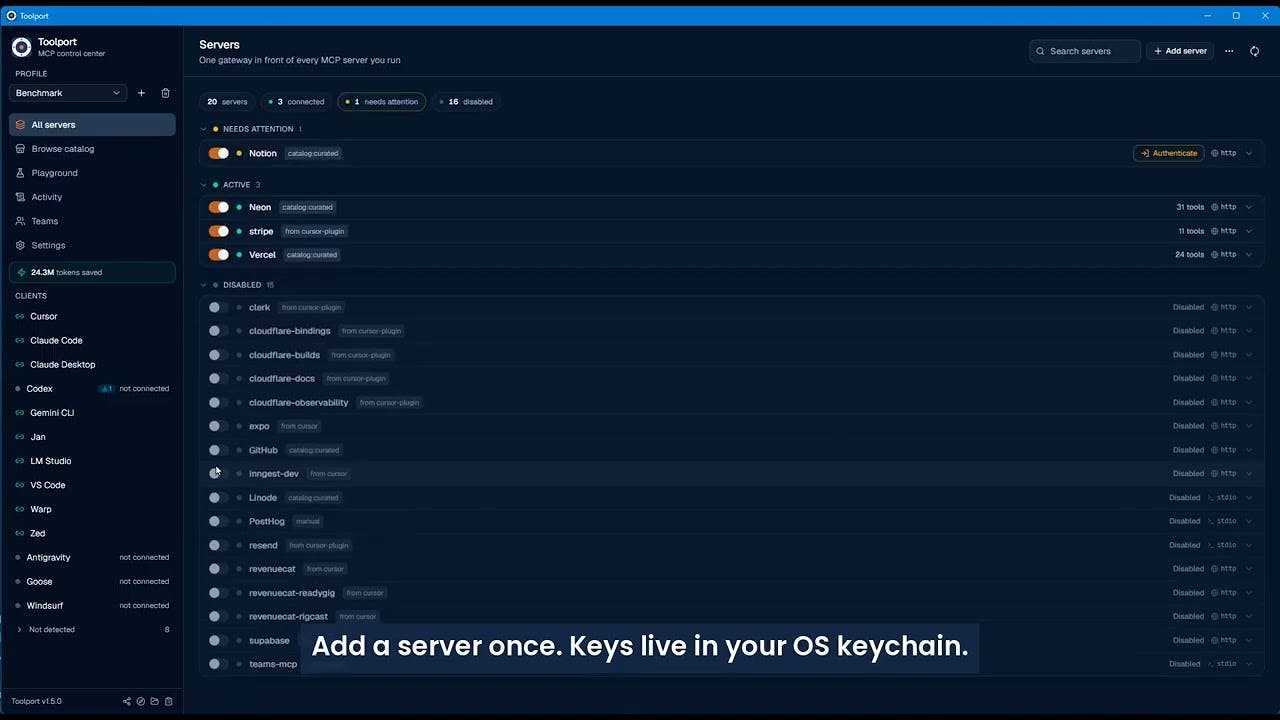
Toolport is a free, open-source (MIT) local gateway for Model Context Protocol (MCP) servers. It solves two concrete problems for developers using AI coding agents: every MCP server dumps its full tool list into the model’s context on every request (three servers ≈ 24,000 tokens before the first prompt), and every AI client (Claude, Cursor, Codex, VS Code, and ~30 more) requires its own duplicate server configuration with plaintext API keys. Toolport routes all servers through one local gateway that exposes four searchable meta-tools, claiming a measured 74–91% token reduction at equal task success, with secrets stored in the OS keychain and security features such as rug-pull and tool-poisoning detection. reddit
The product is genuinely well executed for a two-month-old project: cross-platform signed installers, 35 client integrations, a published reproducible benchmark, headless Docker deployment, and near-daily commits (v1.12.0 at research time). The strongest positive signal is this technical velocity combined with a real, measurable pain point in a growing category — the AI gateway market is projected to grow from roughly $4.9B in 2026 to $11.9B by 2032. note
The central investment concern is structural, not executional. Toolport’s core feature — lazy tool discovery — is exactly the kind of capability AI clients are beginning to absorb natively; a Product Hunt commenter notes Claude Code already defers MCP schemas so they load only when called. Meanwhile, Docker, Microsoft, IBM, and Kong all ship free or open-source MCP gateways. Monetization rests on a low-ACV team subscription ($468/year entry) with zero disclosed paying customers. zuplo
There is no evidence of revenue, retention, funding, or even the founder’s full identity. This is a promising open-source project, not yet a verifiable company. Final decision: Watch.
Product Overview
Toolport targets developers and small teams who run multiple MCP servers across several AI clients. The desktop app (Tauri/React with a Rust gateway binary) lets users add each MCP server once, then shares it across every connected agent, namespacing tools to avoid collisions. Core features: lazy tool discovery via four meta-tools, per-agent scoping, OAuth/key auth with secrets in the OS keychain, tool-integrity fingerprinting (rug-pull and poisoning detection), human-in-the-loop approval for destructive calls, audit logging, and a headless Docker gateway for network use. reddit
Pricing: the local app is free and open source. Toolport for Teams is free up to 5 people; the paid Team plan is $39/month for up to 5, then $12/person/month ($390/year annual option), identical hosted or self-hosted. It replaces the manual workflow of pasting JSON configs and API keys into each AI client separately, and replaces “flat” tool loading that inflates token bills. The product is live, functional, and verifiable. toolport
Founder and Team Assessment
The founder identifies himself only as “Tyler” on Product Hunt (@tsouth2) and GitHub (tsouth89). No LinkedIn profile, prior employment history, previous companies, or exits could be verified. Searches for a company entity surfaced only Toolport GmbH, an unrelated German tent wholesaler — a name-collision risk worth noting. Team size appears to be one; commit history shows tsouth89 plus an AI assistant (“claude”) as co-author. Full-time commitment is not disclosed, though the release cadence (roughly weekly versions, near-daily commits) is consistent with full-time work. linkedin
Technical capability is well evidenced: Rust/Tauri engineering, code-signed and notarized installers, CI, benchmarks, and security-conscious design. Commercial capability — sales, pricing strategy, enterprise motion — is entirely unproven. Key-person risk is at its maximum.
Founder Assessment: Strong technical execution by a solo founder, but identity, background, and commercial capability remain unverified.
Market Opportunity
The initial customer is narrow: an individual developer or 2–20-person engineering team running three or more MCP servers across multiple AI coding clients. The broader MCP gateway/control-plane category is emerging as real infrastructure, with analysts projecting the AI gateway market at ~$4.9B in 2026 growing to ~$11.9B by 2032, and multiple vendors framing MCP gateways as “the missing control plane” for agents. linkedin
Bottom-up: Toolport’s monetizable wedge is paid teams. Assume roughly 50,000–100,000 engineering teams globally will adopt MCP heavily enough by 2028 to need shared, governed server configuration, at a blended ~$600–1,200 per team per year on Toolport’s pricing. That implies a realistic serviceable market of roughly $30M–120M ARR — meaningful, but not obviously venture-scale without moving upmarket to enterprise governance (SSO, audit, policy enforcement) where ACVs reach $25k–100k. Adjacent expansion includes enterprise self-host, registry/catalog curation, and agent observability. Timing is favorable — MCP adoption is early and the spec is still evolving (Toolport already supports the 2026-07-28 spec) — but the same immaturity means enterprise willingness to pay is unproven. github
Traction and Growth Signals
Verified signals: three Product Hunt launches since June 23, 2026 (140 points on the first; 149 points and #5 daily rank on the latest; 350 product followers); 147 GitHub stars and 49 forks; an active Discord; a Reddit thread on r/LocalLLaMA in July 2026; and rapid shipping (v1.12.0, Homebrew cask, GHCR Docker image). The founder engages substantively with technical criticism in comments, including honest treatment of benchmark edge cases. note
However: no revenue, MRR, paying-customer count, download count, or active-user figure is disclosed anywhere. GitHub traction (147 stars in ~2 months) is modest for an open-source devtool seeking venture scale. There are no customer case studies, no enterprise references, and no hiring signals. Product Hunt votes here indicate developer curiosity, not product-market fit.
Most important missing metrics: weekly active gateway users, free-to-Teams conversion, paying team count, and revenue.
Traction Assessment: Promising launch attention and development velocity, but commercially unverified.
Competitive Position
Direct competitors include Metorial (open-source integration gateway), MCPJungle, and MCP360. Far more dangerous are free, platform-backed gateways: Docker MCP Gateway, Microsoft’s MCP Gateway (Kubernetes-native), IBM’s ContextForge, Kong’s MCP gateway, agentgateway, and Zuplo. Zuplo’s June 2026 comparison already catalogs at least ten MCP gateway tools. zuplo
Toolport’s differentiation is real but narrow: local-first desktop UX, one-click setup across 35 clients, OS-keychain secrets, and consumer-grade polish that enterprise gateways lack. Switching costs are low (MIT license, standard MCP on both sides), there is no proprietary data or network effect, and the self-host option undercuts its own hosted tier. note
The critical question — if the largest platform shipped this feature in six months, why would customers stay? — has no strong answer. Claude Code is already deferring tool schemas natively; if Anthropic, Cursor, or Docker bundle lazy discovery and shared config, Toolport’s core value compresses to its security/approval layer, which is also replicable. github
Defensibility Assessment: Low
Business Model and Economics
The model is open-core subscription. Entry ACV is ~$468/year; a 20-person team pays roughly $2,600/year. Because the free tier runs entirely locally (no cloud, no accounts), free-user COGS is near zero — a genuine margin advantage over inference-heavy AI products. The hosted Teams tier carries modest infrastructure costs; self-host shifts those to the customer. toolport
The open questions dominate: free-to-paid conversion (typical open-source devtools convert at low single digits), churn, and whether teams will pay $12/seat for governance when Docker and Microsoft offer gateways free. There is no enterprise tier, no usage-based revenue, and no disclosed expansion motion. At current pricing, even 1,000 paying teams yields only ~$0.5–1.5M ARR. Assumptions requiring verification: conversion rate, seat expansion, support burden, and hosted-tier gross margin. microsoft.github
Unicorn Path
Assumed multiple: 10x ARR, appropriate for a high-growth infrastructure/devtool SaaS with strong retention (generous given current evidence). Required revenue = $1B ÷ 10 = $100M ARR.
At the current blended ~$1,000/team/year, that requires roughly 100,000 paying teams — implausible against free competition from Docker, Microsoft, and IBM. Via an enterprise pivot at $50k ACV, it requires ~2,000 enterprise customers — conceivable in the abstract for a control-plane vendor, but Toolport has no enterprise product, no sales team, no SSO/compliance features disclosed, and no evidence of enterprise demand. ibm.github
Required strategic changes: move from individual developers to enterprise platform (SSO, audit, policy), raise ACV 50x, build a sales motion, and out-execute platform vendors with 100x the resources. The local-first, keys-never-leave-the-machine architecture is philosophically attractive but limits the data/network effects that usually power infrastructure unicorns.
Unicorn Path: Improbable
Valuation Assessment
No funding rounds, investors, valuations, or SAFE terms were found in any public source. The project appears bootstrapped with a GitHub Sponsors page. No revenue exists to anchor a multiple. github
Valuation Attractiveness: Not Assessable. Any range would be fabricated from product quality alone, which this analysis explicitly avoids. Information required: current MRR/ARR and growth, paying team count, retention, founder’s intended round size and instrument, SAFE cap or target post-money, and burn/runway. For calibration only: 2025–26 pre-seed devtool medians cluster around $10–15M SAFE caps; whether Toolport merits even that depends entirely on undisclosed commercial data. startupa
Key Risks
- Platform commoditization: AI clients (Claude Code already defers schemas) absorb lazy discovery natively github
- Free platform competition: Docker, Microsoft, IBM, Kong ship comparable gateways at zero cost konghq
- Unproven willingness to pay: no disclosed paying customers; free core may satisfy most users
- Solo-founder key-person risk: one developer, identity unverified note
- Low switching costs / fork risk: MIT license, standard protocols both sides
- Small ACV economics: $468 entry ACV makes paid acquisition and sales uneconomic; growth must be purely organic
- Self-host cannibalization: identical pricing hosted or self-hosted caps hosted revenue toolport
- MCP ecosystem dependency: spec changes or a decline in MCP adoption directly hit the product
- Brand/trademark exposure: established “Toolport” entities exist in unrelated industries linkedin
Final Assessment
Venture Potential: 48/100
| Category | Score |
|---|---|
| Market Size and Expansion Potential | 13/20 |
| Traction and Growth Evidence | 5/20 |
| Founder and Team | 7/15 |
| Product Strength | 8/10 |
| Distribution Potential | 7/15 |
| Business Model and Economics | 5/10 |
| Defensibility | 3/10 |
| Total | 48/100 |
Strongest element: product quality and execution velocity against a real, measurable pain point. Weakest: defensibility and traction — the core feature is replicable by the very platforms it serves, and there is no commercial evidence whatsoever. At 48, this profiles as a strong open-source project more likely to become a bootstrapped business or an acquisition-hire target than a venture-scale company.
Evidence Confidence: 38/100
Verified: product existence and functionality, pricing, open-source license, development activity, Product Hunt metrics. Company-reported and unverified: benchmark figures (reproducible in principle). Unavailable: founder identity and background, legal entity, headquarters, revenue, users, customers, retention, funding, valuation, and team size. No secondary-source amplification was treated as verification. reddit
Final Decision: Watch
The product is genuinely good and the category is real, but there is no evidence of a company yet — no revenue, no customers, no verified founder, no funding — and the defensibility question has no credible answer. This fits Watch precisely: promising quality, uncertain venture path, insufficient validation for formal diligence.
Upgrade Conditions
- 500+ paying teams or ~$25k+ MRR, verified
- Sustained GitHub growth past ~3,000 stars with external contributors
- Evidence of enterprise pilots or a shipped enterprise tier (SSO, audit)
- Founder identity, background, and full-time commitment verified; team beyond solo
- Demonstrated retention of paying teams over two renewal cycles
Downgrade Conditions
- Native lazy tool discovery shipped by Claude Code, Cursor, or Docker’s gateway
- Commit/release cadence stalls for 60+ days
- Free-to-paid conversion below ~1% after the Teams tier matures
- A platform vendor forks or replicates the security/approval layer
Questions for Further Diligence
- What are current MRR, paying team count, and month-over-month growth since the Teams launch in July 2026?
- What is the free-to-paid conversion rate, and the 90/180-day retention of paid teams?
- How many weekly active gateway installations exist, and how is that measured given the local-first, no-account design?
- What is the hosted Teams tier’s gross margin, and what infrastructure does it actually require?
- What is your full professional background, and is Toolport your full-time commitment?
- What is the legal entity, cap table, and any prior capital raised (including SAFEs)?
- What is the defense roadmap if AI clients ship native lazy discovery — is the answer the security/approval layer, and do customers pay for that standalone?
- Are any enterprises piloting Toolport, and what compliance features (SSO, audit export, SOC 2) are planned?
- Why is self-hosted priced identically to hosted, and what does that imply for the long-term revenue mix?
- What round size, instrument, and valuation cap are you targeting, and what runway does it buy?
Sources
- Product Hunt — Toolport github
- Toolport official site toolport
- Toolport for Teams pricing toolport
- GitHub — tsouth89/toolport note
- GitHub Sponsors — tsouth89 github
- Reddit r/LocalLLaMA thread (secondary) reddit
- Zuplo — MCP Gateway comparison zuplo
- Microsoft MCP Gateway microsoft.github
- IBM ContextForge ibm.github
- Kong — What is an MCP Gateway konghq
- AI gateway market projection (secondary) note
- Startup valuation benchmarks 2026 (secondary) startupa