
Table of Contents
BetterClaw Investment Report
Category: No-code AI agents, workflow automation, managed agent infrastructure
Company Stage: Early commercial / bootstrapped or funding status not disclosed
Founder or Founders: Not formally disclosed; Naveen Gupta appears to lead technical development, while Shabnam Katoch represented the team on Product Hunt
Headquarters: New Delhi, India
Funding: Not publicly disclosed
Business Model: Freemium SaaS with agent- and usage-based subscriptions; custom enterprise plans
Product Hunt Launch Date: August 11, 2026; initial public product launch reported as February 25, 2026
Report Date: August 14, 2026
| Investment Metric | Assessment |
|---|---|
| Venture Potential | 54/100 |
| Unicorn Path | Conditional |
| Valuation Attractiveness | Not Assessable |
| Evidence Confidence | 48/100 |
| Final Decision | Watch |
Executive Summary
BetterClaw is a hosted, no-code platform for deploying autonomous AI agents without configuring servers, Docker, YAML files, or agent-runtime infrastructure. Users connect an AI model, messaging channel, and business applications; define a task in natural language; and schedule the resulting agent. The initial target users are founders, agencies, and operations, support, recruiting, and marketing teams without dedicated AI-infrastructure expertise.
The product addresses a genuine usability problem. Open-source agent frameworks such as OpenClaw and ZeroClaw can be powerful, but require installation, security configuration, monitoring, and maintenance. BetterClaw packages a visual builder, managed runtime, scheduled tasks, OAuth integrations, cost controls, persistent memory, agent-specific permissions, and approval-based trust levels into a simpler hosted product (official website; OpenClaw repository; ZeroClaw repository).
The strongest positive investment signal is product velocity. BetterClaw’s changelog documents releases spanning agent deployment, integrations, team workspaces, a skills marketplace, reusable skills, and security documentation between February and June 2026. The company also reports more than 10,000 monthly agent tasks and more than 50 companies using the platform. However, these metrics are company-reported and have not been independently verified (changelog).
The principal investment concern is the lack of commercial evidence and weak current defensibility. Revenue, paying customers, retention, funding, gross margin, and acquisition costs are unavailable. BetterClaw relies on third-party runtimes, model providers, infrastructure vendors, and integration provider Composio. Comparable capabilities are available through open-source projects, n8n, Zapier, Lindy, Relevance AI, and major cloud platforms.
There are also inconsistencies requiring diligence. Marketing materials reference different numbers of integrations and vetted skills, identify the runtime variously as ZeroClaw and OpenClaw, and make an ISO 27001 certification claim without publishing a certificate or trust-center record. Security documentation says BetterClaw never touches prompts or responses, while its privacy policy explains that managed-model requests are routed through OpenRouter and that certain agent data and logs are retained. These points may have reasonable technical explanations, but should not be accepted without verification.
The appropriate decision is Watch. BetterClaw has a useful product and a potentially large market, but current evidence is insufficient to justify formal diligence. An upgrade would require verified paying-customer growth, retention, unit economics, and a clearer proprietary advantage.
Product Overview
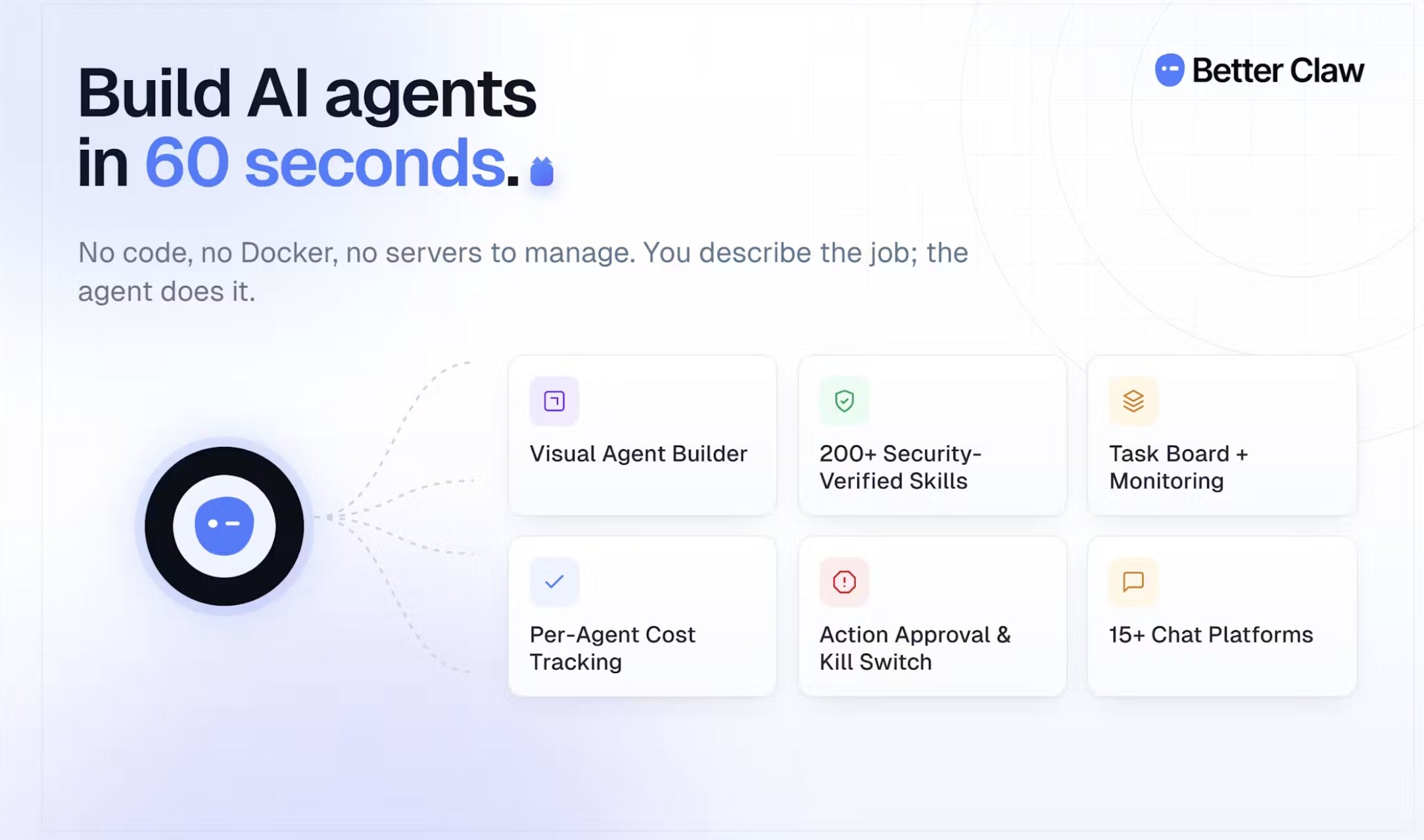
BetterClaw reduces the operational work required to deploy persistent AI agents. Users can select a template or describe an agent, connect channels such as Slack, Telegram, Discord, or Gmail, grant access to tools, and configure recurring tasks. Agents can return files, maintain task states, use persistent memory, and execute actions according to configured approval rules.
Core features include:
- A visual, no-code agent builder;
- Scheduled and recurring autonomous tasks;
- Bring-your-own-model-key support across multiple providers;
- OAuth integrations through Composio;
- Isolated agent containers and encrypted credentials;
- “Intern,” “Specialist,” and “Lead” trust levels;
- Per-agent spending limits and a kill switch;
- A marketplace of reviewed agent skills;
- Team workspaces and multi-account connections;
- Managed cloud deployment through Azure and Railway.
BetterClaw states that it is a separate platform built on the open-source ZeroClaw Rust runtime while supporting OpenClaw-compatible skills. This is more precise than other site language describing the service as powered by an “OpenClaw” runtime and should be clarified contractually (website FAQ; ZeroClaw).
Pricing is transparent:
| Plan | Monthly price | Main allowance |
|---|---|---|
| Free | $0 | 1 agent, 500 credits, 3 connectors |
| Pro | $49 | 5 agents, 12,000 credits, 2 seats |
| Business | $149 | 25 agents, 40,000 credits, 5 seats |
| Enterprise | Custom | Custom agents, infrastructure, seats, and support |
Annual prices are $39 per month for Pro and $119 for Business. Additional agents, seats, and execution credits are sold separately. One credit is described as one minute of agent-machine uptime, although some site language also says connector and proxy activity consumes credits; billing mechanics require verification (pricing).
Product-quality assessment: Good early product breadth and accessible pricing, but production reliability, agent accuracy, and security architecture have not been independently validated.
Founder and Team Assessment
BetterClaw is operated by BitQit Private Limited, a New Delhi software company that also operates Headshot Photo and ecommerce-search product Sparq. The official team page identifies five technical employees, four marketing employees, and two support employees. It does not identify a CEO or formal BetterClaw founder (about page).
Naveen Gupta is listed as a technical team member and appears to lead development and sales calls. His public profiles identify him as a BitQit founder and builder of other SaaS products. Lakshdeep Rajput is also publicly associated with founding BitQit, but the official BetterClaw materials do not state his current role in the product. Shabnam Katoch, identified as a marketing team member, introduced BetterClaw on Product Hunt as “one of the people behind BetterClaw.”
The team has relevant experience operating existing internet products, which provides more execution evidence than a first-time project. Nevertheless, individual responsibilities, equity ownership, full-time commitment, prior revenue outcomes, and technical authorship of the core runtime are not public.
The approximately 11-person roster is company-published rather than independently verified. No current BetterClaw job listings or separate company LinkedIn profile were found.
Founder Assessment: Relevant SaaS-building experience and visible technical capacity, but leadership, ownership, and founder commitment require clarification.
Market Opportunity
The narrow initial segment is small companies and agencies that want persistent AI agents but lack the engineering resources to deploy and secure open-source infrastructure. The customer problem is not access to an LLM; it is maintaining agents, integrations, permissions, scheduling, monitoring, and uptime.
A bottom-up scenario can be constructed from current pricing:
- 500,000 technically suitable small businesses and agencies globally;
- 2% paid penetration, or 10,000 accounts;
- $500–$1,500 annual platform revenue per account;
- Implied annual revenue of approximately $5–$15 million.
This is an analyst scenario, not a verified market figure. It illustrates that the current self-service segment could support a meaningful software business but not necessarily a unicorn.
Larger potential requires enterprise expansion. BetterClaw would need higher-value deployments involving multiple teams, compliance controls, hundreds of agents, proprietary workflow templates, service guarantees, and centralized governance. Adjacent opportunities include vertical agent packages for customer support, recruiting, marketing operations, ecommerce, and agencies managing agents for clients.
Market timing is favorable because open-source agent runtimes are proliferating, while many non-technical businesses cannot operate them securely. However, the same trend lowers barriers for competing hosted services.
Traction and Growth Signals
BetterClaw publicly reports:
- More than 50 companies using the product;
- More than 10,000 agent tasks per month;
- A contractual 99.9% uptime SLA for Business and higher plans;
- 18 curated skills on the homepage, while other pages reference more than 200 verified skills;
- 824 rejected skills;
- More than 50 completed AI-readiness audits.
These figures are company-reported and lack a public methodology. “Companies” is not defined as paid customers, active workspaces, audit participants, or sign-ups. The company’s blog separately claims use by recognizable organizations including Carelon, Grainger, KeHE, Premier, and Robert Half, but no customer case studies or announcements from those companies were found. These names should be treated as unverified customer claims, not established enterprise contracts.
BetterClaw ranked #2 on Product Hunt on August 11, 2026 and received a small number of highly positive reviews. Product Hunt attention demonstrates initial launch interest but does not verify revenue, retention, or sustained use (Product Hunt; awards).
The changelog is a more meaningful signal: it records regular feature releases from February through June. However, the last listed update predates the Product Hunt launch by approximately seven weeks, so ongoing cadence should be monitored.
The most important missing metrics are MRR, paid workspaces, free-to-paid conversion, active agents, tasks per retained customer, cohort retention, and subscription churn.
Traction Assessment: Early product activity is visible, but commercial traction is unverified.
Competitive Position
Direct competitors include hosted OpenClaw providers, Lindy, Relevance AI, CrewAI Enterprise, Gumloop, AgentHub, and other no-code agent builders. Workflow platforms such as n8n, Zapier, Make, and Pipedream provide indirect alternatives. Google Vertex AI Agent Builder, Microsoft Copilot Studio, Amazon Bedrock Agents, and OpenAI’s agent tooling can bundle overlapping functionality.
Free alternatives include self-hosting OpenClaw or ZeroClaw, building workflows in n8n, and running scheduled scripts with model APIs.
BetterClaw’s differentiation consists of:
- Rapid setup for non-technical users;
- OpenClaw-compatible skills on a managed ZeroClaw runtime;
- BYOK pricing without model markup;
- Approval-based trust levels;
- Security review of third-party skills;
- Low, transparent entry pricing.
Switching costs are currently modest. Agent prompts, model keys, and integrations can often be moved to another platform. BetterClaw has no demonstrated network effect, proprietary model, unique dataset, or exclusive distribution channel.
If the largest platform launched the same feature within six months, why would customers stay? The present answers are simpler operations, lower cost, model neutrality, and compatibility with community skills. These are useful but replicable. Durable retention would require trusted workflow libraries, accumulated operational memory, superior monitoring, or strong vertical distribution.
Defensibility Assessment: Low.
Business Model and Economics
BetterClaw earns subscription and usage revenue while allowing customers to pay model providers directly. This limits inference-margin risk on BYOK accounts, but BetterClaw still pays for Railway or Azure compute, storage, OAuth infrastructure, monitoring, support, and free-tier usage.
At $49 monthly, Pro permits 12,000 credits, described as agent-machine minutes. If customers use the full allowance, infrastructure cost could be material. The company has publicly suggested that a free user costs approximately $0.80–$2 monthly, but the figures conflict across Reddit posts and are not verified.
Business pricing offers a dedicated Railway instance and substantial execution capacity for $149 monthly. Gross margin depends heavily on actual utilization rather than nominal allowances. Low-use accounts could be attractive; sustained autonomous workloads could compress margins.
Expansion revenue can come from additional agents, credits, seats, premium support, and enterprise infrastructure. The sales-led free AI audit may help acquire customers, but could become service-intensive if each assessment requires significant manual labor.
Unicorn Path
An 8× ARR multiple is assumed for a scaled, rapidly growing AI SaaS platform. This is generous enough to reflect AI growth but below premium enterprise multiples because BetterClaw currently targets price-sensitive SMBs and incurs hosting costs.
\[
\$1\text{ billion} \div 8 = \$125\text{ million ARR}
\]
At current annual pricing:
- Pro annual revenue of $468 would require approximately 267,000 paying accounts.
- Business annual revenue of $1,428 would require approximately 87,500 paying accounts.
- At a hypothetical $25,000 enterprise ACV, approximately 5,000 enterprise customers would be required.
These figures exclude discounts, churn, payment fees, support, infrastructure, and model-related costs. The current customer and pricing model makes the required self-service scale improbable without exceptional organic distribution.
A credible route would require enterprise contracts, vertical agent solutions, marketplace or transaction revenue, substantially higher ACV, and stronger proprietary workflow or security capabilities.
Unicorn Path: Conditional.
Valuation Assessment
No reliable public evidence of external funding, investors, a SAFE cap, valuation, current fundraising, or acquisition interest was found. BitQit operates other products, but their financial performance is not publicly disclosed.
Valuation Attractiveness: Not Assessable.
Assessment would require current ARR, growth, gross margin, free-to-paid conversion, retention, burn, runway, cap table, round size, post-money valuation, and liquidation preferences.
Key Risks
- Commercial claims and recognizable customer names are insufficiently verified.
- Low ACV creates a difficult path to venture-scale revenue.
- Functionality is readily replicated by hosted open-source competitors.
- Cloud-runtime utilization may compress gross margin.
- Security documentation contains ambiguous or inconsistent data-flow claims.
- Dependence on ZeroClaw, Composio, Railway, Azure, OpenRouter, and model providers.
- Autonomous actions can create customer-data, credential, and operational liability.
- Leadership, ownership, and founder commitment are unclear.
- Free audits may introduce service-heavy customer acquisition.
- Current product activity and retention are not publicly measurable.
Final Assessment
Venture Potential: 54/100
| Category | Score |
|---|---|
| Market Size and Expansion Potential | 15/20 |
| Traction and Growth Evidence | 7/20 |
| Founder and Team | 8/15 |
| Product Strength | 8/10 |
| Distribution Potential | 7/15 |
| Business Model and Economics | 5/10 |
| Defensibility | 4/10 |
| Total | 54/100 |
The strongest elements are the customer problem, product breadth, transparent pricing, and release velocity. The weakest are unverified traction, low ACV, unclear economics, and limited defensibility.
Evidence Confidence: 48/100
The legal operator, location, pricing, team roster, policies, and product positioning are publicly documented. Usage, customer, uptime, security-audit, and savings figures are company-reported. Revenue, retention, funding, margins, ownership, and customer references are unavailable. Inconsistencies across product and security pages further reduce confidence.
Final Decision: Watch
BetterClaw is promising enough to monitor, but does not yet meet the standard for formal diligence. The current evidence supports a useful early-stage product, not a demonstrated venture-scale company.
Upgrade Conditions
- At least $1 million verified ARR with sustained monthly growth;
- More than 1,000 paying workspaces or ten meaningful enterprise contracts;
- Six-month paid retention above 70%;
- Gross margin above 70% at normalized agent utilization;
- Independently verifiable customer references;
- Published security architecture and certification evidence;
- Clear proprietary workflow, data, or distribution advantage.
Downgrade Conditions
- Company-reported customers cannot be substantiated;
- Low free-to-paid conversion or high subscription churn;
- Hosting cost rises faster than subscription revenue;
- ZeroClaw or OpenClaw changes impair compatibility;
- Major automation platforms replicate the managed experience;
- Material credential, privacy, or autonomous-action incident;
- Product updates or community activity decline.
Questions for Further Diligence
- What are current MRR, paid-workspace count, and monthly revenue growth?
- How are the reported 50-plus companies defined, and how many pay?
- Can the named enterprise users provide reference calls?
- What are 30-, 90-, and 180-day paid retention?
- What is free-to-paid conversion by acquisition channel?
- What is gross margin at average and maximum credit utilization?
- How much manual work is required for each free AI audit?
- What portions of the runtime are proprietary versus ZeroClaw-derived?
- How exactly do prompts, logs, OAuth data, and managed-key requests flow?
- Can the ISO 27001 certification and audit scope be provided?
- Who owns BetterClaw, and what are each founder’s responsibilities?
- What are burn, runway, cap table, and proposed financing terms?